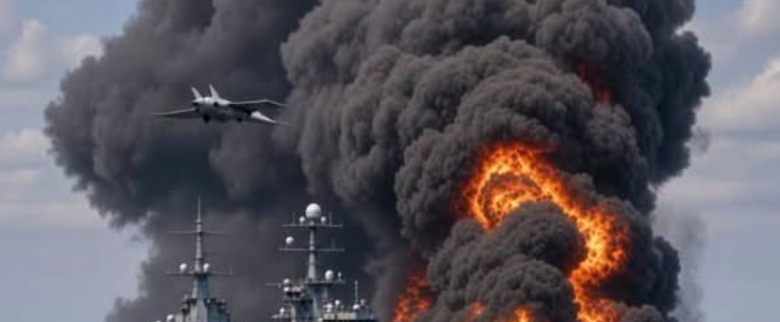
Unverified Naval Strike Reports Raise Questions About Modern Carrier Defense
Reports describing a possible attack involving a modern aircraft carrier and a Russian Su-57 fighter have attracted attention because of the broader questions such an incident would raise about naval defense, air power, electronic warfare, and the reliability of information appearing during periods of military tension.
At this stage, claims surrounding the reported episode should be treated cautiously unless supported by independently verified evidence. Military incidents can generate conflicting accounts, particularly when information begins circulating through social media, anonymous channels, or sources that may have limited access to the battlefield.
Even so, the scenario described in the reports provides an opportunity to examine a larger question: how vulnerable are modern aircraft carriers when confronted by increasingly sophisticated aircraft, missiles, sensors, and electronic warfare systems?
An aircraft carrier is among the most complex military platforms in existence. It is not simply a large ship carrying aircraft. It functions as a floating military base supported by radar systems, communications networks, fighter aircraft, helicopters, defensive weapons, electronic warfare equipment, and escort vessels.
Any credible report of a serious strike against such a vessel would therefore attract significant attention from military planners.
The important issue would not only be whether a weapon reached the ship. Analysts would also want to understand how the threat was detected, how information was shared, what defensive measures were attempted, and what happened afterward.
Why Aircraft Carriers Remain Central to Naval Strategy
Aircraft carriers have played an important role in naval strategy for decades because they allow military forces to operate aircraft far from established land bases.
A carrier can transport fighter aircraft, surveillance platforms, helicopters, maintenance equipment, fuel, ammunition, command facilities, and thousands of personnel.
This creates a mobile aviation capability that can move with a naval task force.
However, the size and complexity of a carrier also create challenges.
The vessel is large enough to be detected by multiple types of sensors. Its flight deck and aircraft create visible signatures, while its communications and support activities generate additional information that could potentially be exploited by an adversary.
For this reason, carriers generally do not operate alone.
They are normally part of larger formations designed to provide overlapping layers of protection.
Destroyers, cruisers, aircraft, submarines, surveillance systems, and other assets can contribute to the defense of the carrier group.
The concept is based on creating multiple opportunities to identify and stop an incoming threat.
The Importance of Layered Defense
Modern naval defense does not depend on one weapon or one radar.
Instead, it relies on layers.
An approaching aircraft or missile may first be detected by long-range sensors. Information can then be shared with other platforms. Fighter aircraft may be launched to investigate or intercept the threat. Surface ships can contribute their own radar and defensive systems, while electronic warfare capabilities may attempt to interfere with an adversary’s sensors or communications.
Shorter-range systems provide another layer of protection if an incoming weapon gets closer to the formation.
The objective is not to create an impenetrable shield.
Rather, it is to provide multiple opportunities to detect, identify, track, and respond to threats.
A successful strike against a heavily protected naval vessel would therefore raise questions about one or more parts of this chain.
But determining exactly what happened would require evidence.
Why the Su-57 Is Relevant to the Discussion
The Su-57 is Russia’s advanced multirole fighter aircraft and is designed to combine high performance with modern sensors, weapons, and reduced radar visibility.
Its development reflects a broader trend in military aviation toward integrating aircraft, sensors, electronic systems, and long-range weapons.
In discussions about a hypothetical or alleged naval strike, the aircraft’s importance would not necessarily come from speed alone.
Modern air combat increasingly depends on information.
An aircraft that can detect an opponent while attempting to reduce its own detectability may gain additional opportunities to approach, launch weapons, or withdraw.
However, the effectiveness of any aircraft depends on the wider system surrounding it.
Sensors, intelligence, communications, weapons, electronic warfare, command networks, and pilot training all influence the outcome of an engagement.
Consequently, identifying a particular aircraft in an alleged incident does not by itself establish how the encounter occurred.
The Role of Long-Range Weapons
Modern aircraft can carry weapons designed to engage targets from considerable distances.
This changes the traditional concept of air defense.
A defending force may not simply be looking for an aircraft approaching directly toward a ship. It may also need to detect weapons launched from outside the immediate defensive area.
This creates additional challenges because the time available for a response can become very limited.
A defender may need to determine the type of incoming weapon, its trajectory, its likely target, and the appropriate response in a matter of minutes or less.
The closer a weapon gets, the less time remains for decision-making.
This is one reason modern military forces invest heavily in early warning systems, integrated radar networks, surveillance aircraft, satellites, and secure communications.
What Would Happen If a Carrier Were Damaged?
An aircraft carrier is designed with extensive damage-control capabilities.
Its crews train for emergencies involving fire, flooding, equipment damage, loss of electrical power, and other hazards.
Large warships are divided into compartments, allowing crews to isolate damaged areas and limit the spread of water or fire.
Emergency teams can also work to restore essential systems and maintain the ship’s ability to operate.
The outcome of an attack would therefore depend on many factors.
The size and location of the damage would matter.
The type of weapon would matter.
Secondary fires or explosions could create additional complications.
The condition of the flight deck, aircraft, fuel systems, communications equipment, and power generation systems could determine whether the ship remained capable of normal operations.
A ship does not necessarily have to sink to suffer a strategically significant defeat.
A carrier that survives but requires extensive repairs could still be temporarily removed from active operations.
The Human Dimension
Behind the technology are thousands of people.
Aircraft carriers function as floating communities with sailors, aviators, engineers, medical personnel, technicians, maintenance specialists, security teams, and command staff.
Any serious incident could therefore have consequences far beyond the physical damage to the vessel.
Crew members would be expected to respond quickly to emergencies while dealing with limited information, smoke, fire, damaged equipment, and potentially changing conditions.
Training is designed to prepare personnel for precisely these circumstances.
Damage-control drills are an essential part of life aboard major naval vessels because the crew may have to act before outside assistance arrives.
The effectiveness of those procedures can influence whether an incident becomes a temporary emergency or a major operational crisis.
Electronic Warfare Could Be a Critical Factor
One of the most important elements of modern military conflict is increasingly difficult to see.
Electronic warfare involves the use of electromagnetic energy to detect, disrupt, deceive, or protect systems.
Radar, communications equipment, navigation systems, data links, and other electronic technologies are central to modern military operations.
If those systems are disrupted, even highly capable weapons can become more difficult to coordinate.
This means that an attack scenario involving an advanced fighter cannot necessarily be understood simply as aircraft versus ship.
The broader contest may involve sensors, communications networks, electronic countermeasures, satellites, aircraft, and command systems.
The side that can maintain a reliable picture of the battlefield may gain an important operational advantage.
Why Verification Matters
Military stories often spread rapidly.
A photograph may be presented as evidence of an attack even though it was taken years earlier.
A video may show a completely different location.
A genuine image may be paired with an inaccurate description.
A satellite photograph can also be interpreted incorrectly when there is insufficient information about when it was taken or what it actually shows.
This is why verification is particularly important when discussing major military incidents.
Official statements can provide useful information, but they may also reflect the interests of the governments issuing them.
Independent satellite imagery, multiple credible news organizations, geolocation analysis, specialist assessments, and visual evidence can help establish what happened.
Even then, some details may remain uncertain for days or weeks.
The Difference Between a Claim and a Confirmed Event
This distinction is essential.
A report can describe an alleged attack.
That does not automatically establish that the attack occurred exactly as described.
Likewise, a statement from one side of a conflict may represent that government’s account rather than an independently verified description of events.
When information is incomplete, careful reporting should distinguish between what is known, what has been claimed, and what remains uncertain.
This is particularly important when the reported event could have major international consequences.
A claim involving an attack on a major naval vessel could potentially influence public opinion, military readiness, diplomatic messaging, and financial markets.
Repeating an unverified allegation as established fact can therefore create additional confusion.
What Military Analysts Would Examine
If evidence of a serious carrier strike emerged, analysts would likely examine several categories of information.
The first would be the approach route.
How did the attacking aircraft or weapon reach the engagement area?
The second would be detection.
When did defensive systems first identify the threat?
The third would be tracking.
Was the target continuously tracked, or was there an interruption?
The fourth would be interception.
What defensive measures were available, and how did they perform?
The fifth would be the weapon itself.
What type of weapon was reportedly used, and from what distance?
Finally, analysts would examine the consequences.
Was the ship able to continue operations?
Were aircraft still able to launch?
Were communications affected?
How long would repairs require?
These questions could provide valuable information about the strengths and weaknesses of modern naval warfare.
Why One Incident Would Not Automatically Rewrite Naval Strategy
Even a confirmed successful strike against a major warship would need to be understood in context.
Military strategy is rarely based on one isolated event.
Analysts would want to know whether the circumstances were unusual, whether the attack exploited a temporary vulnerability, whether intelligence failures contributed to the outcome, and whether the defensive systems involved were operating under normal conditions.
A single event could reveal an important weakness, but it would not necessarily prove that an entire class of ships had become obsolete.
The same principle applies in reverse.
The successful defense of a ship against one attack would not prove that every future threat could be stopped.
Modern warfare is an ongoing contest between offensive and defensive technologies.
As one side develops a new capability, the other side develops countermeasures.
The Growing Importance of Information Networks
Modern military operations increasingly depend on networks.
A fighter aircraft may receive information from sensors that are not physically located on the aircraft.
A ship may receive information from another vessel.
Satellites can contribute intelligence.
Aircraft can provide surveillance.
Ground stations can process data.
Command centers can distribute information.
The value of each individual platform can therefore depend partly on its ability to communicate with the wider network.
This creates both advantages and vulnerabilities.
A well-connected force can build a more comprehensive picture of a developing situation.
But disruption of communications or data links can complicate decision-making.
That is why military organizations continue investing in redundant communications systems and alternative methods of sharing information.
The Broader Strategic Question
The discussion surrounding an alleged carrier strike points toward a much larger issue.
How should navies operate in an environment where aircraft, missiles, drones, satellites, cyber capabilities, and electronic warfare systems can all interact?
The traditional image of a naval battle involving ships exchanging fire from relatively close distances has increasingly given way to a more complicated environment.
Threats can originate far beyond the horizon.
Information can travel across networks almost instantly.
A commander may have only a short amount of time to decide whether an unidentified contact represents a genuine threat.
At the same time, an incorrect decision can have serious consequences.
This makes identification and information management increasingly important.
Why Readiness and Restraint Both Matter
Military forces must be prepared for possible threats.
Ignoring an uncertain warning can create danger.
But acting on incomplete information can also create serious problems.
That tension is particularly important when nuclear-armed states or major military powers are involved.
A mistaken interpretation of an event could potentially increase tensions or lead to responses based on inaccurate assumptions.
For that reason, verification is not simply a journalistic concern.
It is also a strategic issue.
Military organizations need accurate information to make informed decisions.
Governments need reliable intelligence when considering diplomatic or military responses.
The public also deserves a clear distinction between confirmed facts and allegations.
What the Reported Scenario Teaches Us
Whether every detail of the reported incident is eventually confirmed or not, the discussion highlights several characteristics of modern military technology.
First, aircraft carriers remain enormously complex systems rather than simple ships.
Second, their protection depends on multiple layers working together.
Third, advanced aircraft are increasingly designed around combinations of stealth, sensors, electronic systems, and long-range weapons.
Fourth, information can be as important as physical firepower.
Finally, the speed at which military claims spread online creates a separate challenge.
An unverified story can reach a global audience long before investigators have enough evidence to establish what happened.
Final Thoughts
Reports describing an alleged attack involving a Su-57 and an aircraft carrier raise serious questions about modern naval warfare, but claims of this kind require careful verification before they can be treated as established events.
A modern carrier operates within a large defensive network involving aircraft, escort ships, radar, communications systems, electronic warfare capabilities, and trained personnel.
A successful attack would therefore be more complicated than a simple confrontation between one aircraft and one ship.
It would raise questions about detection, intelligence, communications, interception, weapons, damage control, and the wider operational environment.
At the same time, the information surrounding such an event must be examined carefully.
Military conflicts frequently produce competing accounts, incomplete evidence, recycled photographs, misleading videos, and rapidly changing narratives.
The most responsible approach is to distinguish clearly between confirmed information, official claims, independent analysis, and unresolved questions.
The larger lesson is that modern military power depends on coordination.
Aircraft, ships, satellites, sensors, command centers, electronic systems, and human crews must operate together under enormous pressure.
A weakness in one part of that network can create challenges elsewhere.
But understanding exactly what happened in any particular incident requires evidence rather than assumptions.
As military technology continues to evolve, that distinction will become increasingly important—not only for defense planners and governments, but also for anyone trying to understand the rapidly changing nature of modern conflict.