News
Remember When Babies Wore Cloth Diapers? The Messy Household Chore That an Entire Generation Will Never Forget
Remember When Babies Wore Cloth Diapers? The Messy Household Chore That an Entire Generation Will Never Forget

Cloth Diapers, Clotheslines, and the Family Stories We Never Forget
If your childhood memories reach back to the 1950s, 1960s, or 1970s, an ordinary square of white cotton may bring an entire household back to life.
You might remember a laundry basket beside the back door, wooden clothespins in a bag, or rows of freshly washed diapers moving in the breeze. Somewhere nearby, there was probably a diaper pail whose lid everyone preferred to leave alone.
For families who used traditional cloth diapers, these objects belonged to the daily routine. They were as familiar as the kitchen table or the sound of the washing machine.
However, the clean laundry on the line was only the final part of a much longer job.
Behind those white squares were hours of work, interrupted meals, tired parents, and the knowledge that another change would soon be needed. Looking back, it is easy to remember the picture. Understanding the effort behind it sometimes takes longer.
Before the Convenient Fasteners
The diapers remembered in these stories were often simple cotton squares. They had to be folded into shape, secured with pins, and used with waterproof pants.
Unlike a finished garment, the flat piece of fabric needed someone to prepare it. That preparation became a familiar skill, learned through practice and advice from other caregivers.
Grandmothers might have a preferred fold, while a new parent gradually developed a routine that felt manageable.
The details differed between households, but the repeated task was familiar: unfold, arrange, change, and begin again.
At the time, much of this work probably seemed too ordinary to remember. Yet decades later, the smallest detail can return with surprising clarity.
The Diaper Change Was Only the Beginning
A baby needed a clean diaper, but providing one created work beyond the changing area.
Used diapers had to be dealt with, laundry had to be completed, and clean supplies had to be ready before they were needed again.
For the adults responsible, there was no clear finishing point. Completing one load did not mean the task was over for the week.
Meanwhile, the rest of the household continued. Meals still needed attention, someone wanted a clean shirt, and another child might be calling from the next room.
Remembering that overlap helps explain why a seemingly simple item could become the source of both exhaustion and family humor.
The Diaper Pail Everyone Remembered
Few household objects inspired such a clear agreement: leave the lid closed unless you had a reason to open it.
The diaper pail was practical, familiar, and usually unglamorous. Nevertheless, it earned a lasting place in family memory.
Children might not understand the work associated with it, but they quickly learned that adults approached it with a certain purpose.
It was not a toy, a treasure chest, or a promising place to investigate.
Of course, telling a child that something is unpleasant does not always end their curiosity. Sometimes, it creates exactly the kind of challenge that later becomes a story told at every family gathering.
The Little Boy Who Accepted a Dare
One humorous family anecdote includes a boy who was dared to peek inside the diaper pail.
From a child’s point of view, the challenge may have sounded simple. Lift the lid, take a look, and prove that everyone else was exaggerating.
According to the retelling, he regretted that decision immediately.
The comedy came from the sudden difference between his confidence and his discovery. He had volunteered for an experience nobody needed to repeat.
Years later, the family could laugh about the incident because it captured something recognizable: childhood curiosity meeting a household reality.
The pail itself was eventually gone. The story, however, kept its place at the table.
The Mother Who Reached Her Limit
Another anecdote centers on an exhausted mother facing one particularly unpleasant diaper disaster.
By then, she had already completed more rounds of rinsing, washing, drying, and folding than anyone was likely to count.
Something about that final incident was enough.
In the family’s humorous retelling, she announced that she had washed her last cloth diaper. The offending item went into an outdoor fire pit, and the household’s switch to disposables became a dramatic declaration.
The detail survives as part of the anecdote, rather than as a suggestion for handling laundry.
What made the moment memorable was the mother’s certainty. For once, there would be no debate about whether she could manage one more load.
Why Her Declaration Became a Family Legend
The husband in the story apparently needed little convincing. After witnessing the scene, he accepted that the household was changing its approach.
For the children, the moment became an unforgettable example of their mother reaching a decision and meaning every word.
Perhaps they had heard smaller complaints before. This time, there was a clear ending.
As the years passed, the incident joined the collection of stories that families repeat because everyone recognizes the person at the center.
The humor did not erase the exhaustion. Instead, it gave the family a way to remember it together.
A difficult afternoon became a story with a beginning, a turning point, and a mother who had finally had enough.
White Diapers on the Clothesline
Not every memory from those years was unpleasant.
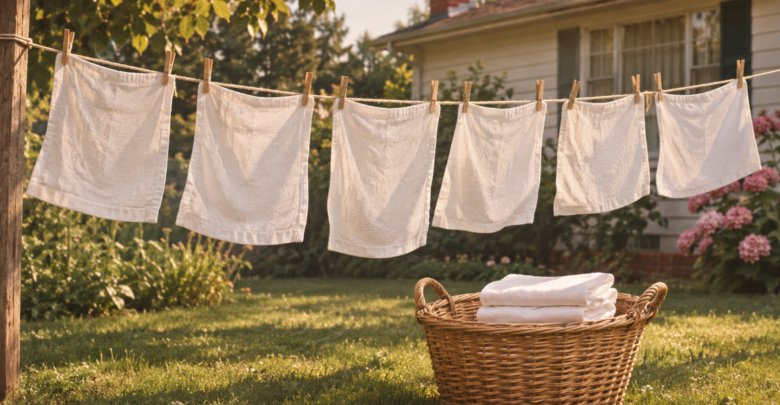
For many people, the image that returns first is a line of clean diapers drying outside. White cotton moved against the sky, held in place by familiar wooden pins.
A basket waited beneath the line, and the work briefly looked peaceful.
From a child’s perspective, it might have been part of the background to playing in the yard. The person hanging the laundry was simply there, doing something adults always seemed to do.
Only later does the scene reveal more of itself.
Those clean diapers represented a completed sequence of tasks—and another small supply of comfort prepared for someone who could not manage without help.
The Familiar Objects Around the Work
Memory often holds on to objects more readily than explanations.
A wicker basket, a particular pail, or the shape of a clothespin may remain vivid even when the rest of the day has faded.
These objects mattered because they appeared repeatedly. They were handled, moved, filled, emptied, and returned to the same places.
Eventually, they became connected with the people who used them.
That is why an old laundry basket can feel personal long after it stops being useful. It may recall a parent coming through the back door, a grandparent gathering dry clothes, or the sound of someone calling the children inside.
The object opens the memory. The person gives it meaning.
Skills Passed From One Caregiver to Another
Traditional cloth diapering also involved knowledge shared between generations.
Experienced caregivers showed others how they organized supplies and managed the routine. New parents then adapted those habits to their own households.
Some advice was welcomed. Other suggestions probably came with the familiar tension of someone insisting that their method was best.
Still, beneath those differences was a practical exchange: one person had learned through experience and was trying to help another.
Looking back, these lessons can reveal how much household knowledge was carried informally.
There was no ceremony when it passed from one set of hands to another. It happened during an ordinary day, while something needed doing.
Some Families Had Help
Not every household handled the work in the same way.
Some used diaper services that collected used diapers and delivered clean supplies. Others managed the entire routine themselves.
Likewise, responsibility could fall differently within each family. Mothers appear at the center of many of these memories, but fathers, grandparents, and other caregivers also had roles.
Acknowledging those differences makes the picture more complete.
The nostalgia belongs to particular people and households, rather than one identical experience shared by everyone.
What connects the stories is the repeated effort involved in keeping a baby comfortable while managing everything else that family life required.
The Work Children Did Not See
Children usually remember the result of care before they understand its preparation.
A clean diaper was simply available. So was a meal, a washed blanket, or a familiar shirt returned to the drawer.
The planning behind those things could remain invisible.
Someone had noticed supplies running low. Someone had made time for laundry despite interruptions. Someone had stayed with the task after the children moved on to something more interesting.
This does not mean childhood memories are incomplete in a disappointing way. They are simply memories formed from a child’s position.
Growing older adds another perspective. The ordinary scene begins to show the work that made it possible.
Why the Stories Become Funnier With Time
The diaper-pail dare and the mother’s final declaration are funny partly because the immediate discomfort has passed.
Nobody telling the story decades later is still standing over that particular load of laundry.
Distance allows the family to notice the expressions, timing, and personalities involved. A moment of frustration becomes recognizable as something that belonged to them.
However, affectionate retelling works best when it leaves room for the effort behind the joke.
The mother was tired. The household task was repetitive. Her dramatic response came at the end of real work.
Remembering those facts gives the humor warmth. The family can laugh while also appreciating why the moment happened.
Nostalgia Does Not Require Wanting the Chores Back
It is possible to love these memories without wishing to repeat every part of the routine.
Someone may miss the sight of laundry on the line while feeling no desire to deal with the diaper pail again.
Similarly, a parent can remember raising small children with affection and still be grateful for changes that made certain tasks easier.
There is no contradiction.
Nostalgia often gathers the meaningful details while leaving the hardest hours less sharply defined. Looking back honestly allows both experiences to remain.
The days held affection and exhaustion, humor and frustration. Neither side needs to be removed to make the memory valuable.
Recognizing Care in Ordinary Routines
The deeper meaning of these stories is found in repeated acts of attention.
A caregiver did not need to describe the task as a sacrifice for it to require patience. Often, there was simply a child who needed something and an adult who responded.
That response happened again and again.
The same pattern can be recognized in many kinds of family life. Supplies are prepared, messes are handled, and routines are repeated because someone depends on them.
The equipment changes, but the effort still deserves to be noticed.
An old cloth diaper can make that effort visible because it reminds us how much work once surrounded something we barely thought about as children.
Questions That Can Bring Back Family Memories
If these details feel familiar, they may offer a starting point for a conversation.
Ask who handled the laundry, whether the family used a diaper service, or which household object everyone remembers.
Someone may recall a particular folding method. Another person might immediately bring up the pail.
The answers do not need to become a formal family history. A short conversation can be enough to recover a detail that has not been mentioned in years.
It may also reveal different versions of the same event.
That is often part of the pleasure: discovering what each person noticed and which moments stayed with them.
A Small Piece of Cotton, a Lasting Memory
An old-fashioned cloth diaper is a modest object, yet it can lead back to an entire world of family routines.
There are the white squares on the line, the basket waiting underneath, and the pail everyone approached with caution.
Then come the people: the curious child, the patient caregiver, and the tired mother whose dramatic decision became a family favorite.
Together, those memories offer more than a picture of how babies were once cared for. They remind us of the work that happened around us before we were old enough to understand it.
Sometimes, remembering a simple household object gives us another chance to appreciate the person who kept it ready.
❤️ What ordinary object brings back the strongest memories of your childhood home?