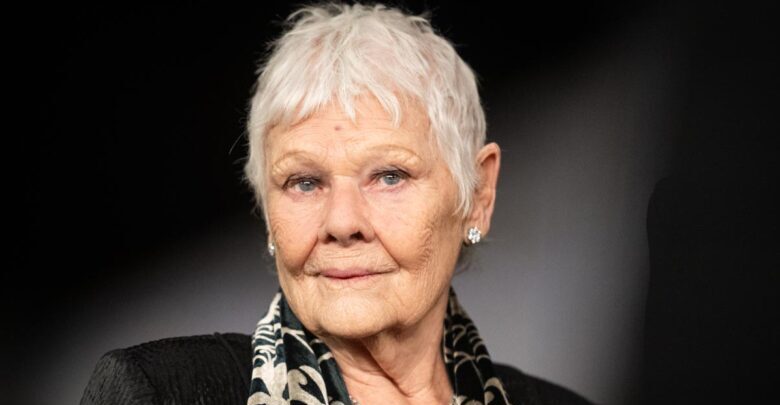
Judi Dench has spent decades captivating audiences with her extraordinary talent, memorable performances, and unmistakable presence on stage and screen. Yet, despite the many honors she has received throughout her remarkable career, the celebrated British actress has little enthusiasm for one particular description: “national treasure.”
At 91, Dench continues to challenge expectations about what it means to grow older. Rather than allowing her age to define her identity or determine when she should step away from her profession, she has made it clear that she wants to keep embracing life for as long as she can.
In a recent interview with The Times, published as she promotes her upcoming memoir, the acclaimed actress reflected on her career, her views on retirement, and the future she hopes to experience. Her comments offered a glimpse into the personality behind one of Britain’s most respected performers: outspoken, independent, humorous, and determined not to be treated as though her best years are necessarily behind her.
Although Dench has faced significant challenges with her eyesight in recent years, her attitude remains characteristically direct. She does not want conversations about her future to focus exclusively on her age or limitations. Instead, she wants to retain the freedom to decide how she lives, works, and spends her time.
Why Judi Dench Dislikes Being Called a National Treasure
For many admirers, Judi Dench represents the very best of British acting. Her decades-long career, numerous awards, and memorable portrayals have earned her widespread admiration. The phrase “national treasure” is often intended as a compliment, suggesting that a performer has become an important part of a country’s cultural identity.
Dench, however, sees the expression differently.
During her recent interview, she revealed that she strongly dislikes the label, explaining that it makes her sound like an object that has been put away and forgotten.
“I loathe it,” she said, according to reporting by LADbible. She went on to compare the expression to the image of a dusty relic stored in the back of a cupboard alongside old fossils and a broken Roman shield.
Her reaction was humorous, but it also reflected a serious point about the way society sometimes treats older people.
A description that sounds affectionate to one person can feel limiting to another. Although the phrase is meant to recognize Dench’s achievements, she appears uncomfortable with the suggestion that she belongs to the past rather than the present.
Her response demonstrates why language matters when discussing age. Even positive labels can unintentionally turn people into symbols instead of recognizing them as individuals who continue to have opinions, ambitions, interests, and plans.
For Dench, being celebrated for a lifetime of achievement does not mean she wants to be treated as though her story has already reached its conclusion.
She may be one of Britain’s most admired actresses, but she remains an individual who wants to live on her own terms.
Judi Dench Has No Immediate Intention of Retiring
Retirement is often presented as the natural destination after a long and successful career. For some people, it offers an opportunity to rest, travel, spend time with family, and explore interests outside work.
For others, however, professional life remains an important source of purpose and personal identity.
Dench appears firmly opposed to the idea that reaching a particular age automatically means someone should stop working.
In her interview, she expressed frustration with the recurring questions about when she intends to retire and whether it is time for her to put her feet up.
Her response was unmistakable: “No, it bloody well isn’t.”
She also said she would like to remove words such as “retire,” “vintage,” and “old” from the conversation.
Her remarks reflect a broader discussion about aging in modern society. People increasingly live longer lives, and many remain active, creative, and engaged well beyond the ages traditionally associated with retirement.
Nevertheless, older professionals can still encounter assumptions that their ambitions should diminish with time. They may be praised for their past achievements while receiving fewer opportunities to demonstrate what they can still contribute.
Dench’s comments challenge that mindset.
Her objection is not necessarily to the idea of resting or changing direction. Rather, she appears to reject the assumption that someone else should decide when her working life has reached its natural end.
For an actress whose career has spanned generations, the ability to keep participating in creative life has clearly remained important.
Her perspective also offers a reminder that retirement is a personal decision. Some people look forward to leaving their professions, while others prefer to continue working in different ways. Neither choice should be dictated by age alone.
At 91, Dench’s words communicate a simple message: she does not want others to write the final chapter of her professional life before she is ready.
The Remarkable Career Behind Her Determination
To understand why Dench’s views on retirement have attracted attention, it helps to consider the extraordinary career that brought her international recognition.
Born in York, England, in 1934, Dench developed a passion for acting that would eventually establish her as one of the most respected performers of her generation.
She built her reputation through theatre, television, and film, earning particular admiration for her command of Shakespearean roles and her ability to bring depth to a wide range of characters.
Her career was never confined to one type of performance. She demonstrated remarkable versatility, moving between classical theatre, intimate dramas, comedies, and major international productions.
Her work with the Royal Shakespeare Company helped establish her reputation as a formidable stage actress. Over the years, she became known for her ability to combine technical precision with emotional intelligence, creating performances that could be powerful without becoming exaggerated.
Film audiences around the world later came to recognize her through roles in productions including Mrs Brown, Shakespeare in Love, and the James Bond series.
In Shakespeare in Love, her brief but memorable appearance as Queen Elizabeth I earned her the Academy Award for Best Supporting Actress in 1999. The performance demonstrated that screen impact does not necessarily depend on the amount of time an actor spends on screen.
She also became widely recognized internationally for portraying M in several James Bond films, bringing authority, sharp humor, and a commanding presence to the character.
Across these different projects, Dench established a reputation for making even relatively small roles feel significant.
Her success has been recognized through numerous honors, including major British acting awards and international recognition for her contribution to the performing arts.
Yet her recent comments suggest that she does not want her achievements to become a reason for people to stop seeing her as a working artist.
A distinguished career can be a source of pride without becoming a boundary around what comes next.
Why Her Views on Aging Resonate With So Many People
Dench’s response to questions about retirement reaches beyond the entertainment industry.
People in many professions understand the frustration of being judged according to age rather than ability, experience, or personal ambition.
In workplaces, older employees may find themselves facing assumptions about their adaptability, energy, or willingness to learn. In creative industries, established performers can become associated so strongly with earlier successes that audiences and commentators overlook their continuing interests.
The problem is not simply the use of a particular word. It is the possibility that age becomes the first and most important thing people notice.
Dench’s rejection of labels such as “old” and “vintage” reflects her desire to be recognized as a complete person rather than reduced to a number.
Her position does not require everyone to approach aging in the same way. Some people find comfort in retirement, while others choose to remain professionally active. The important distinction is that each person should have room to make decisions according to their own circumstances.
Aging can bring changes in physical ability, energy, priorities, and lifestyle. It can also bring experience, perspective, and a clearer understanding of what matters most.
Those realities can coexist.
Dench’s attitude suggests that acknowledging the passage of time does not mean surrendering one’s sense of possibility. A person can recognize limitations while continuing to seek enjoyment, connection, and meaningful experiences.
That balance is particularly important because conversations about older people sometimes focus too heavily on what they can no longer do.
A more thoughtful approach also recognizes their preferences, independence, relationships, and contributions to society.
Judi Dench’s Unconventional Idea of a Life Well Lived
One of the most striking aspects of Dench’s interview was her description of the kind of life she hopes to lead as she grows older.
She referred to actor Newton Blick, who reportedly died in his dressing room after a performance, as an example of someone whose dedication to his profession she admired.
“I want to be like Newton Blick, who died in his dressing room after a performance,” Dench said.
She also expressed a desire to be among the women who throw themselves out of planes at the age of 100.
The remarks were delivered in the context of her determination to keep living actively rather than accepting the expectation that later life must be quiet or uneventful.
Her comments should not be interpreted as a literal prediction about her own future. Instead, they convey a spirited attitude toward possibility, independence, and the value of continuing to participate in the world.
For some people, an adventurous life might involve travel, physical challenges, or discovering unfamiliar places. For others, it might mean continuing to create art, learning new skills, maintaining friendships, or pursuing a long-delayed personal goal.
There is no single definition of an active or fulfilling later life.
Dench’s example is especially interesting because her aspirations coexist with the practical realities of growing older. Her determination does not mean that she is unaffected by health challenges or that every activity remains possible.
Rather, she appears unwilling to let those challenges become the only story people tell about her.
Her humor also plays an important role. By speaking candidly and making exaggerated, playful comparisons, she communicates her views without turning the conversation into a solemn declaration about aging.
The result is a portrait of a performer who continues to value independence and the ability to choose her own direction.
The Health Challenge That Changed Her Relationship With Acting
Although Dench remains determined to live according to her own preferences, she has spoken openly about a significant health challenge that has affected her professional life.
In 2023, she discussed the difficulties she was experiencing because of macular degeneration, a condition that affects the central vision and can make everyday visual tasks increasingly challenging.
The condition is particularly relevant to acting, a profession that often requires performers to read scripts, recognize people and objects, respond to visual cues, and move safely through carefully arranged environments.
Dench explained that her eyesight had deteriorated to the point that reading scripts and seeing clearly on film sets had become difficult.
“I can’t see on a film set anymore. And I can’t see to read. So I can’t see much,” she told The Mirror‘s Notebook magazine at the time, according to LADbible.
She also expressed a practical determination to deal with the situation and carry on as best she could.
Her comments offered a candid account of the difficulties that can accompany changes in vision, particularly for someone whose profession has depended on visual awareness for decades.
For an actor, reading a script is not merely a matter of recognizing printed words. It is often the starting point for understanding a character’s motivations, memorizing dialogue, identifying emotional shifts, and preparing for a performance.
On a film set, visual information can also help an actor understand blocking, respond to other performers, and navigate the physical environment.
When eyesight changes, established working methods may need to be reconsidered.
Such adjustments can be demanding, especially for someone with a long and distinguished career. Nevertheless, Dench’s willingness to speak publicly about her experience has helped bring attention to the practical challenges that people with visual impairments may face.
It is important, however, not to assume that a diagnosis alone tells the complete story of an individual’s abilities or future.
Macular degeneration can affect people differently, and the course of the condition varies. Dench’s personal experience should not be taken as a description of what every person with the condition will experience.
Her comments illustrate the importance of understanding individual circumstances rather than making broad assumptions.
What Is Macular Degeneration?
Macular degeneration refers to conditions that affect the macula, a small area near the center of the retina responsible for detailed central vision.
Central vision helps people perform tasks such as reading, recognizing faces, and seeing fine details. When the macula is damaged, these activities can become more difficult.
Age-related macular degeneration is more common among older adults. Depending on its type and severity, it may cause blurred central vision, difficulty recognizing faces, or problems seeing fine print.
The condition does not necessarily mean that a person loses all their sight. Peripheral vision may remain, although individual experiences vary considerably.
There are different forms of age-related macular degeneration, and medical professionals determine appropriate management according to the specific diagnosis and circumstances.
People experiencing changes in vision should seek advice from a qualified eye-care professional. Regular eye examinations can help identify problems and establish whether treatment, monitoring, visual aids, or other forms of support may be appropriate.
For people whose work depends heavily on sight, adjustments may also help make daily tasks more manageable.
These can include accessible digital documents, larger text, magnification tools, improved lighting, audio support, and assistance with particular activities when needed.
The most suitable approach depends on the individual’s needs and the nature of their vision changes.
Dench’s experience highlights how an eye condition can affect not only practical tasks but also a person’s relationship with a lifelong profession.
At the same time, her comments demonstrate why it is important to discuss health challenges respectfully, without reducing a person to a diagnosis.
Finding New Ways to Continue When Circumstances Change
A long career is rarely a completely predictable journey. Even the most accomplished professionals encounter circumstances that require them to adjust their methods, priorities, or expectations.
For performers, these changes can be especially complicated because acting often involves collaboration among directors, fellow actors, production teams, and audiences.
When a physical ability changes, established routines may no longer work in the same way.
Some performers adapt by changing the roles they accept, exploring different formats, working with additional support, or concentrating on projects that suit their circumstances. Others decide that stepping away from certain responsibilities is the right choice for them.
There is no single correct response.
Dench’s experience illustrates the difference between recognizing a challenge and allowing that challenge to define an entire identity.
She has been open about her eyesight difficulties, but her comments about retirement make clear that she does not want her life discussed solely through the lens of age or health.
That distinction matters because people often have multiple identities beyond their occupations or medical circumstances.
Dench is an actress, but she is also a person with friendships, interests, memories, opinions, and aspirations. Her professional achievements form an important part of her life without representing every part of it.
The same principle applies to people outside the public eye.
A person dealing with a health condition may continue to value independence, creativity, family life, or social connection. Someone who leaves a career may still have ambitions that have nothing to do with work.
Respectful conversations allow room for these different dimensions.
Dench’s straightforward attitude encourages people to consider how they can maintain a sense of agency when life changes in ways they did not choose.
Her Upcoming Memoir Offers Another Opportunity to Reflect
Dench’s recent interview also comes as she promotes her upcoming memoir, creating another opportunity for readers to consider the experiences and perspectives that have shaped her life.
Memoirs allow public figures to offer their own accounts of events, relationships, decisions, and professional milestones. They can also reveal how people understand their experiences after many years of reflection.
For a performer with a career as extensive as Dench’s, there is a great deal of professional history to consider.
Her journey through theatre, television, and cinema has unfolded across several generations of audiences and changing approaches to entertainment.
She has worked in classical productions, modern dramas, major film franchises, and stories that explore intimate human relationships. The range of her work reflects both the changing nature of the industry and her ability to move between different forms of performance.
A memoir can also provide a more personal perspective on the difference between public reputation and private identity.
Audiences may know an actor through famous characters, awards ceremonies, interviews, and widely discussed performances. Yet the person behind those public moments has a life that extends beyond the screen.
Dench’s dislike of the “national treasure” label reflects this distinction. While audiences may understandably celebrate her cultural importance, she does not want that reputation to turn her into a figure who is admired from a distance but no longer viewed as an active individual.
Her remarks remind readers that even celebrated artists may resist the expectations attached to their public image.
The opportunity to tell one’s own story can be particularly valuable when public discussion begins to focus more on age than on the person’s ideas or preferences.
Why Judi Dench’s Perspective Matters Beyond Hollywood
Dench’s comments have attracted interest because they touch on a familiar human concern: the desire to retain independence as circumstances change.
Although her career is exceptional, the questions she raises are relevant to people from many different backgrounds.
When should someone retire? Who gets to decide when a person has done enough? Does reaching a certain age mean ambitions should become smaller? And how can society recognize experience without assuming that older people have nothing new to contribute?
These questions do not have universal answers.
For some individuals, retirement provides welcome freedom after decades of demanding work. Others prefer to remain employed, volunteer, create, or pursue activities that provide structure and purpose.
Some people have the financial resources and physical ability to make many choices, while others face practical barriers that significantly limit their options.
That is why discussions about aging should avoid presenting one lifestyle as the ideal for everyone.
Dench’s perspective is not a requirement that all older people remain busy or professionally active. It is a reminder that they should be allowed to define their own priorities.
Her remarks also challenge the tendency to treat age as a complete explanation for someone’s abilities, interests, or decisions.
A number does not reveal everything about a person’s health, personality, skills, or ambitions. Two people of the same age can have very different experiences and needs.
Recognizing those differences helps create a more respectful approach to aging.
It also allows society to celebrate the achievements of older people without suggesting that they belong exclusively to the past.
A Legacy That Continues to Evolve
Judi Dench has already established a lasting place in the history of British acting. Her performances have entertained audiences, inspired fellow performers, and helped shape the cultural landscape of theatre and cinema.
Yet her recent comments reveal that she does not want her legacy to become a reason for others to decide what she should do next.
Her dislike of being called a national treasure, her blunt response to retirement questions, and her humorous description of future adventures all point toward a consistent theme: she wants to be treated as a living person with choices, not merely as a symbol of past accomplishments.
Her experience with macular degeneration adds another dimension to that perspective. The challenges she has described are real, and they have affected activities central to her profession. But she has also made clear that she prefers a practical approach to dealing with difficulties rather than allowing them to dominate every discussion about her life.
That attitude does not erase the limitations that can come with age or health changes. Instead, it places those challenges within the wider context of a life that includes far more than them.
As Dench prepares to share more of her story through her upcoming memoir, her reflections offer an opportunity to reconsider the language people use when discussing older generations.
Admiration should not become a cage. Respect should not require someone to give up their ambitions. And a remarkable career should not automatically be treated as a finished story.
At 91, Judi Dench remains a compelling example of an artist who values independence, honesty, and humor. Her words encourage a broader understanding of aging—one that acknowledges changing circumstances while leaving room for individuality and possibility.
Ultimately, her message is not that age makes no difference. It is that age should not be the only thing that matters.
For an actress who has spent decades bringing complex characters to life, that may be one of the most fitting principles to carry forward: a person is always more than the labels other people choose for them.