News
Nine Years After Our Divorce, My Colonel Ex-Husband Arrived At My Mother’s Funeral With His New Girlfriend — But When My Identical Twin Sons Walked In Carrying A Mysterious Wooden Box, He Froze…
Nine Years After Our Divorce, My Colonel Ex-Husband Arrived At My Mother’s Funeral With His New Girlfriend — But When My Identical Twin Sons Walked In Carrying A Mysterious Wooden Box, He Froze…

My Ex-Husband Arrived at My Mother’s Funeral and Discovered He Had Eight-Year-Old Twins – Then a Retired General Revealed Our Family’s Hidden Past
An adapted fictional family story about military service, motherhood, sacrifice, emotional resilience, forgiveness, and rebuilding trust after divorce.
When my eight-year-old twins walked into my mother’s funeral, Colonel Grant Whitaker dropped his coffee and stared at them in complete disbelief.
The confident military officer who had walked away from our marriage nine years earlier suddenly appeared incapable of speaking.
His girlfriend reached for his arm, wondering what had caused such an unexpected reaction.
Grant looked at Everett, then at Nolan, before finally turning toward me.
“Audrey,” he whispered. “How old are they?”
Before I could answer, retired Lieutenant General Raymond Holloway struck his cane against the chapel floor.
The room became silent.
He instructed Grant to stand and directed everyone’s attention toward the wooden box my son was carrying.
Inside were military records, personal letters, an old photograph, and a distinguished medal that had once belonged to my father.
What Grant was about to discover would change his understanding of our marriage, his family’s history, and the meaning of personal responsibility.
He had arrived expecting to pay his respects to his former mother-in-law.
Instead, he would leave knowing that he was the father of two children and that his own family’s future had once depended on an extraordinary sacrifice made by mine.
The Telephone Call That Changed My Life
Thirty-six hours before the funeral, I received a telephone call that every daughter fears.
It was shortly before two in the morning.
I was sitting beside my sons, who had both been feeling unwell, after completing a demanding fourteen-hour hospital shift.
My phone displayed the hospital’s number.
When I answered, I immediately recognized the voice of my colleague, Daniel Price.
His hesitation told me that something was seriously wrong.
He explained that my mother, Helen Mercer, had passed away after experiencing a sudden cardiac emergency.
I struggled to understand what he was saying.
Only hours earlier, I had visited her.
She had been talking, eating dinner, and asking me to bring her favorite sweater.
Now, she was gone.
My mother had been the foundation of our little family.
She had supported me throughout medical school, helped raise my children, and stood beside me during some of the most difficult experiences of my adult life.
Losing her meant more than losing a parent.
I had lost my closest confidante, my greatest source of encouragement, and the woman who had helped me rebuild my life after my marriage ended.
But I knew that Everett and Nolan needed me.
There would be time to grieve.
First, I needed to make arrangements for the woman who had spent her entire life caring for others.
The Mysterious Letter My Mother Left Behind
The following morning, I began organizing my mother’s belongings and preparing for the funeral.
While searching her bedroom for the navy dress she loved, I discovered an envelope bearing my name.
Her handwriting was unmistakable.
The instructions requested that I open it before the memorial service.
Inside was a brief but unexpected message.
My mother wanted me to contact Walter Brennan, her attorney and an old military friend of my late father, when Grant arrived at the funeral.
Walter had been entrusted with a wooden box containing important family memorabilia and additional instructions.
Everything was to be revealed in Grant’s presence.
I read the letter several times.
Why would my mother expect Grant to attend?
We had divorced nine years earlier.
He had never met our children.
He did not even know they existed.
When I contacted Walter, he explained that my mother had specifically instructed him to notify Grant of her passing.
He also suggested that there was something important I needed to understand about the connection between our families.
My mother had apparently carried a secret for decades.
And she had decided that the time had finally arrived for it to be revealed.
An Old Military Photograph Revealed an Unexpected Connection
Later that afternoon, while gathering photographs for the memorial service, I discovered an image that immediately caught my attention.
My mother was wearing her Army nursing uniform and standing beside three military officers.
One was my father, Captain Thomas Mercer.
Another was a young Raymond Holloway.
The third man looked remarkably familiar.
His resemblance to Grant was unmistakable.
On the back of the photograph was an inscription referring to the Balkans in 1995.
My mother had added a personal observation about debts that could never truly be repaid.
I stared at the photograph for several minutes.
Throughout my childhood, I had known that my father died while helping fellow military personnel.
However, my mother rarely discussed the specific circumstances surrounding his death.
She preferred remembering the man she loved rather than repeatedly revisiting the tragedy that had taken him away.
Now, I began wondering whether Grant’s family had been connected to my father’s final act of service.
The photograph suggested that our relationship had been shaped by a history neither of us fully understood.
And my mother’s funeral would become the place where that history was finally revealed.
How My Marriage to a Military Officer Slowly Fell Apart
Nine years earlier, my life had looked completely different.
Grant was an ambitious Army officer stationed near Colorado Springs when we first met.
He was charming, confident, disciplined, and passionate about his professional responsibilities.
I was studying medicine and working whenever possible to support my education.
Our early relationship had been filled with excitement and optimism.
We eventually married during a modest ceremony attended by approximately thirty guests.
My mother cried while Grant made his wedding promises.
His father appeared unusually emotional when welcoming me into the family, although I did not understand the significance of that moment.
Over time, Grant’s military assignments required him to spend extended periods away from home.
As the daughter of a military family, I understood the responsibilities associated with service.
His absences were not the primary problem.
The greater challenge was the emotional distance that developed between us.
Conversations became shorter.
He stopped asking about my studies and professional ambitions.
Whenever he returned home, he seemed increasingly disconnected from our relationship.
I continued focusing on medical school, household responsibilities, and building a stable future.
Unfortunately, the independence I developed appeared to create further distance between us.
Eventually, I began feeling lonely even when my husband was sitting beside me.
The Unexpected Discovery That Ended My Trust
One rainy evening, Grant’s phone illuminated while he was sleeping on the couch.
A photograph appeared alongside a message from another woman.
The picture showed him smiling inside an apartment I did not recognize.
It was a familiar expression.
Years earlier, he had smiled at me with that same warmth.
I immediately understood that something important was missing from our marriage.
Several days later, Grant placed divorce documents on our kitchen table.
He explained that he no longer felt emotionally fulfilled and wanted a relationship in which he felt needed.
His explanation was difficult to accept.
For years, I had managed the challenges created by his demanding career.
I had learned to handle responsibilities independently because his professional commitments frequently took him away from home.
Now, that same independence appeared to be one of the reasons he wanted to leave.
I asked whether another person was involved.
He avoided answering directly.
At that moment, I stopped trying to persuade him to remain married.
I could not force someone to value a relationship they had already decided to abandon.
The Ultrasound I Carried Into the Divorce Hearing
The day before our final divorce hearing, I visited a medical professional because I had been experiencing unusual fatigue and nausea.
Initially, I believed the symptoms were connected to stress.
The examination revealed something completely unexpected.
I was seven weeks pregnant.
Even more surprising, I was carrying identical twins.
I sat alone that evening holding the ultrasound photograph and wondering what I should do.
Should I tell Grant?
Would he reconsider the divorce?
Would he stay because he genuinely wanted to rebuild our relationship, or because he felt obligated to protect his professional reputation?
I was frightened by the uncertainty.
At the time, I believed that remaining in a marriage without genuine affection would create an unhappy environment for our children.
The following morning, I carried the ultrasound photograph inside my coat when I entered the courthouse.
Grant appeared eager to complete the proceedings.
He repeatedly checked his watch and seemed distracted by messages arriving on his phone.
Several times, I considered telling him about the pregnancy.
Ultimately, I remained silent.
I signed the divorce documents and returned to my mother’s home in Salida.
Looking back, I recognize that my decision had consequences for everyone involved, including my children and their father.
At that moment, however, I believed I was protecting the future I wanted to create for my babies.
Rebuilding My Life as a Single Mother
When I arrived at my mother’s house, she welcomed me without demanding explanations.
Later that evening, I showed her the ultrasound.
I admitted that I was frightened about raising two children while continuing my medical education.
She listened carefully.
Then she assured me that I would not have to face the situation alone.
Eight months later, Everett and Nolan were born.
From the beginning, my mother became an extraordinary source of support.
She helped with feeding schedules, medical appointments, sleepless nights, and everyday household responsibilities.
As I completed my surgical training and established my professional career, she remained deeply involved in the boys’ lives.
She attended school activities, prepared meals, taught them how to ride bicycles, and created a welcoming home environment.
Her support allowed me to continue pursuing my medical career while raising two wonderful children.
Single parenthood involved emotional challenges, demanding schedules, financial responsibilities, and countless unexpected situations.
However, our household was filled with affection.
The boys grew up knowing that they were deeply loved.
My mother never criticized Grant in front of them.
Whenever they asked questions about their father, she explained that adult relationships could become complicated.
She encouraged them to remain curious without allowing unanswered questions to determine their self-worth.
The Financial Realities of Raising Children After Divorce
Building an independent life after divorce required careful planning.
Medical education, childcare expenses, household bills, transportation, healthcare, and professional responsibilities all demanded attention.
Although my mother provided valuable support, I understood that establishing financial stability was ultimately my responsibility.
I learned to manage my income carefully and prioritize essential expenses.
Long-term financial planning became particularly important because I was responsible for two children.
I wanted to create a household where unexpected expenses would not immediately threaten our stability.
For many single parents, developing financial independence involves balancing employment, childcare, education, healthcare, and housing costs.
Every family’s circumstances are different, but maintaining organized financial records and establishing realistic priorities can provide a stronger foundation for future decisions.
In my case, independence was never about proving that I did not need anyone.
It was about ensuring that my children could depend on me.
My mother’s emotional and practical assistance made that journey considerably more manageable.
My Ex-Husband Arrived at the Funeral With His Girlfriend
On the morning of the memorial service, Everett and Nolan wore matching black suits.
They knew that their biological father would be attending.
Naturally, they had questions.
Would he recognize them?
Would he want to know them?
Would he be happy to discover that he had two sons?
I could not predict his reaction.
Before entering the chapel, Walter entrusted Everett with a polished wooden box that my mother had specifically requested the boys carry.
Shortly afterward, a black vehicle arrived outside.
Grant stepped out wearing his formal Army uniform.
Beside him was Vanessa Caldwell, his girlfriend.
They entered the chapel together.
Grant looked confident and composed.
He offered his condolences and suggested that he could use his professional connections if I needed assistance arranging anything.
I politely declined.
The funeral preparations had already been completed.
For years, I had struggled with the emotional consequences of our separation.
But I no longer needed his approval or assistance to manage my life.
I wanted the day to remain focused on honoring my mother.
Unfortunately, the past was about to become impossible to ignore.
The Retired Three-Star General Who Refused to Shake Grant’s Hand
Shortly before the memorial began, several vehicles arrived outside the chapel.
Among the visitors was retired Lieutenant General Raymond Holloway.
His presence immediately attracted the attention of the military officers attending the service.
Grant stood and attempted to greet him respectfully.
The general acknowledged him briefly but continued directly toward my mother’s casket.
He placed white roses beside her portrait and became visibly emotional.
I had witnessed families experiencing grief throughout my medical career.
Nevertheless, seeing a distinguished military officer struggle to contain his emotions was particularly moving.
He told me that he had known my parents and remembered me as a small child.
I was surprised.
My mother had never explained the depth of their connection.
Grant approached again and expressed surprise that the general was acquainted with our family.
Holloway explained that both he and Grant’s father owed my parents more than Grant could imagine.
The comment immediately changed the atmosphere.
Grant appeared confused.
Walter then announced that my mother had left specific instructions regarding a personal letter and several items of military memorabilia.
He asked me to bring the boys into the chapel.
The Moment Grant Discovered He Had Two Sons
Everett carried the wooden box while Nolan walked beside him.
When we entered the chapel, Grant immediately looked toward us.
His expression changed as he studied their faces.
The resemblance was impossible to overlook.
His coffee slipped from his hand.
Vanessa reached for his arm.
Grant looked at me and asked how old the children were.
Before I responded, General Holloway interrupted.
He instructed Grant to listen carefully before asking further questions.
Walter opened my mother’s letter and invited Everett to read the first section.
My son approached the microphone and began reading.
The letter explained that Grant Whitaker was their biological father.
It also clearly stated that he had never known about my pregnancy.
My mother did not want anyone to believe that Grant had knowingly abandoned his children.
She understood that the decisions surrounding our divorce were complicated.
The boys were not responsible for those decisions.
She encouraged them to consider giving their father an opportunity to know them while reminding them that their personal worth did not depend on his presence.
As Everett finished reading, Grant was already struggling to contain his emotions.
Nine years of separation had suddenly become eight years of missed childhood memories.
The Wooden Box Contained My Father’s Distinguished Service Cross
Nolan opened the wooden box while the general addressed the chapel.
Inside were handwritten letters, military photographs, and my father’s posthumously awarded Distinguished Service Cross.
General Holloway explained that he had served alongside my father during an international humanitarian operation in the Balkans.
During that operation, several American personnel became isolated in dangerous circumstances.
Among them was a young military officer named Douglas Whitaker.
Grant’s father.
My father had volunteered to assist the stranded personnel and help them reach safety.
Douglas survived.
My father did not.
The general explained that Thomas Mercer had sacrificed his own future while helping others return home to their families.
Grant’s father had been able to watch his children grow, celebrate their achievements, and enjoy experiences that my father would never have.
I had been only three years old when he died.
My mother had been serving as an Army nurse.
She continued caring for injured personnel before allowing herself to confront the devastating loss of her husband.
For the first time, I understood why Grant’s father had appeared unusually emotional at our wedding.
His family’s future had been profoundly influenced by the sacrifice made by mine.
Why My Mother Never Requested Financial Compensation From Their Family
General Holloway explained that Douglas Whitaker had remained deeply grateful throughout his life.
He had offered personal financial assistance to my mother following my father’s death.
She declined.
She believed that my father had acted out of duty and compassion rather than the expectation that his family would receive personal favors.
When Douglas discovered that Grant intended to marry me, he was genuinely delighted.
However, my mother asked him not to reveal the circumstances surrounding my father’s sacrifice.
She did not want gratitude to become a condition of our relationship.
She wanted Grant to love me because of who I was, not because his family felt indebted to mine.
Even when our marriage began falling apart, she refused to encourage Douglas to interfere.
She believed that financial influence, professional authority, and family obligations should never be used to force two people to remain married.
Her decisions reflected an extraordinary commitment to personal dignity and independence.
She had carried the knowledge of our families’ connection for decades.
Now, through her final instructions, she wanted the truth to be understood without allowing it to become another source of manipulation.
The Military Tribute That Brought Everyone to Tears
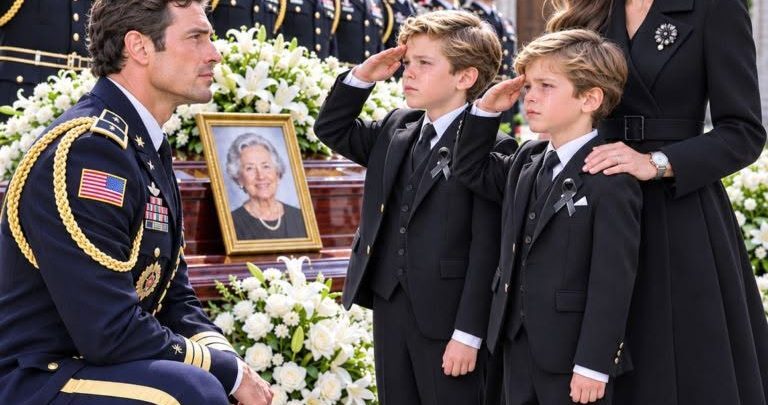
General Holloway approached my sons and entrusted them with their grandfather’s medal.
He explained that its significance extended beyond its physical or financial value.
It represented courage, responsibility, sacrifice, and the decision to help others despite difficult circumstances.
He stepped backward and saluted my mother’s casket.
The military personnel attending the service stood and followed his example.
Grant was among the last to rise.
Tears covered his face.
For the first time since receiving the telephone call about my mother’s death, I allowed myself to cry openly.
My emotions were not simply related to Grant’s reaction or the discovery about our families.
I was overwhelmed by the recognition being given to a woman who had spent her entire life supporting other people.
My mother had raised me after losing her husband.
She had continued working, caring for others, and maintaining our household.
Later, she had helped me raise two children while I rebuilt my professional and personal life.
She had never demanded public recognition.
Yet there we were, surrounded by individuals who understood the significance of everything she had contributed.
I only wished she could have witnessed that moment herself.
A Difficult Conversation About Nine Years of Silence
Following the burial, Grant approached me while the boys were sitting nearby.
His first question was the one I had expected.
Why had I never told him?
I explained that I had been afraid he would remain married for reasons unrelated to genuine affection.
He insisted that he would never have left if he had known about the pregnancy.
That response reflected precisely the concern I had experienced at the time.
But I also understood his perspective.
He had missed their births, first words, early birthdays, school activities, and countless everyday experiences.
I could not give those years back to him.
He acknowledged that his behavior during our marriage had been selfish.
I acknowledged that concealing the pregnancy had also prevented the children from knowing their father.
Neither of us could change what had happened.
What mattered now was determining how to move forward in a way that supported Everett and Nolan.
Grant asked whether he could become part of their lives.
I told him that emotional promises were not enough.
The boys needed reliability, patience, and a relationship that developed at a pace appropriate for them.
Why Responsible Co-Parenting Requires More Than Good Intentions
Children experiencing changes in family relationships may need time to understand and adjust to new circumstances.
Grant was their biological father, but emotionally he remained unfamiliar to them.
I did not want the boys to feel pressured to immediately accept him as though the previous eight years had never happened.
He needed to demonstrate that he was genuinely prepared to become a consistent presence.
We discussed the importance of communication, reliable visitation arrangements, emotional boundaries, and appropriate financial responsibilities.
For families navigating separation or divorce, parenting arrangements can involve complicated practical and legal considerations.
Professional family counseling may help parents understand their children’s needs and improve communication.
Formal parenting agreements can also provide greater clarity regarding responsibilities and expectations, depending on applicable legal requirements.
I wanted our children to grow up without being placed between unresolved disagreements.
Grant and I did not need to restore our marriage to become responsible parents.
We needed to establish a cooperative relationship that prioritized their well-being.
Vanessa Made an Unexpected Decision About Her Relationship
While Grant and I were talking, Vanessa approached us.
The revelations had clearly affected her understanding of their relationship.
Grant had previously described our divorce as a mutual decision between two people who had gradually grown apart.
She had not understood the circumstances that preceded our separation.
After hearing more about our history, Vanessa explained that she needed time to reconsider her own relationship.
She did not want Grant to choose between her and his children.
Instead, she wanted him to recognize that honesty was essential in any meaningful partnership.
She apologized to me if her presence had made the funeral more difficult.
I appreciated her consideration.
Then she left.
Grant appeared devastated.
He wondered whether his previous decisions had destroyed everything important in his life.
I reminded him that the future would depend on what he chose to do next.
Remorse could become meaningful only if it was followed by responsible action.
The First Conversation Between a Father and His Sons
Grant approached the boys cautiously.
He introduced himself and explained that he was their father.
Everett and Nolan listened without immediately responding.
Eventually, Nolan asked whether he remembered their grandmother’s favorite candy.
Grant admitted that he did not know.
Nolan explained that she loved butter pecan toffee.
Then Everett asked whether Grant had been present when they were born.
Again, Grant answered honestly.
He explained that he had not known they were going to be born.
The conversation was uncomfortable, emotional, and completely different from the dramatic family reunions often portrayed in movies.
There were no immediate embraces.
No instant declarations of affection.
No promises that everything would suddenly become perfect.
Instead, the boys asked simple questions that reflected their curiosity and uncertainty.
Grant promised to return the following Saturday.
Everett cautiously accepted.
That small agreement became the first step toward building a relationship that would require considerable patience.
The Following Saturday Revealed a Different Side of Grant
Six days later, a pickup truck arrived outside our home.
Grant stepped out wearing ordinary clothes rather than his military uniform.
He carried apples, tea, and a small package of butter pecan toffee.
He placed the candy beside my mother’s photograph.
Then he noticed that our ceiling fan was making an unusual noise.
He offered to repair it.
Over the next several hours, he fixed the fan, repaired a loose cabinet hinge, and helped clear leaves from the porch.
The boys joined him.
They brought tools, offered water, and asked questions about his work.
There was nothing extravagant about the visit.
He did not arrive with expensive gifts or attempt to impress them through professional achievements.
He simply spent time with them.
Watching the three of them work together, I began understanding that relationships are often built through ordinary experiences.
Children remember whether someone keeps promises, listens carefully, and makes time for them.
Small acts of reliability can eventually become the foundation of trust.
Another Letter Revealed My Father’s Final Personal Gift
While organizing my mother’s remaining belongings, I discovered another envelope.
Inside was an address in Montana and a message explaining that a man named Samuel Keating had something my father intended me to receive.
Several months later, the boys and I traveled to Livingston, Montana.
Grant asked whether he could accompany us.
By that time, he had been visiting regularly and maintaining contact whenever military responsibilities prevented an in-person visit.
We had also begun consulting a family counselor and establishing more formal parenting arrangements.
I agreed that he could join us.
Samuel welcomed us into his home with immediate warmth.
Photographs of his former military companions covered the walls.
After serving refreshments, he returned carrying a small canvas bag.
Inside were a silver pocket watch and a personal letter written by my father.
The letter had been addressed to me when I was still a little girl.
Reading his words brought me closer to the man I had known primarily through photographs and stories.
My Father’s Message About Love and Personal Dignity
My father’s letter explained how much he loved me and how deeply he regretted the possibility of missing important moments in my life.
He wanted me to understand that no professional recognition or military decoration could replace the opportunity to watch his daughter grow.
He also encouraged me never to spend my life attempting to prove that I deserved love.
He reminded me to remain kind without allowing other people to mistake that kindness for weakness.
His words felt especially meaningful after everything I had experienced.
For years, I had worked hard to demonstrate independence.
I had built a medical career, raised two children, and managed responsibilities that sometimes felt overwhelming.
Yet my father reminded me that my worth had never depended on professional achievements or someone else’s approval.
Samuel then turned toward Grant.
Rather than criticizing him for his previous mistakes, he encouraged him to focus on becoming a responsible father.
The conversation was brief but powerful.
We could not restore the years that had been lost.
However, we could make thoughtful decisions about the years ahead.
Rebuilding Trust Through Consistency and Financial Responsibility
Over the following year, Grant remained involved in the boys’ lives.
He attended school conferences, learned about their interests, and became familiar with their everyday routines.
Everett loved model airplanes.
Nolan dreamed of becoming a veterinarian.
Grant learned which foods they disliked and how to prepare their favorite breakfast.
He also contributed financial support under our formal parenting arrangements.
Financial responsibility was important, but it was only one aspect of becoming an involved parent.
The boys needed emotional availability, consistent communication, and meaningful participation in their lives.
Parenting cannot be reduced to financial contributions alone.
Likewise, affection does not eliminate the importance of appropriate financial responsibilities.
A stable family arrangement can benefit from clear expectations about both practical and emotional support.
For divorced or separated parents, qualified legal and financial guidance may help clarify obligations and establish arrangements suited to their children’s needs.
In our situation, the combination of professional counseling, consistent communication, and responsible parenting helped create a more secure environment for Everett and Nolan.
The First Time Nolan Called Him Dad
One Saturday afternoon, Nolan accidentally spilled a pitcher of lemonade across the kitchen counter.
Without thinking, he called toward Grant.
“Dad, can you help me?”
Grant stopped moving.
Nolan did not appear to realize the significance of what he had just said.
But Grant understood immediately.
For months, he had worked patiently to establish a relationship with his sons.
He had avoided demanding affection or insisting that they recognize him in a particular way.
Now, during an ordinary household accident, Nolan had naturally turned to him for help.
Grant looked at me with tears forming in his eyes.
I pointed toward the spilled lemonade and reminded him that he had something to clean.
He laughed, collected a towel, and helped Nolan.
That simple moment represented more progress than any dramatic declaration could have achieved.
Trust had developed gradually through repeated experiences.
And Grant was finally beginning to understand what being a father meant beyond biological connection.
My Ex-Husband Asked for a Second Chance at Marriage
That summer, Grant and I sat together on the porch after the boys had gone to bed.
He admitted that he still loved me and wondered whether we could rebuild our marriage.
Years earlier, hearing those words might have changed everything.
But I was no longer the woman who had entered the courthouse carrying an ultrasound photograph.
I had established a career, created an independent household, and discovered a sense of personal identity that did not depend on our relationship.
I appreciated the effort Grant had made to become a better father.
I was genuinely pleased that the boys had developed a meaningful connection with him.
However, that progress did not mean our marriage needed to begin again.
I explained that forgiving someone does not necessarily require returning to a relationship that previously caused emotional harm.
People can develop healthier relationships in different forms.
Grant could become an important part of our children’s lives without becoming my husband again.
He appeared disappointed but eventually accepted my decision.
For the first time, I felt that he truly respected my independence.
Honoring My Mother’s Legacy Through a Nursing Scholarship
Two years after my mother’s death, our community hospital established the Helen Mercer Memorial Scholarship for future nursing students.
The dedication ceremony brought together healthcare professionals, military veterans, family members, and individuals who appreciated her years of service.
General Holloway attended.
Samuel traveled from Montana.
Grant stood beside our sons.
Everett wore his grandfather’s pocket watch, while Nolan carried the wooden box containing his medal.
Together, the boys helped reveal a portrait of their grandmother wearing her Army nursing uniform.
The scholarship represented a meaningful way to preserve her legacy.
Education can create opportunities for individuals who want to pursue careers in healthcare but face financial barriers.
Scholarships and educational assistance may help eligible students manage some of the expenses associated with professional training.
My mother had dedicated her life to caring for others.
Supporting future nurses seemed like an appropriate way to remember her commitment.
Her influence would continue through generations of individuals who had never personally known her.
For me, that was a beautiful tribute.
Important Lessons About Divorce, Family Relationships, and Personal Independence
The events surrounding my mother’s funeral taught me that family relationships can be considerably more complicated than they initially appear.
Decisions made during periods of emotional distress may have consequences that become clearer over time.
Financial independence can provide stability, but emotional independence is equally important.
Forgiveness can create opportunities for healthier relationships without eliminating the need for boundaries.
Children deserve the opportunity to develop relationships without being made responsible for disagreements between adults.
Family counseling and appropriate legal guidance can help individuals navigate complicated circumstances involving parenting responsibilities, separation, and financial support.
Perhaps the most meaningful lesson involved understanding that personal responsibility cannot be replaced by promises.
Grant’s progress came from the decisions he made after the funeral.
He consistently returned.
He listened to the children.
He participated in their lives.
He accepted that rebuilding trust would require time.
His military achievements had earned him professional recognition.
His behavior as a father gradually earned him something different.
The confidence of his children.
Frequently Asked Questions About Divorce, Co-Parenting, and Family Relationships
Can divorced parents develop a healthy co-parenting relationship?
Yes. Divorced parents may establish cooperative relationships by prioritizing their children’s well-being, communicating respectfully, maintaining appropriate boundaries, and following agreed parenting arrangements.
Why is financial independence important after divorce?
Financial independence can help individuals manage housing, childcare, healthcare, education, and everyday expenses. It may also provide greater flexibility when making important personal decisions.
Can family counseling help rebuild relationships?
Qualified family counselors may help individuals improve communication, understand emotional concerns, and develop healthier approaches to resolving disagreements. Outcomes depend on individual circumstances and participation.
Does forgiveness require restoring a previous marriage?
No. Forgiveness and reconciliation are separate personal decisions. Individuals can acknowledge another person’s growth while choosing not to resume a romantic relationship.
Why are formal parenting arrangements important?
Formal arrangements can help clarify responsibilities involving parenting time, communication, decision-making, and financial support. The appropriate process depends on applicable family law and individual circumstances.
Can a parent rebuild a relationship after missing several years of a child’s life?
It may be possible through patience, consistency, respectful communication, and attention to the child’s emotional needs. Professional guidance may be helpful when introducing a previously absent parent.
Why are scholarships important for future healthcare professionals?
Educational scholarships may help eligible students manage some of the financial costs associated with professional training. They can also provide meaningful opportunities to honor individuals who contributed to their communities.
Final Thoughts: True Honor Is Measured Through Actions, Not Titles
Nine years after our divorce, Grant arrived at my mother’s funeral expecting to pay his respects.
He discovered two sons, a family history he had never understood, and an opportunity to reconsider the choices he had made.
My mother’s final arrangements were not intended to force us back together.
They were intended to ensure that the truth would no longer remain hidden.
She wanted Everett and Nolan to understand where they came from.
She wanted Grant to recognize the importance of becoming a responsible father.
And she wanted me to continue living with dignity, independence, and confidence.
My father’s sacrifice had once given Grant’s family the opportunity to remain together.
Decades later, the truth about that sacrifice encouraged us to establish a different kind of family relationship.
One built through honesty rather than secrets.
Responsibility rather than obligation.
And trust rather than professional appearances.
Grant permanently lost his place as my husband.
However, through consistent effort, humility, patience, and affection, he gradually earned his place as the boys’ father.
I never needed revenge to find peace.
I never needed to restore our marriage to acknowledge his growth.
And I never needed another person’s approval to understand my own worth.
My mother’s greatest legacy was not simply the truth she revealed at her funeral.
It was the courage she gave me to build a meaningful future without allowing the past to control it.