News
I Paid $2,100 a Month Toward Daddy’s Nursing Home for Three Years, Then I Found the $26,000 Rent My Sister Never Mentioned
I Paid $2,100 a Month Toward Daddy’s Nursing Home for Three Years, Then I Found the $26,000 Rent My Sister Never Mentioned

I Paid $2,100 a Month Toward Daddy’s Nursing Home for Three Years, Then I Found the $26,000 Rent My Sister Never Mentioned
The Number That Didn’t Belong
The form was sitting right on top of the stack.
It was a thin white sheet with Bobby Whitt’s name typed in the upper corner and my father’s name underneath it. Halfway down, in a little box, was one word and one number.
Rents. $26,000.
I read it sitting in my car in the gravel lot behind the tax preparer’s office. The engine was off, and the manila folder lay open against the steering wheel. My sister Sherry had asked me to drop off Daddy’s tax papers that morning because her husband, Roger, had a follow-up with his heart doctor.
Underneath the form was Daddy’s December bank statement from Farmers National Bank.
I’m a retired postmaster. After thirty-one years of making numbers match, I knew in about four seconds that these didn’t.
His Social Security went in on the third. Then his long-term care policy paid on the tenth, and the nursing home drew its money out on the fifteenth.
That was it. Nothing else had come into that account.
December showed no rent. Neither did the earlier statements in the folder. There was no $13,000 deposit in March, no second payment in November, and not one single dollar from the 200 acres my father had worked since he was a boy.
So I flipped back to the form, then to the statement, as though the numbers might rearrange themselves if I gave them enough chances.
They didn’t.
What Three Years Had Cost Us
For an hour, I sat there while cars came and went. A man in a feed cap carried a shoebox full of receipts inside and came out without it.
Still, I couldn’t make myself move.
For three years, I had been paying $2,100 a month toward my daddy’s nursing home bill.
The total bill was $7,400 a month. His Social Security and his old long-term care policy covered $5,300. Every month, on the first, the rest came out of my retirement.
Thirty-six months.
There was no need for a calculator. By then, I knew the number the way you know your own phone number.
$75,600.
All of it paid because my sister told me Daddy’s money was gone.
She’d told me the week he went into the home. We were standing in the hallway outside his room, and she held her purse in front of her with both hands like a shield.
“The savings all went on the hospital and the rehab,” she said. “And Bobby’s quit the crop ground, Teresa. He’s just running cattle out there now for keeping the fences up. There’s nothing coming in but Daddy’s checks.”
Of course I believed her. She was my big sister.
Besides, Sherry had Daddy’s power of attorney. She lived eleven miles from him while I lived forty, and she’d always handled the paperwork in our family.
The week after his fall, she’d had a lawyer in town draw up a durable power of attorney. Daddy signed it in his hospital bed, with the pain medicine still in him.
“We’ll Pay It”
That evening, I went home and sat down with my husband, Doug, at our kitchen table.
Doug drove a road grader for the county highway department for twenty-eight years. He doesn’t waste words, and that night was no different.
“We’ll pay it,” he said. “Your daddy fed half this county one way or another. We’re not going to let him sit in that home worrying about money.”
At the time, we believed Daddy couldn’t get Medicaid with 200 acres in his name. And he would have died before he sold that land.
So we paid.
The next morning, I called the man who handles our retirement account at the Edward Jones office in town. Together, we set up a monthly withdrawal from my IRA: $2,100 on the first, deposited into our checking account, then sent straight to the nursing home.
“That’s a pretty big draw for your age, Teresa,” he said carefully. “You sure about this?”
“It’s my daddy,” I said.
After that, he didn’t ask again.
Meanwhile, we put off the new roof. The shingles over the back bedroom had been curling for two years, and the estimate was $11,000.
We’d been saving for it. Instead, we set out pans when it rained hard.
Even the trip to the Smoky Mountains slipped out of our conversations. Doug and I had talked about that trip for twenty years. We used to lie in bed planning which cabin, which overlooks, which pancake house.
Eventually, we just stopped talking about it.
Why I Didn’t Call Sherry
Through all of it, I never complained to Sherry or asked her to show me a statement.
That was my mistake, and I own it. Because the person handling the papers was my sister, I trusted numbers I’d never seen.
Now the paper was sitting on my steering wheel. According to that form, Bobby Whitt had paid my father $26,000 in rent last year.
And Bobby was not a man who sent a form to the government unless the money had actually changed hands.
Even then, I didn’t call Sherry.
I want to say that plainly, because I’ve thought about it a hundred times since. My phone was in my hand, her name on the screen, my thumb right over it.
But a phone call would only have given her time to build a story. Sherry had always been good with a story.
More than that, it wasn’t my money to fight over. It wasn’t even my bill, not really.
This was Daddy’s land. His rent. His life.
And whatever else had happened to my father, he could still talk.
Before handing over the folder, I took a clear picture of the form. Then I went inside and gave the papers to the preparer, a nice young woman with reading glasses on a beaded chain.
Without mentioning the rent, I smiled and said thank you.
Then I drove the forty miles home with the radio off.
The Man Behind Those Acres
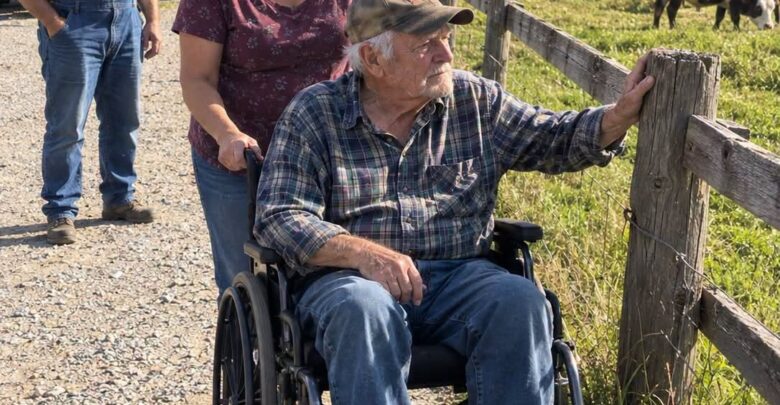
My daddy is Clayton Akers. He’s 84 years old.
For most of his life, he raised burley tobacco and black cattle on the same rolling ground in south-central Kentucky that his own daddy had farmed.
Even into his seventies, he was cutting tobacco by hand, sweating through his shirt in August with a tobacco knife and a spear.
Then, three years ago, he fell in the barn lot and broke his hip.
They pinned it at the hospital in Bowling Green. Afterward, he worked hard at rehab, harder than the therapists expected an 81-year-old to work.
Despite all that effort, his legs never came back the way they were. He could no longer get from the bed to the bathroom by himself.
That was when he went into the nursing home in town.
His mind, though, never left him for a single day.
Every morning, he reads the county paper from front to back. Ask him what corn brought at the elevator in 1974, and he can tell you. The aides call him Mister Clayton and come to his room to settle their arguments about ball scores.
That was what made the whole thing so hard to understand.
Sherry hadn’t taken money from a man who wouldn’t know. Instead, she’d taken it from a man who would understand the very minute somebody told him.
Until then, nobody had.
A Drive With Daddy
That night, I printed the picture of the form and laid it on our kitchen table in front of Doug.
He read it twice, with one finger moving under every line, the way he reads anything that matters.
“Well,” he said finally.
After setting the paper down, he pushed it back across the table.
“What are you going to do?”
“I’m going to take Daddy for a drive.”
For a long moment, Doug looked at me. Then he nodded slowly.
“You want me along?”
At first, I considered it. Doug is a good man, and Daddy likes him.
But I also knew my father. This was going to be a hard day, and he wouldn’t want an audience, even a kind one.
“No,” I said. “I want it to be just him. Him and his land. He doesn’t need a crowd. He needs to sit on his own ground and ask his own question.”
By Sunday morning, I knew where I needed to start.
So I drove to the nursing home early, before the church crowd came through.
Daddy was already dressed and sitting in his recliner by the window. His glasses rested low on his nose as he read the paper.
“You’re early,” he said without looking up. “Did the preacher die?”
“Not that I heard.”
I kissed him on top of the head. His white hair was combed flat with water, the same way he’d combed it every morning of his life.
Two Different Stories
“I want to show you something, Daddy,” I said. “And then I want to ask you something.”
After pulling the other chair close, I sat down and put the copy of the form in his hands.
There was no need to explain it. Daddy had filed farm taxes for sixty years. He knew what that sheet of paper meant better than I did.
He read it once.
Then he took off his glasses and wiped them slowly on the front of his shirt. With them back in place, he read the page again.
His mouth got thin.
“Sherry told me Bobby’s rent goes on my bill here,” he said slowly. “She told me the rent and my checks cover it. With a little left over for the taxes on the place.”
Until that moment, I hadn’t known she’d told him anything at all.
For a minute, I had to sit very still before I could answer.
“Daddy,” I said. “I’ve been paying your bill. Twenty-one hundred dollars a month. Sherry told me your money was gone.”
At that, he looked straight at me.
As long as I live, I will never forget that look.
It wasn’t anger. Not yet.
It was the look of a man who walks out to the barn at daylight and finds the door standing wide open and every stall empty.
“How long?” he said.
“Since you came in here. Three years.”
“Get My Hat”
Daddy set the form on the arm of his recliner and laid his hand flat on top of it.
Those big old knuckles were swollen from arthritis, the skin spotted from eighty summers in the sun.
For a long time, he sat that way, looking through the window at the parking lot.
Finally, he spoke.
“Why didn’t you call your sister?”
It wasn’t so much a question as him checking my thinking.
That had always been Daddy’s way. When I was a girl and came to him with a problem, he wouldn’t tell me what to do. Instead, he’d ask why I’d done what I’d done and make me hear myself say it.
“Because it’s not my money,” I said. “It’s yours. And because I figured you might like to ask somebody about it yourself.”
For another moment, he was quiet.
Then he said, “Get my hat.”