News
That Tiny Metal Mystery Piece? It’s a Compass Lead Holder
That Tiny Metal Mystery Piece? It’s a Compass Lead Holder

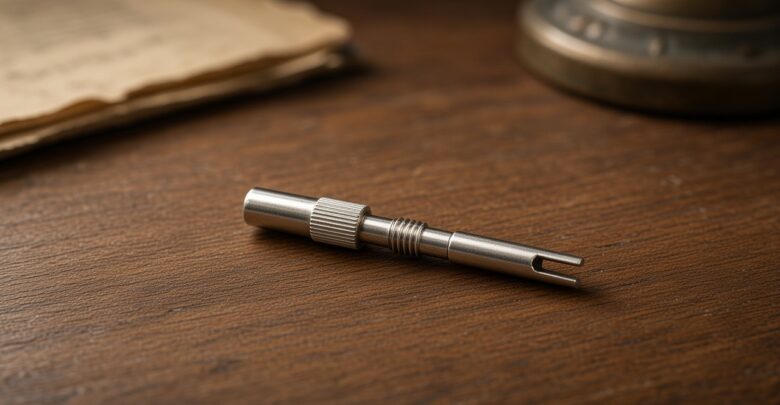
Someone picks up a tiny silver metal piece with two little prongs and no obvious home. It looks like it might belong to a bike, a gadget, or some forgotten repair kit. Then the answer clicks: it is a compass lead holder—the small attachment from a school geometry set that grips graphite so a compass can draw a clean circle.
If you ever lost one mid-semester, you already know the frustration. Without that little holder, the compass becomes a fancy metal V that can’t do its job. Here’s why this overlooked tool mattered so much, how it works, and why spotting one now feels like opening a time capsule from math class.
This identification matches what collectors and school-supply veterans recognize from classic geometry kits: a small metal piece that fits on one compass arm and clamps the lead in place.


That One Item That Was Always Getting Lost
Geometry kits usually arrived with a compass, spare leads, a sharpener, and a few odd extras tucked into molded plastic trays. The piece that vanished most often was the lead holder.
It fits onto one arm of the compass and holds the graphite used to draw precise circles. No holder, no reliable line. The needle side can still plant itself on paper, but the drawing side has nothing secure to write with. Tape and broken pencil stubs were the desperate workarounds, and they rarely worked well.


A Small Tool With a Big Job
For something so tiny, the compass lead holder does serious work. It keeps the graphite straight so arcs stay smooth and measurements stay honest. Many older sets include a small screw adjustment so you can tighten or loosen the grip on the lead.
That control is the difference between a wobbly scribble and a circle you can actually trust for a diagram. Teachers could spot the difference from the front of the room. Students felt it immediately when the lead slipped mid-arc and ruined a careful construction.


Look closely at mystery photos of these holders and you’ll often see fine ridges for grip and a forked tip that seats the lead. That shape is easy to misread as a valve tool or cable part until you place it next to a compass arm. Context finishes the identification.
Shared online puzzles sometimes guess “bike spoke nipple” or “electronics pin” first. Those guesses are understandable. The confirmed school-supply answer—compass lead holder—fits the geometry-set evidence and the way the piece attaches to a drawing compass.
From Everyday School Tool to Forgotten Relic
Geometry sets carry a whole sensory memory: plastic cases snapping shut, metal tools clinking, rulers with pointed ends, and the smell of pencil shavings. The lead holder lived in that world without fanfare. It wasn’t cute. It wasn’t famous. It was simply required.
Today it rests among long-forgotten objects that once shaped homework nights and blackboard demonstrations. Pull out a complete set and you can almost hear chalk on a board and feel the pressure of getting a radius “just right.”

Parents hunting through junk drawers for “that little metal thing” often describe the same moment of recognition. The piece looked useless until someone said “compass.” Then every geometry class memory lined up: the scratched desk, the broken lead, the scramble before the bell.
Hardware stores and online stationery shops still list replacement lead holders because older compasses outlive their tiny parts. If your set is missing one, matching the style of your compass arm matters—some holders clamp with a screw, others rely on a friction fit. The two-prong tip style in many mystery photos is a common classic design.
Still Useful If You Can Find One
The basic design of a compass lead holder has stayed familiar. Replacements are still sold and often work with older-style compasses. If you’re restoring a geometry set or helping a student revive a hand-me-down kit, that tiny part is still the piece that makes the whole tool usable again.
Digital drawing apps can make perfect circles in one click, sure. But hands-on geometry still teaches patience, pressure control, and the satisfaction of a clean arc you made yourself. The lead holder is the quiet hardware behind that satisfaction.
Teachers used to keep spare holders in desk drawers for exactly this reason. A whole lesson could stall when half the class had compasses that couldn’t grip lead. That tiny part controlled classroom momentum more than any poster on the wall.
Artists and drafters outside school used similar systems too, though modern technical pens and digital tablets changed the toolkit. The school compass version remains the one most people remember because almost everyone met it the same way: through homework.
Why the Mystery Object Fools People
Out of context, the shape looks technical and a little alien. Two prongs. Threads or ridges. No handle. No obvious “front.” It’s easy to file under “bike part” or “electronics leftover” until someone who sat through compass constructions says, “Wait—that’s from math class.”
That’s the fun of these identification puzzles when the answer is solid. The object isn’t random scrap. It’s a purpose-built school tool that spent decades hiding in plain sight inside plastic cases.
If you’re sorting a thrift-store geometry set, check the molded tray first. Empty slots tell a story. A missing lead holder is the usual gap. Finding one loose in a pencil cup or sewing tin is also common—kids moved them, dropped them, and promised to put them back.
Handle older metal parts gently. Points are sharp. Leads snap. And if a found object doesn’t match a compass system after a careful look, don’t force it onto a tool. This article’s answer is for the classic two-prong school lead holder described in the source mystery, not for every unnamed metal scrap on earth.
There’s a reason these posts get comments like “I never thought it would be this.” The brain expects a dramatic machine part. The truth is ordinary and oddly touching: school, graphite, and a circle drawn carefully enough to earn a check mark.
Keep the piece if it completes a set. Gift it to a teacher who still teaches constructions by hand. Or simply enjoy knowing the name. Mystery solved, memory unlocked, junk drawer slightly smarter than it was yesterday.
Collectors of school nostalgia sometimes display complete geometry sets as tiny museums of childhood. The lead holder is the part that makes the display honest—because a compass without it is incomplete theater. Function always was the point.
A Tiny Link to Hands-On Learning
The compass lead holder deserves a little respect. It kept graphite steady while students learned circles, arcs, and constructions one careful turn at a time. It connected basic tools to bigger ideas—measurement, precision, and the pride of a diagram done well.
Next time a mystery metal piece turns up in a junk drawer, check the geometry set theory before you toss it. You might be holding the smallest hero of math class.
Name it once and the junk-drawer mystery loses its power—in the best way.
Thanks for opening the geometry case with us! This piece is for entertainment and general info only—not professional advice. If you’re identifying a found object for safety or repair reasons, double-check with a knowledgeable source before you rely on it.