News
At My Wedding, My Stepmother Told Every Guest My Late Mother “Left Me Nothing” — Then My Aunt Stood Up With an Envelope Mom Had Sealed 20 Years Ago
At My Wedding, My Stepmother Told Every Guest My Late Mother “Left Me Nothing” — Then My Aunt Stood Up With an Envelope Mom Had Sealed 20 Years Ago

My Stepmother Said My Mother Left Me Nothing—Then My Aunt Handed Me a Letter She Had Kept for Twenty Years
This is a fictional story. All names, characters, and events are invented.
My stepmother stood in the middle of the dance floor with the microphone in her hand.
“And Natalie,” she said, smiling toward the head table, “I hope you understand how fortunate you are. Your mother left you nothing, and your father and I have done everything we could for you.”
For a moment, I could hear the soft hum of the speakers.
Then someone set down a glass.
Beside me, my husband, Ben, reached for my hand beneath the table.
I looked at the flowers my aunt had arranged that morning. Small white blossoms, autumn leaves, and ribbons she had tied herself.
I had been married for less than three hours.
I did not want to spend the rest of the evening trying not to cry.
Then Aunt Joanne stood up.
The Mother I Remembered in Pieces
My mother died when I was eight.
She was thirty-four and had ovarian cancer.
At that age, I understood that she was sick, but I did not understand how a person could stop being part of ordinary life.
For months afterward, I expected to hear her calling from the kitchen.
As I grew older, some memories became less clear. I could no longer remember every conversation or the exact sound of her footsteps.
Other details remained.
The way she tucked my hair behind my ear when I was concentrating.
Her handwriting on the labels inside my school clothes.
The small circle she rubbed on my back when I could not sleep.
Aunt Joanne, her younger sister, helped keep those memories close. She answered questions my father found too painful to discuss.
A New Family with Unequal Rules
My father married Cheryl two years later.
Her daughter, Madison, was my age.
There was no single moment when I decided the arrangement was unfair. It became clear through a collection of smaller experiences.
Madison received the larger bedroom because she had more furniture.
At sixteen, she received a car because her activities required transportation.
When I needed a ride, I was encouraged to become more independent.
Cheryl rarely raised her voice.
Instead, she explained things patiently, leaving me feeling unreasonable for noticing the difference.
My father worked long hours and often accepted whichever explanation was offered first.
I learned to avoid arguments that ended with everyone discussing my attitude rather than the original question.
By the time I left for college, asking for less had become a habit.
The Wedding Budget
When Ben and I became engaged, Dad offered to contribute toward the wedding.
I thanked him before asking how much.
A few days later, Cheryl called.
“Eight thousand dollars,” she said. “That is what we can manage.”
It was a generous amount, and I told her so.
Then she added that Madison would be getting married the following year.
“We have to be fair.”
I later learned that Madison had been promised forty thousand dollars.
The difference hurt, but I did not want wedding planning to become another family dispute.
Ben and I reviewed what we could afford ourselves.
We found a barn available in October, chose a simple meal, and kept the guest list focused on people we wanted around us.
Aunt Joanne offered to handle the flowers.
Building a Day That Felt Like Ours
My dress came from a rack rather than a private appointment.
It fit beautifully after alterations.
Ben chose a suit he could wear again.
Friends helped with place cards, and we borrowed decorations instead of buying everything new.
The planning was sometimes tiring, but it also revealed how many people wanted to help without making their contribution a subject of conversation.
Joanne arrived the day before the wedding with buckets of flowers in the back of her car.
She spread ribbon across the kitchen table and asked where I wanted my mother’s photograph placed.
We chose a small table near the entrance.
Beside the photograph, I put a candle and a vase of the flowers Joanne was arranging.
It was enough to make the space feel personal.
A Beautiful Beginning
The ceremony was everything I hoped it would be.
Ben looked at me as though he had forgotten anyone else was present.
Dad walked beside me slowly, his hand trembling against mine.
Afterward, guests gathered outside while the tables were prepared.
Someone took a photograph of Ben holding my bouquet because I needed both hands to fix my shoe.
I laughed so hard that Joanne asked the photographer to keep taking pictures.
At dinner, the barn glowed with soft lights.
My grandmother sat near the front. Friends from college crowded together at one table, already telling stories.
For a while, I stopped thinking about budgets, comparisons, and the person who should have been sitting beside my father.
I was simply happy.
The Speech Nobody Had Planned
Cheryl was not scheduled to speak.
After the best man and my maid of honor finished, she approached the DJ and took the microphone.
“I would like to say something on behalf of the family.”
I smiled because I thought perhaps she was making an effort.
She spoke about joining our household and the responsibilities she had accepted.
Then she described raising me as though I were her own child.
I kept looking at her, waiting for the speech to become about the wedding.
Instead, she mentioned my mother.
“Your mother left you nothing,” she said. “So I hope you appreciate what your father and I have provided.”
My grandmother put down her fork.
Dad stared at Cheryl.
I could feel my face growing hot.
Aunt Joanne Reached Into Her Bag
Joanne did not interrupt immediately.
She looked at me first.
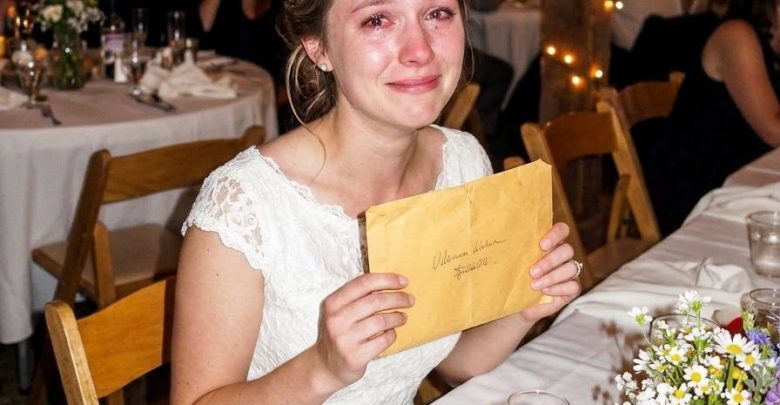
Then she stood, opened her handbag, and removed a cream-colored envelope with edges softened by time.
She walked to the head table.
“Natalie,” she said quietly, “I was going to give you this somewhere private later.”
My name was written across the front.
I recognized the handwriting before I understood what I was holding.
“Your mother asked me to save it for a day like this.”
I looked up.
“My wedding?”
Joanne nodded.
I had spent years imagining what my mother might say if she could see me grown.
Now there were words in front of me that she had actually chosen.
I slid a finger beneath the flap.
The Letter Written Before Goodbye
There were three pages inside.
The handwriting became less steady toward the bottom of each one.
“My darling Natalie,” the letter began.
“If you are opening this on your wedding day, I wish more than anything that I could see you.”
I pressed my lips together.
She wrote about hoping I had found someone kind, someone who listened when I spoke and made ordinary days enjoyable.
She told me not to worry if my dress was simple or the weather refused to cooperate.
“I hope you laugh today,” she wrote. “Please let somebody take a picture while you are laughing. Those are always my favorites.”
I looked toward the photographer.
Joanne smiled through her tears.
She knew exactly which pictures had just been taken.
What My Mother Had Arranged
A separate folder accompanied the letter.
Joanne explained that, before her death, my mother had arranged for fifty thousand dollars from her life insurance proceeds to fund a trust for my benefit.
Joanne was named trustee.
The arrangements were made with professional help, and the trust documents governed how the money could be used.
The wedding letter was personal. It was not the document that created or controlled the trust.
Over the years, Joanne managed the funds with an adviser and kept the required records.
Some of the money had paid my college expenses.
At the time, I knew Joanne administered an education fund established by my mother. I had not known its original amount or that it would continue beyond school.
The statement showed what remained.
Eighty-one thousand, four hundred dollars.
The Money Was Only Part of It
I looked at the figure for a long time.
Then I returned to the letter.
My mother had imagined a future she knew she would not share.
There were lines about education, disappointment, friendships, and the difficulty of choosing a life without knowing how everything would turn out.
She had not known Ben’s name.
She could not have known where I would live or which kind of work I would choose.
But she had trusted that I would become someone capable of making those decisions.
One sentence made me stop.
“I hope the person beside you understands how lucky they are to know you.”
Ben leaned closer.
“He does,” he whispered.
I laughed and cried at the same time.
My Father Finally Spoke
Dad had moved his chair beside mine.
Tears were running down his face.
He remembered my mother discussing plans for my future, but he had never managed the trust or followed the details of its later administration.
Joanne had handled that responsibility directly.
He asked whether I wanted water.
It was such a small, practical question that I nearly cried harder.
Across the room, Cheryl still held the microphone.
She began saying that she had only meant—
Dad stood.
“Cheryl, please sit down.”
He took the microphone and handed it back to the DJ.
Then he returned to me.
“I am sorry,” he said.
I nodded, unable to answer.
There would be more to discuss later.
For that moment, I needed him beside me.
The Dance My Mother Had Hoped For
Near the end of the letter, my mother asked me to dance with my father if we were both able.
She remembered being nervous at her own wedding and how he had made her laugh when they lost track of the steps.
Joanne had given the DJ the name of their song earlier that afternoon.
She had hoped there might be a suitable moment.
Dad held out his hand.
“Would you like to?”
I looked at Ben.
He nodded.
My father and I walked into the center of the barn.
For the first few steps, we said nothing.
Then he told me that my mother had stepped on his shoe during their first dance.
“She blamed me,” he said.
“That sounds like her.”
He smiled.
For a few minutes, we remembered her together.
After the Guests Went Home
Cheryl left before the reception ended.
Madison stayed.
Before going home, she approached me and said she was sorry about the speech.
I thanked her.
I did not ask her to explain her mother’s behavior.
Later, Ben and I sat in the quiet room where we had left our belongings.
My shoes were on the floor.
The flowers were beginning to droop slightly, and someone had packed cake for us in a cardboard box.
I read the letter again.
Ben stayed beside me without trying to turn the evening into a lesson or a victory.
“Do you wish Joanne had waited?” he asked.
I thought about it.
“I wish Cheryl hadn’t said it.”
He nodded.
“So do I.”
The Conversations That Followed
Dad called when we returned from our short honeymoon.
This time, we spoke without Cheryl present.
I told him about the smaller moments I had learned not to mention.
He listened more carefully than I expected.
Sometimes he remembered the event differently. Sometimes he admitted he had allowed an explanation to end a conversation he should have continued.
One apology could not repair years of feeling secondary.
Still, his willingness to remain in the conversation mattered.
I also told him I did not want future family gatherings to include remarks about my mother or the support I had received.
He agreed.
Cheryl never gave me an apology that addressed what she had actually said.
I stopped waiting for one before deciding how much contact felt comfortable.
A Beginning My Mother Helped Make Possible
Joanne and I met with the adviser after the wedding.
We reviewed the trust records and discussed the options available under its terms.
I wanted to understand the money before making plans for it.
Eventually, part of it contributed toward a modest first home for Ben and me.
There were moving boxes, paint samples, and evenings spent deciding which repairs needed attention first.
I found myself wishing I could call my mother to ask what she thought of the kitchen.
Instead, I asked Joanne.
She studied the photographs and said my mother would have wanted us to check the cupboards before choosing a paint color.
It was exactly the kind of answer I needed.
The Letter in Our Hallway
I keep the original letter safely stored.
A framed copy hangs in our hallway beside a photograph from the wedding.
In the picture, I am laughing while Ben holds my bouquet and I try to fix my shoe.
Dad is behind us, smiling.
Joanne stands near the edge of the frame with a ribbon caught around her wrist.
Visitors usually notice the photograph first.
Sometimes they ask about the letter.
I tell them my mother wrote it when I was a child and asked her sister to keep it for me.
I do not always explain the speech or the money.
Those details belong to the story, but they are not the part I return to most often.
I return to the woman who was terribly ill and still found the strength to imagine me happy.
She could not attend my wedding.
She could not meet my husband or visit our home.
But twenty years after I last heard her voice, she gave me something I had wanted for longer than I could remember.
A few pages in her own handwriting.
A message addressed to the woman I had become.
This story is fictional and is presented for entertainment.