News
For 412 Mornings, a 17-Year-Old Boy Paid for the Same Nurse’s Coffee, Then One Morning He Disappeared
For 412 Mornings, a 17-Year-Old Boy Paid for the Same Nurse’s Coffee, Then One Morning He Disappeared

The Morning the Green Honda Was Missing
“Where’s my boy?”
As soon as she rolled down her window, the nurse asked that question. Snow was blowing sideways across Route 9, and the wipers on her dented silver Corolla were going as fast as they could. Instead of looking at me, she looked toward the gas station across the road, where for over a year a rusty green Honda had sat every school morning with its engine running.
This time, however, the lot was empty except for the snowplow driver filling up at pump four.
She said it like a joke, but her eyes weren’t joking.
“Didn’t show today,” I said. “First time in a year.”
So she paid for her own small vanilla latte: $4.85, the same as always. She dug the money out of a little coin purse shaped like a strawberry, and she looked strange doing it, like a woman reaching for a stair that isn’t there.
“Huh,” she said. “Snow day, probably.”
“Probably,” I said.
Yet neither of us believed it, and neither of us knew his name.
The Boy at My Drive-Thru Window
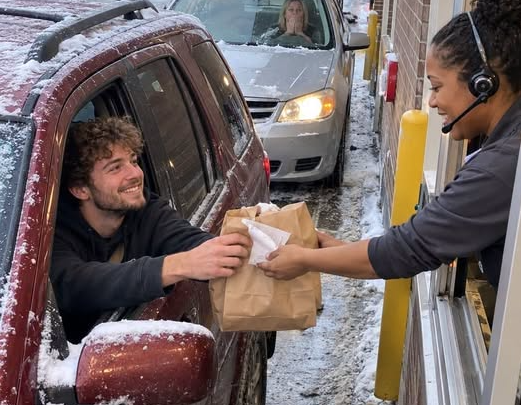
My name is Rosemary Delgado, although most people call me Ro. I’m fifty-eight, and for eleven years I’ve worked the 5 a.m. drive-thru window at the Mug & Muffin, a little coffee stand on Route 9 just outside Bangor, Maine. It’s a shed with a window, really, painted barn red, with a hand-lettered menu and a tip jar that says “Fueling Maine Since 1998.”
Over time, you learn people by their cars at that window. There’s the plumber in the white van, large black, two sugars. There are the twins in the minivan who always want whipped cream, and a retired game warden in a Ford Ranger who orders decaf and pretends it’s regular.
And there was the boy in the rusty green Honda.
He started coming the September before last: a skinny kid in a gray hoodie, with a Bangor High School parking sticker on the windshield and a crack running across the passenger side of the glass. The muffler on that Honda sounded like a lawnmower with bronchitis.
Each morning, he ordered a small hot chocolate for $2.75. Then, before I could close the window, he’d glance in his rearview mirror.
“Whatever the car behind me gets,” he’d say. “I’ll pay for it.”
At first, I thought he was being sweet. After all, kids sometimes copy things they see on TikTok.
The second time, I noticed the car behind him. It was a dented silver Corolla with a tired woman behind the wheel in navy blue scrubs and a hospital ID badge clipped to her collar. She ordered a small vanilla latte, $4.85.
Waiting for the Silver Corolla
By the third visit, however, I realized he was waiting for her.
So I started watching, as you do at a drive-thru window at five in the morning, when there’s nothing on the radio but the farm report and the Red Sox losing.
Before joining my line, he’d park in the lot of the Irving station across the road with his engine running and his headlights off. He’d sit there five minutes, sometimes fifteen. Then the silver Corolla would come down Route 9 from the direction of Hermon, and the second her blinker went on, the green Honda would pull out and slide into my line right in front of her.
And so it continued, every school day for over a year.
Together, his hot chocolate and her latte cost $7.60. Most days it was a five-dollar bill and a handful of quarters and dimes, counted out carefully, like every coin mattered. Then he’d pull away before she reached the window.
When I told her the kid ahead had paid, she’d smile and shake her head.
“That kid again,” she’d say. “Tell him thank you.”
“I’ll tell him.”
Still, she never knew who he was. As far as I could tell, she barely saw him, because he always drove away before she reached the window.
A Cupcake with One Blue Candle
Then, on her birthday in September, the boy handed me a cupcake through the window, chocolate with pink frosting and a single blue candle, in a plastic clamshell from the Hannaford bakery.
“Can you give this to her?” he said. “With the coffee? It’s her birthday.”
“How do you know it’s her birthday?”
Instead of explaining, he shrugged and looked at his steering wheel. “I just do.”
I lit the candle with the lighter we keep for the propane heater, and while he waited, I snapped a quick photo of him through the window with my phone. He was leaning out a little, squinting at the flame, with the gray hood pushed back for once and his hair sticking up. Perhaps I took it simply because the sight made me smile.
When the Corolla pulled up and I handed the nurse her latte and the cupcake with the candle still burning, she just sat there and stared at it.
“How did he know?” she whispered.
“He wouldn’t say.”
After blowing out the candle, she rested her forehead on the steering wheel for a few seconds. Only then did she drive off to work.
Eventually, I asked the boy straight out.
It was October, cold and still dark, with frost on the window ledge. As usual, he counted out $7.60 for the two drinks.
“Do you know her?” I said. “The nurse?”
Rather than meet my eyes, he looked at the money in my hand.
“Not really,” he said.
Then he drove away.
However, that “not really” stayed with me. It gave me neither a clear yes nor a clear no. It was the answer of a kid carrying something too heavy to set down in front of a stranger.
Kurt Had His Doubts
Meanwhile, my manager, Kurt Gagnon, hated the whole routine.
Kurt was thirty-four, the owner’s nephew, and he ran the Mug & Muffin like it was a Fortune 500 company. With a clipboard and a stopwatch app, he timed every car at the window. The franchise office in Portland measured “average service time,” and Kurt wanted a bonus.
“He’s holding up the line every morning,” Kurt said, standing behind me with his arms crossed. “Waiting across the street like some kind of stalker. If he does it again, I’m calling the school.”
“He’s buying a nurse a coffee, Kurt.”
“He’s weird. Besides, kids that age don’t do that for nothing.” He tapped his clipboard. “If he’s parked over there tomorrow, I’m calling the cops.”
Eventually, Kurt leaned right over my shoulder one morning at the window and said it to the nurse herself.
“Lady, that kid’s a creep,” he told her. “He’s probably checking out your car and learning your schedule. You should report him.”
In response, the nurse looked at him for a long moment.
“He buys me coffee, Kurt,” she said. She read his name off his tag. “Nobody’s done that for me in years.”
The next morning, the green Honda was there anyway. Kurt glared at it the whole time, but he never made the call. I think he knew how it would sound out loud. “Officer, there’s a teenager buying lattes for a nurse.”
Despite his complaints, the boy and I carried on.
Small Coins, Morning After Morning
By Christmas, I’d done the math on the back of an order pad. He’d been paying $4.85 every school morning since September, plus his own $2.75. Across more than a year of visits, the total had already passed a thousand dollars.
Yet he drove a rusty Honda with a cracked windshield and a muffler held on with a coat hanger. To a kid like that, it must have been a fortune.
Where was a seventeen-year-old getting that kind of money? And why was he spending it on a woman he said he didn’t really know?
Then, on a Tuesday in February, the green Honda didn’t come.
That morning, wet, heavy snow was falling hard enough to snap power lines. Bangor schools had announced a two-hour delay, so I figured that was it. He’d be sleeping in like every other kid in Penobscot County.
But the Corolla came, right on time.
That’s when the nurse rolled down her window and looked past me at the empty lot.
“Where’s my boy?”
However, Wednesday passed without him, and Thursday did too.
On Thursday, Kurt actually smiled. “Problem solved,” he said, tapping his stopwatch app. “Our average service time dropped eleven seconds.”
Instead of answering, I kept watching the road.
A Nurse Named Joanne
On Friday, the nurse came through the line looking like she hadn’t slept in three days. With her hair in a messy knot and dark shadows under her eyes, she looked worn out. Even her hospital badge was clipped on crooked. For the first time, I could read the name on it: JOANNE PELLETIER, RN, CRITICAL CARE.
“Still no?” she asked.
I shook my head.
As we spoke, she gripped the steering wheel with both hands.
“I keep thinking something’s wrong,” she said. “Maybe that sounds stupid, because I don’t even know who he is. Still, I lie awake at night thinking about it.”
Then she hesitated, and her voice dropped.
“A seventeen-year-old came into intensive care Monday night after a car accident on Route 9, near the Hermon line. They mentioned black ice, and he still hasn’t woken up.”
She swallowed hard.
“Because I work in the heart care unit, I’m not on his case. So far, I’ve only seen him through the glass while walking past.”
“What did he look like?” I asked. My own voice sounded far away.
The Photograph on My Phone
“Skinny. Brown hair.” She closed her eyes. “His things came in with him in a plastic bag. Patient belongings. They hang them on a hook outside the room. There was a gray hoodie in it.”
At those words, my stomach seemed to drop through the floor of that little red shed.
I pulled out my phone with my fingers shaking and scrolled back through my photos, past my granddaughter’s dance recital and a picture of a moose that wandered into the Irving lot. Finally, there it was: the birthday photo, with the boy, the cupcake, and the gray hoodie.
Then I turned the screen toward her.
To see it clearly, she leaned halfway out of her car window into the snow.
Then she put her hand over her mouth.
“That’s him,” she whispered. “That’s the boy in bed four.”
Then she looked at the photo again, closer this time, and said something that made me grab the counter.
“Wait,” she said. “I know that face. I’ve seen it before.”
Meanwhile, Kurt was in the back counting the cash drawer. Although three cars behind Joanne’s Corolla were honking, I couldn’t turn away.
“Where?” I said. “Where have you seen him?”
While snow settled on her scrubs and hair, Joanne stared at the photo.
The Mother in Intensive Care
“Two years ago,” she said slowly. “Almost two and a half. In the ICU. A woman came in with sepsis, a dangerous reaction to a kidney infection. She was forty-one, a single mom. She worked at the Walmart on Stillwater Avenue, and she’d put off going to the doctor because she didn’t have insurance and couldn’t afford it. By the time she reached us, however, she was terribly ill.” Joanne’s voice was shaking. “She was in my unit for nine days.”
“And the boy?”
“Her fifteen-year-old son waited there every day for nine days. At night, he slept in the chairs. Nobody came with him, because his grandmother was ill and couldn’t drive, and there was no dad beside him.” She pressed her fingers against her lips. “He never cried. Not once that I saw. Instead, he sat in that same gray hoodie, doing homework and waiting for someone to say his mom would be okay.”
Behind her, the minivan with the twins laid on the horn.
Even so, Joanne didn’t seem to hear it.
Nine Mornings of Hot Chocolate
“That first night, I brought him a hot chocolate from the second-floor vending machine because he looked so cold. It cost a dollar twenty-five.” She laughed, and it came out as a sob. “Then I did it every morning when I came on shift. All nine mornings. It was the only thing I could think of to do for him. I’d hand it to him and say, ‘Drink this, honey, you need something warm.’”
By then, tears were running down her face.
“On the ninth night, his mother died while I held her hand. Afterward, I had to go into the waiting room and tell him.”
For a moment, I couldn’t speak.
“Small hot chocolate,” Joanne whispered. “He always orders a small hot chocolate, doesn’t he?”
“Every single morning,” I said.
Joanne Pelletier sat in her car at my drive-thru window in the snow and cried like her heart was breaking. I reached through the window and held her hand. The minivan with the twins finally backed up and pulled around to the exit without their whipped cream.
Just then, Kurt came up behind me with the cash drawer.
“Ro, what is going on? We’ve got cars backed up to the road!”
“Kurt,” I said, without turning around, “take the window.”
“What?”
Leaving My Shift Early
“Take the window. I’m going to the hospital.”
I’d never left a shift early in eleven years. Not when my husband, Hector, had his gallbladder out, and not the morning my granddaughter was born. I’d worked through two ice storms and a power outage and the winter my furnace died and I slept in my coat.
This time, however, I took off my apron, hung it on the hook, and walked out to my car.
Kurt stood in the window with his mouth hanging open. “Ro! You can’t just leave! Who’s going to work the window?”
“You’ve got two hands and a stopwatch, Kurt,” I said. “Figure it out.”
The medical center sits up on the hill on State Street, eight floors of brick and glass overlooking the Penobscot River. Joanne met me in the main lobby at 7:30 in her scrubs, with her badge still crooked.
“We’ll need to speak with his family before asking about a visit,” she said quietly. “His grandmother is upstairs.”
“What’s his name?”
She took a breath.
“Elijah Thibodeau,” she said. “Everybody calls him Eli.”
Eli. After more than a year of mornings at my window, he finally had a name.
Meeting Eli’s Grandmother
“His grandmother’s upstairs,” Joanne said. “She’s been here every day. Because she’s seventy-four and doesn’t drive, she takes the city bus from Brewer, with two transfers.” Her voice caught. “She’s sitting in the same waiting room he sat in two years ago.”
Then we took the elevator to the fourth floor. Joanne walked me down a long hallway that smelled like hand sanitizer and floor wax, past a nurses’ station with blinking monitors, to a small family waiting room with blue vinyl chairs, a TV playing the Weather Channel with the sound off, and a vending machine humming in the corner.
Beside the window sat a small, thin woman with white hair pinned back under a knit cap. A winter coat was folded in her lap, and a rosary was wound through her fingers. On the chair beside her sat a battered canvas tote bag stuffed with papers.
“Mrs. Thibodeau?” Joanne said gently.
The old woman looked up, and when she saw Joanne’s face, she went very still.
“You,” she whispered. “You’re the nurse. The one from before. When my Danielle…”
“Yes, ma’am,” Joanne said. “I’m Joanne. I was Danielle’s nurse.”
At that, the old woman’s face crumpled.
“He talked about you,” she said. “Every day, for two years. The nurse with the hot chocolate. He said you were the only person in this whole hospital who saw him.”
The Boy Who Helped with the Bills
Her name was Bernadette Thibodeau. She was seventy-four, a retired school lunch lady from Brewer, the town right across the river. Since her daughter Danielle died, she’d been Eli’s legal guardian. The Penobscot County Probate Court had appointed her the month after the funeral.
For the next three hours, we sat with her in that little waiting room. Joanne went back to her unit when her shift started, but she came by every break. I bought Bernadette a cup of tea from the vending machine, and she held it in both hands without drinking it.
“He’s the best boy,” she said. “After school, he works at the Hammond Lumber yard on Odlin Road three afternoons a week, plus all day Saturday. From his wages, he gives me half for groceries and the light bill. Apparently, that’s his rent.”
“Bernadette,” I said carefully, “do you know where Eli went every morning before school?”
She looked confused. “At a quarter to six, he leaves for school. Because he’s applying to colleges, he said he wanted to use the library early.”
“He came to my drive-thru,” I said. “Every school morning for over a year. He bought a hot chocolate, and then he paid for the coffee of the car behind him.” I paused. “It was always the same car, Bernadette. It was always Joanne.”
At that, the old woman set down her tea.
“Every morning?”
“Every school morning.”
Why He Never Told Her
Bernadette pressed the rosary against her lips and closed her eyes.
“He told me he was going to find her,” she said quietly. “After Danielle died. He said, ‘Mémère, I’m going to find that nurse and pay her back someday.’ I told him the hospital wouldn’t give out a nurse’s name. But he said a name wasn’t necessary because he would recognise her.” She shook her head. “I thought it was just grief talking.”
“He found her,” I said. “And then he waited for her every single morning, across the road, so he could pay for her coffee before she ever got to the window.”
“Why wouldn’t he just tell her?” Bernadette whispered. “Why all that sneaking around?”
Once again, I thought about the boy at my window, saying “Not really” before driving away.
“I think,” I said slowly, “he didn’t want her to feel like she owed him anything. After all, she gave him something when he had nothing, without expecting it back. I think he wanted to give it back the same way.”
Bernadette started crying then, the quiet, worn-out crying of a woman who’s done too much of it.
The Envelopes in Bernadette’s Bag
Then she reached into the canvas tote bag beside her and pulled out a thick stack of envelopes held together with a rubber band.
“I don’t know what to do with these,” she said. “They keep coming. The hospital, the insurance, the lawyers. I can’t read half the words. Until the accident, Eli had handled the mail and almost everything else.”
I went through the envelopes one at a time, right there in that waiting room.
Although I’m neither a lawyer nor an accountant, I know how frightening a stack of bills can be. But I raised three kids and buried a husband, and I’ve fought with enough insurance companies to know when somebody’s trying to take advantage.
The first envelope was from the medical center’s patient accounts office: an “Estimate of Patient Responsibility” for Elijah Thibodeau. ICU care was running about $13,800 a day. He’d been there four days, and there was a line for “Self-Pay Balance.”
“He doesn’t have insurance?” I asked.
Bernadette shook her head. “He was on MaineCare when Danielle was alive. That’s the state insurance for kids. But when he came to live with me, there was some paperwork. I didn’t understand it. They sent a letter saying his coverage ended.” She wiped her eyes. “I meant to fix it. I just didn’t know how.”
Bills from His Mother’s Final Illness
However, the second envelope was worse. It came from a collection agency in Portland called Coastal Recovery Services. Inside was a demand for $31,240.17 for “the outstanding medical balance of Danielle M. Thibodeau, deceased.” It was addressed to Bernadette, and it said: “As next of kin, you may be responsible for this obligation. Failure to respond may result in further collection action.”
“They’ve been calling me for two years,” Bernadette said. “Every week. Eli told me not to answer, but I worry. He’s been paying them fifty dollars a month out of his lumberyard money so they’ll stop calling.”
At that, my hands went cold.
“Bernadette, did Danielle leave anything when she died? A house? A bank account?”
“She rented a trailer in Hermon. She had about four hundred dollars in the bank and her car. That’s all.” She hesitated. “And a little life insurance policy through Walmart. Twenty-five thousand dollars. The probate court put it in a special account for Eli. Nobody can touch it until he’s eighteen. A lawyer helped me set it up for free, through Pine Tree Legal.”
A Settlement Offer with a Deadline
Then I opened the third envelope and wanted to throw something.
It came from an insurance company called Granite State Mutual and was addressed to “The Guardian of Elijah Thibodeau.” Inside was a two-page letter and a single-page form titled “Full and Final Release of All Claims.”
According to the letter, Granite State Mutual insured a delivery truck owned by North Woods Freight LLC of Old Town, Maine. That truck had been “involved in” Monday night’s accident on Route 9. In exchange for a signed release ending all claims from the accident, the company offered $15,000. However, the offer would expire in ten days.
At the bottom of the release form, there was a line for Bernadette’s signature.
“A man from the insurance company called yesterday,” Bernadette said. “Very nice. He said fifteen thousand dollars would help with the hospital bills. Because the offer would run out, he said I should sign quickly.” She looked at me with frightened eyes. “Should I sign it? Fifteen thousand dollars is so much money.”
Yet the hospital estimate beside that form showed a daily cost of $13,800.
“Bernadette,” I said, “don’t sign anything. Not one thing. Not until we talk to a lawyer.”
What the Accident Report Revealed
The police accident report came out the following Wednesday. Joanne’s friend in the ER, a nurse whose husband was a Maine State Police trooper, helped Bernadette request a copy. It cost $10.
Later, I read all six pages at Bernadette’s kitchen table in Brewer on a cold gray afternoon while she made tourtière, the meat pie her mother taught her to make in Van Buren up in the County.
Monday night, 9:47 p.m., Route 9 near the Hermon town line. Road conditions: snow-covered with patches of black ice. Vehicle 1: a 2009 Honda Civic, green, driven by Elijah Thibodeau, age 17, eastbound. Vehicle 2: a 2021 Freightliner box truck owned by North Woods Freight LLC, westbound.
Next came the trooper’s account, written in that flat, careful police style.
“Witness statement from driver of Vehicle 3 (traveling behind Vehicle 2) indicates Vehicle 2 was traveling at approximately 55 mph in a posted 45 mph zone at time of incident, under snow and ice conditions. Witness observed driver of Vehicle 2 looking down at a handheld device immediately prior to the vehicle crossing the center line. Vehicle 2 crossed into eastbound lane. Vehicle 1 swerved to avoid head-on collision, lost traction on ice, left roadway, and struck a utility pole. Driver of Vehicle 2 did not stop at scene. Vehicle 2 was located 2.3 miles west at North Woods Freight terminal. Driver cited for failure to stop and render aid, speed greater than reasonable and prudent, and use of handheld device while operating a commercial motor vehicle.”
The Driver Who Kept Going
After reading that, I put the report down.
Until then, I had pictured a simple skid on black ice. Now the report told a far worse story. A truck driver on his phone, going ten over the limit in a snowstorm, crossed the center line and ran him off the road. Then he drove away and left a seventeen-year-old boy unconscious in a ditch, in a crumpled Honda, in the snow.
And four days later, his company’s insurance carrier mailed his grandmother a fifteen-thousand-dollar check offer with a ten-day deadline.
“Bernadette,” I said quietly. “Who found him? On Route 9? Who called 911?”
She set down her rolling pin.
“A plow driver for the Town of Hermon,” she said. “He saw headlights in the ditch, although Eli’s car was half buried. According to him, another twenty minutes in that cold could have cost Eli his life.”
I called a lawyer the next morning, and that was Kurt’s doing.
Kurt Changes His Mind
When I next came back to work, I told him everything: Joanne, Danielle Thibodeau, the nine mornings of vending machine hot chocolate, the truck, and the insurance letter. As usual, I expected an eye roll and a glance at his stopwatch.
Instead, Kurt went very quiet. Then he took his phone out of his pocket and scrolled through his contacts.
“My cousin Danny was hit by a drunk driver in Ellsworth six years ago,” he said. “The insurance company offered him ten grand the week after. My aunt almost signed it. A lawyer in Bangor got him a settlement of four hundred thousand.” He held out his phone. “Thomas Ouellette. Ouellette & Roy, on Main Street. He’ll talk to her for free. He did for us.”
I looked at Kurt.
“You called that boy a stalker,” I said.
Kurt’s ears went red.
“You’re right,” he said. “It was wrong.” After rubbing his face, he tried again. “Maybe I didn’t believe anybody would do something nice for nothing. But that’s no excuse, Ro. I’m sorry.”
“Tell Joanne that,” I said.
“Actually, I already did,” Kurt said. “She came through this morning at 6:10. I told her I was sorry I called him a creep.” He swallowed. “Then, for the first time, she paid for the car behind her: a guy in a pickup who looked confused as hell.”
A Lawyer Reads the Offer
Thomas Ouellette was in his sixties, with a gray beard, a tweed jacket, and an office above a bookstore on Main Street that smelled like old paper and woodsmoke. He read the police report, the insurance letter, and the release form while Bernadette and I sat across from his desk.
When he finished, he took off his reading glasses and set them down slowly.
“Mrs. Thibodeau,” he said, “I’m going to be very direct with you, because that insurance company wasn’t. Do not sign this release. If you’d signed it, you would have given up every right your grandson has to recover for his injuries, his medical bills, his lost future earnings, all of it, for fifteen thousand dollars. His hospital bills are already well past fifty thousand, and he’s still in the ICU.”
At that, Bernadette went pale.
“And there’s something else you need to know,” Ouellette said. “In Maine, any settlement of a claim on behalf of a minor has to be approved by a judge. That protects children from exactly this kind of thing. Even if you’d signed it, that release might not have held up without court approval. But they were hoping you didn’t know that.”
“They told me it would expire in ten days,” Bernadette whispered.
“They tell everybody that,” Ouellette said. “It’s pressure.”
Someone to Speak for Eli
Then he pulled a legal pad toward him.
“Commercial trucking companies in Maine are required to carry substantial liability insurance. Federal rules require at least $750,000 for interstate carriers, and many carry a million or more. This driver was speeding, on a handheld device, and left the scene. That’s about as clear a case of negligence as I’ve seen in thirty-five years.” He looked at Bernadette over his glasses. “Mrs. Thibodeau, if you’ll let me, I’d like to represent Eli. On contingency. You won’t pay me a dime unless we recover something for him.”
When Bernadette looked at me, I nodded.
“Yes,” she said. “Please.”
The Collection Letters
However, Ouellette didn’t stop at the trucking company.
“Ms. Delgado, you said the grandmother’s getting collection calls about her daughter’s medical bill?” he asked me that afternoon. “Bring me those letters.”
So I brought him the whole stack from Coastal Recovery Services: two years of demand letters, along with the receipts for every fifty-dollar payment Eli had made out of his lumberyard paychecks. It came to $1,200.
Ouellette read the first letter and actually laughed, a short, angry bark.
“‘As next of kin, you may be responsible,’” he read aloud. “That’s a lie dressed up in a maybe. Under Maine law, a person’s debts are paid from their estate when they die. If the estate doesn’t have enough money, the debt generally dies with them. A mother isn’t responsible for her adult daughter’s medical bills unless she signed something agreeing to pay them, and certainly not a fifteen-year-old grandson.” He shook his head. “And collecting from a minor’s wages to pay a dead parent’s debt is the kind of thing the Consumer Financial Protection Bureau has strong opinions about.”
The Money Comes Back
That same afternoon, he wrote Coastal Recovery Services a letter. Although the copy I read was polite, its message was firm. First, he demanded that they stop all contact with Bernadette Thibodeau and her grandson immediately. Next, he explained that Danielle Thibodeau’s estate had been closed in Penobscot County Probate Court with no remaining assets. Finally, he asked them to refund the $1,200 collected from a minor in violation of the Fair Debt Collection Practices Act, within thirty days, or face a lawsuit.
As a result, nineteen days later, the money was refunded. The check came by FedEx with no letter, made out to Elijah Thibodeau.
Restoring Eli’s Health Coverage
Meanwhile, Joanne went to the hospital’s financial counseling office. A patient financial advocate named Linda Morrissette helped Bernadette fill out an emergency application to restore Eli’s MaineCare coverage. It turned out that when Eli moved in with his grandmother, his coverage lapsed only because a renewal form was mailed to Danielle’s old trailer in Hermon after she died. Nobody ever got it.
“Based on these records, he qualified the whole time,” Linda said. “After all, he was a minor who had lost his mother and lived with a low-income guardian.” She typed fast. “MaineCare allows retroactive coverage for up to three months before the application date if you were eligible. That covers the accident. That covers all of it.”
Two weeks later, MaineCare approved Eli’s coverage retroactive to November first. As a result, his ICU bill of more than $160,000 was covered.
For the first time since that snowy Tuesday, Bernadette Thibodeau slept through the night.
But Eli still hadn’t woken up.
The Long Road to Recovery
Eventually, Eli woke up. After another three weeks in hospital, he moved to a rehab facility in Brewer for six more. He had a fractured pelvis, three broken ribs, a broken collarbone, and a traumatic brain injury that the doctors said would take months to heal fully. At first, he needed a walker to learn to walk again; later, he used a cane. In addition, headaches and trouble finding words made some days harder than others.
But he was alive. The doctors kept saying it like it surprised them.
Eventually, I went to see him one Sunday afternoon at the rehab center, the first time he was well enough for visitors besides family. I brought him a small hot chocolate in a Mug & Muffin cup with a lid, and I set it on his tray table.
After looking from the cup to me, his face turned red all the way to his ears.
“You’re the window lady,” he said.
“I’m the window lady,” I said. “Rosemary. Ro.”
“I’m sorry,” he said. “For holding up your line. Every morning. That guy Kurt was always so mad.”
“Kurt’s been paying for your hot chocolate for the last month,” I said.
In surprise, Eli stared at me.
“Kurt?”
“People surprise you,” I said.
A Gift Without a Debt
Then I sat in the vinyl chair beside his bed.
“Eli, can I ask you something? Why didn’t you ever tell her? For over a year, you made sure you arrived just ahead of her. You could have just pulled up to her window and said thank you.”
Before answering, he picked at the edge of his blanket for a long time.
“My mom died owing everybody,” he said quietly. “The hospital, the electric company, the landlord. She was always apologizing to people. ‘I’m sorry I’m late with the rent. I’m sorry, I’ll pay you next week.’” He swallowed. “Then, because she was scared of owing more, she put off going to the doctor when she got sick. And she died in that hospital owing thirty-one thousand dollars.”
“Eli…”
“And then this nurse,” he said, “this stranger, came out to the waiting room every morning for nine days and handed me a hot chocolate. A dollar twenty-five. And she never asked for anything. She didn’t want me to owe her. She just wanted me to have something warm.” He looked up at me with wet eyes. “Do you know what that’s like, when you’ve watched your whole family drown in owing people? To have somebody just give you something?”
I couldn’t answer.
What Those Drinks Really Meant
“It wasn’t about paying her back,” Eli said. “Instead, I wanted to give her something the way she gave it to me, without making her feel she owed me anything.” He shrugged with his good shoulder. “I figured if she knew it was me, it would turn into a thing. A transaction. I didn’t want it to be a transaction.”
“Over a year of mornings,” I said. “Seven dollars and sixty cents a visit, including your drink. Together, those visits add up to a lot of lumberyard money.”
“It’s a dollar twenty-five a day,” he said. “Nine days. It was the only thing anybody gave me that whole year.”
The Final Settlement
Eventually, the case against North Woods Freight settled in August.
In the end, Ouellette secured a settlement for Eli. To support the claim, he sent Granite State Mutual a demand letter with the police report, the witness statement, the trooper’s citations, the driver’s cell phone records, which Ouellette got through a preservation letter and a subpoena, and eighty-four pages of medical records. The cell phone records showed the driver had been texting his girlfriend for eleven minutes straight, up until four seconds before the crash.
The driver, a twenty-six-year-old named Tyler Cullen, pleaded guilty in Penobscot County District Court to leaving the scene of an accident involving personal injury and to using a handheld device while operating a commercial vehicle. He lost his commercial driver’s license for five years and was ordered to pay $2,500 in restitution and fines. North Woods Freight fired him.
Although Granite State Mutual first offered $15,000, the final agreement was very different. The final settlement, approved by a Penobscot County Probate Court judge in a small hearing room in Bangor on a hot afternoon in August, was $975,000. That was nearly the full limit of North Woods Freight’s commercial liability policy.
Under Maine law, the judge had to approve it because Eli was still a minor. She read every page. Then she asked Eli directly whether he understood the settlement.
Beside Bernadette, Eli sat at the table, leaning on his cane, in a borrowed sport coat that was too big in the shoulders.
“Yes, ma’am,” he said. “Mr. Ouellette explained it.”
Eli Tells the Judge His Plan
Next, the judge looked over her glasses at Ouellette. “Counsel, how is the minor’s portion being protected?”
“Your Honor, after attorney’s fees of thirty-three and a third percent and reimbursement of costs, the net settlement to Elijah is approximately $642,000,” Ouellette said. “We’re placing it in a structured settlement and a court-supervised trust until his twenty-first birthday. Mrs. Thibodeau will be co-trustee with an independent professional trustee from Bangor Savings Bank. Any distribution before age twenty-one, other than for education or medical care, requires court approval.”
“Good,” the judge said. “And what are Elijah’s plans, if he doesn’t mind my asking?”
Before answering, Eli straightened up in his chair.
“I want to be a nurse, Your Honor,” he said. “An ICU nurse.”
At that, the judge smiled for the first time all afternoon.
“Approved,” she said, and signed the order.
A Town Starts Paying It Forward
There’s more, because there’s always more in a small town like Bangor.
Earlier, the day after Eli woke up, the Bangor Daily News had run a little story after a reporter heard about his morning visits. Its headline read, “Teen Paid for Nurse’s Coffee Every School Morning. She Never Knew Who He Was.”
Soon, somebody shared it on Facebook. By the next week, it had been shared two hundred thousand times. A national morning show called the Mug & Muffin. Kurt actually answered the phone and said, “We’re kind of busy right now,” and hung up, which I’ll love him for until the day I die.
As the story spread, people began showing up at my window. They came from Brewer and Hampden and Orono, and some from as far away as Portland and Boston. They’d order a coffee and then say, “Whatever the car behind me gets, I’ll pay for it.”
By spring, it was happening forty or fifty times a morning. In fact, some mornings nobody at the window paid for their own coffee at all.
To keep track, Kurt put a chalkboard beside the menu: “PAY-IT-FORWARD COUNT.” He changed the number every morning with a piece of yellow chalk. By the first day of summer, it was over six thousand.
The Money in Eli’s Jar
Meanwhile, Kurt’s uncle, who owns the stand, put out a second jar next to the tip jar, labeled “Eli’s Jar.” People filled it with dollar bills, fives, and twenties. A man in a Tesla dropped in a hundred and told me not to tell anybody. By the end of June, there was $11,826 in that jar.
When we offered the money to Bernadette, she refused it twice. The third time, Joanne sat her down in her kitchen in Brewer and said, “Bernadette, you taught me something two years ago. You let me do something for your grandson when I didn’t know what else to do. Let these people do the same.”
Eventually, Bernadette used the money to catch up on overdue costs tied to the reverse mortgage on her little house. She’d fallen behind on her property taxes and homeowner’s insurance the year Danielle died, and the lender had sent her a default notice in January. Until then, she had kept the problem from Eli and everyone else.
However, Eli found the letter confirming the overdue amount had been paid. After reading it at the kitchen table, he cried for an hour.
The Kindness Nobody Knew About
Yet Joanne had done something else in private, long before any of us knew. I only know because Linda Morrissette, the financial advocate, mentioned it to me months later.
When Danielle Thibodeau was dying in the ICU two and a half years earlier, Joanne had sat with her one night after her shift. Danielle told her that her biggest fear was that her son would end up drowning in her debts the way she’d drowned in her own mother’s.
After that night, Joanne quietly asked the hospital’s charity care committee to review Danielle’s account. The committee forgave $14,000 of Danielle’s balance under the hospital’s financial assistance policy before it ever went to collections. Joanne never told Danielle, and she never told Eli or Bernadette.
Even after that help, the remaining balance was $31,240.17, the amount Coastal Recovery Services later chased.
“She’d already been paying it forward for two years,” Linda told me. “Long before that boy ever bought her a coffee.”