News
My Daughter-in-Law Put My Late Husband’s Recliner on the Curb — Then the Garbage Man Found Something Sewn Inside
My Daughter-in-Law Put My Late Husband’s Recliner on the Curb — Then the Garbage Man Found Something Sewn Inside

They Put My Late Husband’s Recliner Out With the Trash—Then a Stranger Found His Letter
My husband, Harold, sat in the same brown leather recliner every evening for thirty-one years.
He read the newspaper there, watched Cardinals games, and fell asleep with our grandson resting against his chest.
Eventually, the leather cracked. One arm became smoother than the other because he always rubbed it while thinking.
To someone unfamiliar with our home, it might have looked like an old chair.
To me, it held the shape of our life.
When Harold’s cancer worsened, lying flat became uncomfortable. He began sleeping in the recliner, while I slept on the couch beside him.
Across the small gap between us, we held hands.
Fourteen months before the morning this story began, he died there at five o’clock, with the television on mute.
Afterward, I left the chair exactly where it was.
The People Who Came to Help
My son, Kevin, and his wife, Brittany, moved in after the funeral.
They said they wanted to help.
At first, I welcomed the company. The house felt painfully quiet, and some evenings I found myself listening for sounds Harold would never make again.
Kevin carried groceries inside. Brittany prepared a few meals. Having people upstairs made the nights feel less empty.
However, the arrangement gradually changed.
Their belongings spread beyond the guest rooms. Decisions about the house began happening without me.
At seventy-nine, I often chose silence over an argument.
I told myself that getting used to their habits was easier than explaining why every familiar corner mattered.
What I failed to notice was how quickly my silence became something they expected.
A House Becoming Unfamiliar
Brittany repainted the living room gray without asking.
My china went into boxes in the garage. Then she began calling my sewing room “the office” and moved her laptop onto the table.
Each change arrived with an explanation.
The room needed updating. The dishes took up space. She needed somewhere quiet to work.
Whenever I hesitated, I felt as though I had become difficult in my own home.
Kevin usually stayed out of those conversations.
That hurt more than I admitted.
He had grown up among those dishes and watched me sew in that room. Yet he seemed comfortable allowing someone else to decide that they no longer belonged.
Still, Harold’s chair remained.
Until the morning it did not.
Four Dents in the Carpet
Last Tuesday, I came downstairs and stopped in the living room doorway.
The recliner was gone.
For a moment, I wondered whether I had walked into the wrong room.
Then I saw the four dents in the carpet.
They marked the exact place where Harold had spent his evenings, where I had adjusted his blanket, and where our hands had reached toward each other during his final weeks.
A strange panic rose inside me.
I looked toward the front window.
There it was.
The chair sat beside the trash cans at the curb.
Outside, Brittany was loading her car.
“Why is Harold’s chair on the street?”
She continued arranging things in the trunk.
“Ruth, it’s falling apart. We’re getting a sectional.”
“It’s Just a Chair”
I stood on the porch in my robe.
“You could have asked me.”
Brittany shut the trunk.
“The leather is cracked, and it smells like an old man. Old junk goes out with the trash.”
Old junk.
Before I could answer, Kevin came outside carrying his coffee.
I turned toward him, certain he would understand.
“Mom, it’s just a chair.”
The words seemed to travel slowly.
“Your father sat in it for thirty-one years.”
“Dad would want you to move on.”
Then he got into his car and left.
Brittany followed soon afterward.
I remained on the porch, looking at the chair beside the bins.
Neither of them had asked what moving on might mean to me.
They had simply decided what I should be ready to lose.
Waiting at the Window
I tried to bring the recliner back myself.
It shifted a little when I pulled, but the weight was too much.
After moving it only a short distance, I had to sit on the curb and catch my breath.
The street looked ordinary.
Somewhere, a car door closed. A neighbor continued with the morning. The rest of the world had no reason to understand what was happening beside my driveway.
Eventually, I returned inside.
From the front window, I watched the chair and waited for the collection truck.
My sadness surprised me with its force.
Harold was already gone. I knew that.
Yet the thought of watching his chair disappear felt like losing another place where I could still recognize him.
At 9:40, the truck arrived.
The Worker Who Stopped
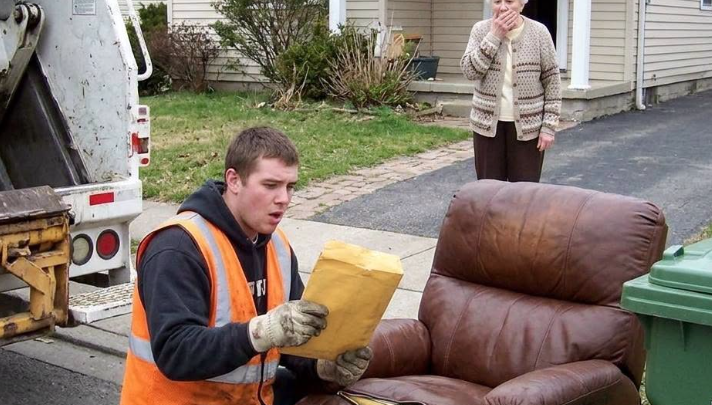
A young man stepped down wearing an orange vest and work gloves.
He emptied the trash cans, then approached the recliner.
I held the curtain between my fingers.
As he began tipping the chair, something made him pause.
He lowered it again and pressed a hand against the cushion.
Then he frowned.
Instead of lifting the recliner onto the truck, he opened the cushion cover and reached inside.
When his hand emerged, it held a thick, yellowed envelope.
He turned it over and read the writing.
Then he looked directly toward my house.
Before he reached the porch, I opened the door.
“Ma’am, are you Ruth?”
“Yes.”
He held the envelope carefully.
On the front, in Harold’s unmistakable handwriting, were the words:
For Ruth. When they try to throw my chair away.
An Unexpected Place to Find His Voice
My knees weakened.
I sat on the stairs with the envelope resting in my lap.
The young man introduced himself as Luis.
He lingered near the doorway, uncertain whether to leave.
“Would you stay for a moment?” I asked.
“Of course.”
Inside the envelope were two pages written in pencil, a folded document with a blue cover, and a bank passbook I had never seen.
For a while, I could only look at the handwriting.
Harold had written grocery lists that way. Notes about the car. Reminders beside the telephone.
Now those familiar letters were waiting for me fourteen months after his death.
Finally, I unfolded the first page.
Ruthie,
If you’re reading this, somebody has put my chair outside.
What Harold Had Heard
The letter continued.
I suspect it was Brittany. I hope I’m wrong.
During those afternoons when everyone thought I was asleep, I heard more than they realized.
She talked about getting you into a home after I was gone. Then she talked about the house going to Kevin.
He didn’t argue. That was the part I could not stop thinking about.
I lowered the letter.
Luis stood quietly beside the door.
For months, I had wondered whether my discomfort was unreasonable. Perhaps I was grieving badly. Perhaps every change felt larger because Harold was gone.
But here was his handwriting describing concerns that had begun before the funeral.
I took a breath and continued.
So I spoke with Bill Hendricks. He has the documents and can explain the arrangements I made to protect your home and your decisions.
The Passbook Beneath the Letter
Harold had also written about money from his union pension buyout.
The account is there for you, Ruthie. Ask Bill to help you check everything.
Fix the roof. Visit your sister in Phoenix. Buy yourself a ridiculous hat.
Despite my tears, I almost laughed.
That sounded exactly like him.
Then I reached the end.
You have spent your life being considerate. Please remember that your wishes matter too.
I love you.
I’m sorry I won’t be sitting in the chair anymore.
Harold.
Beneath the letter, the passbook showed a balance of $38,400.
I stared at the number, then at the pages in my lap.
The money mattered.
However, hearing my husband tell me that I still had choices mattered just as much.
Bringing the Chair Home
Luis wiped his face with the back of his wrist.
“Would you like us to bring the recliner inside?”
“Yes,” I whispered. “Please.”
He returned to the truck and spoke with the driver.
A moment later, the two men carried Harold’s chair up the driveway.
The driver introduced himself as Gus. Inside the living room, he removed his cap while we decided where to place it.
“Right there,” I said.
They lowered the recliner into its four familiar dents.
The room settled around it.
Nothing about the leather had changed. Its cracks remained, and the arms still showed years of wear.
Yet the chair no longer looked like something waiting to be discarded.
It was back where I wanted it.
Before leaving, Luis asked whether I needed anything else.
“You have already done more than you know.”
The Call to Bill Hendricks
That afternoon, I called the lawyer named in Harold’s letter.
Bill recognized my name immediately.
He explained that Harold had made arrangements concerning the house and a separate account. Then we discussed the documents and what they meant for my situation.
For the first time in months, I had someone helping me understand decisions instead of making them around me.
Bill also helped me plan how to address Kevin and Brittany’s living arrangement.
There would be proper written communication and a clear departure plan.
By the time we finished, my hands had stopped trembling.
The grief remained, but something stronger had joined it.
I knew what I wanted to say.
Sitting in Harold’s Chair
Kevin and Brittany returned around six.
I was waiting in the living room.
For the first time in thirty-one years, I had sat in Harold’s recliner.
It still carried the familiar scent of his aftershave and the newspapers he used to fold across his knees.
Brittany stopped in the doorway.
“Why is that back?”
“Because I want it here.”
“We talked about replacing it.”
“You decided to replace it.”
Kevin appeared behind her.
Before either could continue, I handed him copies of the documents and his father’s letter.
He began reading.
When he reached the part about the conversation Harold had overheard, the color faded from his face.
The Explanations Came Quickly
Brittany took the letter from Kevin.
After reading it, she began speaking rapidly.
Harold had misunderstood. The conversation had meant something else. He had been ill and taking medication.
I listened until she stopped.
“Bill has reviewed the documents with me,” I said. “We are dealing with what is written and what happened here.”
Kevin looked toward the recliner.
Nobody mentioned the sectional again.
With the arrangements put in writing, I gave them thirty days to leave.
It was a difficult conversation. However, I no longer felt responsible for making it comfortable.
They had made decisions about my belongings without asking.
Now I was making decisions about my own home with a clear understanding of my position.
Kevin’s Last Evening in the House
Brittany moved out after nine days and stayed with her sister.
Kevin remained until the agreed departure date.
On his last evening, he found me watching a Cardinals game with the television muted.
He sat on the couch beside the recliner.
For a long time, neither of us spoke.
Then he reached across the gap and took my hand.
The gesture brought back so many evenings with Harold that I had to look away.
“I’m sorry, Mom.”
I waited.
“I should have stood up for you. I should have asked what you wanted.”
His voice broke.
“Dad knew I might not. That is what I keep thinking about.”
For once, his apology did not ask me to dismiss what had happened.
He simply sat with it.
So did I.
Learning a Different Way to Visit
Kevin moved into his own apartment.
Later, he and Brittany separated. He began counseling, and I allowed him to tell me only what he chose to share.
Their relationship was something they needed to address themselves.
Our relationship also required time.
Eventually, Sunday dinners became part of a new routine.
He knocked before entering. He asked before moving things.
Those small changes did more for me than repeated promises could have done.
I wanted a son who understood that helping required listening.
Slowly, he began showing me that he was learning.
The past did not disappear, but our conversations started making room for something beyond it.
The Roof, the Visit, and the Purple Hat
I used some of Harold’s money to repair the roof.
For years, we had talked about getting it done. Watching the work begin felt like finishing a conversation he had left open.
Then, in March, I flew to Phoenix to see my sister.
We spent hours talking, sometimes about Harold and sometimes about ordinary things.
Before coming home, I bought a purple hat with a feather.
It was exactly as ridiculous as he would have hoped.
I wore it to the bank.
For once, I did not stop to wonder whether someone else would approve.
I could almost hear Harold laughing at the sight of me.
A Sandwich Every Other Tuesday
Luis began stopping by every other Tuesday after his route.
I made him a sandwich, and we talked.
He told me he was saving for community college.
As I listened to his plans, I thought about the morning he had stopped beside an old chair instead of finishing the task without another glance.
His attention had returned something precious to me.
Eventually, I told him I wanted to help with his education through a scholarship carrying Harold’s name.
He looked surprised.
“You don’t owe me anything.”
“I know,” I said. “This is something I want to do.”
The distinction felt important.
It was my choice, made with care.
The Chair Is Still Here
Harold’s recliner remains in the living room.
Its feet rest in the same four dents. The leather is still worn, and nobody would mistake it for something new.
Sometimes, I sit there to watch a game.
Other evenings, I read or close my eyes for a while.
The chair does not replace my husband. Nothing could.
But I am allowed to keep something that reminds me of our life together. I am allowed to decide when a room changes and which memories remain part of it.
For a long time, I thought protecting the peace meant saying less.
Now I understand that my voice belongs in the house too.
And sometimes, when I rest my hand along the arm of that old recliner, the distance between memory and the present feels a little smaller.
It feels almost like someone is still holding my hand.
The End.