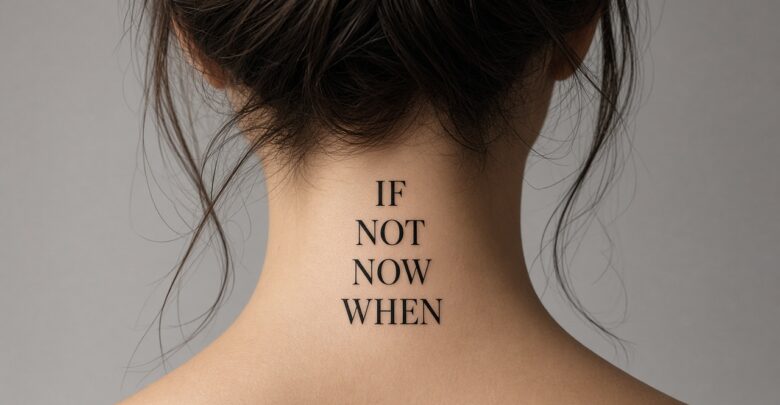
What Does This Tattoo Say? The Small Letters Reveal the Message
Some designs catch your attention because they are colorful or detailed. Others make you pause because you cannot immediately work out what they say.
This tattoo belongs to the second group. At first, its large letters seem to form an incomplete message. Look more closely, however, and the smaller letters help complete a familiar question:
“If not now, when?”
The answer comes from reading the whole arrangement rather than focusing only on its most prominent parts. Different letter sizes turn a short sentence into a small visual puzzle.
There is no need to search for a secret symbol or an unusual translation. The interest lies in how the words fit together—and how easily a quick glance can leave part of the message unread.
The accompanying supporting images are illustrations. They do not document the wearer’s identity, personal history, or tattoo appointment.
The Answer Is “If Not Now, When?”
The intended reading is straightforward once you include the smaller letters.
The design uses changes in size and placement to break up the sentence. As a result, the most noticeable letters do not tell the complete story on their own.
Read every part together, and the message becomes “If not now, when?”
That short question provides the reveal. It asks the reader to think about something they may be putting off, although its personal meaning will depend on the individual.
The wording and the arrangement are separate parts of the design. Someone may recognize the phrase immediately but still enjoy examining how the artist fitted the letters together.
Another person may need a hint before the sentence becomes clear. Both responses fit the same small reading challenge.
Why the Smaller Letters Matter
Large lettering naturally gives part of the design more visual emphasis. In this arrangement, however, some of the smaller additions carry information you need to finish the words.
Skipping them leaves gaps.
A useful way to approach the image is to stop treating the biggest shapes as the entire message. Instead, look beside them and consider how the smaller forms connect.
In the explanation accompanying the image, the upper grouping helps form “IF NOT NOW.” Below it, a smaller leading W completes the word “WHEN.”
Once you notice those connections, you can follow the sentence without guessing at missing words.
The result is a design that rewards a second look. Its meaning does not change between the first glance and the next. You simply notice more of what was already present.
A Familiar Phrase in an Unfamiliar Layout
Most everyday text follows a predictable pattern.
Words appear along a line. Spaces separate them. Letters usually share a similar size, and punctuation helps guide the reading.
This tattoo changes some of those familiar cues.
Instead of presenting the sentence as one clear line, it turns the wording into a compact composition. The reader has to connect parts that do not all receive equal emphasis.
That explains the puzzle without requiring a dramatic claim about how the brain works. The layout itself creates the challenge.
You can see a similar difference by comparing a plain written sentence with a decorative version of the same words. Both may contain identical information, yet one takes more effort to read.
Here, the extra effort becomes part of the design’s appeal.
How to Read the Design Step by Step
If the message still feels difficult to follow, take it one section at a time.
First, identify the letters you can read clearly. Then look for smaller marks that belong with those larger forms.
Next, compare the arrangement with the complete sentence:
IF NOT NOW, WHEN?
Match each word to its place in the image. This gives you a way to check the explanation rather than accepting an answer without understanding it.
Finally, look at the full design again. Once you know the sentence, the individual pieces may feel easier to connect.
There is no need to rush. A comfortable zoom level may also help if the smaller letters appear tiny on your screen.
The goal is simply to trace the wording, not to complete a timed test.
What the Question Can Mean
“If not now, when?” invites reflection about delay.
A reader might connect it with a creative project they keep postponing. Someone else may think about learning a skill, contacting a friend, or making time for something important.
Those are possible interpretations of the phrase. They are not confirmed reasons why the person pictured chose the tattoo.
That distinction leaves room for both curiosity and respect. We can discuss what the words suggest without claiming to know the wearer’s private life.
The question also remains open-ended. It does not name a particular ambition or tell every reader to make the same decision.
Instead, it gives people a short prompt they can consider in relation to their own circumstances.
Inspiration Can Begin With a Small Step
One thoughtful reading of the phrase is to choose a manageable next step.
That might mean opening a notebook and outlining an idea. It could involve setting aside time to practice something or gathering information about a long-delayed project.
The step does not have to be dramatic to be useful.
For example, someone who wants to write may begin with one page. A person hoping to learn an instrument might start by exploring lessons rather than buying equipment immediately.
These examples show how a broad question can lead to a specific action.
At the same time, the phrase does not tell you whether a particular choice is right. It offers a starting point for reflection, while the decision still belongs to you.
“Now” Can Include Time to Prepare
The wording may sound urgent, but it does not require an impulsive response.
Some plans need time, discussion, or careful preparation. Taking those steps can be part of moving forward.
A useful distinction is the difference between waiting without a plan and choosing to prepare. Both may involve delay, but they serve different purposes.
Someone might decide that today is the day to begin researching an idea. Another person may realize that their best next step is a conversation with someone affected by the decision.
In that sense, the phrase can encourage attention rather than haste.
You can appreciate its energy while still allowing important choices the time they deserve.
What the Image Does Not Tell Us
The tattoo gives us words to read and a layout to discuss. It does not provide a biography.
The supplied material does not include an interview with the wearer explaining the choice. Therefore, it cannot establish whether the phrase relates to a particular event, relationship, ambition, or memory.
It also does not tell us when the tattoo was made or whether its personal meaning has changed.
Those unknowns do not weaken the design discussion. They simply mark the boundary between observation and assumption.
A reader may find the message encouraging, while the wearer may have chosen it for entirely different reasons.
Leaving that possibility open allows us to enjoy the design without inventing a story about a stranger.
An Interesting Image Does Not Need a Popularity Claim
The supplied article describes the tattoo as viral. However, it does not provide a verified audience count or a clear history of where the image first spread.
For that reason, there is no basis here for claiming that millions of people viewed it or that everyone struggled to understand it.
The image can still be interesting without those claims.
Its appeal is easy to describe: a short question appears in an unusual arrangement, and the smaller letters help reveal the full wording.
Some readers will notice the answer quickly. Others will enjoy working through it more slowly.
Neither response needs an exaggerated headline. The visible design already provides enough material for a friendly discussion.
Clever Lettering and Clear Lettering Are Different Preferences
Not everyone wants words to function as a puzzle.
Some people enjoy lettering that reveals itself gradually. Others prefer a sentence they can read at once.
Both preferences make sense.
A compact arrangement may look appealing while requiring more explanation. A simple line of text may communicate clearly while offering less of a visual surprise.
Discussing that difference can be more useful than deciding that one reaction is correct.
You might appreciate the idea behind this tattoo while preferring a different layout for yourself. Likewise, you can find the message meaningful without wanting it as a permanent design.
Enjoying an image does not require copying it or agreeing with every design choice.
Questions to Consider About a Lettering Design
For anyone exploring a lettering tattoo, this image raises useful questions about communication.
Can you read every word in the proposed arrangement? Does the sentence still make sense without a caption beside it? Are the smaller letters an intentional part of the idea?
Checking the wording carefully matters as much as choosing the visual style.
It may also help to compare several layouts. Seeing the same phrase in a plain version and a more decorative one can clarify which qualities you value most.
An experienced tattoo artist can discuss how a proposed design relates to its intended placement.
The image here can serve as inspiration for a conversation. It does not need to become a template that everyone follows.
A Small Puzzle With a Clear Reveal
The answer to the lettering puzzle is “If not now, when?”
Its unusual appearance comes from the relationship between large and small letters. Looking only at the most prominent forms leaves the reading incomplete. Including the smaller additions reveals the question.
From there, the discussion can go in several directions. You may enjoy the typography, reflect on the wording, or decide that a simpler arrangement would suit your taste.
None of those reactions tells us anything definite about the person wearing it.
The satisfying part is the reveal itself: a familiar sentence becomes visible once you give every letter a place.
Did you read the full message immediately, or did the smaller letters make you look twice?