Woman at Supermarket Accused a 7-Year-Old Boy of Stealing — What Security Cameras Revealed Left Her in Tears
My son was trembling when a stranger called him a thief in front of everyone. I thought the security footage would settle everything, but my son made an unexpected request that changed the entire situation.
A Stranger Stops Our Shopping Cart
The woman grabbed the front of our shopping cart so hard that a bag of apples tipped sideways.
“Stop right there! Your little boy stole something!”
My son Ethan stumbled back, then slipped behind me.
At seven, he was barely tall enough to see over the cart’s handle.
We’d come straight from his soccer practice, and his cleats were still muddy inside the bag hanging from my shoulder.
“Excuse me?” I asked. “What exactly did he steal?”
The woman looked to be in her 50s.
She wore a gray cardigan, and her face had gone red with anger.
“I saw him putting something in his jacket pocket near the electronics section! Kids these days have absolutely no manners!”
Ethan gripped my shirt. “Mommy, I didn’t steal anything, I promise!”
His voice trembled.
When I looked down, tears were gathering in his eyes.
“Ma’am, please leave my son alone,” I said firmly.
Instead, she raised her voice.
“Oh, so you’re raising a thief and defending him? Wonderful parenting!”
People stopped beside the produce displays.
Nearby, a man carrying a basket slowed down to stare.
Ethan pressed his forehead against my back as though he could disappear.
My name is Rachel. I’m 34, and until that Saturday, I had never imagined an ordinary grocery trip could make my child afraid to stand in public.
A store employee hurried over.
“Is there a problem?”
“This boy stole an expensive electronic item,” the woman announced. “Call security.”
“What item?” I asked again.
“I don’t know what it was. He hid it too fast.”
“You didn’t actually see him take anything?”
“I know what I saw.”
“Can we just check the cameras instead of humiliating a seven-year-old?” I asked.
Checking the Security Cameras
The employee nodded and radioed for security.
So I agreed to go to the office. Ethan kept whispering that he wanted everyone to know he hadn’t stolen anything.
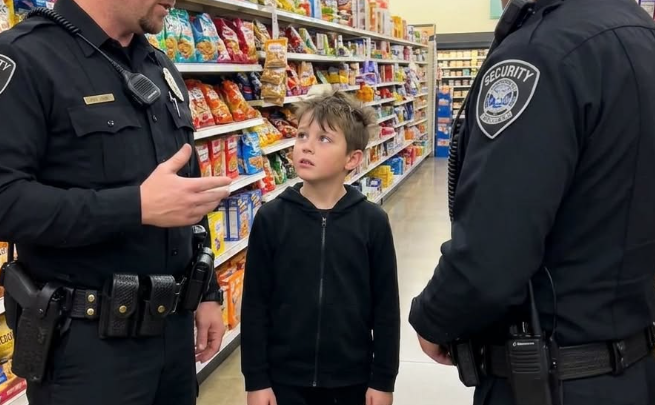
A guard named Marcus led us into a small room with two monitors.
Ten minutes later, we were watching footage from the electronics aisle.
The recording showed our shopping cart rolling past a display of headphones and chargers.
On the screen, I stopped to check the list on my phone.
Ethan walked a few steps ahead, then returned when I called him.
At no point did he touch a shelf.
Marcus replayed the video.
Then he played it again, slowing down the moments when Ethan passed the items on display.
“Ma’am, there’s absolutely no evidence of theft,” he told the woman.
She folded her arms. “Then check another angle! I know what I saw!”
I turned toward Ethan, ready to tell him we could leave.
Instead, he tugged at my sleeve.
“Mom, can they show us the security camera footage from the electronics section five minutes earlier?”
Everyone looked at him.
“Why five minutes earlier, honey?” I asked.
He glanced at the woman, then at the screen. “Because that’s when she dropped something.”
At that, the woman made an impatient sound. “Now he’s inventing stories.”
“Let him finish,” I said.
Ethan lowered his eyes. “I tried to tell her.”
Marcus pulled his chair closer to the monitor. “What did you see?”
“Something fell out of her bag. By the picture frames.”
Without thinking, the woman reached for her purse.
For the first time since she’d stopped our cart, she looked uncertain.
What the Earlier Recording Showed
Marcus explained that the first clip showed the time when she claimed Ethan had stolen something.
However, an earlier recording from a camera facing the aisle entrance might show the display Ethan meant.
“Please play it,” I said.
The screen changed.
A timestamp in the corner moved backward.
This time, we saw the woman enter the aisle alone.
Beside a display of electronic photo frames, she stopped and took a small photograph from her purse.
Even through the grainy image, I could tell she studied it for a long time.
She put the photograph away, but didn’t close her bag properly. As she turned, a folded piece of paper slipped over the edge and fluttered to the floor.
“There,” Ethan whispered.
The woman leaned forward in her chair.
A moment later, Ethan appeared at the edge of the recording.
Instead of looking at the products, he was looking down.
Then he bent, picked up the paper, and turned toward the woman.
Although he took several quick steps after her, she had already gone around the corner.
After stopping, Ethan looked back toward where I stood outside that camera’s view. He folded the paper smaller and slipped it into his jacket pocket.
There were no expensive headphones or hidden goods. Instead, the recording showed a child picking up something an adult had dropped.
The Truth About Ethan’s Pocket
I turned to the woman. “That’s what you saw?”
She shook her head. “No. I saw him near the shelves later.”
Marcus switched to the later clip.
On the screen, Ethan pressed a hand against his pocket while he waited for me beside the cart.
“That?” I asked.
The woman said nothing.
Ethan nodded slowly. “It kept sticking out. I didn’t want it to fall.”
“Why didn’t you tell me you found something?” I asked softly.
“I was going to. Then she started yelling.”
His voice was so small I wanted to take him home immediately.
But he also deserved to leave that room with everyone knowing the truth.
“Do you still have it?” I asked.
Ethan reached into his jacket and brought out a folded sheet of pale blue paper.
The woman rose halfway out of her chair.
“Where did you get that?”
“From the floor,” he answered. “It fell out of your purse.”
At the sight of the paper, her expression changed so suddenly that even Marcus stopped speaking.
For a moment, she stared at the paper as if no one else were in the room.
“May I see it?” she asked.
I held out my hand to Ethan.
He gave me the paper, and I turned it so the writing on the outside faced her.
There were only two words written there:
“For Mom.”
A Letter From Her Daughter
The woman covered her mouth.
“Is this yours?” I asked.
She nodded. “Yes. Please.”
I passed it to her.
Holding the folds carefully between her fingers, she tried to open it. However, her hands were shaking.
Then her eyes reached the first line.
She sat down hard and began to cry.
These were quiet tears, unlike the anger she had shown just minutes before.
Her shoulders sagged, and she bent over the letter as though trying to shield it.
Ethan looked frightened again.
“Did I do something bad?”
“No, sweetheart.” I pulled him close. “You didn’t.”
The woman shook her head without looking up. “No. No, you didn’t.”
Marcus placed a box of tissues on the desk.
For a while, all we could hear was the monitor humming and the woman’s shaky breathing.
Deborah Explains Why the Letter Mattered
Finally, she said, “My name is Deborah.”
Even so, I didn’t respond. Knowing her name changed nothing about what she’d done.
She looked at Ethan. “My daughter wrote this.”
Her fingers smoothed the paper across her knees.
“She died almost two years ago. She was sick for a long time. Near the end, she wrote me a letter because talking had become difficult for her.”
Deborah swallowed and looked down again.
“She thanked me for sitting with her when she was scared. She told me I didn’t have to be brave every minute. I keep it with me because sometimes I need to see her handwriting.”
I looked at the photograph still visible on the paused recording.
Deborah followed my gaze.
“That’s her, too,” she said. “I was looking at digital frames. I thought I might put some of her pictures together for her birthday next month.”
She had been holding her daughter’s photograph when the letter slipped away.
Until now, she hadn’t even known it was missing.
Why an Apology Still Mattered
Deborah looked at Ethan. “If you hadn’t picked this up, someone might have thrown it away.”
Ethan shrugged nervously. “I thought it was important.”
“How did you know?”
“It was folded nice. And it had writing on it.”
He looked at me for reassurance.
I squeezed his shoulder.
Deborah began crying again, quieter this time. “You saved it.”
Even then, she seemed to expect those words to settle everything.
They didn’t.
“Deborah,” I said, “you accused my son of stealing in front of a store full of people.”
Her eyes lifted.
“You grabbed our cart and called him a thief. Then you told me I was a bad mother for believing him. Even after the cameras showed he hadn’t touched any products, you still wouldn’t stop.”
“I’m so sorry,” she whispered.
“He’s seven. He was scared to speak because you were shouting at him.”
Meanwhile, Ethan had edged closer to my leg. Deborah looked toward him.
“I wasn’t trying to hurt him,” she said.
“But you did.”
Deborah wiped her face. “Since my daughter died, I’ve had days when I barely recognize myself. Small things make me angry. Then I assume people are being careless or disrespectful.”
I waited.
“That’s not an excuse,” she added. “I know it isn’t.”
“Then why didn’t you listen when he said he hadn’t stolen anything?”
Before answering, she glanced at the monitor. The paused image showed Ethan picking up her letter.
“I was so sure,” she said.
“After seeing his hand in his pocket, I decided what it meant. Instead of asking him, I assumed the worst. The truth is, I didn’t even know what I thought he’d taken.”
Giving Ethan a Chance to Speak
That honest answer mattered more to me than another round of tears.
I crouched beside Ethan. “Do you want to tell us what happened when she stopped the cart?”
He looked from Deborah to Marcus and back again.
“Her bag was open. When I tried to catch her, she walked away. So I thought I could give it back if we saw her again.”
“Did you see her again before she stopped us?” I asked.
He shook his head. “No. I was fixing the paper in my pocket because it was poking out.”
“Then what happened?”
“She grabbed the cart. I was gonna say I found her paper, but she said I stole something.”
His chin trembled.
“I thought if I took it out, she’d say I stole that, too.”
Deborah pressed the letter against her chest.
“I made you afraid to tell the truth.”
Ethan nodded.
“I’m sorry,” she said. “Grabbing your cart and shouting was wrong. So was calling you a thief. You were helping me, and I treated you terribly.”
He watched her without answering.
Then she glanced at me, perhaps hoping I’d tell him to forgive her.
I said nothing.
After all, he didn’t owe her words to make her feel better.
Making Sure the Store Knew the Truth
Marcus cleared his throat. “I’ll have the floor manager come in. We can make sure there’s no misunderstanding about what happened.”
“Please do,” I said.
A few minutes later, the manager joined us.
Marcus then showed her the clips and explained that Ethan hadn’t taken anything from the store.
He had recovered Deborah’s letter after it fell from her purse.
The manager turned to me. “I’m sorry your son was put through this.”
In response, I thanked her. However, I also asked her to make sure the employee from earlier knew Ethan hadn’t stolen anything.
Otherwise, he might repeat Deborah’s version of events after we’d gone.
“I’ll speak with him,” she promised.
Deborah stood, still holding the letter. “I’d like to tell him myself.”
Correcting the Accusation
We walked back toward the front of the store together.
Ethan held my hand and stayed close enough for our shoulders to touch.
The employee from earlier was stationed near the registers.
He straightened when he saw us.
Deborah approached him before I had to say anything.
“I was wrong about that little boy,” she said clearly. “He didn’t steal anything. He found something I dropped and kept it safe for me. Instead of asking what happened, I accused him without proof.”
The employee looked at Ethan.
“I’m glad we got that cleared up.”
She turned to Ethan once more. “Thank you for returning my letter.”
He studied the floor.
Finally, he looked up. “I was going to give it back. You didn’t let me tell you.”
Deborah nodded. Her eyes filled again, but she didn’t ask him to make her feel better.
“You’re right,” she said. “I should have listened.”
Ethan’s fingers loosened around mine for the first time since the confrontation.
Deborah stepped aside to let us pass.
This time, she gave him space. There was no attempt to hug him or offer him money.
I was grateful for that.
After all, a real apology should not place another demand on a frightened child.
A Quiet Conversation Outside
Outside, the afternoon air felt warmer than it had when we’d arrived.
I realized we’d left our cart behind, still holding most of the groceries we’d chosen.
“We forgot everything,” Ethan said.
“We can come back another day.”
He looked worried. “Are you mad?”
“Not at you.”
“Even though I didn’t tell you about the paper?”
I stopped beside the car and knelt so we were eye to eye.
“No. After picking up something someone dropped, you tried to return it. Then, even though you were scared, you found a way to show us what happened.”
For a moment, he considered this.
“She was really mean,” he said.
“She was.”
“But she was sad, too.”
“She was. Both things can be true.”
Ethan looked down at his jacket pocket. “I thought maybe I should have just left the paper there.”
I hated that this was what the afternoon had taught him to wonder.
“You did a kind thing,” I told him. “Someone else behaving badly doesn’t make your kindness a mistake.”
After a quiet moment, he asked whether we could get something to eat. He had missed his snack after soccer practice.
What I Hoped My Son Would Remember
I smiled and told him we could.
As I opened the car door, he put his hand into the pocket Deborah had pointed at so angrily.
After feeling around for a moment, he pulled it out empty.
“At least I don’t have to worry about that paper falling out anymore,” he said.
“No,” I answered. “You don’t.”
Once he climbed into his seat, I buckled him in.
Before I closed the door, he reached for my hand again.
I thought of Deborah holding her daughter’s letter, and of how close she’d come to losing it.
But what stayed with me most was seeing Ethan standing in that security office, frightened and still determined to tell the truth.
The cameras had proved he wasn’t a thief. They also showed me something I already knew about my son: even when no one was watching, he tried to do the right thing.
And I hoped that, when he remembered that Saturday, he’d remember that more clearly than the shouting.
If a stranger publicly accused your child of stealing and later apologized after learning the truth, would you accept the apology or insist they correct the accusation in front of others?
Found this story interesting? Here’s another one you might like even more: Four years after my divorce, I walked into our college reunion determined not to let my ex-husband control the room. Then he mocked the life I had rebuilt, and the one man who had always stood beside him revealed that Craig’s cruelest lie had started long before he left me.