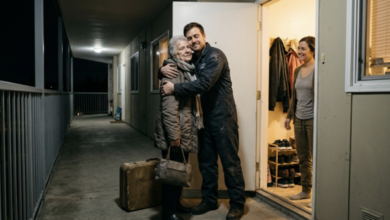
A Mother’s Unexpected Return Exposed a Secret That Could Have Changed Her Daughter’s Life Forever
I thought the worst thing my husband had done was leave our four-year-old daughter alone for three days while he enjoyed a Caribbean cruise. I was wrong.
When I returned home early from my six-month military deployment, I expected to surprise my family with a joyful reunion. Instead, I found my daughter, Lily, frightened, weak, and desperately waiting for someone to come home.
Then I discovered a locked closet containing documents that revealed a plan far more disturbing than anything I could have imagined.
My husband, Derek, had not simply neglected our child. He had allegedly been preparing to take her away, gain control of my property and finances, and make it appear that I had willingly surrendered my parental responsibilities.
And the final steps were scheduled for the very day I was originally supposed to return.
What I uncovered next changed everything I thought I knew about my marriage.
The Document That Carried My Name
The first thing I noticed was my name printed across the top of a document.
HANNAH ELIZABETH NOLAN.
Beneath it were the words Voluntary Transfer of Parental Authority.
I stared at the page in disbelief. The document claimed I had agreed to transfer custody of Lily to my mother-in-law, Patricia Nolan. It also suggested that I had authorized Patricia to relocate my daughter outside Virginia.
I had done neither.
Officer Marcus Bell, who was documenting the evidence, looked at me carefully.
“Major Nolan, did you ever sign anything giving your husband’s mother custody of your daughter?”
“No.”
“Did you authorize anyone to move Lily out of the country?”
“Absolutely not.”
He placed the document inside an evidence sleeve.
“Then we need to investigate how this document was created and what someone intended to do with it.”
My phone was still connected to Derek. For several moments, he had been listening silently.
“Derek,” I said, trying to control my anger, “why is there a document claiming I gave your mother custody of Lily?”
The silence lasted several seconds.
Then he answered with words I would never forget.
“You weren’t supposed to find that.”
Officer Bell heard him clearly.
I felt a chill move through me. Until that moment, some part of me had hoped there was a reasonable explanation for the documents. Perhaps they were incomplete paperwork. Perhaps someone had misunderstood an arrangement.
But Derek’s response made those explanations difficult to believe.
He tried to defend himself by saying that I had been away for six months and that his mother had been trying to protect Lily.
“Protect her from what?” I asked.
“Instability,” he replied.
I could hardly believe what I was hearing. Our daughter had been left without proper care, and Derek was attempting to blame the instability on my military service.
Before I could respond, Officer Bell introduced himself and asked Derek where he was.
“On a ship,” my husband answered.
The officer requested the vessel’s name and itinerary. Derek refused to provide more information and asked for a lawyer.
Then the call ended.
I stood in the room, holding my phone, trying to understand how the man I had married could have become someone I barely recognized.
Then I heard Lily’s voice behind me.
“Mama?”
She stood in the doorway wrapped in a blanket, her eyes moving between me and the black document case.
“Are you going away again?” she asked.
I knelt and pulled her close.
“No, sweetheart. I’m here.”
She looked at me uncertainly.
“Daddy said you didn’t want me anymore. He said you liked being in the Army better than being my mama.”
My heart broke.
Then she whispered another sentence.
“Grandma said I had to learn to call her Mommy when we went to the new house.”
Suddenly, the documents made terrible sense.
This was not simply about money. Someone had apparently been preparing to change Lily’s living arrangements and make me appear to have agreed to it.
I held my daughter tightly and promised her that she had done nothing wrong.
The Calendar That Revealed the Plan
At the hospital, doctors admitted Lily for dehydration, malnutrition, and observation.
The pediatrician explained that her condition raised concerns about inadequate nutrition over a longer period. She could not determine an exact timeline from the examination alone, but Lily’s overall condition suggested that the problems might have started before the three days she had been left alone.
I sat beside my daughter’s bed, thinking about the six months I had spent overseas.
During our video calls, Derek had always assured me that Lily was fine. His mother had also told me not to worry.
I had believed them because I had trusted them with the most important person in my life.
Detective Rebecca Shaw arrived at the hospital with additional information from the investigation.
Among the items recovered from the closet was a page titled Nolan Family Transition — Final Schedule.
It contained several dates:
- September 30 — Financial consolidation.
- October 7 — Obtain replacement identification documents.
- October 12 — Complete authorization paperwork.
- October 16 — Confirm overseas residence.
- October 20 — Family departure.
- November 10 — Hannah scheduled to return.
My original return date had been November 10.
But the planned departure was October 20.
On the back of the page, investigators found a handwritten note:
If she returns early, use alternate plan.
Beneath the message was an address for a private storage facility in Norfolk.
I stared at the calendar, trying to understand why anyone would need an alternate plan if a mother returned home ahead of schedule.
Detective Shaw explained that investigators were examining the storage facility and determining what evidence might be connected to the case.
Then she asked me a question that led to another disturbing discovery.
“Do you own your house?”
“Yes,” I answered. “I bought it before I married Derek.”
“Is he listed on the deed?”
“No.”
She showed me a real estate listing agreement bearing my address.
At the bottom was a signature that looked almost exactly like mine.
Someone had apparently attempted to represent me in a property transaction without my authorization.
But the signature contained a small mistake. Whenever I signed my full legal name, I formed the initial of my middle name with a distinctive loop.
The signature on the document did not have it.
It was a convincing imitation, but it was not mine.
My house had apparently been prepared for sale, and investigators found evidence that a deposit had already been placed into an escrow account.
I had spent years working to provide security for my daughter. Now someone appeared to have been trying to take that security away.
The Messages That Exposed My Mother-in-Law
The next morning, Detective Shaw contacted me again.
Investigators had recovered a prepaid phone containing messages between Derek and Patricia.
Some of the messages referred to my military deployment, our financial accounts, and paperwork concerning Lily.
One message from Patricia read:
Once Hannah comes home, she’ll be too busy with the custody situation to challenge the house.
Another suggested that a court might consider my long absence evidence that I was less involved in Lily’s daily life.
I read the messages repeatedly.
Patricia had never supported my military career. At family gatherings, she often suggested that I cared more about promotions than motherhood. Whenever I received new orders, she criticized my decision to continue serving.
I had dismissed her comments as disapproval.
I had never imagined that she might attempt to use my career against me in a custody dispute.
Then Detective Shaw showed me another exchange.
Patricia had instructed Derek to make sure Lily said that Grandma took care of her. When Derek explained that Lily cried every night and continued asking for me, Patricia responded that the child needed to stop asking.
I put the phone down.
For months, I had worried about missing bedtime stories and little moments that I could never get back. I had trusted my husband and mother-in-law to make sure Lily felt loved while I was away.
Instead, the messages suggested that my absence had become part of a plan.
There was still an important question.
Why had Derek left Lily alone in the house if he and Patricia were supposedly preparing to take her somewhere else?
Detective Shaw said investigators had obtained doorbell-camera recordings from a neighbor named Evelyn Price.
The footage showed Patricia arriving at my house two days before the cruise departed. She carried a small overnight bag, but the recording showed no evidence that she stayed to care for Lily.
At one point, Lily appeared behind the glass door, crying.
Patricia leaned toward her and said, “Stop crying, Lily. Your father will come back when you learn to behave.”
Then Patricia walked away.
Investigators believed Derek had already left for Florida.
The footage and other evidence suggested that Patricia knew Lily was without a caregiver, although detectives were still establishing the full sequence of events.
I remembered Derek’s explanation that his mother would keep an eye on things.
There had been no reliable arrangement for Lily’s care.
My husband and his mother had apparently assumed that someone else would notice if something went wrong.
That assumption had put my daughter’s life at risk.
The Storage Unit in Norfolk
Two days later, Detective Shaw asked me to come to the police station.
Investigators had searched the Norfolk storage facility identified in the calendar.
Inside, they recovered sealed boxes, financial records, documents bearing my name, and evidence of preparations for international travel.
One photograph showed copies of my military identification records and old tax returns. Another showed paperwork connected to accounts I had never opened.
Then I saw a familiar pink suitcase decorated with little yellow stars.
It belonged to Lily.
On top of the suitcase was a laminated card identifying Patricia as Lily’s emergency contact.
Beneath it lay a printed itinerary for a flight to the Dominican Republic scheduled for October 20.
The booking listed one adult and one child.
That was the same date written on the family transition schedule.
I looked at Detective Shaw.
“Was Patricia planning to leave the country with my daughter?”
“The evidence suggests that was being considered,” she explained. “We’re investigating the intended arrangements and how they changed.”
The suitcase made the situation painfully real. This was no longer just a collection of suspicious papers.
There had apparently been preparations involving a specific child, a specific date, and an international destination.
Then Detective Shaw showed me another document.
It began with a statement claiming that I, Major Hannah Elizabeth Nolan, acknowledged that my military obligations prevented me from providing a stable home for my daughter.
The document continued by requesting that Patricia be recognized as Lily’s primary legal guardian.
At the bottom was another imitation of my signature.
A second document sought emergency temporary custody based on allegations that I had abandoned my daughter through repeated overseas deployments.
I stared at the pages.
“They left Lily alone themselves,” I said. “And they were going to tell a court that I abandoned her?”
Detective Shaw nodded, explaining that investigators were documenting the apparent contradictions.
For the first time since returning home, I could no longer hold back my tears.
I cried for Lily, for the frightened little girl who had wondered whether her mother still wanted her, and for the months during which she had been made to feel that my work meant I had chosen to leave her behind.
I also cried for the marriage I had believed I was protecting.
The documents suggested that someone had been trying to turn my service, my property, and my love for my daughter into tools against me.
When the Cruise Finally Ended
Derek returned to Virginia five days later.
He did not come home. He went directly to the police station with an attorney.
By then, investigators had gathered evidence relating to Lily’s neglect and suspected financial wrongdoing. The investigation was continuing, and the authorities were examining the conduct of each person separately.
Derek was taken into custody.
Patricia returned separately, while Derek’s sister, Jenna, declined to speak with investigators without legal counsel. Her precise knowledge of the alleged plan remained under investigation.
Detective Shaw called me with the news while I was sitting beside Lily’s hospital bed.
“Your husband has been taken into custody,” she said.
“Did he ask about Lily?”
She paused.
“He asked whether you would speak to him.”
I looked at my daughter. Her cheeks were slowly regaining some color, and that morning she had eaten half a bowl of oatmeal without asking whether she was allowed to have it.
It was such a small thing, yet it nearly brought me to tears.
“No,” I said. “I don’t want to speak to him.”
A week later, my attorney filed for divorce and requested emergency sole custody. We also began protecting the house and our financial accounts, disputing unauthorized transactions, and notifying the appropriate military legal and financial offices.
The attempted property transaction was stopped before closing. Some accounts were frozen, and the forged custody documents became important evidence in the investigation.
But the most painful discovery came from Lily herself.
One evening, after she had been discharged from the hospital, I tucked her into bed in our temporary apartment.
“Mama?” she asked.
“Yes, sweetheart?”
“Is Daddy mad because I told you about the closet?”
I sat beside her.
“Why would you think that?”
She looked down at her stuffed rabbit.
“He said if I told anyone, you wouldn’t come home.”
I took her hands gently.
“Lily, listen to me. Nothing you said caused any of this. Daddy made his own choices. You did the right thing by telling me.”
She was quiet for a moment.
Then she whispered, “I tried to be good.”
My throat tightened.
“You are good, baby. You never had to do anything to deserve being cared for.”
She told me about boxes in the garage that Derek had said were for the new house. She also remembered Patricia talking about a place with a beach.
They had apparently described the move as a surprise.
I had returned early because I wanted to surprise my family with love.
Someone else had apparently been preparing a surprise that could have separated me from my daughter.
I kissed Lily’s forehead and stayed beside her until she fell asleep.
Six Months Later, We Began Again
The legal proceedings took time.
Investigators uncovered additional accounts opened without my authorization and more suspicious transactions connected to Derek’s debts. His role, Patricia’s alleged participation, and Jenna’s knowledge were examined separately rather than treated as the same matter.
Derek eventually entered a guilty plea to charges arising from Lily’s neglect and financial wrongdoing. Patricia faced charges connected to the alleged fraudulent paperwork and financial scheme.
There were hearings, legal filings, evidence reviews, and months of uncertainty.
Nothing about the process could erase what had happened.
No court decision could return those frightening seventy-two hours to my daughter. No recovered money could make me forget the sight of her sitting on the hardwood floor with an empty cereal bowl.
But slowly, our lives began to change.
Lily started working with a counselor experienced in childhood trauma. At first, she hid crackers under her pillow and asked permission before drinking water.
She woke during the night to check whether I was still there.
I never scolded her for any of it.
We took each day as it came.
Eventually, she stopped hiding food. She became more comfortable asking for what she needed, and she began sleeping through the night more often.
The first time she asked for a second serving of dinner, I had to step into the kitchen because I could not stop crying.
We moved into a smaller house near a park. I changed my military assignment to one that allowed me to remain closer to home while we rebuilt our routine.
There were still difficult days. Sometimes Lily became frightened when I stepped outside to collect the mail. Sometimes I questioned every decision I had made during my deployment.
But we kept moving forward.
One Saturday, while unpacking the final box in our new living room, I found a photograph of Lily and me before I left for deployment.
I was wearing my uniform, and she was sitting on my shoulders, laughing.
Lily looked at the picture.
“Mama, why did Daddy say soldiers don’t love their babies?”
I knelt in front of her.
“Because Daddy said something that wasn’t true.”
She thought about that for a moment.
“Do soldiers love their babies even when they go far away?”
“Yes, sweetheart. They do.”
She wrapped her arms around my neck.
“I’m glad you came back.”
I held her tightly.
“So am I.”
Then she pulled away and asked whether we could make pancakes with chocolate chips.
For the first time in months, I laughed without feeling that I was betraying my own sadness.
“Extra chocolate chips,” I promised.
She ran toward the kitchen, and I followed her.
The sound of little footsteps inside our home no longer filled me with fear.
It made me happy.
The Letter I Never Answered
A few weeks later, Derek sent me a letter from custody.
I left it on the kitchen counter for three days before opening it.
He wrote that he had been overwhelmed by debt. He claimed Patricia had convinced him that moving Lily abroad temporarily would solve their problems.
He insisted that he had never intended to hurt our daughter.
Then I reached the sentence that showed me he still did not understand the consequences of his choices.
I wish you had just waited until your scheduled return date. None of this would have happened.
I read it twice.
According to Derek, my early return had disrupted his plans.
But if I had waited three more weeks, Lily might have been taken away. My house might have been sold without my authorization. My financial accounts might have suffered further losses, and false documents might have been used to portray me as a mother who had willingly surrendered her child.
There was an even more frightening possibility.
If I had not returned when I did, Lily might not have survived the period during which she was left alone.
Derek wanted me to believe that my return had destroyed his life.
The truth was that returning home had given my daughter a chance to be safe.
I folded the letter and placed it with the court documents.
I never replied.
The Real Meaning of Home
On the anniversary of my return, Lily and I visited the little park near our new house.
She was five years old now. Her cheeks were full again, and she had made friends at kindergarten. She had also developed a fascination with purple butterflies and announced that she wanted to become a veterinarian.
We sat on a bench eating ice cream.
After a while, she looked up at me.
“Mama, do you remember when you came home and found me?”
“I remember,” I said softly.
“I thought you weren’t coming.”
I put my arm around her.
“But I did come home, sweetheart.”
She leaned against me and watched two butterflies hovering over the flowers.
Then she said something I would remember for the rest of my life.
“I don’t need a big house anymore. I just need a house where nobody leaves me alone.”
I hugged her tightly.
For years, I had believed that providing for my family meant earning enough money, maintaining a comfortable home, and building a secure future. I had worked hard to give Lily opportunities and protect her from uncertainty.
I wanted her to have a beautiful bedroom, a college fund, family vacations, and a safe neighborhood.
But my daughter had taught me something more important.
A home was not simply a property with my name on the deed. It was not the money in a bank account or the marriage I had once hoped would last forever.
Home was the place where Lily could fall asleep knowing someone would be there when she woke up.
That evening, after I tucked her into bed, she called me back into her room.
“Mama?”
“Yes, sweetheart?”
“Can you leave the hallway light on?”
“Of course.”
She settled beneath her blanket.
“And Mama?”
“Yes?”
“Don’t lock the closet.”
I stopped in the doorway, remembering the black document case, the forged signatures, and the plans hidden behind a locked door.
Then I walked back and kissed her forehead.
“We won’t have a locked closet, baby.”
She smiled sleepily.
“Good.”
I left the hallway light glowing.
As I closed her bedroom door, I finally understood the truth behind everything that had happened.
The locked closet had contained evidence of a plan that threatened my home, my finances, and my relationship with my daughter. Discovering it had forced me to confront a painful reality about the people I had trusted.
But it had also helped me protect Lily and begin rebuilding our lives.
I had not failed my daughter simply because my military service had taken me away from home. I had trusted the people who promised to care for her, and that trust had been betrayed.
The responsibility for those choices belonged to the people who made them.
The day I returned early was not the day my family was destroyed.
It was the day Lily and I began building a safer life together.
And from then on, I measured the meaning of home in a different way.
Not by the size of the house.
Not by the money in the bank.
Not by the promises someone made.
I measured it by the peace in my daughter’s voice when she called for me at night—and by the certainty she was finally beginning to feel that I would answer.
Sometimes, the most important thing we can give a child is not a perfect life, but a safe place to begin again.