Unique Properties
The Forgotten Victorian Villa: The Mysterious Abandoned House Hidden in the Forest
The Forgotten Victorian Villa: The Mysterious Abandoned House Hidden in the Forest

The Forgotten Victorian Villa: The Mysterious Abandoned House Hidden in the Forest
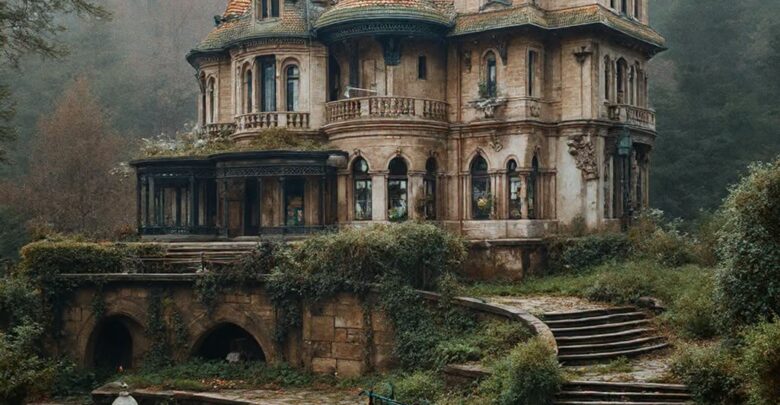
Deep within an old forest, surrounded by towering trees, thick vegetation, and endless layers of morning fog, stood a magnificent house that time seemed to have forgotten.
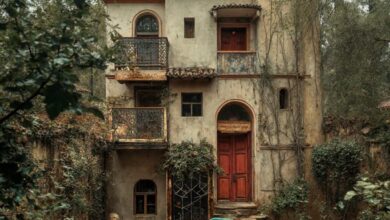
Its tall chimneys reached toward the pale sky, while its weathered brick walls displayed the remains of an elegant architectural design. Large windows overlooked the overgrown gardens, and an impressive stone staircase connected the lower grounds to the main entrance.
The building looked as though it had once belonged to an extraordinarily wealthy family.
Its balconies, decorative arches, steep tiled roof, and elaborate windows suggested a time when the property had been filled with life, music, and grand celebrations.
But those days were long gone.
The garden had become wild. Moss covered the stone pathways, bushes surrounded the old fountain, and climbing plants slowly covered sections of the exterior walls.
A small green bench remained beside one of the pathways, facing the abandoned house as if someone had once spent hours sitting there.
Nobody visited anymore.
The windows were dark, the doors remained closed, and the surrounding forest had slowly reclaimed the property.
Local residents called it The Forgotten Villa.
According to village stories, the mansion had been abandoned after an entire family disappeared without explanation.
Some believed the owners had left during a terrible financial crisis. Others claimed that something happened inside the house that was never officially revealed.
But the strangest part of the story was not the family’s disappearance.
It was the fact that, even after more than a century, people occasionally reported seeing a light moving behind the upstairs windows.
This is the fictional story of the forgotten Victorian villa, the mysterious family who once lived there, and the secret that remained buried beneath its beautiful garden.

A Mansion Built for Wealth and Elegance
The story begins in 1886, when a wealthy industrialist named Charles Harrington purchased a large piece of land near a quiet European village.
Charles had made his fortune through several successful businesses and wanted to build a private residence that would represent his family’s wealth and social position.
He chose a location surrounded by forests and rolling hills.
The land offered privacy, beautiful views, and enough space for an enormous garden.
Construction began the following spring.
The mansion was designed in a Victorian-inspired architectural style, with decorative brickwork, tall chimneys, elaborate rooflines, and large windows intended to bring natural light into the main rooms.
The property included several bedrooms, formal reception rooms, a spacious dining area, a private library, and a large entrance hall.
Outside, the gardens were carefully planned.
Stone pathways connected the different sections of the grounds. A circular fountain was installed near the lower garden, while ornamental bushes and mature trees created a peaceful atmosphere.
A small bench was placed beside one of the pathways, overlooking the fountain.
Charles wanted the estate to become a place where his family could enjoy a comfortable and private life.
When the mansion was finally completed, it became one of the most impressive residences in the surrounding countryside.
People from nearby villages often stopped to admire the building from the road.
Few could imagine that, only a few decades later, it would become one of the area’s most mysterious abandoned properties.
The Harrington Family
Charles moved into the villa with his wife Margaret and their three children: Edward, Amelia, and Thomas.
At first, the family appeared to enjoy a comfortable life.
Margaret loved gardening and spent much of her free time arranging flowers around the fountain.
Amelia was interested in painting and often sat on the upper balcony, creating sketches of the surrounding forest.
Edward preferred books and spent hours in the private library.
Thomas, the youngest child, was fascinated by the mansion’s architecture and frequently explored its many corridors and hidden corners.
The house was full of activity.
Servants prepared meals, gardeners maintained the grounds, and visitors regularly arrived for formal dinners.
During the summer, the family organized celebrations in the garden.
Music could be heard through the open windows, and lanterns illuminated the stone pathways.
But the family’s peaceful appearance concealed growing problems.
Charles had become increasingly strict with his children.
He believed that the family name was more important than personal happiness and expected everyone to follow his instructions.
Edward began questioning his father’s decisions.
Amelia wanted to pursue her interest in painting rather than follow the traditional expectations placed upon her.
Margaret tried to keep the family together, but the tension inside the mansion continued to grow.
By the beginning of the twentieth century, the atmosphere had changed completely.
The servants noticed that the family rarely gathered together anymore.
The children spent more time in separate rooms, and Margaret increasingly avoided the main reception hall.
Then, one winter, the entire estate fell silent.
The Last Winter at the Villa
December 1904 brought unusually cold weather to the region.
Heavy rain and strong winds affected the countryside, and the surrounding forest became covered in thick fog.
According to local accounts, the Harrington family had planned to spend the winter at the mansion before traveling to another property in the spring.
But their plans suddenly changed.
One evening, the servants heard a heated argument coming from Charles’s private office.
The argument continued for several minutes.
Then a loud crash came from somewhere on the upper floor.
Shortly afterward, Margaret instructed the household staff to leave the mansion early the following morning.
Nobody was given an explanation.
The next day, the servants arrived to discover that the main entrance was locked.
There was no sign of Charles, Margaret, or the children.
The family’s belongings remained inside.
Clothes were still hanging in wardrobes, books remained on the library shelves, and several personal objects had been left exactly where they had been used.
The dining room table was still arranged for a family meal.
It appeared as though the Harringtons had simply disappeared during the night.
The servants contacted local authorities.
A search was organized, but no convincing explanation emerged.
The surrounding forest was examined, nearby roads were checked, and people in neighboring villages were questioned.
Nothing was discovered.
Eventually, the investigation ended.
The mansion remained empty.
The Garden That Slowly Disappeared
After the family’s disappearance, the property fell into neglect.
Without gardeners, the carefully maintained grounds began changing.
Grass grew between the stone pathways, bushes spread across the lower garden, and climbing plants covered sections of the walls.
The fountain stopped working.
Its basin filled with rainwater, leaves, and fallen branches.
The green bench remained beside the pathway, although its paint gradually faded.
The mansion itself began showing signs of deterioration.
Some roof tiles became damaged, water entered through weakened sections of the roof, and the wooden window frames slowly deteriorated.
During winter, cold air moved through the broken openings.
Birds began nesting beneath the roof, and small animals occasionally entered through damaged sections of the exterior.
The property became increasingly difficult to approach.
The road leading toward the mansion was gradually covered by vegetation, and eventually only a narrow path remained.
Local residents began telling stories about strange sounds coming from the estate.
Some claimed to hear footsteps on the upper floor.
Others said they had seen a woman standing near one of the windows.
Most people dismissed these stories.
But there was one detail that continued to attract attention.
Every year, on the same date in December, a small light appeared behind one of the mansion’s upstairs windows.
Nobody knew who turned it on.
The Photographer Who Found the Villa
More than a century later, a young photographer named Daniel arrived in the region.
He specialized in documenting abandoned architecture and forgotten places.
He had spent years traveling through different countries, photographing old factories, abandoned hotels, historic buildings, and houses that had been left behind.
Daniel was particularly interested in Victorian architecture.
When he heard about an abandoned mansion hidden in the forest, he immediately wanted to find it.
He asked several local residents for directions.
Most knew the property but offered little information.
An elderly shopkeeper finally explained how to reach the estate.
Before Daniel left, the man gave him one warning.
“If you see a light in the upstairs window, do not stay until morning.”
Daniel smiled.
He assumed it was another local legend designed to frighten visitors.
The following morning, he packed his camera, flashlight, notebook, and other equipment.
After walking along a narrow forest road, he finally reached the property.
The mansion appeared through the fog.
Daniel stopped.
It was far more impressive than he had expected.
The building stood on slightly elevated ground, surrounded by overgrown gardens and enormous trees.
Its weathered brick exterior looked almost golden beneath the pale morning light.
The balconies, tall chimneys, decorative roof, and large windows created a beautiful but unsettling image.
Daniel immediately began photographing the estate.
He captured the front elevation, the staircase, the fountain, and the old bench.
Then he noticed that the main entrance was not completely closed.
Curiosity encouraged him to approach.
Inside the Abandoned Victorian House
The front door opened with a long creaking sound.
Daniel stepped into the entrance hall.
The interior was cold and covered in dust.
An enormous staircase stood directly in front of him, leading toward the upper floors.
The wooden railing was decorated with detailed carvings, although several sections had been damaged by years of neglect.
A large chandelier hung from the ceiling.
Its remaining glass pieces reflected Daniel’s flashlight.
The walls displayed faded wallpaper and several empty picture frames.
He entered the main reception room.
Old furniture remained beneath dusty covers.
A damaged sofa stood beside a fireplace, while a small table contained several books.
Daniel photographed the room.
He then discovered the dining room.
A long wooden table occupied the center of the space.
Several chairs remained around it, and a collection of old porcelain plates had been placed inside a cabinet.
Everything suggested that the family had once lived comfortably.
But something was unusual.
On the dining table sat a small silver pocket watch.
Daniel examined it.
Its hands had stopped at exactly 11:47.
He took a photograph and placed it back where he had found it.
As he continued exploring, he noticed several family portraits hanging in a corridor.
The largest showed Charles, Margaret, Edward, Amelia, and Thomas standing outside the mansion.
The photograph appeared to have been taken shortly before their disappearance.
On the back of the frame was a handwritten note:
“Christmas, 1904. Our last photograph together.”
Daniel stared at the words.
Why would someone have written that?
The Secret Library
On the upper floor, Daniel discovered a private library.
The room was larger than the others and contained shelves covering almost every wall.
Hundreds of books remained inside.
A large desk stood near the window, overlooking the garden and the old fountain.
Daniel opened several drawers.
Inside one, he discovered a collection of letters tied together with a faded ribbon.
The letters belonged to Amelia.
They described her life inside the mansion, her relationship with her family, and her growing desire to leave.
One letter contained an especially interesting passage:
“Father believes that everything in this house belongs to him. He controls every room, every decision, and even the future of his children. Mother says we must be patient, but I can no longer imagine spending another year here.”
Daniel continued reading.
The letters revealed that Amelia had become close to a young architect named William.
William had visited the estate several times and was reportedly helping her prepare to leave the family home.
But Charles strongly disapproved of the relationship.
He believed William was interested in the family’s wealth.
In one letter dated December 18, 1904, Amelia wrote:
“William has discovered something about the old foundations. He says there is a room beneath the garden that does not appear on any of Father’s plans. He wants to investigate it, but I am afraid of what we might find.”
Daniel stopped reading.
A room beneath the garden?
He looked toward the window.
The old fountain stood directly below.
The Hidden Entrance Beneath the Fountain
Daniel returned to the garden.
The fog had become thicker, and the mansion seemed to disappear behind the surrounding trees.
He walked toward the fountain and examined its stone structure.
At first, he found nothing unusual.
Then he noticed a small decorative stone near the base.
Unlike the surrounding stones, it appeared slightly loose.
He carefully moved it.
Behind it was a narrow metal handle.
Daniel pulled.
A section of the stone platform shifted, revealing a dark opening beneath the fountain.
He turned on his flashlight.
Stone steps descended into the ground.
The air coming from below was cold and damp.
Daniel hesitated.
He remembered the warning from the shopkeeper.
But his curiosity was stronger.
He descended carefully.
The passage led to a small underground chamber.
Its walls were made from old stone blocks, and several wooden shelves stood along one side.
There were boxes, papers, and a collection of personal belongings.
At the center of the room was a wooden chest.
Daniel opened it.
Inside were several documents, photographs, and a leather-bound journal.
The first pages described the construction of the mansion.
But the later entries revealed a much darker story.
What Really Happened to the Harrington Family?
The journal belonged to Charles Harrington.
Its final entries explained that the family had been facing serious financial problems.
Charles had invested much of his fortune in several businesses that eventually collapsed.
He had hidden the situation from Margaret and the children.
The mansion, which represented the family’s wealth and reputation, was heavily connected to his debts.
Charles feared losing everything.
He had begun selling valuable belongings without informing his wife.
Eventually, Edward discovered the truth.
He confronted his father and threatened to reveal the situation to the authorities.
The family argument became increasingly intense.
But the journal revealed something even more surprising.
Charles had secretly discovered the underground chamber years earlier.
He believed it contained documents connected to the original owners of the land.
Some of those documents suggested that part of the estate had been transferred through an agreement that had never been properly recorded.
Charles had been hiding the papers because he feared losing ownership of the property.
Margaret eventually discovered the secret.
She wanted the family to leave the mansion before the situation became worse.
The final journal entry was dated December 22, 1904.
It contained only a few sentences:
“Margaret has decided that we must leave. Edward agrees with her. Amelia refuses to go without William. Thomas has been crying all evening. I have spent my entire life building this house, yet tonight I realize that it has taken everything from me.”
There were no further entries.
Daniel closed the journal.
The family’s disappearance might not have been supernatural at all.
Perhaps they had secretly left the property to escape their financial problems and the conflict surrounding its ownership.
But one question remained.
Why had the mansion been abandoned for so long without any attempt to recover it?
The Photograph in the Wooden Chest
Before leaving the underground chamber, Daniel noticed one final object.
A small photograph was hidden beneath several documents.
It showed Margaret standing in front of the fountain with her three children.
Charles was not present.
On the back was a message:
“To the ones who will remember us. We left because we wanted to live.”
Daniel read the sentence several times.
It appeared to confirm that at least part of the family had intentionally left the estate.
But there was something else.
The photograph was dated January 1905.
That was several weeks after the date when the family had supposedly disappeared.
This meant that someone had taken the photograph after the final journal entry.
Someone had returned to the mansion.
Daniel searched the remaining documents.
He discovered a letter addressed to William.
It explained that Margaret, Amelia, Edward, and Thomas had escaped to another town.
Charles had remained behind for several days, attempting to settle the family’s affairs.
The letter ended with a simple request:
“Please never bring them back to this place.”
Daniel placed everything carefully inside the chest.
Then he climbed back into the garden.
The Light in the Upstairs Window
The afternoon was beginning to fade.
Daniel collected his camera equipment and prepared to leave.
Before stepping onto the forest path, he turned around to take one final photograph of the mansion.
That was when he noticed something strange.
A warm light appeared behind an upstairs window.
He lowered his camera.
The light remained.
He looked carefully.
A silhouette seemed to be standing behind the glass.
It resembled a woman.
Daniel raised his camera and took a photograph.
The flash illuminated the exterior.
For a brief moment, the window appeared completely empty.
When he checked the photograph, there was no visible figure.
He looked up again.
The light had disappeared.
Daniel felt uncomfortable.
He quickly walked toward the forest path.
Behind him, the mansion remained silent.
But just before he reached the trees, he heard a faint sound.
It was the sound of a door closing.
He turned around.
The main entrance, which he had left slightly open, was now completely shut.
Daniel never returned.
The Final Story of the Forgotten Villa
Several months after his visit, Daniel began researching the Harrington family.
He discovered references to a Margaret Harrington living in another region during the early twentieth century.
There were also possible records of a woman named Amelia who later married an architect.
The dates appeared to match the information found in the underground chamber.
However, Daniel could not establish whether the records definitely belonged to the missing family.
The story remained partly unresolved.
He eventually published several photographs of the mansion along with a fictionalized account inspired by the documents and local legends.
The images attracted considerable attention.
People were fascinated by the building’s architecture, its abandoned garden, and the mystery of its former owners.
Some readers believed the family had escaped and started a new life.
Others thought that the mansion contained secrets that had never been discovered.
The property continued to deteriorate.
The fountain became covered in vegetation, the stone pathways disappeared beneath moss, and the old bench slowly weakened.
The mansion remained hidden behind the forest.
Its windows watched over the garden.
Its rooms remained silent.
And the underground chamber stayed closed.
A House That Never Stopped Remembering
Today, the Forgotten Villa exists in the imagination of those who hear its story.
Its impressive Victorian architecture represents a different time, when wealthy families built enormous residences to display their status and success.
But behind the beauty of the building lies another story.
A story about family conflict, financial troubles, secrets, and the desire to escape an unhappy life.
Perhaps the Harringtons simply wanted a new beginning.
Perhaps they had grown tired of living inside a house that represented their father’s ambitions rather than their own happiness.
Or perhaps something happened during those final winter nights that the surviving documents never revealed.
Nobody knows for certain.
And maybe that is why the mansion remains so fascinating.
The overgrown garden, the silent fountain, the old stone staircase, and the dark windows create the feeling that the building is still waiting for someone.
Waiting for a visitor.
Waiting for an explanation.
Waiting for the past to be remembered.
Because some houses are abandoned when their owners leave. Others remain standing because their stories have never truly ended.