Uncategorized
The County Gave My Father 30 Days to Tear Out His Garden—Then One Saturday Changed Everything

The Letter That Threatened Everything My Father Had Built
The letter arrived on a Tuesday morning, and the moment my seventy-nine-year-old father finished reading it, the kitchen seemed to fall silent.
I was standing at the sink, rinsing his coffee pot, when I heard the envelope tear open. At first, I thought nothing of it. My father received advertisements, bills, and the occasional letter from the county. But when I turned around, I found him sitting motionless at the kitchen table, his reading glasses resting low on his nose and a single sheet of paper trembling slightly between his hands.
He read it once.
Then he turned it over, checked the back, and read it again.
“Dad? What is it?”
He lowered the paper onto the table and carefully smoothed it with his palms.
“Apparently,” he said, “I’ve got unmaintained agricultural use in a residential zone.”
I stared at him.
“What does that even mean?”
He pushed the letter toward me.
It came from the county’s Code Enforcement Division. Someone had filed a complaint about the property, and an inspection had been scheduled. The letter explained that the garden behind our family home might violate local zoning regulations because its cultivated area exceeded the permitted size.
If the county determined that the property was out of compliance, my father could be required to reduce the garden or remove it entirely.
He had thirty days to address the violation.
I read the letter twice before looking through the kitchen window.
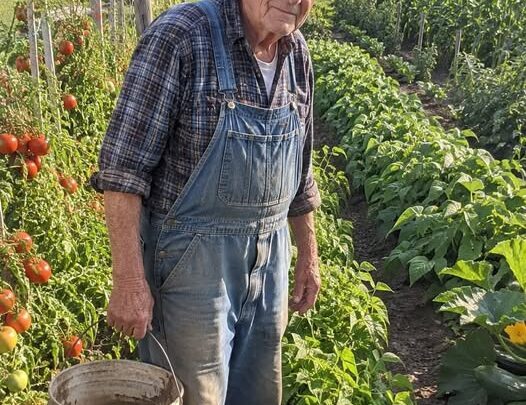
Beyond the back porch, the clothesline, and the old red shed stood my father’s garden.
Half an acre of carefully tended soil. Nine long rows of green beans. Hundreds of tomato plants supported by homemade cages. Potatoes, onions, carrots, beets, cucumbers, squash, and two impressive rows of sweet corn swaying in the summer breeze.
Along one edge grew the strawberry plants my mother had planted three decades earlier.
There wasn’t a weed in sight.
My father spent hours out there every day, often beginning before sunrise. He knew which plants needed water, which vines needed support, and which vegetables were ready to pick. He could recognize a struggling tomato plant from across the garden.
And now someone had described his work as a nuisance.
“Dad,” I said, trying to keep my voice steady, “this garden is probably the most carefully maintained property in the entire county.”
He folded his glasses and slipped them into his shirt pocket.
“Well,” he replied, “somebody sees it differently.”
I was furious.
My father, Arne Lindqvist, had lived in that house his entire life. He was born there in 1947, as had generations of his family before him. He worked thirty-four years at the local paper mill, then spent another twelve driving a school bus before retiring.
After retirement, he devoted himself to growing vegetables.
It was more than a hobby. It was the rhythm of his days, the thing that gave him purpose after a lifetime of work.
Three years earlier, my mother, Marta, had died from pancreatic cancer. Their marriage had lasted fifty-one years, and losing her had changed my father in ways I was still learning to understand.
I thought he might sell the house after she died. I imagined him moving into a small senior apartment, somewhere with a manageable patio and neighbors close enough to check on him.
Instead, he made the garden bigger.
I had never understood why he grew so much food. He was a small man who ate simple meals and rarely seemed interested in keeping more than a few vegetables for himself.
Once, while watching him work among the bean rows, I finally asked the question that had been on my mind.
“Dad, who are all those beans for?”
He didn’t look up.
“People,” he answered.
Then he went back to tying a tomato plant to its stake.
I assumed he meant neighbors, church friends, or relatives. I never pressed him for details.
I should have.
The Neighbor Who Saw an Eyesore
The complaint had almost certainly come from our new neighbor, Brent Hollis.
Brent had purchased the property next door after the previous owners sold their land to a developer. The old Swenson farmhouse, where I had learned to ride a bicycle, had been demolished and replaced by a large modern home with gray siding, black-framed windows, a three-car garage, and a perfectly manicured lawn.
The house looked like something from a luxury magazine.
Its most prominent feature was a broad second-story deck overlooking my father’s garden.
Brent was around forty-five, successful, well-dressed, and apparently very particular about his surroundings. On Sunday mornings, when I visited my father for coffee, I often saw him standing on the deck, looking down at the vegetables.
He seemed especially irritated by the corn.
That summer, the stalks had grown more than seven feet tall, partially blocking his view of the valley.
My father didn’t seem concerned.
“Your neighbor doesn’t look too happy about the garden,” I remarked one morning.
Dad shrugged.
“Takes all kinds.”
I had met Brent once before the complaint arrived. My father had walked to the fence carrying a small basket of fresh strawberries, eager to welcome the new neighbor.
“First of the season,” he had said. “My wife planted these. Best strawberries in the county, if I do say so. You’re welcome to them.”
Brent glanced at the fruit and then at the garden.
“No, thanks. I’m not big on fruit.”
My father lowered the basket.
“That’s all right. Tomatoes will be ready in July. Beans in August. Just holler if you want something.”
Brent nodded and disappeared inside.
When I reminded my father how rude the encounter had been, he defended the man.
“Maybe he was busy thinking,” Dad said.
That was my father. He could find something kind to say about almost anyone.
But I wasn’t interested in defending Brent when the county threatened to destroy something that mattered so much to our family.
“It’s him,” I told Dad, holding up the letter. “He complained about your garden. He moved here five months ago, and now he thinks he can tell you what to do with land your family has owned for generations.”
Dad studied the notice.
“County says they can.”
“Then we’ll challenge it. I know someone who knows a property lawyer.”
“Kristin.”
“I mean it, Dad. We aren’t just going to let them tear everything out.”
He rested his hands on the table.
“Let’s see what the inspector says first.”
I couldn’t understand his calmness. I was already imagining legal letters, hearings, and arguments about property rights.
He simply looked through the window at his vegetables.
“You learn some things can’t be rushed,” he told me. “You plant the seed. You wait. You see what comes up.”
I had no idea what he meant.
Thirty Days to Save a Lifetime of Work
I took Thursday off work so I could accompany my father during the inspection.
At seven that morning, I arrived to find him already in the garden, picking beans.
“Dad, the inspector is coming at nine.”
“I know.”
“Shouldn’t you come inside and get ready?”
He looked down at his faded blue work shirt, the one with the torn pocket.
“What’s wrong with my shirt?”
I gave up.
Instead, I sat on the porch and watched the sunrise illuminate the garden. Bees moved between the squash blossoms, birds searched for worms, and the leaves glistened with morning dew.
It was beautiful.
I couldn’t imagine how anyone could look at that place and see a problem.
At five minutes before nine, a small white county vehicle pulled into the driveway. The inspector, Tyler Ostrowski, was a young man with glasses, a clipboard, and a county identification badge.
He shook our hands and addressed my father respectfully.
“Mr. Lindqvist, thank you for meeting with me.”
“Would you like some coffee?” Dad asked.
Tyler seemed surprised by the offer but politely declined.
He walked the garden’s boundaries, took photographs, measured the cultivated area, and made notes. My father followed him quietly while I stayed close enough to hear every word.
Eventually, Tyler stopped beside the tomato rows.
“How many hours a day do you spend maintaining all this?” he asked.
“Six, maybe seven,” Dad replied. “More when the weeds are bad.”
“Every day?”
“Every day God gives me.”
Tyler looked across the rows and then toward Brent’s house.
When we returned to the porch, he seemed uncomfortable.
“I’m sorry,” he began. “The zoning ordinance requires a special permit for agricultural use over a quarter acre in this residential district. Your garden is approximately half an acre.”
“But this garden has been here for decades,” I protested.
“The zoning changed in 2019. There may be provisions concerning established uses, but the complaint requires us to investigate.”
“And what happens now?”
Tyler glanced at his clipboard.
“I have to issue a notice of violation. You would have thirty days to bring the property into compliance. That could mean reducing the cultivated area or applying for a special permit.”
“A permit that takes six months,” I said. “What are we supposed to do in the meantime?”
He admitted that the process could be complicated and that the complaint might remain open while the application was reviewed.
I felt my anger rising.
Thirty days.
That was all the county had given my father to potentially dismantle years of work and a garden that had become part of his life with my mother.
Before I could say anything else, Dad placed a hand on my arm.
Then he stood and offered Tyler his hand.
“I appreciate you coming out,” he said. “I know you’re just doing your job.”
Tyler shook his hand.
“Would you do me one favor before you finish the paperwork?” Dad asked.
“If I can.”
“Come back Saturday morning. Six o’clock.”
Tyler looked confused.
“Saturday? Why?”
“There’s something I’d like you to see before you decide.”
After a moment, Tyler agreed.
I watched him drive away, wondering what my father could possibly show him that a thorough inspection hadn’t already revealed.
“What’s happening Saturday?” I asked.
Dad picked up his bucket.
“Saturday’s Saturday,” he said.
Then he walked back into the garden.
The Secret Behind the Friday Morning Deliveries
I stayed overnight at my childhood home because I was too upset to return to my apartment.
That evening, I went to Brent’s house and confronted him.
He didn’t deny filing the complaint.
“The garden is an eyesore,” he explained. “I paid a lot of money for this house. I don’t want to look at a farm from my deck.”
I reminded him that my father had lived there for nearly eighty years and that his family had owned the land long before Brent arrived.
He shrugged.
“That’s unfortunate, but zoning laws exist for a reason.”
Then he made an accusation that surprised me.
He said he had noticed my father’s truck leaving before sunrise every Friday. He had watched Dad load boxes into the back and drive away. According to Brent, that looked less like a private garden and more like an unlicensed business.
“He’s probably selling vegetables,” Brent said. “I’m doing the county a favor.”
I stared at him.
“You have no idea who my father is.”
“I don’t need to,” he replied.
Then he closed the door.
When I returned home, Dad was sitting on the porch, shelling peas.
“Brent thinks you’re running an operation,” I told him. “He says you’re selling vegetables without a license.”
Dad laughed.
“An operation. That’s a good one.”
But when I mentioned the Friday deliveries, his hands stopped moving.
“You leave before sunrise every week,” I said. “Where do you go?”
He returned to shelling the peas.
“You’ll see Saturday.”
That night, I woke at four-fifteen to the sound of a truck engine. From my bedroom window, I watched my father carry cardboard boxes from the shed to his old green pickup.
Eleven boxes.
They were filled with tomatoes, beans, potatoes, and squash. He secured a tarp over the vegetables, checked the knots twice, and drove away.
He returned several hours later with an empty truck bed.
At breakfast, he acted as if nothing unusual had happened.
“Big day tomorrow,” he said.
I knew then that Saturday would reveal something important. I just didn’t realize how much I had misunderstood about my father, my mother, and the garden.
The Saturday Morning That Changed Everything
The morning arrived beneath a thick blanket of fog.
I woke before five and found my father preparing coffee in the enormous urn my mother had once used for church gatherings.
“Expecting company?” I asked.
He only smiled.
At five minutes before six, Tyler’s white county car appeared through the fog. He walked up the driveway, looking sleepy and uncertain, and accepted a cup of coffee from me.
“Where’s your father?” he asked.
I pointed toward the bean rows, where a familiar figure was already working.
Then headlights appeared on the road.
An old red pickup pulled over beside the ditch. A white Chevrolet followed, then a blue Dodge, a small sedan, a station wagon, and a collection of older cars and minivans.
One after another, vehicles arrived and parked along the road.
People began stepping out.
An elderly man in suspenders carried a small gardening fork. A young mother held a baby against her chest while guiding a toddler by the hand. Two teenage boys carried an empty laundry basket. A woman in medical scrubs brought grocery bags, and an older woman leaned on a cane as she made her way toward the driveway.
Others arrived carrying buckets, boxes, and reusable shopping bags.
Nobody appeared confused about where to go.
They walked into the garden as though they had been doing it for years.
The elderly man headed straight for the potatoes. The teenage boys began picking corn. The woman in scrubs moved toward the tomatoes, while the young mother settled her toddler beside the strawberry patch my mother had planted decades earlier.
My father greeted each person warmly.
He handed out vegetables, answered questions, and helped people choose what was ready to harvest.
Some took potatoes and onions. Others filled bags with beans or gathered a few tomatoes and squash.
Nobody took more than they needed.
There was no cash register, no list of customers, and no exchange of money. There were simply people collecting food from a garden maintained by an old man who had spent years growing far more than he could ever eat.
Tyler lowered his clipboard.
“What is this?” he whispered.
I couldn’t answer.
I was too overwhelmed by the sight of so many people moving through the garden. I had visited my father countless times and seen him working in those rows, yet I had never understood their purpose.
Then I noticed the neighbor’s deck.
Brent stood at the railing in a dark blue bathrobe, holding a coffee mug. He had clearly come outside to watch the inspection.
But he wasn’t watching Tyler anymore.
He was staring at the people in the garden.
The Woman With Two Empty Grocery Bags
A silver minivan arrived last.
It parked at the end of the line, and for a moment the driver remained inside. Eventually, an older woman stepped out wearing a tan raincoat and white sneakers.
She carried two empty grocery bags.
She walked slowly toward the house, keeping her eyes on the gravel. Then, halfway up the driveway, she looked toward the garden.
Her gaze traveled past the fence and the vegetables.
Then she looked up at Brent’s deck.
She stopped.
One of her bags slipped from her arm and fell onto the gravel.
Brent set down his coffee cup.
For several seconds, neither of them moved.
Then he hurried through his house, came around the side, crossed his immaculate lawn, and stepped over the low section of fence between the properties.
He walked through the edge of the corn and stopped in front of the woman.
“Mom?” he said.
Her face crumpled.
“Brent. What are you doing here?”
“I live here,” he answered, gesturing toward the large gray house. “That’s my house.”
She looked at the building in disbelief.
“I didn’t know,” she whispered. “You never invited me out here.”
Brent glanced at the grocery bags in her hands.
“What are you doing here?”
She didn’t answer immediately.
Then he looked toward the garden and understood why she had come.
“Are you here to get food?”
His mother raised her chin.
“Every Saturday,” she said. “For a year and a half.”
Brent stepped backward.
“But I send you money every month.”
“You send me two hundred dollars,” she replied gently. “And I’m grateful, honey. I really am. But my pension is eleven hundred dollars a month. My rent is eight hundred. My heart medicine costs three hundred and forty dollars after insurance. Then there’s electricity, the phone, and car insurance.”
She shook her head.
“It doesn’t add up.”
Brent stared at her.
“Why didn’t you tell me?”
“Because you worked so hard to build your life. You went to college, worked two jobs, and built your company. You were so proud when you called me to talk about your clients and your new house.”
Her voice broke.
“I didn’t want you to think I was dragging you backward. I didn’t want you to look at me and remember the old house, the empty cupboards, and everything we struggled through.”
Brent looked at the garden again.
My father had walked over from the bean rows and stood nearby, holding his bucket.
He greeted the woman gently.
“Morning, June.”
Brent turned toward him.
“You know my mother?”
“Every Saturday for a year and a half,” Dad said. “She likes the yellow squash and the little red potatoes.”
June let out a small, tearful laugh.
Brent looked between them, struggling to understand.
“You knew she was coming here?”
“I knew June,” Dad answered. “I didn’t know she was your mother. People don’t have to explain their lives to get a bag of beans.”
Brent lowered his head.
“I called the county on this garden,” he said. “I told them it was an eyesore. I wanted them to make you tear it out.”
“I know,” Dad replied.
There was no anger in his voice.
That seemed to make the moment even harder for Brent.
The Memory He Had Tried to Bury
Brent sat down on the gravel driveway, still wearing his expensive bathrobe.
He covered his face with his hands.
“When I was a kid,” he finally said, “we lived in a trailer on County Road 9. My dad drove a delivery truck until he hurt his back. After that, money was always tight.”
June closed her eyes.
“My mother grew vegetables because we needed them to survive. I spent summers picking beans instead of doing the things other kids did. At school, they called me ‘Bean Boy.’ I went to class with dirt under my fingernails, and no matter how hard I scrubbed, I couldn’t always get it out.”
He gave a strained laugh.
“We ate beans constantly. Green beans, bean sandwiches, beans and rice. I promised myself I’d never be poor again. I’d never let anyone look at me and see dirt.”
He looked up at his large house.
“So I worked. I built my company. I bought the house. I made everything look perfect.”
Then he looked at my father’s garden.
“And every morning, I came out on that deck and saw the trailer, the empty cupboards, and my mother working in the dirt. I thought I’d escaped all of it, but looking at this garden brought it all back.”
He swallowed hard.
“I couldn’t stand it. So I tried to make it disappear.”
His mother stood beside him, holding her grocery bags.
And for the first time, Brent seemed to understand that the thing he wanted removed from his view was also helping the woman he loved survive.
My father slowly lowered himself onto the gravel beside him.
“In 1982, the paper mill laid off two hundred workers,” Dad began. “I was one of them.”
He had a mortgage, a wife, and a five-year-old daughter. For months, work was difficult to find. Their savings dwindled, and winter became frightening.
“There was a week in February when all we had left was a box of crackers and a jar of peanut butter,” he said. “My wife, Marta, kept giving our daughter her share of the food. She pretended she wasn’t hungry.”
I listened from the porch, stunned. I barely remembered those years. I had never understood how difficult that period had been for my parents.
“One morning, I opened the front door and found a box on the porch. Potatoes, onions, canned vegetables, flour, and a ham. There was a note that said, ‘From the neighbors. Pass it on.’”
My father paused.
“Every Friday, another box appeared until I found work again. We never learned for certain who left them. My wife always suspected the Swensons, who used to live on Brent’s property.”
He looked toward the garden.
“When I got back on my feet, Marta made me promise that we’d help other families the same way. She said we’d never let somebody on this road open their cupboards and find nothing if we could do something about it.”
That promise had grown into the garden.
For forty years, my mother had helped provide fresh vegetables to local families. On Saturdays, people could come and collect what they needed. On Fridays, my parents delivered boxes to elderly residents, people with disabilities, families facing financial hardship, and anyone who couldn’t easily make the trip.
When my mother became ill, she made one final request.
“Arne,” she had told him in the hospital, “the Fridays. Don’t you dare stop the Fridays.”
My father had kept his promise.
After she died, he continued planting, harvesting, packing, and delivering vegetables every week.
Eleven houses each Friday. The remaining produce went to the local food pantry.
He had done it quietly, without asking anyone to thank him.
I stood on the porch with tears running down my face.
All those years, I had watched my father work and never truly understood what he was doing.
I knew he loved his garden.
I hadn’t known that the garden was also how he and my mother had spent decades keeping their promise to their community.
The Inspector Makes a Different Decision
Tyler had stopped writing.
He looked at the people standing among the rows, at the boxes of fresh vegetables, and at my father sitting beside Brent on the driveway.
“How many families does this help?” he asked.
“About forty on Saturdays,” Dad replied. “Sometimes more. Eleven deliveries on Fridays, and anything left over goes to the food pantry.”
Tyler stared at the clipboard in his hands.
The notice of violation was still partly filled out.
He removed the sheet, folded it, and placed it in his jacket pocket.
“Mr. Lindqvist,” he said, “the ordinance refers to unmaintained agricultural use.”
“That is what the letter said,” Dad answered.
“In my professional opinion, this is one of the best-maintained properties I’ve ever inspected.”
Tyler explained that he would document his findings carefully and review the applicable provisions. He also offered to help my father pursue a community garden permit or any available exemption, although the final decision would depend on the county’s rules and approval process.
He was no longer looking at the property as a possible nuisance.
He was looking at the people who depended on it.
Brent stood up and brushed the gravel from his robe.
“I want to withdraw my complaint,” he said. “I’ll sign whatever paperwork is necessary.”
Tyler nodded.
“I’ll bring you the form Monday.”
Then Brent turned toward my father.
“I’m sorry, Arne. I don’t know what else to say.”
Dad looked up at him.
“Help me up,” he said. “My knees don’t work like they used to.”
Brent reached down and helped him stand.
For a moment, the two men faced each other: my seventy-nine-year-old father in his faded work shirt and the neighbor who had tried to have his garden removed.
“Is there anything I can do?” Brent asked.
Dad picked up his old metal bucket and held it out.
“Beans are on the left. Nine rows. Pick from the bottom up. The ones near the ground are ready first.”
Brent looked at the bucket.
He hesitated, remembering years of childhood humiliation and everything he had tried to leave behind.
Then he took it.
“Bottom up,” he repeated.
“Bottom up,” Dad agreed.
Brent walked into the garden, knelt beside the first row, and began picking beans.
His mother watched him with tears in her eyes.
Around them, the other visitors quietly returned to their work.
The Fridays I Had Never Understood
That Friday, I accompanied my father on his delivery route.
I set my alarm for three-forty-five in the morning. When I entered the kitchen, Dad was already packing eleven cardboard boxes.
He showed me how to arrange the vegetables so the tomatoes wouldn’t bruise. Potatoes went on the bottom, followed by squash and beans. The tomatoes were placed on top, protected by sheets of newspaper.
We drove through the dark, stopping at houses and apartment buildings throughout the area.
At one home, my father left a box for a ninety-one-year-old man who could no longer drive. At a trailer park, we delivered vegetables to a mother whose husband was hospitalized. At an apartment building, Dad carried food up three flights of stairs for several elderly residents.
At another house, we met Curtis, a veteran who used a wheelchair.
He recognized me as Arne’s daughter and told me how my mother used to bring him peach pie every August.
“I miss her,” he said.
“So do I,” I answered.
We continued to the remaining houses, and then we took the last boxes to the church food pantry.
As we drove home, Dad turned toward the cemetery on the hill behind the church.
He carried a paper bag across the wet grass to my mother’s grave.
The inscription read:
MARTA ELISE LINDQVIST
1949–2023
SHE PASSED IT ON.
Dad removed a large, perfect tomato from the bag and placed it gently on the headstone.
“Eleven houses this week, Marta,” he said. “And St. Luke’s. Forty-two families on Saturday. That’s a record.”
He stood quietly for a moment.
“The neighbor’s going to be all right, too. June’s boy is coming around. I think you’d like him once he lets you.”
Then he rested his hand on the stone.
“I haven’t missed a Friday,” he whispered. “Not one.”
I stood beside him, finally understanding what the garden represented.
It wasn’t simply a place where vegetables grew.
It was a promise that had survived hardship, grief, and decades of changing circumstances. It was my mother’s kindness, carried forward by my father’s hands.
And now, somehow, it had reached Brent, too.
A Garden Becomes a Community
Over the following months, things began to change.
Tyler helped my father navigate the county’s permit process, and the garden eventually received official recognition as the Marta Lindqvist Community Garden.
A wooden sign appeared at the end of the driveway. Tyler made it in his garage.
Brent withdrew his complaint and began visiting my father regularly.
In the autumn, construction workers arrived at his property. At first, I worried he might be building a taller fence to block the garden from view.
Instead, he removed part of his perfectly manicured lawn.
One afternoon, he knocked on my father’s back door.
“I want to grow vegetables on my side of the fence,” he said. “If that’s okay with you. Mom says we could put pole beans along the property line. She has some strong opinions about squash.”
Dad looked through the window at the newly turned earth.
“Your mother’s right about the squash,” he replied.
They built a wooden gate between the properties. It hung slightly crooked, but Dad said that was how you could tell it had been made by hand.
In November, June moved into Brent’s house.
She resisted at first. She didn’t want to be a burden, and she had grown accustomed to living independently in her small apartment.
But Brent kept asking.
“I’ve got four empty bedrooms,” he finally told her. “And a garden that needs somebody who knows what she’s doing. Please, Mom.”
She moved into a bedroom overlooking the vegetables.
Soon, the two of them were spending mornings on the deck, drinking coffee and tea while discussing where to plant tomatoes and how much space the squash needed.
Brent began helping with Friday deliveries, too.
He couldn’t always come because of his business, but most weeks he arrived before sunrise wearing jeans and a sweatshirt. He drove while Dad gave directions, and he carried the boxes to the doors.
They talked about gardens, work, and the years both families had struggled.
Brent began to understand that his childhood wasn’t something he had to erase. It was part of the life that had made him who he was.
He also learned that accepting help and offering help were not signs of failure.
They were ways people cared for one another.
The Garden Keeps Growing
My father turned eighty the following May.
In March, he experienced a heart problem that required a hospital stay and a procedure to place a stent. For four days, he complained about the same thing.
“Nobody’s planting my peas.”
Brent took care of them.
He worked with June, Tyler, the teenage brothers who had become regular volunteers, the young mother named Ashley, and several other community members. Together, they planted the rows, installed tomato cages, tied strings for the beans, and prepared the soil.
When I brought Dad home, he stood on the porch for a long time, staring at the garden.
Every row was planted.
Every bed was ready.
He looked at the people working in the distance and shook his head.
“Well,” he said softly. “Would you look at that.”
“You have help now, Dad.”
“I see that.”
He sat in his old metal lawn chair, and I settled onto the steps beside him.
He admitted that my mother had worried about the garden’s future during her final months. She wondered who would keep it going after she was gone.
Dad had promised he would figure something out.
Neither of them could have imagined that the man who once wanted the garden destroyed would become one of its most committed volunteers.
But that was the strange thing about people.
Sometimes they needed to see the consequences of their assumptions before they could understand the lives of others.
And sometimes a simple act of kindness could open a door that anger and arguments would never unlock.
The Question That Finally Had an Answer
I visit my father every Saturday now.
At first, I came because I wanted to help him manage the garden. Eventually, it became a tradition I couldn’t imagine giving up.
We bring an extra coffee urn, set out buckets and boxes, and welcome everyone who arrives.
The line of cars has grown longer.
One foggy Saturday, twenty-three vehicles parked along the road. People stepped out carrying grocery bags and empty containers. They knew where to go, and the regulars helped newcomers feel welcome.
June was at the yellow squash, choosing the smaller red potatoes she liked best. Tyler and his girlfriend picked tomatoes. Ashley’s little girl wandered through the strawberry patch, eating more fruit than she placed in her basket.
My father worked slowly at the end of the bean rows, stopping occasionally to rest.
Brent was beside him, kneeling in the dirt. His jeans had holes in the knees, and there was soil beneath his fingernails.
He no longer tried to scrub every trace of it away.
That morning, a young couple arrived with a little boy. Their car had a cracked windshield, and they seemed uncertain about whether they belonged there.
The father explained that someone at a gas station had told them there was a place nearby where families could collect fresh food.
Brent walked over to greet them.
“Morning,” he said. “First time?”
The father nodded.
Brent handed them a bucket and led them toward the garden.
The little boy looked around at the rows of vegetables and the people working among them.
“Mister,” he asked, “whose garden is this?”
Brent paused.
He looked toward June, then Tyler, then the families filling their bags. Finally, he glanced at my father, who was slowly straightening up to see who had arrived.
“It’s Mr. Lindqvist’s garden,” Brent said. “And his wife’s. She started it a long time ago.”
The boy looked at the green bean rows.
“Who are all the beans for?”
Brent smiled.
It was the kind of smile I had never seen on his deck, when he stood looking down at the garden and wishing it would disappear.
He knelt until he was at the boy’s eye level.
“People,” he said. “People who need them. People like you.”
The boy considered that answer, then accepted the bucket.
Brent pointed toward the first row.
“Beans are on the left. Nine rows. Pick from the bottom up. The ones near the ground are ready first.”
The boy walked into the garden and began picking.
Across the rows, my father caught my eye. He raised his hand in a small wave, then bent back down to his work.
I stood on the porch with my coffee and watched the garden fill with people.
Some arrived with full lives and comfortable homes. Others came carrying the quiet worries they didn’t know how to explain. Some were elderly, some were raising children, and some simply needed a little help getting through a difficult month.
The garden didn’t ask anyone to prove their worth.
It didn’t demand an explanation.
It offered food, dignity, and a place where nobody had to pretend they were doing better than they were.
My mother had understood that long before I did.
On the hill behind St. Luke’s, her headstone still carries the words SHE PASSED IT ON.
She passed on a promise.
My father kept it alive.
And Brent, the man who once wanted the garden torn out, now helps it grow.
The county’s letter had given my father thirty days to change his property. But one Saturday morning, the people who came for vegetables revealed something that no inspection could measure.
A garden is not always just a garden.
Sometimes it is a community’s safety net. Sometimes it is a family’s legacy. Sometimes it is a quiet promise made during the hardest days of life.
And sometimes, when we finally look beyond our assumptions, it becomes the place where people learn to forgive, reconnect, and begin again.
The beans were never just for my father.
They were for everyone who needed them.
And now, they were for everyone willing to pass the kindness on.