“She can’t even afford economy.”
My father didn’t whisper those words. He said them loudly enough for everyone waiting near the airport gate to hear.
Then Harlon Cassidy smiled.
It wasn’t a friendly smile. It was the familiar expression he wore whenever he believed he had successfully reminded me of my place in the family.
“Marlo, sweetheart,” he continued, raising his voice, “you don’t have to pretend. If you couldn’t afford the ticket, you should have just said so. We would have understood.”
He paused before delivering another insult.
“You could have stayed home and watched the dogs.”
My stepsister, Brindle, burst out laughing.
She stood beside him wearing cream designer trousers, expensive sunglasses, and a cashmere coat that probably cost more than my first car.
“Dad, be nice,” she said, pretending to defend me.
Then she looked directly at me.
“Not everyone can fly first class. Some people are just… economy people.”
A businessman nearby looked away. Another passenger pretended to concentrate on his phone. Even the gate agent seemed uncomfortable.
I said nothing.
For most of my life, silence had been my assigned role.
Brindle was the beautiful daughter. My stepmother, Delphine, was the elegant wife. My father was the successful businessman whose name everyone in Colorado seemed to recognize.
And I was simply Marlo.
The quiet daughter from his first marriage.
The one who had lost her mother when she was nine years old.
But that morning, at an airport bound for Savannah, my family was about to discover that the daughter they had underestimated had been keeping a very different kind of account.
The Daughter My Father Never Really Saw
My father, Harlon Cassidy, owned three car dealerships across Colorado. He had spent decades building a reputation as a successful businessman, and he made sure everyone knew it.
He loved expensive watches, exclusive clubs, private dining rooms, luxury vehicles, and being recognized wherever he went.
He also loved appearing generous.
When other people were watching, he could be remarkably charming. He would pay for dinners, give impressive gifts, and tell stories about how much he valued family.
But behind closed doors, his generosity seemed to have a very specific guest list.
Brindle, his daughter from his second marriage, received nearly everything she wanted.
I was usually expected to be grateful for whatever remained.
At Christmas, Brindle received jewelry while I received a department-store gift card.
When she graduated from college, Dad rented a private dining room and invited dozens of guests.
When I completed graduate school, his entire response was a text message:
“Good job.”
When Brindle needed help paying for her first apartment, Dad covered six months of rent.
When I asked him about the trust my mother had left me, he leaned back in his office chair and dismissed the question.
“Life is expensive, Marlo. You should be grateful I kept a roof over your head.”
At the time, I believed him.
I thought perhaps he had used the money for family expenses. I thought perhaps there were documents I didn’t understand.
I was young, grieving, and unwilling to believe that my own father might have hidden something important from me.
My mother, Coraline, had died when I was nine.
Even after twenty-two years, I could remember her lavender lotion, her gentle humming while washing dishes, and the way she would crouch down so we could look directly into each other’s eyes whenever she wanted to tell me something important.
One evening, she had told me:
“You never have to become loud just because someone else is cruel.”
For years, I misunderstood that advice.
I thought it meant I should tolerate disrespect without responding.
Eventually, I learned that quiet dignity and accepting mistreatment were two very different things.
The Ticket That Was Supposed to Humiliate Me
The family trip to Savannah was supposed to be a special occasion.
My maternal grandmother was turning ninety, and everyone had been invited to celebrate at her home.
I wanted to attend because my grandmother had always been kind to me. After my mother’s death, she had remained one of the few people who made me feel connected to the family I had lost.
My father arranged the flights.
He purchased first-class tickets for himself, Delphine, and Brindle.
For me, he forwarded a screenshot showing my assigned seat.
34B.
A middle seat near the rear of the aircraft.
His accompanying message contained only two words:
“You’re welcome.”
I stared at the message before laughing quietly.
Not because it was funny.
Because it was so perfectly Harlon.
I had spent years watching him use money as a way to establish who mattered most.
At the airport, Brindle made sure the situation became even more embarrassing.
She held up her phone and began recording herself.
“Savannah!” she announced cheerfully.
Then she turned toward me.
“Enjoy your middle seat, sis. Try not to spill anything on your neighbor.”
She laughed.
Delphine adjusted the lapels of her tailored suit and gave me a sympathetic smile.
“Don’t worry, Marlo. It’s only a three-hour flight. Perhaps you can read a book or take a nap. You work so hard doing… whatever it is you do with numbers.”
I looked at her without responding.
My father checked his gold watch.
“Group One is about to board. Let’s go, ladies.”
Then he turned toward me.
“Marlo, wait for general boarding. And please don’t crowd the line. It’s unbecoming.”
I looked at him.
“I’m not waiting in that line, Dad.”
He stopped walking.
His expression changed immediately.
“Marlo, don’t start making a scene because your pride is wounded. If you don’t line up, the plane will leave without you, and I’m not reimbursing you for another ticket.”
“I don’t need a reimbursement,” I replied. “And I won’t be taking this flight.”
Brindle lowered her sunglasses.
“Oh, please. What are you going to do? Take a Greyhound bus to Savannah? Grandma’s dinner is tonight.”
Dad shook his head dramatically.
“She’s throwing a tantrum. After all the money I spent on her ticket, this is how she behaves. Ungrateful.”
I remained calm.
I knew something they didn’t.
And I wasn’t going to explain it to them.
The Captain Who Walked Straight Past My Father
Before my father could continue, I heard purposeful footsteps approaching from behind us.
A deep, professional voice cut through the airport noise.
“Excuse me.”
We all turned.
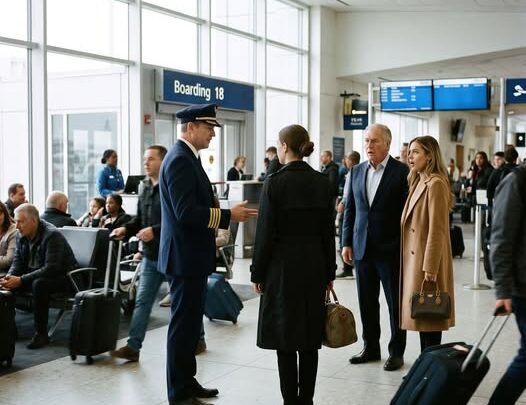
A tall man in a navy captain’s uniform stood a few feet away. His jacket had four gold bars on the shoulders, and he carried his pilot’s cap beneath one arm.
Beside him was a customer-service representative from the private aviation company.
My father immediately straightened.
His familiar businessman’s confidence returned.
“Good morning, Captain,” he announced, extending his hand. “If this is about a VIP escort or an upgrade, we’re ready for boarding. Harlon Cassidy. Colorado Motor Group.”
The captain didn’t take his hand.
He stepped around my father and stopped directly in front of me.
Then he gave a polite nod.
“Good morning, Ms. Cassidy. Captain Vance. We’ve completed our pre-flight checks and filed the flight plan directly to Savannah International. Your private jet is ready, ma’am.”
Silence.
Complete silence.
The businessman who had been looking at his phone froze.
The gate agent stopped moving.
My father’s hand remained suspended in the air.
Brindle’s phone nearly slipped from her fingers.
“Wait… what?” she stammered.
She looked at the captain, then at me.
“Her? A private jet? You have the wrong person. She’s in seat 34B!”
Captain Vance didn’t react to the comment.
He remained focused on me.
“Your vehicle is waiting downstairs at the executive terminal, Ms. Cassidy. The catering requested by your office is already onboard. We have a light breakfast, fresh fruit, and your mother’s favorite peach tea prepared.”
I smiled.
“Thank you, Captain. That sounds wonderful.”
He nodded.
“Whenever you’re ready, ma’am.”
My father finally found his voice.
“Marlo…”
His tone was no longer loud or commanding.
It was thin and uncertain.
“What is this? Is this some kind of joke?”
I looked at him.
“How could you possibly afford a chartered flight?” he asked.
I almost smiled.
He still believed that money was something he alone understood.
The Truth About My Mother’s Trust
For years, I had quietly built a professional career.
I graduated with top honors in forensic accounting. I worked with financial records, corporate structures, asset investigations, and complex transactions.
I later partnered with an international asset-management organization.
My father never bothered to understand what I actually did.
He assumed I was a clerk who spent her days checking numbers.
He never asked about my clients or the projects I handled. He never asked how my career was progressing.
And he certainly never imagined that my professional experience would eventually lead me back to the one financial question he had spent years avoiding.
My mother’s trust.
Two years earlier, I had decided to examine the estate records more carefully.
I had found references to shares connected to her family’s southern logistics interests. Those shares had been part of a financial arrangement that predated my father’s later business expansion.
The documentation raised serious questions.
Why had I been told the trust had disappeared?
Why had the shares apparently been absorbed into business transactions?
And why had my father never provided a complete accounting of the assets my mother had left?
I hired attorneys and independent financial professionals to review the records.
The investigation took time.
There were old corporate documents, ownership records, transfers, and legal questions that needed to be examined carefully.
Eventually, the recovery audit was finalized.
The records supported a claim that capital belonging to my mother’s estate had been improperly transferred or used without the necessary authorization.
The recovery process resulted in the return of the identified funds, together with applicable interest, to my mother’s estate.
The legal documentation had been finalized the previous Friday.
The formal notice was waiting on my father’s desk in Denver.
And he had absolutely no idea.
The Conversation My Father Never Expected to Have
I looked directly at him.
“My mother left me more than memories, Dad.”
His expression tightened.
“She left a trust connected to her family’s shares in southern logistics. Shares you apparently believed had quietly become part of your dealership expansion fifteen years ago.”
His face changed.
At first, he looked confused.
Then recognition appeared.
Then fear.
“I found the documentation, Harlon,” I continued.
For the first time, I didn’t call him Dad.
“My attorneys finalized the recovery audit last Friday. The capital identified in the investigation, including applicable interest, was returned to my mother’s estate yesterday afternoon.”
He stared at me.
“You’re making a mistake,” he finally said.
“Then you can discuss it with my attorneys.”
He looked toward Delphine.
She had grabbed his arm.
“Harlon? What is she talking about?”
He didn’t answer.
He couldn’t look at her.
And he certainly couldn’t look at me.
All those years, he had made sure I understood that I was the less important daughter.
He had treated my questions as inconveniences and my achievements as minor details.
He had assumed that because I didn’t boast about money, I didn’t have any.
But the truth was that I had spent years learning how to understand financial records, trace transactions, and identify discrepancies.
I hadn’t needed to announce my accomplishments.
I had simply done the work.
Brindle’s Perfect Image Finally Cracked
Brindle stood frozen.
Her expensive sunglasses were still in one hand, and her phone was pointed toward the floor.
“Marlo,” she said slowly, “you own a private jet?”
I shook my head.
“I never said I owned one. The aircraft has been chartered through my office for this trip.”
She looked confused.
“But how?”
I glanced at her.
“By building a career and managing my finances. Something you never seemed particularly interested in asking about.”
Her cheeks turned red.
Delphine tightened her grip on my father’s arm.
“What happens now?” she asked.
I answered calmly.
“The estate’s attorneys will handle the remaining legal and administrative matters. Everyone involved will receive the necessary documentation.”
My father finally stepped forward.
“Marlo, wait. We need to discuss this privately.”
I looked at him.
“You had twenty-two years to discuss it honestly.”
He swallowed.
“I’m still your father.”
I thought about my mother.
I thought about the little girl who had once sat in his office asking about the trust she had been promised.
I remembered the answer.
Be grateful I kept a roof over your head.
I had spent years trying to earn respect from someone who seemed determined never to give it.
“Being my father doesn’t give you permission to ignore my mother’s wishes or treat me as though I have no rights,” I said.
He didn’t respond.
I Chose Not to Board Their Flight
Captain Vance waited patiently beside me.
“Whenever you’re ready, Ms. Cassidy.”
I picked up my small leather weekend bag.
Then I turned toward my father, Delphine, and Brindle.
“Enjoy your first-class flight.”
Brindle looked as though she wanted to say something, but no words came.
I continued.
“Grandma and I will be waiting on the veranda when you arrive. If you manage to get a ride from the main terminal, that is.”
My father stared at me.
“Marlo, don’t do this.”
I gave him one final look.
“I already have.”
Then I turned away.
Captain Vance walked beside me toward the private terminal doors.
The customer-service representative followed, carrying the remaining travel information.
For the first time in my life, I wasn’t walking away because I was afraid of what my family might say.
I was walking away because I no longer needed their approval.
The Journey to Savannah
The executive terminal was quiet compared with the crowded commercial gate.
My car was waiting outside.
The driver opened the door, and I settled into the back seat with my weekend bag beside me.
A few minutes later, I stepped aboard the aircraft.
Everything was prepared.
Fresh fruit, breakfast, coffee, and peach tea had been arranged according to the instructions from my office.
The tea reminded me of my mother.
She used to prepare it on warm afternoons when my grandmother visited. They would sit together on the veranda, talking about family, old photographs, and the people they had loved.
I closed my eyes for a moment.
I wasn’t thinking about the first-class passengers.
I wasn’t thinking about Brindle’s designer coat or my father’s gold watch.
I was thinking about my grandmother.
She had been waiting for this birthday celebration for months.
And I wanted to arrive with a clear mind.
The aircraft departed on schedule.
As the runway disappeared beneath us, I looked out the window.
For years, I had believed that my father’s opinion was something I needed to overcome.
Now I understood that I didn’t have to spend the rest of my life trying to prove anything to him.
The Birthday Celebration That Mattered Most
When I arrived in Savannah, my grandmother was waiting on the veranda.
She was ninety years old, but her smile was as warm as I remembered.
“Marlo!”
I walked toward her and wrapped my arms around her.
She held me tightly.
“I was beginning to wonder when you would arrive.”
I laughed.
“I’m here, Grandma.”
She looked at me for a moment.
“Where are the others?”
“They’re on their way.”
She nodded and took my hand.
We sat together on the veranda, just as she and my mother used to do.
I told her about the journey, but I didn’t immediately discuss the airport confrontation or the financial documents.
It was her birthday.
I wanted her to enjoy it.
Later, when we had a quiet moment, I explained that the review of my mother’s estate had finally been completed.
Her expression became serious.
“Your mother would have wanted you to know the truth,” she said.
I nodded.
“I know.”
She took my hand.
“Your mother was proud of you, Marlo. She never wanted you to measure your worth by what other people could afford to give you.”
For the first time that day, I felt tears forming.
I thought about the words my mother had once spoken.
You never have to become loud just because someone else is cruel.
Perhaps I had finally understood what she meant.
I didn’t need to shout.
I didn’t need to humiliate anyone.
I simply needed to know my own worth and protect what belonged to me.
What My Father Never Understood
My father had spent years confusing wealth with importance.
He believed expensive clothing, luxury travel, and public recognition were proof of success.
He believed that whoever paid for the tickets controlled the journey.
He believed that a person who sat in economy was somehow less valuable than someone sitting in first class.
But the airport had revealed something he never expected.
The daughter he dismissed had built a successful professional life without his approval.
She had learned to investigate the financial records he assumed she would never understand.
And she had found the documentation connected to the inheritance her mother had left behind.
The private jet was never the most important part of that morning.
It was simply the moment when my family discovered that their assumptions about me had been wrong.
I didn’t need to own an aircraft to be successful. I didn’t need a luxury car, a designer coat, or a first-class ticket to prove that I deserved respect.
I needed honesty.
I needed independence.
And I needed the courage to stop accepting a version of family in which I was always expected to be grateful for less.
My mother had left me more than a financial legacy.
She had left me a memory of kindness, a belief in personal dignity, and a reminder that quiet people are not necessarily powerless.
That evening, as the sun began setting over Savannah, I sat beside my grandmother on the veranda.
The family celebration was finally beginning.
And for once, I wasn’t worried about where my father wanted me to sit, what Brindle might say, or whether Delphine approved of my choices.
I was exactly where I wanted to be.
With the people who loved me for who I was.
And that was worth more than any seat in first class.