News
My Son Offered Me a Tiny Garage Room for $700 a Month—But When His Wife Handed Me Her House Rules, I Revealed the Little Pink Notebook That Changed Everything
My Son Offered Me a Tiny Garage Room for $700 a Month—But When His Wife Handed Me Her House Rules, I Revealed the Little Pink Notebook That Changed Everything

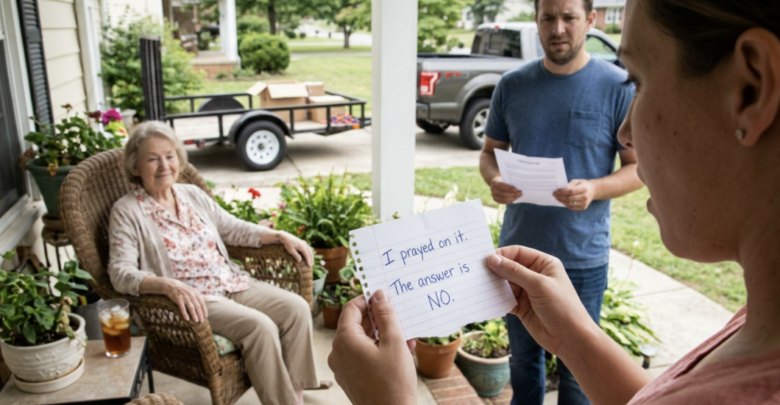
They Offered Me a Garage Room for $700—But Their Notebook Revealed the Real Arrangement
A fictional story about family expectations, retirement, and the right to make your own plans.
The First Page
I opened the little pink notebook and placed it between us.
My son, Hugh, leaned forward.
The handwriting belonged to his wife.
At the top of the page, Marlee had written:
How to make Tressie agree to the garage apartment.
Below that were reminders about what to say.
Mention the cost of living alone.
Explain that seven hundred dollars was a family discount.
Remind me how much the grandchildren needed someone they knew.
Avoid involving other relatives in the discussion.
Hugh read without speaking.
Then he looked at Marlee.
“What is this?”
“Notes,” she said. “I was trying to prepare.”
I turned the page.
“Then let’s look at what you were preparing for.”
Fifty-Five Hours
The next page contained a weekday schedule.
Monday through Friday.
Six-thirty in the morning until five-thirty in the evening.
Augie was six. Lily was four. Ben had recently turned two.
Eleven hours a day.
Fifty-five hours a week.
Beneath the schedule was another note.
If I complained about being tired, Marlee planned to remind me that I was retired.
I looked at those words for a moment.
I had spent forty years nursing.
I knew the weight of a long shift, the exhaustion of interrupted sleep, and the feeling of carrying responsibility long after arriving home.
Retirement had not made those years disappear.
Apparently, Marlee believed it had left me with unlimited time.
What the Room Was Supposed to Cost
The offer had sounded simple.
A small room in the garage arrangement.
Seven hundred dollars a month.
Close to the children.
Close to Hugh.
I had considered it because I loved them, and because living alone at seventy-four sometimes felt daunting.
But the notebook described something we had never discussed openly.
School pickups.
Meals.
Laundry.
Weekend babysitting.
The plan was to introduce those duties after I moved in, when changing my mind would be more difficult.
Hugh looked at his wife.
“Were you expecting Mom to do all of this?”
“We both work,” Marlee replied. “Someone has to help.”
“Then you needed to ask me,” I said.
“We were going to.”
“After I moved?”
She reached for the notebook.
I let her take it.
I had already read enough.
My Own Arrangement
A truck stopped near the house.
Mr. Crenshaw stepped out wearing his brown work jacket, with a folded crossword tucked into his pocket.
“Morning, Tressie.”
“Good morning.”
He glanced toward the driveway.
“Ready?”
“Yes.”
Hugh turned toward me.
“Ready for what?”
“My move.”
Marlee looked from him to me.
“You’re moving here.”
“No. I’m renting the apartment above Mr. Crenshaw’s hardware store.”
For a moment, neither of them spoke.
Then Hugh shook his head.
“Since when?”
“Since I looked at it, asked questions, and decided it suited me.”
Marlee folded her arms.
“You should have told us.”
“I should have told you my decision sooner,” I replied. “But I hadn’t agreed to yours.”
The Keys
Mr. Crenshaw approached with a small set of keys.
“Front entrance and apartment door,” he said.
I took them.
Marlee looked at him.
“You know she’s seventy-four?”
“Yes.”
“She might need help.”
“Most people do sometimes.”
He said it without making a speech.
Then he turned back to me.
“The furniture is upstairs. Your quilt is on the bed.”
I felt my throat tighten.
“Thank you.”
“We still need to discuss the casserole dishes.”
“What about them?”
“I counted fourteen.”
“That sounds possible.”
“For one person?”
“I like to be prepared.”
He smiled.
For the first time that morning, I laughed.
Hugh Asked for a Conversation
My son stood beside his truck.
“Mom, can we talk privately?”
I agreed.
We sat on the porch while Mr. Crenshaw checked the last of my things.
Hugh looked at his hands.
“I didn’t know about that notebook.”
“I believe you didn’t know what was written in it.”
“I thought we were offering something helpful.”
“I considered it for that reason.”
He glanced toward the driveway.
“Then why didn’t you want to?”
I took time to answer.
“Because I want to know what I’m agreeing to before I arrange my life around it.”
He nodded slowly.
“And because I want a home where resting doesn’t need an explanation.”
Grandmother, Not a Full-Time Schedule
Augie stood nearby holding a plastic dinosaur.
I watched him make it climb the side of a box.
“I love those children,” I told Hugh.
“I know.”
“I want to spend time with them. I want to hear about school and bake something with them and occasionally help when I can.”
“Then we could make it work.”
“Not on the schedule in that notebook.”
He looked away.
“I don’t want to resent them because I’m exhausted,” I continued. “They haven’t done anything wrong.”
Hugh rubbed his forehead.
“What’s the rent at Crenshaw’s?”
“Five hundred and fifty.”
“That’s less.”
“Yes.”
He sat quietly.
Then he asked whether the apartment had a kitchen.
“An actual kitchen,” I said. “With room for at least some of my casserole dishes.”
He gave a small laugh.
An Apology Before the Move
“I’m sorry,” Hugh said.
I touched his arm.
“I’m glad you said that.”
He looked relieved.
“But we still need to understand each other.”
“I thought you’d be lonely.”
“Sometimes I am.”
“Then—”
“Being lonely doesn’t mean every offer is the right one.”
He considered that.
I invited him to visit once I had settled in.
He could bring the children.
We could make pancakes.
He nodded.
There was still hurt between us, but I did not want to turn the morning into a choice between accepting every condition and losing my family.
I wanted a different arrangement.
One in which I could remain part of their lives without handing over my own.
The Apartment Above the Store
By noon, I stood in my new living room.
Two windows overlooked the street.
The kitchen had a small refrigerator, an older stove, and cupboards that would require careful organization.
The bedroom held my bed and a closet I could reach without moving anything else first.
There was a little bathroom with a window.
It was not luxurious.
It was enough.
Mr. Crenshaw had placed my late husband Harold’s photograph where I would see it from my chair.
I straightened the frame.
Then I walked through the rooms again.
The rent, the keys, and the responsibilities had been discussed before I moved.
Nobody had left a hidden schedule waiting in a drawer.
Coffee and Pie
Mr. Crenshaw appeared at the doorway.
“Found everything?”
“Most of it.”
“Coffee?”
“I’ve made some.”
“Then I’ll bring pie.”
He went downstairs.
I sat beside Harold’s photograph.
For months, every conversation about my future had seemed to begin with what I could no longer do.
Now I was thinking about where to put the teacups.
The difference was small enough to describe and large enough to make me cry.
When Mr. Crenshaw returned, he pretended not to notice.
He set down the pie.
“Fourteen casserole dishes,” he repeated.
I laughed again.
The Evening Call
Hugh called while I was preparing for bed.
“Mom?”
“You sound tired.”
“Marlee’s upset.”
“I expected she might be.”
“She says you embarrassed her.”
I sat on the edge of the bed.
“What did you want to discuss?”
“Childcare.”
I closed my eyes.
Now that I was not moving in, they needed another arrangement. Hugh described the cost and difficulty of finding someone.
I listened.
Then he asked whether I could still watch the children during the week.
“Full-time?”
“Maybe we could start with three days.”
“Hugh, I’m not available for a regular childcare commitment like that.”
He sighed.
“I can help occasionally when we discuss it in advance and I’m able,” I said. “That isn’t the same as being available whenever the schedule needs filling.”
The Envelope Under the Door
The next morning, an envelope waited beneath my apartment door.
Marlee had written my name across it.
Inside was a printed page titled:
Proposed Grandmother Visitation and Childcare Expectations
I read it at the kitchen table.
The wording described regular weekday care and cooperation with the children’s schedules.
It did not read like a question about when I might enjoy a visit.
Near the bottom was a statement that Hugh agreed the arrangement was necessary.
A signature appeared beneath it.
I looked at the date.
The document had been prepared before I announced the apartment.
I read it again, then placed it beside my coffee.
I had moved into a different home.
The expectation had followed me upstairs.
“Did You Sign It?”
I called Hugh.
“Everything all right?” he asked.
“I received the childcare proposal.”
He went quiet.
“Did you sign it?”
“Yes.”
There was no need to examine the handwriting after that.
“Did you read it?”
“I looked through it.”
“Then you saw what it expected from me?”
“Mom, it was supposed to help us organize.”
“You can organize a proposal. You can’t organize my agreement before asking for it.”
“That isn’t how I meant it.”
“Then explain what you did mean.”
He struggled.
Eventually, he admitted that Marlee had been upset and he had wanted to avoid another argument.
I looked around my quiet kitchen.
His answer was honest.
It was also painful.
The Argument He Had Passed Along
“Hugh, avoiding that conversation did not make the problem disappear.”
“I know.”
“It brought the same demand to my door.”
“We need a plan.”
“Yes. You do.”
He sighed.
I kept my voice steady.
“I’m willing to discuss visits. I’m not agreeing to the schedule on this page.”
“Could we at least—”
“No, sweetheart. I’ve answered.”
For a while, I heard only the sound of him moving somewhere in his house.
Then he said, “All right.”
I hoped that meant he understood.
I also knew I would have to judge that through what happened next.
Before we ended the call, I asked that future arrangements be discussed with me before anyone wrote down what I was expected to do.
The Morning Still Belonged to Me
Afterward, I folded the paper.
I put it in a drawer rather than leaving it beside my breakfast.
There were groceries to buy.
I needed bread, milk, and something for supper.
For years, a difficult family conversation could consume the rest of my day. I would replay it, prepare another explanation, and wonder whether a gentler answer might keep everyone comfortable.
That morning, I put on my coat.
The conversation had happened.
My answer remained the same.
I walked downstairs and stopped beside the hardware-store window.
Mr. Crenshaw looked up from the counter and waved.
I waved back, then continued to the grocery store.
Building a Routine
Over the next two weeks, the apartment began to feel familiar.
I learned which window caught the morning light.
I found a place for every dish.
Some mornings, I lingered over coffee. On others, I went out early.
I spoke with my sister more often.
When the grandchildren called, I enjoyed hearing their stories without wondering whether the conversation would end with an assumption about my next eleven hours.
There were still matters to settle with Hugh and Marlee.
I did not pretend otherwise.
But those matters no longer filled every room around me.
I had begun making plans that did not require waiting for someone else’s approval.
A Few Hours Downstairs
On Tuesdays and Thursdays, I started helping at the hardware store for a couple of hours.
Mr. Crenshaw needed assistance with old records, invoices, and telephone calls.
We discussed the hours and payment first.
I appreciated that.
The work was modest, but it gave me something useful to do without taking over the week.
One afternoon, I finished sorting a stack of records and placed them beside the counter.
Mr. Crenshaw looked through the labels.
“I’ve been meaning to organize these for years.”
“They were waiting for someone who enjoys a good folder.”
He smiled.
“Apparently.”
I glanced at the clock.
My agreed hours were nearly finished.
Upstairs, my apartment was waiting.
So was the crossword I had left beside my chair.
To be continued.