News
My Neighbor Kept Piling Snow Across My 83 Year Old Aunts Driveway So I Used Dads Old Loader to Clear the Entire Road
My Neighbor Kept Piling Snow Across My 83 Year Old Aunts Driveway So I Used Dads Old Loader to Clear the Entire Road

I Cleared Every Driveway After the Blizzard—Then My Aunt Explained What Our Neighbor Had Forgotten
A fictional story about a winter storm, an old coffee cup, and a kindness passed from one generation to the next.
The Call Beneath Bus Fourteen
My aunt called on a Tuesday afternoon after the blizzard.
I was underneath Bus Fourteen at the school district garage, trying to locate an air leak, when my phone vibrated.
Aunt Ione rarely called during working hours.
I rolled out from beneath the bus and answered.
“Are you all right?”
“My heart’s behaving,” she said. “It’s the mail I’m worried about.”
Her medication delivery was being held at the post office because the carrier could not reach her mailbox.
She had enough left through Thursday.
“How long has the mail been held?”
I heard her counting quietly.
“Nine days.”
I sat on the creeper beside the bus tire.
There had been two storms close together. The most recent one had left deep drifts across the countryside.
“The township road is open now,” she explained. “But the end of my driveway isn’t.”
Then she added, “It’s Hollis’s snow, Jessa. Again.”
The Farmhouse Beside the Lilacs
Aunt Ione was eighty-three.
She had spent thirty-eight years working as a nurse and most of her adult life in the red farmhouse my grandparents left her.
The fields had been sold long ago.
She kept the house, five acres, a garden, bird feeders, and a gray cat named Thor.
Her driveway met the road near the entrance to the Brandvold farm.
A strip of ground and a row of lilacs separated the approaches.
Hollis Brandvold had taken over the farm after his father, Arvid, died two years earlier.
When Hollis cleared his lane, he pushed snow toward the end of Ione’s driveway.
Each storm left a ridge.
The ridge froze.
Then my aunt went outside with a shovel and tried to remove it.
“Snow Has to Go Somewhere”
I had spoken to Hollis twice.
The first time, I found him filling his pickup at the service station.
“Could you leave Ione’s entrance clear when you finish your lane?”
He listened.
Then he shrugged.
“Snow has to go somewhere, Jessa.”
“There’s a field on the other side.”
“That’s how Dad always did it.”
The second time, he said he would try to remember.
The next storm left another wall.
What confused me was his reference to Arvid.
Arvid had cleared that lane for decades.
I remembered my aunt’s driveway being open.
So did my father.
Somewhere between watching his father work and taking over the tractor, Hollis had missed something.
I did not yet know what.
Dad’s Loader
I fix school buses for a living.
I understand engines, cold mornings, and machinery that needs attention before anyone else’s day can begin.
But my pickup plow was not the right equipment for the frozen barrier at Ione’s entrance.
Dad had an old loader.
He also had a recently replaced knee and strict instructions to take his recovery seriously.
When I told him about Ione, he lowered the television volume.
“How high?”
“She says taller than she is.”
His jaw tightened.
“That boy’s father never left her blocked in.”
“I know.”
Dad looked toward the back door.
“The loader key is in the shop.”
He wanted to go himself.
I could see it.
Instead, he asked me to check the machine, prepare it for the cold, and use the good insulated gloves.
Then he asked whether someone could collect Ione’s medication if the delivery remained delayed.
I told him we were making sure that possibility was covered too.
The snow needed moving.
Her prescription could not become an afterthought while we argued about a driveway.
The Woman With the Shovel
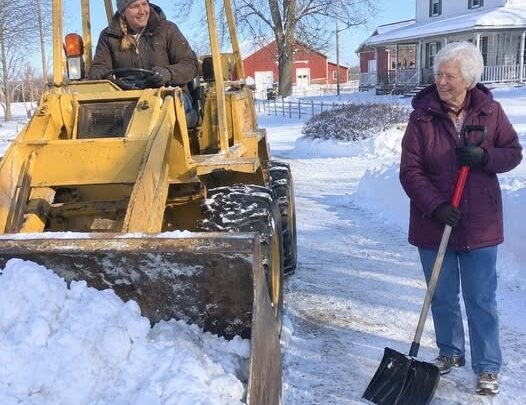
At first light on Wednesday, I drove out with the loader.
The fields lay beneath a hard blue sky.
Snowbanks caught the morning light, making the countryside look calmer than the week had felt.
When I reached Ione’s place, she was already outside.
She wore her long navy coat, a white hat, and old mittens.
In her hands was a shovel.
The wall across the entrance was enormous.
She had managed to chip out a small notch.
“I thought I could at least reach the box,” she said.
I looked at the red mailbox rising above the packed snow.
Then I looked at her.
“Let me do the rest.”
She began explaining that she hated calling me away from work.
“I’m here now.”
I waited until she was safely back from the machine.
Then I began.
The Red Mailbox
The loader broke through what her shovel had barely marked.
It still took care.
There was a mailbox to protect, gravel beneath the snow, and limited room to work.
When the entrance was open, I stopped.
Ione walked toward it slowly.
She placed a mittened hand on top of the red box.
“I’ve been looking at this from my kitchen window for nine days.”
Her voice was quiet.
I could not think of anything useful to say.
A cleared entrance meant she could leave.
It meant someone could reach her.
It meant the mailbox was an ordinary mailbox again, rather than something visible but inaccessible beyond a wall.
She stood there a moment longer.
Then she looked up at me.
“I’ll call the post office.”
Eleven Driveways
From the loader seat, I could see farther down Brandvold Road.
The township crews had opened the road itself.
Along the edges, the work had left packed ridges across the driveways.
Ione was not the only person looking at a barrier they could not easily remove.
There were eleven houses along that stretch.
I knew the people in most of them.
Some were older.
Some had livestock.
One young mother needed to reach an afternoon shift.
I could clear Ione’s entrance and leave.
That would solve the immediate problem I had come to address.
But the machine was already there.
I had arranged the morning away from the garage.
After checking with the first neighbor, I kept going.
Gus at His Front Door
Gus Lindquist lived near the bend.
He had lost his wife the previous spring.
Since then, he spent more time inside than he once had.
I stopped where he could see me and indicated the blocked entrance.
He opened the door, understood what I was offering, and nodded.
When the way to his garage was clear, he stood on the step holding a coffee cup.
“Thank you, Jessa.”
His voice barely carried above the machine.
“I wasn’t sure how I’d get out.”
I raised a gloved hand.
There was nothing grand about the exchange.
A blocked driveway.
A person with the means to clear it.
For a few minutes, the problem matched the equipment.
That was enough.
Tess and the Minivan
Farther along, Tess Anderson stood beside a shovel.
Her twin boys watched from a safe distance near the house, bundled into bright snowsuits.
Her husband was away driving a truck.
She needed to get to work.
“I’ve been at this since early,” she told me.
I looked toward the minivan and the barrier at the road.
She showed me where she needed access, then took the boys inside while I worked.
When I finished, they appeared at the window.
Both waved as though the loader had come specifically to entertain them.
Tess returned to the door.
For a moment, she looked too relieved to speak.
Then she mouthed thank you.
I went on to the next house.
Coffee and Eggs
Word traveled faster than the loader.
At one house, a neighbor brought out a thermos.
I stopped for a proper break and warmed my hands.
At another, someone asked whether I could help with a path beyond the driveway.
Merle Anderson needed to reach his chicken coop.
He was eighty-eight and had no intention of giving up his hens.
Once he could get through, he returned carrying a carton.
“From the girls.”
Inside were brown eggs.
I began to object.
He looked offended.
“You cleared a path. I’m giving you eggs.”
I accepted them.
By then, I understood that the morning was no longer only mine to organize.
People were checking on one another, finishing small sections with shovels, and asking what the next household needed.
The Carrier Behind Me
Near the end of the road, Darlene, the rural mail carrier, caught up with me.
She had a container of held mail.
“Ione called,” she explained. “Once I knew the entrances were being opened, I checked the route.”
“Did her parcel arrive?”
“Delivered.”
I let out a breath I had been holding longer than I realized.
“She was waiting by the door,” Darlene added.
I looked back along the road.
The mailboxes I had cleared were being used again.
Letters and parcels were reaching people who had watched for them from their windows.
That was the point of all the noise and fuel.
Not making a statement.
Making ordinary things possible again.
The Last Lane
Eventually, only Hollis’s entrance remained.
His lane was drifted over too.
He worked nights and farmed around those shifts. I knew he had come home exhausted.
I also knew he had ignored me twice.
For a moment, I sat with the engine idling.
Then I cleared the entrance.
I worked along the lane and left the snow where it would not block Ione’s drive.
The task took longer than some of the others.
It gave me time to be irritated.
It also gave me time to stop rehearsing what I might say when he saw me.
When I finished, I returned to Ione’s entrance and checked what remained there.
Then I shut down the loader.
The sudden quiet felt enormous.
Hollis Comes Outside
He appeared at his door a few minutes later.
He looked along his cleared lane.
Then he looked toward Ione’s driveway.
He went inside for his coat.
When he returned, he walked down toward us.
A few neighbors were still outside, finishing their own work or speaking across the snowbanks.
Hollis stopped near the lilacs.
“You did my lane.”
“I did the road.”
He looked back.
“You put it on the other side.”
“Yes.”
He stood for a moment.
Then he turned to Ione.
“I’m sorry.”
She leaned lightly on her shovel.
“I should have checked where it was landing,” he continued. “Jessa asked. I kept thinking I was doing it the way Dad did.”
Ione looked at him.
“Not all of it.”
What Arvid Did Afterward
Hollis frowned.
“I watched him.”
“I know.”
“He pushed it that way for years.”
“Yes,” Ione said. “And then he came back.”
He looked toward her driveway.
“Every time he finished his own lane, he cleared the end of mine.”
Hollis said nothing.
“Every storm,” she continued. “He never left me with that ridge.”
I remembered Dad saying the same thing.
Now I understood why.
Hollis had copied the first part of a familiar routine.
He had not known there was another journey afterward.
“Then he came in for coffee,” Ione said.
She looked toward her kitchen.
“His cup is still there.”
The Mug on the Hook
Ione invited Hollis and me inside.
The neighbors returned to their homes. Darlene continued her route.
I carried Merle’s eggs into the kitchen.
Thor inspected our arrival from a chair.
Beside the back door was a row of hooks.
One held a chipped white enamel mug with a faded green tractor logo.
Ione took it down, washed it, and filled it.
She placed it before Hollis.
“That was your father’s.”
He wrapped both hands around it.
“He kept a cup here?”
“For a long time.”
Hollis looked around the room.
The kitchen was full of ordinary things: a calendar, a dish towel, plants near the window.
But he seemed to be seeing a place he had never known existed.
Before They Were Neighbors With Tractors
“How long did you know him?” Hollis asked.
Ione sat across from him.
“We were sweethearts in high school.”
He looked up.
She gave a small smile.
“I went away for nursing school. He stayed when his family needed him on the farm.”
Life changed their plans.
Arvid married Marit.
Ione returned home later to help care for her parents.
They became neighbors with separate lives.
“Your mother was a good woman,” Ione said. “I want that understood.”
Hollis nodded.
“She knew about the coffee?”
“Of course. Sometimes she sent pie.”
I looked down at my cup.
There was no secret romance waiting to explain the years.
There was a friendship that had continued within the lives they built.
The First Winter Alone
The driveway help began after Ione’s father died.
She remembered going outside after a storm and finding a packed wall across the entrance.
“I needed to get to work,” she said. “I stood there with a shovel, feeling as though everything in the house and outside it had become my problem.”
Arvid saw her.
He returned with the tractor.
Afterward, she offered coffee.
The next storm, he came back without being asked.
Over the years, the routine became so familiar that neither made much of it.
“He knew I could ask,” she said. “He also knew I usually wouldn’t.”
Hollis stared at the mug.
For two winters, he had repeated his father’s movements without understanding the attention behind them.
What His Father Had Tried to Say
“When Dad was in the hospital,” Hollis said, “he kept saying something about the drive.”
He rubbed his forehead.
“I thought he meant keeping the tractor going.”
Ione reached across the table.
“Maybe he meant this one. We can’t know for certain.”
Hollis nodded.
“I told him I’d do it just like he did.”
For a while, he could not continue.
Ione left her hand near his.
Thor climbed into the empty chair as though he had decided the conversation required supervision.
Nobody tried to hurry Hollis through the moment.
There was coffee.
There was a place to sit.
That was what Ione and Arvid had offered one another for years.
The Folded List
Eventually, Hollis took a folded paper from his wallet.
“I found this in the tractor toolbox after he died.”
He opened it carefully.
Names and addresses appeared in pencil.
Ione’s name was first.
Then Gus and Ruth.
Merle.
The Hagens.
Other households along the road.
“I didn’t know what it was,” Hollis said.
Ione studied it.
“He checked whoever needed help after a bad storm.”
“Not just you?”
“No.”
She pointed to one name.
“After the hip operation.”
Another.
“When Ruth was ill.”
Hollis read the list again.
His father had left more than a machine and a habit.
He had left a record of people worth looking back for.
Three Weeks Later
The next substantial storm arrived in February.
By morning, the schools were closed.
I dressed and drove to Dad’s place, planning to borrow the loader again.
He was at the kitchen table with his coffee.
“You going to Ione’s?”
“Yes.”
“You might call first.”
I did.
She answered promptly.
“My drive’s clear, honey.”
“Already?”
“You can still come for coffee.”
Later that morning, I turned onto Brandvold Road.
Gus’s entrance was open.
Tess’s minivan was gone.
Merle had a path to the coop.
The dairy lane was accessible.
At the end of Hollis’s lane, the tractor stood near the lilacs.
I parked and walked to Ione’s back door.
The Chair by the Window
Hollis sat at the table.
His father’s mug was between his hands.
He looked tired.
He also looked pleased.
“I used the list,” he said.
Ione set another cup on the table for me.
“He asked Merle how Arvid used to arrange the work.”
“Merle had quite a few opinions,” Hollis said.
“That sounds like Merle.”
“And eggs.”
We laughed.
I sat down.
Outside, the cleared entrance lay bright beneath the morning light.
Inside, the furnace hummed.
Thor slept through the conversation.
For a while, nobody mentioned the earlier storms or the ridge that had started it.
We drank our coffee while Ione divided the egg bake.
Back on Its Hook
Before leaving, Hollis looked across at my aunt.
“I’ll check after every storm.”
She nodded.
“And afterward, if you’re making coffee…”
“I generally am.”
He smiled.
When he finished, he washed the mug and dried it with the towel beside the sink.
Then he returned it to the hook.
He did not take it home.
I watched him step outside and walk toward the tractor.
Ione stood beside me at the window.
For a moment, she said nothing.
Then she looked at the mug.
“His father used to put it back exactly like that.”
Outside, Hollis started the engine.
Ione returned to the table and reached for the pencil beside her calendar.
Another morning.
The mail could come.
The cup was ready for next time.