News
My Parents Tried to Take My $18.7 Million Inheritance Before I Moved to London — But Empty Bank Accounts Exposed Their Entire Plan
My Parents Tried to Take My $18.7 Million Inheritance Before I Moved to London — But Empty Bank Accounts Exposed Their Entire Plan

My Parents Tried to Take My $18.7 Million Inheritance Before I Moved to London — But Empty Bank Accounts Exposed Their Entire Plan
Editor’s note: This dramatized story explores family relationships, inheritance disputes, financial independence, personal boundaries, and the importance of protecting one’s future.
The Morning That Changed My Relationship With My Family Forever
Three days before I was scheduled to leave Boston and begin a new chapter of my life in London, my father invited me to a meeting that would permanently change the way I understood my family.
He described it as a simple financial discussion.
According to him, there were a few documents that needed my signature before I moved overseas. He assured me that everything was routine and that completing the paperwork would make managing my financial affairs much easier while I was abroad.
But something about his explanation didn’t feel right.
My father, Conrad, had never shown much interest in simplifying my life. Throughout my childhood and early adulthood, most of his attention had been directed toward my older brother, Desmond.
Whenever Desmond needed something, my father found a way to provide it. Whenever I needed help, I was encouraged to become more independent.
For years, I accepted that arrangement without questioning it.
I worked hard, supported myself, and built a successful career in cybersecurity. Eventually, I received an opportunity to relocate to London and help oversee major technology infrastructure projects.
It was everything I had worked toward.
Yet instead of celebrating my achievement, my father seemed unusually concerned about something else.
My inheritance.
Four years earlier, my grandmother had left me an estate consisting of investments, real estate, and other valuable financial assets. Over time, its combined value had grown to approximately $18.74 million.
It represented decades of careful planning and financial discipline.
More importantly, it represented my grandmother’s belief that I deserved the freedom to build a life of my own.
My father apparently had a different interpretation.
And on that cold morning in Boston, I was about to discover exactly what he had planned.
Growing Up in My Brother’s Shadow
To understand what happened in that attorney’s office, you need to understand what life was like growing up in our family.
Desmond was three years older than me.
He was confident, outgoing, and naturally comfortable around people. My father often described him as someone who was destined to become a successful businessman.
I was different.
I enjoyed computers, mathematics, reading, and solving complicated problems. I preferred spending an afternoon learning something new rather than attending expensive social gatherings.
My grandmother appreciated those differences.
My father did not always understand them.
Whenever Desmond received recognition at school, our family celebrated. When he expressed interest in business, my father introduced him to professional contacts and encouraged his ambitions.
My accomplishments were usually acknowledged with a brief compliment before the conversation returned to my brother.
At first, I assumed this was normal.
I believed that older siblings naturally received more attention because they reached important milestones first.
But as the years passed, the differences became increasingly difficult to ignore.
Desmond received expensive gifts, opportunities, and financial support.
I received advice about responsibility.
There is nothing wrong with teaching children responsibility. In fact, many of the lessons I learned during those years eventually helped me become successful.
What hurt was knowing that the same expectations rarely applied to both of us.
My grandmother noticed it too.
Whenever I visited her, she asked about my education, my goals, and the things I wanted to accomplish.
She never made me feel that my interests were less important simply because they were different from my brother’s.
Her home became the place where I felt comfortable being myself.
Years later, I would realize that she understood our family dynamics far better than I did.
The College Savings That Disappeared
One of the most painful experiences of my early adulthood happened when I was preparing to attend university.
For years, I had believed that a savings account established for my education would help cover some of my tuition expenses.
I had planned carefully around that money.
I researched universities, calculated living costs, and considered how much additional income I would need from part-time employment.
Then, shortly before I was supposed to begin my studies, I discovered that the money was gone.
My father had used it to purchase an expensive Porsche for Desmond.
When I confronted him, he explained that my brother needed a reliable vehicle because he was beginning an important stage of his life.
I asked what that meant for my education.
He told me that I was intelligent enough to figure something out.
At eighteen years old, I didn’t have the confidence to challenge him the way I would later in life.
Instead, I spent the following weeks searching for scholarships, applying for work, and adjusting my plans.
My mother promised that everything would eventually be made right.
She told me not to hold resentment toward my brother.
I wanted to believe her.
But the money was never replaced.
I worked evening and overnight shifts while attending university. Some weeks were exhausting. I often studied when other students were sleeping and worked when they were enjoying their weekends.
My grandmother helped whenever she could, but she also encouraged me to develop skills that nobody could take away from me.
She reminded me that education, experience, and independence could become more valuable than any expensive possession.
At the time, I didn’t realize how important those lessons would become.
Building a Career Without Depending on My Family
After completing my education, I began working in information technology.
My first positions were not particularly glamorous. I spent long hours reviewing systems, responding to technical problems, and learning how organizations protected sensitive information.
But I enjoyed the work.
Cybersecurity appealed to me because it required patience, attention to detail, and the ability to recognize problems before they became serious.
Over the years, I earned professional qualifications, gained experience, and accepted increasingly demanding responsibilities.
Each promotion felt meaningful because I knew how much effort had gone into achieving it.
Meanwhile, Desmond followed a different path.
With my father’s financial assistance and business connections, he established a real estate development company.
For a while, everything appeared to be going well.
He attended industry events, traveled frequently, purchased luxury vehicles, and spoke confidently about future investment opportunities.
My father regularly praised his business achievements during family gatherings.
I was happy that Desmond appeared to be doing well.
Despite our difficult relationship, I never wanted him to fail.
I simply wanted the freedom to pursue my own goals without constantly being compared to him.
As my cybersecurity career developed, I began saving and investing my own income.
Financial independence became increasingly important to me, partly because I remembered what had happened to my college savings.
I wanted to make decisions without worrying that someone else might interfere.
That desire for independence would eventually become the very thing my family tried to take away.
My Grandmother’s Unexpected Inheritance
My grandmother passed away four years before the meeting that changed everything.
Losing her was one of the most difficult experiences of my life.
She had been more than a grandmother to me. She was the person who listened when I needed someone to talk to, encouraged me when I doubted myself, and reminded me that my achievements mattered.
She had spent decades building and managing her financial assets.
Her estate included investment portfolios, properties, and other holdings accumulated through careful decisions over many years.
When her estate arrangements were explained, I discovered that she had designated me as the beneficiary of a substantial portion of her wealth.
I was overwhelmed.
The inheritance was far beyond anything I had imagined receiving.
My grandmother had always lived comfortably, but she rarely discussed the full extent of her financial affairs.
She preferred practical decisions over displays of wealth.
Her decision to leave me such a significant inheritance came with a message that I never forgot.
She wanted me to have choices.
She wanted me to pursue opportunities without allowing financial pressure to dictate every decision.
Most importantly, she wanted me to remain independent.
My father did not respond to the news with the same appreciation.
He questioned why she had made those arrangements.
He suggested that family assets should remain under collective management.
At first, I assumed he was simply disappointed.
I had no idea that his concerns would eventually develop into a carefully organized attempt to gain authority over my financial future.
Why I Decided to Move to London
The opportunity to relocate to London arrived after years of professional development.
My employer was expanding several major cybersecurity projects and needed experienced professionals capable of managing complicated international responsibilities.
When I received the offer, I was excited.
London represented more than a promotion.
It represented an opportunity to experience a different culture, expand my professional network, and establish a life outside the environment where I had grown up.
I began researching neighborhoods, preparing relocation documents, and arranging accommodation.
For the first time in years, I felt that my future was moving in exactly the direction I wanted.
I told my family during dinner.
My mother congratulated me, although she seemed worried about the distance.
Desmond asked several questions about my salary and relocation package.
My father remained unusually quiet.
Finally, he asked what would happen to my investments while I was abroad.
I explained that professional financial institutions and existing estate arrangements would continue managing the relevant assets.
There was no reason for anything to change simply because I was relocating.
He didn’t appear satisfied.
He suggested that overseas living could create unnecessary complications and that having someone in the United States oversee my financial affairs would be beneficial.
I thanked him for his concern.
Then I changed the subject.
Unfortunately, he had no intention of letting the matter go.
The First Signs That Something Was Wrong
Approximately six months before my planned departure, I received an unusual security notification from one of the financial institutions associated with my inheritance.
Someone had attempted to obtain information about an account using credentials that had not been authorized.
Because of my professional background, I understood the importance of investigating unexpected financial security alerts.
I contacted the institution through its official communication channels.
After verifying my identity, I learned that the attempted access had been unsuccessful.
At first, I considered the possibility that it was an ordinary security incident.
Financial institutions regularly deal with suspicious activity, and a single unsuccessful request did not necessarily prove that someone personally connected to me was involved.
However, additional incidents occurred over the following weeks.
There were unusual information requests, attempted verification procedures, and inquiries involving details that were not publicly available.
I began preserving the relevant records.
I contacted the professionals responsible for overseeing my grandmother’s estate and asked whether any legitimate administrative changes were underway.
They assured me that there were not.
The situation became more concerning when I learned that some of the requests appeared connected to my father’s business office and a legal firm with which he had previously worked.
I didn’t confront him immediately.
I wanted facts rather than assumptions.
During my cybersecurity career, I had learned that jumping to conclusions could create unnecessary problems.
So I continued gathering information and discussing the situation with independent professionals.
That decision proved to be one of the most important choices I ever made.
Meeting With My Grandmother’s Trusted Adviser
My grandmother had worked with an experienced financial adviser and estate administrator named Silas for many years.
He understood her financial arrangements better than almost anyone.
Several days before the meeting with my father, I visited his office and explained what had been happening.
He listened carefully as I described the security notifications, unusual requests, and my father’s growing interest in managing my inheritance.
When I finished, he remained silent for a moment.
Then he opened a file containing documents associated with my grandmother’s estate.
“Your grandmother was a remarkably thoughtful woman,” he said.
“I know.”
“She anticipated situations that other people might never consider.”
I asked what he meant.
He explained that her estate plan included protective arrangements intended to preserve my financial independence if certain unauthorized attempts to obtain control were identified.
Those arrangements were specific to the fictional estate structure she had established and would require appropriate professional and legal review before being activated.
We discussed the available evidence and the steps necessary to secure the assets.
Silas coordinated with the relevant financial institutions and independent legal professionals.
The objective was simple.
Protect the inheritance while preserving records and ensuring that nobody could make unauthorized financial decisions.
For the first time in months, I felt a sense of relief.
My grandmother was no longer alive, but the careful planning she had completed years earlier continued to protect me.
An Invitation I Couldn’t Ignore
Two days after meeting Silas, my father called.
He sounded unusually cheerful.
“Preston, I’ve arranged a meeting with Pierce. We need to finalize a few things before you leave.”
Pierce was an attorney who had previously assisted my father with business matters.
I asked what the meeting concerned.
“Nothing complicated,” Dad replied. “Just some arrangements to make sure everything runs smoothly while you’re overseas.”
“What arrangements?”
“Financial management. Property administration. Things like that.”
I could hear the impatience developing in his voice.
He had always disliked being questioned.
I told him I would attend the meeting but would not agree to anything without reviewing the documents independently.
He laughed.
“You’re making this more complicated than it needs to be.”
Perhaps.
But experience had taught me that important financial documents deserved careful attention, particularly when someone was encouraging me to sign quickly.
The meeting was scheduled for the following morning.
My father also mentioned that he had arranged lunch afterward.
Apparently, he expected everything to be completed before noon.
I wondered what exactly he intended to celebrate.
The Forty-Page Agreement
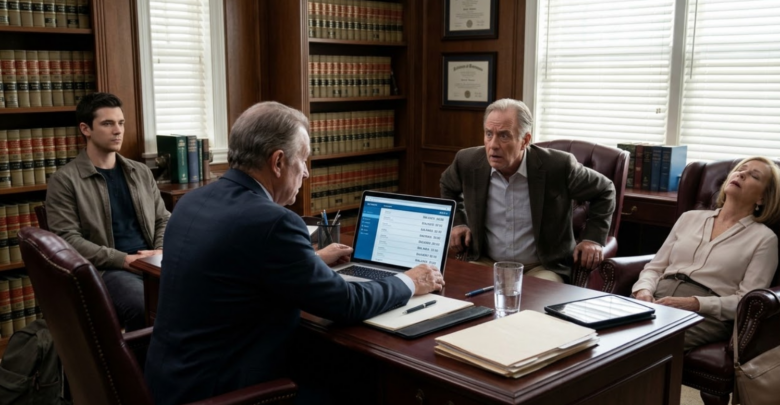
When I arrived at the law office, everyone was already waiting.
My father sat near the head of a large conference table.
My mother was beside him.
Desmond was looking at his phone.
Pierce had several folders arranged neatly in front of him.
A gold fountain pen rested beside a thick agreement.
My father greeted me with the kind of smile he usually reserved for important business associates.
“Good. You’re here.”
I took a seat.
Pierce began explaining the purpose of the meeting.
According to him, relocating overseas could complicate certain aspects of financial administration.
The proposed agreement was intended to establish a more convenient management arrangement.
I listened without interrupting.
Then he pushed the document toward me.
It was approximately forty pages long.
My father pointed toward the signature page.
“Everything has already been prepared.”
I opened the agreement and began reading.
Several provisions immediately caught my attention.
The document granted my father extensive authority over the inherited assets.
It included powers relating to investment management, asset sales, financial transfers, and the appointment of additional representatives.
There were also provisions concerning transactions involving affiliated business entities.
This was not a simple administrative convenience.
Signing the agreement could have significantly reduced my direct control over the inheritance.
I looked at Pierce.
“Why does my father need this level of authority?”
He explained that the document was designed to provide flexibility.
“For whose benefit?” I asked.
My father interrupted.
“Preston, we’re trying to help you.”
I looked down at the agreement again.
Help was not the word I would have chosen.
The Moment the Bank Accounts Showed Nothing
Before discussing the agreement further, Pierce attempted to confirm certain account information.
He entered the details of the first account into the institution’s verification process.
His expression changed.
He tried another account.
Then another.
My father leaned forward.
“What’s the problem?”
Pierce didn’t answer immediately.
He continued reviewing the available information.
Several of the accounts associated with the proposed arrangement were no longer active under their previous structure.
Their balances appeared empty because the assets had already been transferred into the independently managed protective arrangement.
My father stared at the monitor.
“That can’t be right.”
Pierce reviewed the information again.
Desmond finally put his phone away.
“Where’s the money?”
Nobody answered.
My father’s expression shifted from confusion to frustration.
“Those accounts held millions of dollars.”
Pierce explained that the previous accounts were no longer holding the assets they had expected to find.
Dad turned toward me.
“Preston, what did you do?”
I folded my hands on the table.
“Before I answer that, I think you should explain why you prepared an agreement giving yourself control over my inheritance.”
The room became completely silent.
My father had expected me to arrive, accept his explanation, and sign the paperwork.
He had not expected me to ask questions.
And he certainly had not expected the financial arrangements to have changed before the meeting began.
The Evidence My Father Hadn’t Expected
I opened my briefcase and removed a folder.
Inside were copies of relevant security notifications, correspondence, and records obtained during the preceding months.
I placed the first document on the table.
It concerned an unsuccessful request for financial information.
I explained that the request appeared connected to his business office.
My father barely looked at the document.
“That doesn’t prove anything.”
“Perhaps not by itself,” I replied.
I presented additional records.
There were several unusual requests involving information connected to my grandmother’s estate.
Some appeared associated with the legal firm that had prepared the proposed agreement.
Pierce became noticeably uncomfortable.
My father insisted that everything had been done with my interests in mind.
He described his actions as responsible family management.
I asked why nobody had simply contacted me and explained what they wanted.
He didn’t answer.
Instead, he accused me of treating him like a stranger.
“You’re questioning your own father.”
“I’m questioning financial decisions that were being made without my permission.”
My mother looked increasingly distressed.
Desmond avoided eye contact.
At that moment, I began to understand that the agreement was not an isolated misunderstanding.
It was the result of discussions that had been taking place without me for months.
But there was still one question I needed answered.
Why?
My Brother’s $9.5 Million Business Problem
I removed another document from my briefcase.
It was related to legal claims involving Desmond’s real estate development company.
According to publicly available court records within the story, investors were pursuing claims totaling approximately $9.5 million.
Desmond stared at the document.
“Where did you get that?”
I explained that the information had been available through public records.
My father immediately insisted that my brother’s business difficulties were unrelated to the inheritance.
I wasn’t convinced.
Desmond eventually admitted that several development projects had encountered serious financial problems.
Construction costs had increased.
Some business partners had withdrawn.
Expected sales had not developed as planned.
Investors were demanding explanations, and the company faced substantial obligations.
For years, Desmond had presented himself as a successful entrepreneur.
Now, sitting across from me, he appeared exhausted and worried.
I could understand why he was frightened.
Business failure can have serious financial and emotional consequences.
However, understanding his situation did not mean accepting responsibility for it.
I asked whether he had considered telling me the truth.
He looked toward our father.
Dad interrupted again.
“Your brother needs support.”
I agreed that family members could support one another.
But support should begin with an honest conversation.
It should not involve preparing legal documents designed to give someone access to another person’s financial assets without fully explaining the purpose.
Desmond suddenly became defensive.
“You have millions of dollars available while I’m trying to save everything I’ve built.”
There it was.
For the first time, someone had openly acknowledged what the meeting was really about.
They believed my inheritance could solve his financial problems.
The Difference Between Helping Someone and Losing Yourself
My father leaned forward.
“Family helps family.”
It was a phrase I had heard throughout my life.
Whenever Desmond needed assistance, it became the explanation for why sacrifices were necessary.
Whenever I questioned those sacrifices, I was reminded of my responsibilities as a son and brother.
I looked at my father.
“I agree that family should help each other.”
He seemed relieved.
Then I continued.
“But helping someone is different from giving them control over your future.”
His expression changed.
I explained that Desmond could have approached me honestly.
He could have described his company’s situation and asked whether I would consider providing advice or assistance.
I might have helped him examine possible options.
I might have introduced him to professionals who could assist with restructuring his obligations.
But those decisions should have belonged to me.
Instead, they had prepared an agreement that could have allowed my inheritance to be used in ways I had never approved.
My father insisted that their intentions were temporary.
Temporary arrangements, however, can have lasting consequences.
Especially when millions of dollars and struggling business entities are involved.
I looked at my mother.
“Did you know about this?”
Her eyes filled with tears.
She admitted that Dad had told her the arrangement would help stabilize Desmond’s business.
She had believed that everything would eventually return to normal.
I asked whether she understood how much authority the agreement granted him.
She lowered her head.
Her silence answered the question.
The Hidden Provision in My Grandmother’s Estate Plan
As the conversation continued, Pierce began reviewing additional estate documents.
He appeared increasingly uncomfortable.
Eventually, he removed a separate envelope from his files.
Inside were instructions associated with my grandmother’s original estate arrangements.
My father immediately became concerned.
“That’s not necessary,” he said.
Pierce continued reviewing the document.
He explained that my grandmother had established an independent protective mechanism addressing circumstances in which another person attempted to obtain unauthorized control of the inherited assets.
The arrangement was designed around her desire to preserve the beneficiary’s financial independence.
I listened carefully.
Although Silas had discussed the protections with me, I had not previously seen all the documentation Pierce was reviewing.
My grandmother had apparently anticipated that family pressure could become a serious problem.
She had understood that money sometimes changed relationships.
She had also understood that emotional pressure could be just as powerful as financial pressure.
Under the estate arrangement, Silas had responsibilities relating to the independent administration of the protected assets.
The recent evidence had already prompted a professional review.
The former account structure had been replaced with a more secure arrangement established under the applicable estate documents.
My father was furious.
He asked why he had not been informed.
Pierce explained that the financial arrangements concerned assets over which my father did not have the authority he was seeking.
For the first time that morning, Dad seemed to understand that his plan was not going to succeed.
My Mother’s Emotional Confession
The tension in the conference room became overwhelming.
My mother stood up, apparently intending to say something.
Instead, she became unsteady and reached for the back of a chair.
I immediately moved toward her.
Desmond stood up as well.
Within moments, the meeting was interrupted while medical assistance was arranged.
The paramedics evaluated her and recommended that she receive additional medical attention.
Whatever had happened between us, she was still my mother.
I was concerned about her well-being.
When she was feeling more stable, she reached for my hand.
“Preston, please don’t leave.”
For a moment, I remembered being eighteen years old.
I remembered sitting beside her after discovering that my college savings had disappeared.
She had promised that everything would eventually be resolved.
I had believed her because I wanted to believe that my parents would always protect me.
Now, years later, she was asking me to remain beside her again.
I told her I would make sure she was safe.
But I also knew that compassion did not require me to abandon my financial boundaries.
As the paramedics prepared to take her for further evaluation, she whispered something unexpected.
“Your father didn’t tell me everything.”
I asked what she meant.
She glanced toward him.
Then she mentioned that my grandmother had left instructions concerning the inheritance.
Before she could explain further, my father interrupted.
He insisted that she needed rest.
The conversation would have to continue later.
The Letter My Grandmother Had Left Behind
That evening, I visited my mother.
She appeared tired and emotionally overwhelmed, but she was able to speak comfortably.
For several minutes, we discussed ordinary things.
Then she opened a drawer beside her bed and removed an envelope.
She told me that my grandmother had given it to her after updating her estate arrangements.
The instructions were simple.
If my father ever attempted to take control of the inheritance, she was supposed to give the envelope to me.
I carefully opened it.
Inside was a handwritten letter.
I immediately recognized my grandmother’s writing.
My dearest Preston,
If you are reading this, then the people I loved most may have forgotten the difference between family and ownership.
I established these arrangements because I wanted you to have the freedom to make your own decisions. Trust the people who respect your independence, and never allow anyone to convince you that protecting your future makes you a bad son.
You are allowed to say no, even to family.
With all my love, Grandma.
I read the letter twice.
Then I folded it carefully.
I asked my mother why she had waited so long to give it to me.
She admitted that she had been afraid of challenging my father.
For years, she had avoided difficult conversations because she believed keeping the family together was more important than confronting the unfairness taking place within it.
I understood that she had struggled.
But understanding her choices did not erase their consequences.
I told her that rebuilding our relationship would take time.
She nodded.
For once, she didn’t ask me to forget what had happened.
The Independent Financial Review
Following the meeting, the independent review of the estate arrangements continued.
Silas worked with appropriate legal professionals and financial institutions to secure the assets and preserve the relevant records.
The review indicated that the attempted access was not limited to a single incident.
There had been several efforts to obtain financial information over an extended period.
Communications associated with my father’s business interests also suggested that the inheritance had been discussed as a potential source of financial support for Desmond’s company.
I found those discoveries deeply upsetting.
Not because I had lost money.
The assets remained protected.
What hurt was knowing that my family had been discussing my future as though it belonged to them.
They had apparently convinced themselves that obtaining access to the inheritance was justified because the money could solve a problem they were facing.
My grandmother had intended the inheritance to provide me with independence.
My father had apparently viewed that independence as an obstacle.
The professionals continued handling the necessary administrative and legal matters.
I focused on preparing for my relocation.
For years, I had allowed family conflicts to occupy an enormous amount of emotional energy.
I was determined not to let this situation destroy the opportunity I had earned.
A Conversation With My Brother
Before leaving Boston, I arranged to meet Desmond privately.
He arrived at my apartment wearing ordinary clothes rather than his usual designer outfits.
He seemed nervous.
For nearly a minute, neither of us spoke.
Finally, he said, “I know you probably hate me.”
I told him that I didn’t hate him.
I was disappointed, frustrated, and deeply hurt.
But hatred was not something I wanted to carry into the next stage of my life.
He admitted that he had known about the proposed financial arrangement.
Dad had told him that obtaining access to the inheritance could provide enough resources to stabilize his company.
Desmond had wanted to believe that everything would work out.
I asked why he had never approached me directly.
He didn’t have a convincing answer.
Eventually, he admitted that he was embarrassed.
His company had become closely connected to his identity.
For years, people had praised him for being successful.
Admitting that his business was failing would mean confronting the possibility that he had made serious mistakes.
He had become so focused on maintaining his lifestyle and reputation that he had stopped considering how his decisions affected other people.
I listened.
His honesty was important, but it did not automatically repair the damage.
I told him that I hoped he would take responsibility for his company’s obligations.
I also told him that my inheritance would not be used to rescue him.
For the first time, he accepted my decision without arguing.
Why My Brother Had Always Felt the Need to Compete
Our conversation eventually moved beyond the failed business.
I asked Desmond why our relationship had always felt like a competition.
He looked surprised.
Then he admitted something I had never expected.
He had been jealous of me.
I struggled to understand how that could be possible.
From my perspective, he had received nearly every advantage our family could provide.
Financial assistance.
Business connections.
Expensive gifts.
Opportunities I had never been offered.
But Desmond explained that he had constantly felt pressure to maintain our father’s expectations.
Every achievement needed to be followed by something bigger.
Every business success needed to become more impressive.
He had been afraid that losing his wealth would mean losing the respect of the people around him.
Meanwhile, he had watched me develop a career independently.
He knew our grandmother trusted my judgment.
He also knew that I had learned to continue moving forward without depending on our father’s approval.
His explanation didn’t excuse what he had done.
However, it helped me understand that our childhood experiences had affected both of us in different ways.
I had spent years believing that I needed to earn the attention I rarely received.
He had spent years believing that he needed to maintain the attention he had been given.
Neither of those beliefs had created a healthy relationship.
Before leaving, Desmond apologized.
It was not a perfect apology.
But it was a beginning.
Leaving Boston Without Looking Back
Three days after the meeting at the law office, I arrived at the airport.
My luggage was packed.
My relocation documents were ready.
The necessary arrangements concerning my grandmother’s estate were being handled by qualified professionals.
For the first time in several months, I could concentrate on my own future.
As I waited near the departure gate, my phone vibrated.
It was a message from Silas.
He confirmed that the latest independent valuation of the estate was approximately $18,740,000 and that the assets remained protected under the established arrangement.
I felt grateful.
Not simply because the money was secure, but because my grandmother’s wishes had been respected.
Another message arrived from my mother.
She wished me a safe journey and told me she was proud of me.
I thanked her and promised to call after arriving in London.
Then I received a message from my father.
He wanted to discuss what had happened.
He reminded me that he was still my father and insisted that we should resolve the situation before I left.
For years, a message like that would have made me feel guilty.
I would have immediately rearranged my plans.
I would have apologized for creating tension, even when the underlying problem was not mine.
This time, I put the phone away.
I wasn’t interested in punishing him.
I simply understood that I did not have to respond to every demand.
When the boarding announcement came, I collected my belongings and walked toward the aircraft.
As Boston disappeared beneath the clouds, I felt something I hadn’t experienced in a long time.
Freedom.
Beginning a New Life in London
The first few months in London were filled with unfamiliar experiences.
I had to adjust to a new workplace, a different transportation system, and the everyday routines of living in another country.
There were moments when I missed familiar places in Boston.
But there were also countless opportunities to explore something new.
I enjoyed walking through different neighborhoods, visiting museums, discovering small restaurants, and spending weekends exploring the city.
My work was challenging in the best possible way.
I collaborated with talented engineers and technology professionals on complicated cybersecurity projects.
The responsibilities required focus, teamwork, and continuous learning.
I rented an apartment overlooking the Thames.
It wasn’t enormous or excessively luxurious.
I chose it because I liked the location and the peaceful atmosphere.
For the first time, I was creating a home based entirely on my own preferences.
I purchased furniture slowly.
I decorated the apartment with photographs, books, and objects that reminded me of important moments in my life.
One of those objects was my grandmother’s letter.
I kept it somewhere safe.
Whenever I began doubting whether I had made the right decision, I remembered the words she had written.
I was allowed to make choices about my own life.
And I didn’t need anyone’s permission to do so.
What Happened to My Brother’s Real Estate Company?
During the months following my departure, Desmond’s company continued facing financial difficulties.
The business eventually entered a formal restructuring process.
Investors pursued their outstanding claims, and Desmond had to reconsider the lifestyle he had maintained for years.
Several personal assets were sold.
His expensive apartment was replaced with more modest accommodation.
The luxury vehicles that had once represented his success were no longer part of his daily life.
My father also faced difficult questions concerning his involvement in the proposed financial arrangement.
Some of his business relationships changed.
He was required to address matters connected to the independent review.
I did not celebrate these developments.
Watching people experience the consequences of their decisions was not something that brought me happiness.
I hoped Desmond would eventually find a healthier way to rebuild his life.
I hoped my father would understand why his actions had damaged our relationship.
But I also recognized that their recovery was not something I could accomplish on their behalf.
Each person needed to accept responsibility for their own choices.
Protecting my inheritance did not mean that I wanted my family to fail.
It meant that I was no longer willing to sacrifice my future to prevent them from facing difficult realities.
That distinction took me years to understand.
Creating Something Meaningful With My Inheritance
As I settled into my new life, I began thinking more seriously about what my grandmother’s inheritance represented.
I could have purchased an enormous house.
I could have collected expensive vehicles or surrounded myself with luxury possessions.
There was nothing inherently wrong with enjoying financial success responsibly.
However, I wanted the inheritance to accomplish something that reflected my grandmother’s values.
I remembered the years I had spent working overnight shifts while attending university.
I remembered worrying about textbook costs and tuition payments.
I remembered how difficult it had been to concentrate on my education while constantly calculating whether I could afford the next semester.
Those memories inspired me to establish a charitable education fund in my grandmother’s name.
The initial contribution was $500,000.
Its purpose was to help students from lower-income households manage educational expenses, including tuition, textbooks, and essential living costs.
Silas assisted with the professional arrangements necessary to establish the fund.
For me, it represented an opportunity to transform a difficult personal experience into something constructive.
My grandmother had helped me believe that my future mattered.
Through the education fund, I hoped other students would receive encouragement and practical assistance when they needed it most.
The inheritance became more than a collection of financial assets.
It became an opportunity to honor the person who had believed in me long before I believed in myself.
An Unexpected Phone Call From Desmond
Approximately six months after I moved to London, my phone rang one afternoon.
It was Desmond.
We had exchanged occasional messages, but we had not spoken for a significant length of time.
I considered letting the call go unanswered.
Then I decided to pick up.
His voice sounded different.
There was less confidence, but also less defensiveness.
He told me that he had found employment with a property management company.
The position was not particularly prestigious.
However, it provided a regular income and an opportunity to rebuild his professional experience.
He was living in a smaller apartment and working through his remaining financial obligations.
He had also begun attending counseling sessions to better understand his relationship with money, status, and our father’s expectations.
I was genuinely pleased to hear that.
For years, I had watched him pursue increasingly expensive possessions because he believed they represented success.
Now he was beginning to measure progress differently.
Before ending the call, he told me that he had visited our grandmother’s grave.
He had apologized for the choices he had made.
He wished he had appreciated her advice when she was alive.
Then he asked whether I thought we could ever become close again.
I told him that I was willing to try.
But our relationship needed to be built on honesty rather than financial expectations.
He agreed.
It wasn’t a dramatic reconciliation.
There were no grand promises.
Just two brothers acknowledging that their relationship needed to change.
Sometimes, that is enough to begin.
Returning Home Almost a Year Later
Nearly a year after leaving Boston, I returned for a short visit.
My mother invited me to dinner.
Instead of arranging an expensive restaurant or a formal family gathering, she prepared one of my grandmother’s favorite meals.
Desmond joined us.
My father was not there.
He had expressed interest in meeting with me, but I had declined.
I wasn’t ready for that conversation.
During dinner, my mother brought out an old photograph.
It showed my grandmother sitting between Desmond and me in her garden.
We were both children.
Neither of us was thinking about business success, financial independence, investment portfolios, or inheritance disputes.
We were simply laughing.
My mother placed the photograph on the table.
“She loved both of you,” she said.
Desmond nodded.
He admitted that he wished he had understood that earlier.
For a few moments, the conversation became quiet.
I looked at the photograph and remembered a time when our relationship had been uncomplicated.
We had changed significantly since then.
Some experiences could never be undone.
But perhaps we could build something better from what remained.
After dinner, my mother gave me the photograph.
I took it back to London and placed it beside my grandmother’s letter.
Together, those two items reminded me that protecting myself did not require forgetting every good memory.
It simply required being honest about the difficult ones.
Understanding the Importance of Financial Independence
Before receiving my inheritance, I had believed that financial independence meant earning enough money to support myself.
Over time, I discovered that it meant something more.
It also meant having the ability to make decisions without being controlled through financial pressure.
Money can provide opportunities.
It can help someone pursue education, purchase a home, start a business, or prepare for retirement.
But financial resources can also become a source of disagreement when expectations are not clearly communicated.
My experience taught me to take financial documents seriously.
I learned the importance of reviewing agreements independently and understanding the responsibilities associated with significant assets.
I also learned that professional assistance can be valuable when dealing with complicated inheritance arrangements.
Most importantly, I learned that financial boundaries are not necessarily a rejection of the people we love.
A person can care about family members while maintaining control over their own resources.
They can offer assistance when appropriate without accepting unlimited responsibility for another person’s decisions.
Those distinctions matter.
Financial independence is not simply about the amount of money someone possesses.
It is also about the freedom to determine how that money will be managed and used.
Forgiveness Does Not Mean Forgetting What Happened
My relationship with my mother gradually improved.
We spoke regularly.
She apologized for allowing fear of my father to influence decisions that affected me.
I appreciated her willingness to acknowledge what had happened.
However, I did not pretend that everything had immediately returned to normal.
Trust takes time to rebuild.
A sincere apology may begin the process, but consistent behavior is often what allows a damaged relationship to recover.
Desmond and I also continued speaking.
We occasionally discussed work, ordinary family memories, and the challenges of rebuilding our relationship.
My father remained more distant.
Perhaps we would eventually have an honest conversation.
Perhaps our relationship would always be complicated.
I no longer felt obligated to determine the outcome immediately.
For most of my life, I had believed that keeping the family together was more important than expressing my own feelings.
Now I understood that healthy relationships require participation from everyone involved.
Forgiveness does not necessarily mean returning to the same circumstances that caused the original pain.
It can mean releasing resentment while maintaining reasonable boundaries.
It can mean recognizing someone’s humanity without giving them unlimited access to your life.
And it can mean accepting that certain relationships may never become exactly what you hoped they would be.
The Fountain Pen That Reminded Me of Everything
On my thirty-first birthday, I received a small package from my mother.
Inside was an old fountain pen that had belonged to my grandmother.
I recognized it immediately.
She had used it to write birthday cards, personal letters, and notes throughout my childhood.
A small message accompanied the gift.
For Preston, who finally learned that his signature belongs to him.
I held the pen for several minutes.
Then I remembered the conference room in Boston.
The forty-page agreement.
The gold fountain pen my father had placed beside it.
The financial accounts that no longer contained the assets he expected to find.
And the moment I realized that he had assumed my future could be negotiated without my meaningful consent.
My grandmother’s fountain pen represented something entirely different.
It reminded me that important decisions should be made thoughtfully.
A signature can represent agreement, responsibility, trust, and personal commitment.
Nobody should feel pressured to sign away important rights simply because someone else insists that doing so is convenient.
I placed the pen beside my grandmother’s photograph.
It became one of my most valued possessions.
Not because it was expensive.
Because of what it represented.
The Most Valuable Thing I Reclaimed Wasn’t Money
My parents had entered that Boston law office expecting to obtain control over a substantial inheritance.
They had prepared documents.
They had discussed potential financial arrangements.
They had apparently convinced themselves that using my grandmother’s assets could resolve Desmond’s business difficulties.
They believed I would cooperate because I had spent so many years accepting their expectations.
But they had overlooked something important.
I was no longer the eighteen-year-old student who had discovered that his college savings had disappeared.
I was an adult who had worked hard to build a career.
I understood the importance of protecting sensitive information.
I understood that financial decisions could have lasting consequences.
And I finally understood that being someone’s son did not mean surrendering my independence.
The $18.74 million remained protected under the arrangements established through my grandmother’s estate.
I continued developing my career.
I continued supporting educational opportunities.
I continued rebuilding the relationships that could be rebuilt.
And I stopped measuring my worth through my father’s approval.
The most valuable thing I reclaimed that morning was not the inheritance.
It was the freedom to make my own decisions.
What This Story Teaches Us About Family, Money, and Trust
Inheritance disputes can reveal unresolved disagreements that have existed within families for many years.
Money may become the immediate subject of conflict, but deeper issues involving favoritism, expectations, communication, and control can contribute to the situation.
Preston’s story illustrates the importance of distinguishing generosity from obligation.
Helping a family member can be a meaningful decision when it is made voluntarily and with a clear understanding of the circumstances.
However, personal relationships should not replace transparent communication when significant financial matters are involved.
The story also demonstrates why independent professional guidance can be valuable when reviewing complicated financial arrangements.
Estate planning, inheritance administration, investment management, and legal agreements can involve responsibilities that deserve careful consideration.
Every real-life situation is different, and appropriate decisions depend on individual circumstances and applicable laws.
Perhaps the most important message, however, concerns personal boundaries.
A healthy family relationship should leave room for individual choices.
It should allow people to pursue their goals without constantly being asked to sacrifice their financial security or emotional well-being.
Love and independence do not have to be opposites.
Family members can care about one another while respecting different priorities, responsibilities, and decisions.
Final Thoughts: Sometimes Saying No Is the Beginning of a Better Life
Years after my grandmother’s passing, I finally understood why she had placed so much importance on financial independence.
She wanted me to have opportunities.
She wanted me to pursue my education, develop my career, travel, and create a meaningful life.
She also wanted me to understand that generosity should come from choice rather than pressure.
My father had viewed my inheritance as a possible solution to our family’s financial difficulties.
My brother had viewed it as an opportunity to rescue his struggling company.
But my grandmother had viewed it as something entirely different.
A chance for me to live without being controlled by someone else’s expectations.
By protecting the inheritance, I wasn’t rejecting everything my family represented.
I was honoring the intentions of the person who had understood me best.
Today, when I look at her photograph and read her letter, I no longer think primarily about the amount of money involved.
I think about the opportunities she gave me.
The education fund established in her name.
The career I continued building.
The relationships I learned to approach with greater honesty.
And the peaceful life I was finally able to create.
Sometimes, the greatest inheritance someone leaves behind is not financial wealth.
It is the wisdom to recognize your own value.
My grandmother gave me both.
And I will always be grateful.
THE END.