News
My Best Friend Took My Son to the Same Diner for Ten Years—Then a Waitress Told Me Why
My Best Friend Took My Son to the Same Diner for Ten Years—Then a Waitress Told Me Why

Three people said my son’s name before we even sat down.
We stepped into the diner at six o’clock on a Saturday evening in April. It’s called The Blue Spoon. It sits out on Route 12, past the tire place, in a little strip of buildings that hasn’t been updated since about 1987. Brown vinyl booths with duct tape on two of the seats. A pie case that hums so loud you can hear it from the door. A laminated menu with photographs of the food on it, which I honestly thought had gone extinct.
The door swung shut behind us with a little jingle.
And three different people called out to my son.
“Happy birthday, Noah!”
“Eighteen! No way!”
“Hey, hey, birthday boy!”
Noah barely reacted. He lifted one hand about six inches off his hip, the way he does, and kept walking toward the back of the restaurant.
Like being greeted by name by strangers in a public place was the most ordinary thing in the world.
I stopped so suddenly my husband, Matthew, nearly stepped into the back of me.
He laughed. “Look at that. Our kid’s a local celebrity.”
But I was not laughing.
I looked over at Megan.
And Megan wasn’t smiling.
She was looking at the floor.
Then an older woman came around the end of the counter, fast, drying her hands on a dish towel.
She was maybe sixty. Short, sturdy, with gray hair twisted up in a clip and reading glasses pushed up on top of her head. Her name tag said DONNA.
“There he is!” she said.
And Noah’s whole face changed.
I know my son’s face. I’ve been reading it for eighteen years like it’s the only book I own.
And I watched it do something I almost never see it do in public. It loosened. Everything let go. His shoulders. His jaw. The little line between his eyebrows that’s almost always there when we’re somewhere new.
That’s the face he makes at home. On the couch. In his room with his headphones on.
That’s the face he makes when he doesn’t have to work.
“Hi, Donna,” he said.
Donna hooked a thumb toward the back.
“Booth seven?”
“Yes.”
“Gary still hasn’t fixed that wobbly leg, honey. I’ve asked him four times.”
“I know,” Noah said. “It’s the front left one. It needs a shim.”
“I told him it needs a shim.”
“He should use a shim,” Noah said.
And he walked off toward the back of the diner. Toward booth seven. Like he’d walked that path a thousand times.
I stood there in the middle of the diner holding a gift bag with tissue paper sticking out of it.
I could not make any of it fit together.
Noah hadn’t introduced himself. Megan hadn’t introduced anybody.
But this woman knew his name. Knew his birthday. Knew which booth he sat in. Knew about a wobbly table leg that my son apparently had strong opinions about.
Then Donna turned to Matthew and me.
“And you two must be Noah’s parents.”
“I’m Stephanie,” I said. “This is Matthew.”
“I know,” Donna said.
She said it so easily. Without any ceremony at all.
And my stomach went tight.
Because I know meant somebody had talked about us. For a long time. In a place I’d never been.
I looked at Megan again.
She was studying the dessert case like it was going to be on a test.
To explain why I never asked more questions, I have to go back.
Way back.
Megan Vance has been my best friend since the fourth grade.
We met on the first day of school at Lincoln Elementary. She sat behind me and kept kicking my chair. When I turned around to tell her to stop, she held out half of a peanut butter cup and said, “Truce?”
I took it.
We’ve been friends ever since.
We grew up two streets apart. We learned to ride bikes on the same hill. We had the same terrible haircut in seventh grade. We went to the same college for one semester before I transferred closer to home. She was my maid of honor. She gave a toast at my wedding that made my grandmother cry and my uncle choke on a shrimp.
And she was in the waiting room when Noah was born.
Thirty-one hours of labor. Megan stayed for all of them. She slept in a plastic chair. She ate eleven bags of pretzels from the vending machine.
When Matthew came out and said, “It’s a boy,” she cried so loud a nurse told her to keep it down.
Noah was diagnosed with autism when he was three.
I’d known something was different for some time. He did not point at things. He did not wave bye-bye. He lined up his toy cars in perfect rows across the living room floor and screamed if anyone moved one. He did not answer to his name. Sometimes I wondered if he could hear at all.
Then one afternoon, I dropped a pot lid in the kitchen, and he screamed like he’d been burned, and he didn’t stop for forty minutes.
He could hear.
He could hear everything.
The diagnosis came in a small office with a beige carpet and a box of tissues on the table. The doctor was kind. She talked for a long while.
I don’t remember most of it.
I remember one thing.
She said, “The world isn’t built for kids like Noah. You’re going to spend a lot of time building a bridge for him.”
I drove home and sat in the driveway with Noah asleep in his car seat, and I made a decision.
I would build that bridge.
I would build it out of my own body if I had to.
And I did.
For fifteen years, I was the bridge.
I learned everything. I read every book. I went to every workshop. I sat in every meeting. I filled two whole filing cabinets with paperwork. I learned the words. Sensory processing. Executive function. Stimming. Masking. Overload. Shutdown.
I learned my son. Every sign. Every signal.
I knew what it meant when he went quiet. I knew what it meant when he started tapping his thumb against his finger.
I knew the exact pitch of the noise he made when he was about to fall apart, and I knew I had about ninety seconds to get him out of wherever we were before it happened.
I knew which restaurants had loud music. Which grocery stores had the buzzing lights. Which birthday parties had balloons that might pop.
I was always first.
First to see it coming. First to step in. First to explain him to a stranger. First to answer for him.
I called it helping.
Noah was a wonderful kid. I want to be clear about that.
He was funny. He was honest in a way most people aren’t brave enough to be. He knew the name of every bird that came to our feeder. He could tell you the weight of every planet in the solar system. He noticed everything. Everything.
The crack in the ceiling that hadn’t been there yesterday. The car that drove by twice. The book on the shelf that I’d put back upside down.
But the world wasn’t patient with him.
And restaurants were the worst.
Restaurants are loud.
Servers ask questions fast. Dishes crash in the kitchen. Chairs scrape on tile floors. The music changes without warning. Somebody drops a tray. A baby screams. A table of eight bursts out laughing. And through all of it, a stranger stands over you with a pen, waiting for an answer. Right now.
Noah needed several seconds.
That’s all. Not minutes. Seconds.
He needed to hear the question. Hold it. Sort it out. Find the answer in his head. And then say it.
But by the time he got there, I’d already said it for him.
Every single time.
There was one afternoon in particular.
Noah was eight. Megan and I took him to lunch at a chain restaurant near the mall. It was a Saturday. Packed. Loud.
The waitress came over. Young. Fast. She had three other tables waiting.
She glanced down at Noah.
“And what can I get for you, buddy?”
Noah looked at the menu.
One second.
Two.
His fingers tightened on the edge of the page.
“He’ll have fries,” I said.
The waitress wrote it down and hurried away.
He ate every single fry. So I filed it as a success.
I’d read the room. I’d protected him from a stranger standing over him tapping a pen. I’d gotten him what he wanted. Crisis averted.
Then, out in the parking lot, while I was digging through my purse for my keys, Megan crouched down in front of him.
“Hey,” she said. “Did you want fries, sweetie?”
“Yes, Aunt Megan.”
“Good. That’s good.”
Noah hesitated.
He looked at the ground. He tapped his thumb against his finger. Three times.
“But I wanted to say it,” he said.
I heard him.
I want to be honest about that. I heard every word.
And every defensive thing in me came up at once.
I knew what he wanted. Of course I did. I was keeping a rushed stranger from staring at him. I was making it easier. I was doing what you do. What I’d always done. What I’d been doing since he was three years old.
I found my keys. I unlocked the car. I buckled him in.
I said nothing.
Neither did Megan.
Not that day. Not ever.
But a month later, she showed up at my front door on a Saturday morning, holding her car keys.
“I’m borrowing Noah,” she said.
“For what?”
“Three hours of freedom.”
“For him or for me?”
“Both,” Megan said. “Obviously.”
I started rattling off instructions.
I could not help it. It just came out. About crowds. About noise. About what it means when he goes quiet. About the thumb tapping. About how he gets right before he’s overloaded, even if he hasn’t said anything yet. About which lights bother him. About the backup snack in his backpack. About the noise-canceling headphones in the front pocket. About—
Megan put both her hands on my shoulders.
“Steph,” she said. “I know him.”
And Noah appeared behind her in the hallway, with his backpack already on and his shoes on the wrong feet.
“I’m ready, Aunt Megan.”
Three hours later, they came back.
Noah walked in the front door smelling like french fries.
“Where’d you go, bud?”
“Park,” Noah said. “Bookstore. And diner, Mama.”
Megan dropped onto my couch like she’d run a marathon.
“I found a little place out on 12,” she said. “He likes it.”
“The fries are correct,” Noah said.
I laughed. “Correct?”
“Yes, Mama. Crispy outside. Soft inside. That’s correct.”
That was it.
That was the whole story I got. And I accepted it completely.
The diner became a thing. Once a month. Sometimes twice. Every time, Noah came home smelling like fryer oil. Every time, I asked where they’d been. And every time, Megan gave me the same answer.
“That little diner. He likes the fries.”
For ten years.
I never questioned it. Not once.
Looking back now, I can see it.
Noah told me. Over and over. For ten years. In his own way.
I just never understood what I was being told.
When he was nine, he came home and said, “Donna touched my shoulder.”
I went on full alert.
“Did you tell her you didn’t like it?”
“Yes, Mama.”
“What happened?”
“She said okay.”
That was it. That was the whole conversation. I asked Megan if everything was all right. She said it was fine. I moved on with my life.
The next month, he said, “Donna doesn’t ring the bell when I’m there anymore.”
“What bell?”
“The service bell, Mama. On the counter. For when the food is ready.”
Megan explained. The sharp ding had bothered him. So they’d stopped ringing it when he was there.
I remember thinking, What nice people.
And I never once asked why a restaurant would change the way it operated for a nine-year-old who came in once a month.
When he was twelve, he said, “Mr. Donald likes me.”
“Who’s Mr. Donald?”
“He drinks coffee, Mama.”
Megan laughed. She said Mr. Donald was an old man who sat at the counter every Saturday and put away four cups of coffee per visit, minimum.
She said he was at this point roughly thirty percent caffeine by volume.
Noah immediately corrected her math. Out loud. With reasoning. Something about the average volume of a diner coffee mug and the water content of the human body.
We all laughed.
And I thought nothing of it.
When he was fourteen, he came home half an hour later than usual. He smelled like coffee and fryer oil instead of just fries.
“What were you doing?”
“Helping Donna, Mama.”
“Helping her with what?”
“Sugar,” Noah said.
And he went upstairs.
I turned to Megan with my eyebrows somewhere up near my hairline.
She laughed. She told me Noah had gone around to every single table in the diner and reorganized the sugar packet caddies. Somebody on the closing shift the night before had mixed all the colors up.
“They were mixed, Aunt Megan,” Noah called down the stairs.
“Apparently,” Megan said to me, “pink next to yellow is an international crime.”
“They have sections, Aunt Megan,” Noah called. “White, then pink, then blue, then yellow, then brown. It’s the order.”
After he’d gone into his room, I looked at her.
“Chlo,” I said. “Why is a waitress letting my kid reorganize her tables?”
She hesitated.
Just a beat.
“He likes helping, Steph,” she said.
Something about that answer sat wrong with me.
It really did. I felt it. Like a tiny pebble in a shoe.
But then the dryer buzzed. Or the phone rang. Or one of the eleven thousand other things happened that happen in a day when you’re the parent of a kid like Noah. And the conversation went away.
Two years later, when he was sixteen, he came home with a big ketchup stain down one sleeve.
“What happened?”
“I filled bottles, Mama.”
I turned to Megan.
“They’re letting customers refill the ketchup now?”
“He was helping.”
“Again?”
And for one second, Megan looked genuinely uncomfortable.
She looked away. She shifted her weight. Her hand went to the side of her thumb.
I almost pushed.
I had the words ready. Megan, what is actually going on at that diner?
Then Noah called down from upstairs. He couldn’t find his charger. And by the time I’d found it in the couch cushions and come back to the kitchen, Megan had her purse on her shoulder and was halfway out the door.
“See you next month,” she said.
I never asked again.
I should have.
On the morning of Noah’s eighteenth birthday, we were all sitting at the kitchen table. Matthew. Me. Noah. And Megan, who’d come over early with a box of donuts like she does every year.
“Okay,” I said. “Birthday boy. Where do you want to go for dinner tonight?
Anywhere. Your pick.”
Noah didn’t even hesitate.
“The diner!”
Megan nearly put her coffee mug through the table.
I laughed.
“Finally,” I said. “After ten years, I’m going to see the famous correct fries.”
Matthew laughed too.
But Megan didn’t laugh.
Instead, she started offering alternatives.
“We could do somewhere nicer, though,” she said. “It’s eighteen. That’s a big one.”
“The diner is nice,” Noah said.
“I mean somewhere special.”
“The diner is special.”
Matthew grinned into his cereal.
“Birthday boy wins,” he said. “That’s the rule.”
But Megan kept going.
“What about the steakhouse? The one out by the highway? With the big leather booths?”
“No thank you,” Noah said.
“That Italian place. With the good bread. You love that bread.”
“No thank you.”
“The seafood place? On the lake?”
“No thank you.”
“The Thai place? The new one?
Or the Mexican place downtown, with the—”
“No thank you, Aunt Megan,” Noah said. Patiently. Every single time. “I want the diner.”
She’d listed five restaurants in about ninety seconds.
I folded my arms.
“Megan,” I said. “Why don’t you want us going to the diner?”
Her face went white.
“I never said that.”
“You’ve taken him there once a month for ten years. And now we want to go one single time, and you’re throwing steakhouses at us.”
“Steph. You’re reading way too much into this.”
Maybe I was.
But I’ve known that woman since we were nine years old.
And I know exactly what she does when she’s lying.
She picks at the skin beside her thumbnail.
She was doing it right then. Under the table. Where she thought I could not see.
“I want the diner,” Noah said again.
“Then that’s where we’re going,” I said.
Megan looked down into her coffee.
She barely said twenty words the rest of the afternoon.
So now, standing in the middle of The Blue Spoon with a gift bag in my hand, I understood why she’d been nervous.
Or I thought I did.
Everybody in this place knew my son personally.
We followed Noah back to booth seven.
It was in the far corner, against the back wall, away from the kitchen door and the bathrooms and the front entrance. Under a window that looked out at the parking lot. Away from everything loud.
Of course it was.
Noah slid in first, all the way to the wall. Matthew slid in next to him. Megan and I sat across.
The table wobbled. Front left leg.
Noah pressed down on it with his palm. “It needs a shim,” he told Matthew.
“I heard,” Matthew said.
Donna came over.
She did not bring Noah a menu.
She just stood there with her order pad.
“Usual?”
Noah thought about it. Really thought. One second. Two. Three.
Donna waited. She did not tap her pen. She did not shift her weight. She did not look at me. She just waited.
“Grilled cheese today,” Noah said.
Donna put her hand on her chest and gasped. Like he’d just announced a career change.
“On your birthday? Living dangerously.”
Noah smiled.
An actual smile. The wide one. The one he gives maybe four people in the whole world.
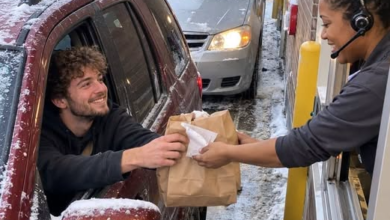
Then a teenage busboy went by our booth with a gray plastic tub full of dirty dishes. He was maybe seventeen. Skinny, with a nose ring and a black apron. His name tag said RYAN.
He called over his shoulder without even slowing down.
“Saturday still good, Noah?”
“Yes,” Noah said.
I turned to my son.
“What’s Saturday?”
And before Noah could answer, Megan’s fork slipped out of her hand and hit her plate with a bright, sharp metal clang.
Noah flinched.
“Sorry, buddy,” Megan said, fast.
But she wasn’t looking at Noah.
She was looking at me.
A few minutes later, an old man came over to our booth.
He was in his eighties, at least. Tall, but stooped. Thin white hair combed carefully to one side. A brown cardigan with leather patches on the elbows. He was carrying a coffee mug in one hand that he’d obviously brought from his own table at the counter.
“Eighteen years old,” he said. “Hard to believe it.”
Noah looked up at him.
“Time doesn’t change,” Noah said, completely deadpan, “based on whether you believe it, Mr. Donald.”
The old man laughed so hard he had to steady his mug with his other hand.
“No,” he said. “No, I suppose it doesn’t.”
Then he looked across the table at me.
His eyes were pale blue and watery and very kind.
“You raised a good one, ma’am,” he said.
Before I could form a single question, like How do you know my son? or How long have you known my son?, Mr. Donald reached down and tapped the edge of our table twice with two fingers.
Tap. Tap.
And Noah, without even looking up from his water glass, reached out and tapped twice back.
Tap. Tap.
The old man nodded once. Then he turned and walked slowly back to his seat at the counter.
They had a thing.
A greeting. A signal. Something the two of them had built together. Something with a beginning I hadn’t been there for.
I leaned across the table toward Megan.
“Tell me what’s going on,” I said. Low.
“Not here, Steph.”
My heart started pounding.
“So there is something. What have you been—”
Noah looked over at us.
And I stopped.
Because whatever this was, I was not going to turn my son’s eighteenth birthday into an interrogation across a diner table.
The food came. Noah’s grilled cheese was cut diagonally. Into exactly four triangles. All the same size. Nobody asked how he wanted it.
Donna set it down. “Four triangles. Crusts on. Pickle on the side, not touching.”
“Thank you, Donna.”
“Don’t thank me. Thank Gary. He measured.”
I watched Noah pick up the first triangle.
I did not cut my son’s grilled cheese into four triangles until he was eleven. I did not know he wanted it that way until he told me.
These people knew.
Then dessert came.
And something else hit me.
There was no song.
No cluster of employees crowded around the booth, clapping and shouting some off-brand restaurant version of “Happy Birthday.” No sparkler. No bell. No balloon.
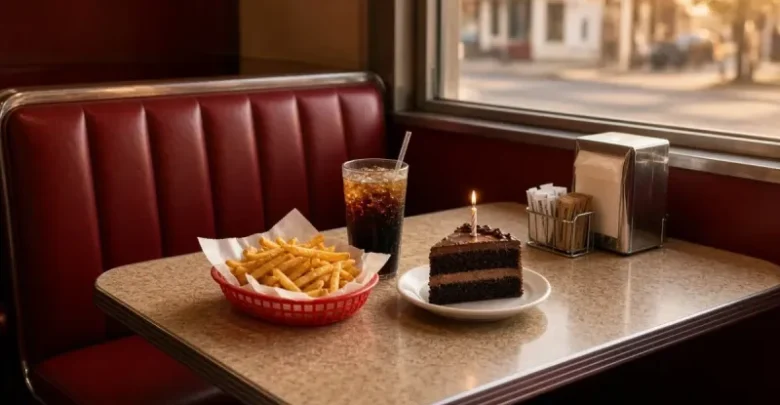
Donna came over and set down one slice of chocolate cake on a white plate.
One candle in it. Already lit.
She set it in front of Noah and stepped back.
He blew it out.
And the three employees nearby, Donna and Ryan and a young waitress with a long braid, clapped softly.
Exactly once.
Together.
Then they returned to work.
I sat there in that vinyl booth and looked around a diner on Route 12 with completely different eyes.
These people knew not to touch him without warning.
They knew which sounds landed wrong.
They knew how long to wait after asking him something.
They knew how he wanted his grilled cheese cut.
And they knew, and this is the one that undid me, how he wanted to be celebrated.
I’d thrown him eighteen birthday parties. Some of them had gone well. Some of them had ended with him under a table with his hands over his ears.
These people had figured it out.
Across the booth, Megan was wiping her cheek with the back of her wrist.
“Why are you crying?”
I said.
“Later.”
“Stop saying later.”
“Steph,” she said. “Please.”
There was something in her voice that scared me.
Near the end of dinner, I went to the restroom.
The hallway that led back to the bathrooms was narrow and dim, with old wallpaper peeling away near the ceiling. Little flowers. Faded yellow.
When I came out, Donna was standing there.
Waiting.
“Stephanie?”
I stopped.
She glanced past me, back toward the dining room. I could feel Megan watching us from the booth.
“You need to know,” Donna said, “what your son has actually been doing here. All these years.”
My pulse jumped straight into my throat.
“What has he been doing?”
She did not answer.
She just nodded past my shoulder.
“Watch,” she said.
I turned around.
Noah had gotten up from our booth.
He walked across the diner. Past the pie case. Past the register.
And then he went behind the counter.
My first instinct was to call him back.
Noah, honey, that’s staff only. That’s not where customers go. Come out of there.
The words were already in my mouth.
Something stopped me.
Because nobody said anything.
Not one person looked up. Not one person looked surprised. The young waitress with the braid was carrying two plates of meatloaf. She simply turned her shoulders sideways to let him get by. The way you do with a coworker.
Noah reached up and took a black apron off a hook by the kitchen pass-through.
He pulled it over his head.
He tied it behind his back. Badly. He had to do it twice. The way he ties everything.
He went to the little sink in the corner. He turned on the water. He washed his hands. Thoroughly. Front, back, between the fingers, under the nails. Counting under his breath.
I could see his lips moving. Seventeen. Eighteen. Nineteen. Twenty.
He dried his hands on a paper towel. He threw it away.
Then he moved down to the condiment station at the end of the counter.
He picked up two ketchup bottles. He checked the caps. He wiped one with a clean rag.
He looked at the napkin holders. Two of them were half an inch out of line. He squared them up.
And then he walked out from behind the counter, toward Mr. Donald at the end, like he’d done it four hundred times.
Which, I would learn in about ninety seconds, he had.
I could not move.
“The fries were real,” Donna said softly beside me. “He does love the fries. That part’s true. But that’s never been why Megan brought him here.”
“I don’t—” My voice cracked. “I don’t understand.”
Donna smiled.
“Neither did we,” she said. “Not at first.”
She told me about the first visits.
Ten years ago. A Saturday in May.
Megan came in with a skinny little eight-year-old boy who had his hands pressed over his ears before he even got through the door. They sat at the counter, because that’s where the open seats were. Right next to the kitchen.
“The service bell scared him to death,” Donna said. “Every time it rang. And I’m telling you, we ring that thing two hundred times a lunch. He’d jump out of his skin. Every single time.”
The questions overwhelmed him. Donna asked him what he wanted to drink, and when he didn’t answer fast enough, she asked again, and then she started listing options, and he shut down completely.
“And then,” Donna said, “I made the worst mistake of all.
I came up behind him. To say goodbye. And I put my hand on his shoulder.”
She shook her head.
“He came right up off that stool like I’d burned him. And he looked at your friend and said, ‘Can we leave now, please?’”
“I figured that was it,” Donna said. “I figured, well, this just isn’t the right place for that little boy. Too loud. Too fast. Some kids do great in a diner, and some don’t. I thought I’d never see either one of them again.”
“But you did.”
“They came back the next month,” Donna said.
“And Megan asked me a question.”
I waited.
“She did not ask me how she could get Noah to handle the restaurant better,” Donna said. “That’s what I thought she was going to say. That’s what everybody asks. How do we fix the kid.”
She looked out at the dining room.
At my son, standing at the end of the counter, wiping down the spot beside Mr. Donald’s coffee mug.
“She asked me how the restaurant could be better for Noah.”
Donna shook her head.
“Twenty-six years I’d been waitressing at that point. Thirty-six now. And in all that time, nobody had ever asked me that. Not once.”
So they started small.
Nobody touched him unless he could see them coming first.
When anybody asked him a question, they waited. A few extra seconds. Instead of filling the silence, they just stood there and let him find it.
Somebody would call out “Loud one!” before the dish tub went down on the counter.
They moved the radio from the shelf by the kitchen to the far end of the room. They turned it down.
And they stopped ringing the bell.
“Just when he was here, at first,” Donna said.
“And then after a while, Gary said, ‘You know what? I don’t think anybody actually likes that bell.’ And we put it in a drawer. It’s still in there. Nine years now.”
“None of it was complicated,” Donna said. “None of it cost a dime. It was a handful of habits. Took maybe two months before it was all automatic.”
She smiled.
“And then,” she said, “Noah started helping us.”
It started with the sugar packets.
He fixed one caddy, at booth seven, on his own. Donna watched him do it from behind the counter. She did not stop him.
The next month, he did two. Then all of them.
Then the napkin dispensers. He noticed they were never full, and they were never lined up straight.
Then the condiment bottles.
“He has a whole system,” Donna said. “You know that? For the ketchup and the mustard.
He checks every single cap for stickiness. He wipes them down. And he rotates them, so the older bottles get used up first and the new ones go to the back. Nobody taught him that. He just started doing it. One day, our day manager, Lisa, saw what he was doing and she made it the official policy. For the whole staff. It’s on a sign in the back now. Rotate the bottles. Noah’s rule.”
And then, at some point, he started helping with the regulars.
Standing in that narrow hallway with the peeling yellow wallpaper, ten years of little comments came back to me all at once.
In his voice.
I helped Donna, Mama.
Mr. Donald likes me.
The sugar was mixed.
I filled bottles, Mama.
I had heard every single one.
I had just never once understood what I was being told.
“We learned Noah,” Donna said softly.
“And then Noah learned us.”
Out on the floor, my son picked up three glasses of water off a tray.
He carried them carefully. Very carefully. Watching the surface of the water the whole way, so it wouldn’t slosh. He set one down in front of Mr. Donald. The other two went to the couple in the booth next to him.
Then he turned back to Mr. Donald.
“Usual today?” Noah asked.
The old man beamed at him.
“You remembered.”
Noah frowned slightly.
“You always get the usual, Mr. Donald,” he said. “There’s nothing to remember.”
Mr. Donald laughed. Loud. Delighted.
And my eyes went completely.
I turned around.
Megan was standing in the hallway, right behind me.
I hadn’t heard her come. Her face was wet.
“You let me think,” I said, “that they were just getting fries.”
“Steph—”
“For ten years, Megan.”
“I know.”
“Why?”
Her eyes went red.
“Because this was his place,” she said.
I said nothing.
“You love that kid more than anybody on this earth,” Megan said. “I have never, ever doubted that. Not once. Not for one second.”
She drew a breath.
“But whenever he struggled, even a little, you were there before he had a chance to find out whether he could do it himself.”
I looked away.
At the peeling wallpaper. At the little yellow flowers.
Because it hurt exactly as much as things hurt when they’re true.
“I was protecting him,” I said.
“Sometimes he needed that,” Megan said softly. “Steph. Sometimes he really did. You were right a lot of the time. You were right most of the time.”
She reached out and touched my arm.
“But sometimes,” she said, “all he needed was three extra seconds.”
Three seconds.
That was the whole thing.
Three seconds before I ordered for him.
Three seconds before I answered a question that somebody asked him. Three seconds before I smoothed something over. Stepped in. Explained him to a stranger. Fixed it.
Ten years of Saturdays. Hundreds of little moments. Maybe thousands.
And the difference between the two versions of my son’s life was about three seconds.
“I should have told you more,” Megan said. “I was wrong about that part. I’ve known it for some time. Years, honestly.”
She wiped her face with the heel of her hand.
“But I wanted him to come home and tell you whatever he wanted to tell you about it. Whatever he chose to tell you. In his own words.”
Her voice cracked.
“I wanted him to have one place that was just his. Before all of us turned it into another program. Another plan. Another goal on his IEP. Another thing for Noah.”
And God help me, I understood exactly what she meant.
Because there had been so many plans for Noah.
IEP meetings every year. Speech therapy. Occupational therapy. Social skills groups on Tuesday afternoons. Transition planning binders. A stack of evaluations two inches thick, with words like deficit and delay and below expected.
All of it necessary. Every single bit. All of it done with love.
And not one square inch of it was his.
Then Megan said something I did not expect.
“Do you remember my brother?”
“Ryan?”
I did. Megan’s little brother. Four years younger than us. Skinny, quiet. He used to follow us around on his bike.
He had a stutter. A bad one.
“Do you remember how my mom used to finish all his sentences?” Megan said. “Every single one? He’d start to say something, and he’d get stuck on the first word, and she’d just jump in and say it for him.
Every time. Because she loved him. Because she couldn’t stand to watch him struggle.”
I remembered.
“By the time he was twelve,” Megan said, “he’d stopped talking. Almost completely. At school. At home. Anywhere. Because why would you bother, when somebody else is always going to say it for you?”
She looked out at the dining room. At Noah.
“He’s thirty-four now,” she said. “He lives alone in Columbus. He still doesn’t call anybody. Not even me.”
I had no idea what to say.
“When Noah said But I wanted to say it,” Megan said, “in that parking lot. When he was eight. I heard Ryan.”
She swallowed.
“I said nothing to you. I did not know how. I did not want you to think I was telling you how to raise your own kid.
So I just… took him somewhere where nobody would say it for him.”
Donna came back over.
I hadn’t even noticed she’d left.
She was holding a small white card. Like an old index card. Stiff paper.
She handed it to me.
NOAH was printed across the top in ballpoint pen. Underneath were blank rows. Lines for dates. Lines for hours. IN. OUT.
“What is this?” I said.
“His time card,” Donna said.
I stared at her.
“We offered him a job,” she said. “Last month. Gary and Lisa and me.”
My breath went right out of me.
“He starts Saturday,” Donna said. “Three hours.”
“Three?”
“That’s what he asked for.”
Not what Megan suggested. Not what Donna thought would be reasonable. Not what I would have decided after researching it for six weeks, calling two specialists, and making a pros-and-cons list.
What Noah asked for.
“He sat right there in booth seven,” Donna said, “with Gary. And Gary asked him how many hours he wanted. And Noah thought about it for a while. A long while. And then he said, ‘Three. Ten to one. Because after one is the lunch rush, and the lunch rush is too loud.’”
She laughed.
“Gary said, ‘Well, that’s the smartest scheduling request I’ve had in thirty years.’”
He’d negotiated his own hours.
My son had sat in a booth in a diner on Route 12 and negotiated his own hours with his own boss.
And I hadn’t known any of it was happening.
Donna folded her arms.
“I’ll tell you what we need around here,” she said. “We need somebody who notices when things aren’t where they belong. Who remembers what every regular orders. Who actually cares whether the ketchup bottles are sticky.
Because I promise you, the rest of these kids do not.”
I laughed. My face was a complete mess. I did not care.
Then Donna said something more seriously.
“And I want to be clear about something, Stephanie. We’re not hiring him because we feel sorry for him. We’re not doing it to be nice. We’re hiring him because he’s useful.”
Useful.
That word went through me harder than anything else that whole night.
Not protected. Not supported. Not accommodated. Not a good kid who deserves a chance.
Useful.
Needed.
Somebody needed my son.
A few minutes later, I returned to our booth. Megan slid in next to me. Neither of us said anything.
Matthew looked at both of our faces. He did not ask. He just handed me a napkin.
Then Noah came back to our table.
He was wearing the black apron.
He had a little order pad in one hand and a pen in the other.
Matthew grinned up at him.
“Looking sharp, bud.”
“I know, Papa,” Noah said.
I laughed out loud.
Then Noah turned to me.
Completely serious. Pen ready over the pad.
“What can I get you, Mama?”
And without thinking, without one single conscious thought in my head, I turned toward Matthew and began to answer for him.
“He’ll have—”
Under the table, Matthew took my hand.
He squeezed it once.
I stopped.
Noah waited.
And here’s the thing.
Nobody rushed to fill the silence.
Not Megan beside me. Not Donna behind the counter. Not Ryan the busboy with his gray tub. Not Mr. Donald at the counter with his coffee.
Nobody.
They all just waited.
Matthew answered for himself.
“Coffee, please,” he said.
Noah wrote it down. Carefully. Slowly. Every letter.
Then he glanced at me.
“And you?”
For eighteen years, I’d believed that loving my son meant getting to the world first. Smoothing it out for him. Answering for him. Standing between him and every possible moment of friction. Because I was certain, absolutely certain, that the world would never be patient enough with him.
That night, in a booth with a wobbly leg, love looked like something completely different.
Love looked like waiting.
“Tea,” I said. “With lemon.”
“Okay!”
He wrote it down. T-E-A. L-E-M-O-N.
And he walked away to put in the order.
Three seconds.
That was all he’d ever needed from me.
Before we left, Donna pointed at an old punch clock mounted on the wall by the kitchen door. A big gray metal box. The kind I’d only seen in old movies.
“Don’t forget,” she said to Noah.
Noah took his white card.
He slid it into the slot at the top.
The machine made a loud, heavy metal CHUNK as it stamped the date.
His first shift.
And the entire staff cheered.
Really cheered. Six or seven people, whooping and hollering. Ryan pumped his fist. The waitress with the braid clapped her hands over her head. Somebody in the kitchen started banging a spatula on the metal pass.
Noah’s hands flew straight to his ears.
And the whole diner went silent.
Instantly.
Like somebody flipped a switch.
Nobody stared at him. Nobody panicked. Nobody rushed over and apologized in a loud voice, which is the thing that always makes it worse.
They just stopped.
Got quiet.
And waited.
Slowly, Noah lowered his hands.
Donna made a face.
“Sorry, hon,” she said softly. “We forgot ourselves.”
Noah thought about that for several seconds. He really considered it.
The way he considers everything.
“It’s okay, Donna,” he said. “It’s okay, everyone. You remembered fast.”
I had to turn and face the front door so he wouldn’t see me crying again.
At the door, I noticed the black apron still hanging on its hook behind the counter. Where he’d left it.
My hand actually began to come up. The words were already in my mouth.
“Noah, honey, you forgot your—”
I stopped myself.
It took physical effort. I want to be honest about that. It was like not scratching an itch. Like holding your breath underwater.
I stood there with my hand halfway up and my mouth halfway open.
And I counted.
One.
Two.
Three.
Four.
Noah noticed it himself.
He turned around. He walked back to the counter. He took the apron down off the hook.
He folded it. Carefully. In half.
Then in half again. Corners matched exactly.
Then he put it in a plastic bin under the register. With the other folded aprons.
Because he’d need it on Saturday. And that’s where they go.
“See you Saturday!” he called out to the room.
And four different voices answered him at once, from all over that diner.
“See you Saturday, Noah!”
Outside in the gravel parking lot, Matthew took my hand.
Up ahead of us, Megan was walking next to Noah. He was explaining something to her about the sugar caddies. About a new sort of sweetener the supplier was sending, and where it should go in the order. She had her hands in her jacket pockets and she was smiling down at the gravel.
For years, since Noah was about six, there was one question that kept me awake at two in the morning.
What happens to my son when Matthew and I aren’t here anymore?
Every parent of a kid like Noah knows that question. It sits down on your chest in the dark, and it doesn’t move.
But standing there in the gravel outside a diner on Route 12, a different question came and took its place.
Who else could Noah become important to?
Because that’s a different question entirely.
The first one has no good answer.
The second one does.
And I was looking straight at it through a window.
Through the diner window, I could see Donna behind the counter.
She was sliding my son’s white time card into a metal rack on the wall. Beside the cards of all the other employees.
Right where it went.
The next Saturday, I drove him to his first shift.
He’d told me the night before that he could take the bus. There’s a bus that goes out Route 12.
It stops right in front of the tire place.
I said I’d drive him. Just the first time.
He thought about that for some time.
“Okay,” he said. “Just the first time.”
He was ready at 9:15. His shoes were on the right feet. He had his time card in his shirt pocket, the white one, because Donna said he could take it home if he wanted, as long as he brought it back.
In the car, he said nothing. He looked out the window. He tapped his thumb against his finger.
One, two, three. One, two, three.
I knew what that meant. I’d known what it meant for fifteen years.
He was nervous.
Every bone in my body wanted to say something.
You’ll be fine, honey. You know everybody there. You’ve been there a hundred times. If it gets too loud, you can go out to the car.
I’ll be right in the parking lot. You can call me. You have your headphones, right? Did you bring your headphones? Let me check your backpack—
I gripped the steering wheel.
And I did not say any of it.
When we pulled into the parking lot, he sat there for a minute.
Then he unbuckled his seatbelt.
“Mama,” he said.
“Yes, bud?”
“You can go home now.”
I looked at him.
“I was going to wait,” I said. “In case.”
“In case what?”
I did not have an answer.
“I’ll be okay, Mama,” Noah said. “Donna’s here. Mr. Donald’s here. Ryan’s here. I know where everything goes.”
He opened the car door.
“You can come back at one,” he said. “One-ten. I have to clock out.”
He got out.
He walked across the parking lot. He pulled open the door of the diner.
I heard it jingle from the car.
And then he was gone.
I did not go home.
I’m not that strong. Not yet.
I drove across the street to the gas station and parked where I could see the diner’s front window, and I sat there.
I did not text him. I did not call. I just sat there.
At ten-thirty, somebody knocked on my car window.
I almost jumped out of my skin.
It was Megan. Holding two cups of gas station coffee.
She came around and got in the passenger seat. She handed me one of the coffees.
“I figured,” she said.
“How did you know?”
“Because I’ve known you since the fourth grade,” Megan said. “And you have never once in your life done what you said you were going to do when it came to that kid.”
I laughed. I could not help it.
We sat there together and watched the diner window.
We couldn’t see much. Shapes moving. Somebody in a black apron walking back and forth.
“Is that him?” I said.
Megan squinted.
“That’s Ryan,” she said. “Noah’s taller.”
“Megan,” I said, after a while.
“Hmm?”
“I’m sorry. About Ryan. Your brother. I never knew. I mean, I knew. But I never… I never put it together.”
She was silent for a long moment.
“I called him,” she said. “On Tuesday. After the birthday.”
“Ryan?”
“He picked up,” Megan said. “Which he never does. And I told him about Noah. About the diner. About the apron and the time card and three seconds.”
She stared at her coffee.
“And he said nothing for a long while. And I almost said something. I almost filled it in. I almost said, ‘Anyway—’”
“But you didn’t.”
“I did not,” Megan said. “I waited.”
She smiled.
A small, wet smile.
“And after a while, he said, ‘I’m glad somebody waited for him.’”
At ten after one, Noah came out the front door of the diner.
He had his time card in his hand. He stood on the sidewalk and looked around the parking lot for my car.
It was not there. It was across the street at the gas station, with Megan in it.
He looked around for several seconds.
Then he saw us.
He lifted his hand about six inches. The way he does.
And then he did something I’d never seen him do before.
He looked both ways. Very carefully. Twice.
And he crossed the street by himself.
He opened the back door and got in.
“You didn’t go home,” he said.
“No,” I said. “I did not.”
He looked at Megan in the front seat.
“Aunt Megan didn’t go home either.”
“Nope,” Megan said.
Noah thought about that.
“That’s okay,” he said. “Next time you can go home.”
“How was it?” I asked.
He thought about it. One second. Two. Three.
I waited.
“Good,” he said. “I did the bottles. All of them. And the sugar. And I took Mr. Donald his coffee. Four times.”
“Four?”
“He had four,” Noah said. “He always has four.”
“Of course he does.”
“And a lady dropped a plate,” Noah said. “In the kitchen. It was very loud.”
My whole body went tight.
“What happened?”
“Ryan yelled ‘loud one’ first,” Noah said. “So I knew. So it was okay.”
He looked out the window.
“I want to go back next Saturday,” he said.
He went back the next Saturday. And the one after that.
He took the bus on the third Saturday. I let him.
I sat at my kitchen table with my phone face-up in front of me the entire three hours, and I did not call him once.
I counted. I counted a lot.
About six weeks in, something happened that I need to tell you about.
Because it’s the part where I almost ruined everything.
I’d started going to the diner myself. On Saturday afternoons. Just once in a while. Not to watch him. Okay, a little to watch him. But mostly because the fries really are correct.
I’d sit at the counter. Never in Noah’s section. Donna’s rule. “He doesn’t need his mama watching his tables,” she said. “You can watch from over here like the rest of the regulars.”
So I did.
That Saturday, a man came in that nobody knew.
He was maybe forty. Business casual. Expensive watch. On his phone the entire time he walked in. He sat in one of Noah’s booths.
Noah walked over with a glass of water.
He set it down carefully.
“Hello,” Noah said. “What can I get you?”
The man didn’t look up from his phone.
“Burger. Medium. Fries.”
Noah wrote it down. He stood there for a moment.
“What sort of cheese?” Noah asked.
The man kept typing.
Noah waited. One second. Two.
“What sort of cheese?” Noah asked again.
The man looked up.
“What?”
“What sort of cheese,” Noah said. “We have American, cheddar, Swiss, pepper jack, or no cheese.”
The man stared at him.
“Are you serious? It’s a burger. Just bring me a burger.”
Noah stood there. I could see his thumb tapping against the edge of his order pad.
One, two, three. One, two, three.
“I need to know the cheese,” Noah said softly. “For the ticket. Gary needs to know.”
The man put his phone down on the table. Hard.
“Is there somebody else who can take my order?
Somebody who’s actually—”
I was already off my stool.
I don’t even remember getting up. I was just standing. Halfway across the diner. My mouth open. The words already coming.
He’s asking you a simple question. He’s doing his job. If you’d look up from your phone for one second—
Then someone grabbed my wrist.
Mr. Donald.
He’d been sitting next to me at the counter. Eighty-four years old. His grip was like iron.
He said nothing.
He just held on.
And he shook his head. Once.
I stood there with my heart pounding so hard I could hear it.
I watched my son.
He was standing beside that booth with his pad and his pen. His thumb was tapping. His face had gone very still. That stillness I know. The one that comes before a shutdown.
I counted.
One.
Two.
Three.
Four.
Five.
Noah drew a breath.
“I can get someone else,” he said. “If you want. But Donna will ask you about the cheese too. Everybody asks about the cheese. It’s the rule.”
The man stared at him.
Noah looked right back at him.
“American, cheddar, Swiss, pepper jack,” Noah said again. Slower. “Or no cheese.”
There was a long silence.
Then, from across the diner, Donna’s voice. Calm. Not loud.
“He’s right, sir. Gary won’t make it without the cheese. He’s very particular.”
The man looked at Donna. Then at Noah. Then around the diner.
At all the regulars, who’d stopped eating and were just softly looking at him.
He picked up his phone. He put it face-down on the table.
“Cheddar,” he said.
“Okay,” Noah said.
He wrote it down. C-H-E-D-D-A-R.
“Thank you,” Noah said.
And he walked away to put in the order.
Mr. Donald let go of my wrist.
I sat back down on my stool. My legs were shaking.
Mr. Donald picked up his coffee mug. He took a long sip. He set it down.
“Ten years,” he said softly, “I’ve watched that boy learn this place.”
He glanced at me with his pale, watery blue eyes.
“He doesn’t need you to fight for him in here, ma’am,” he said. “He’s got about twenty of us for that. If he ever really needs it.”
He tapped the counter twice. Tap. Tap.
“But mostly,” he said, “he doesn’t need it at all.”
When the man left, he left a twenty on a fourteen-dollar check.
Noah brought it to the register. He looked at it for a long while.
“Donna,” he said.
“He gave me six dollars extra.”
“That’s called a tip, honey.”
Noah thought about that.
“He was mean,” Noah said. “And then he gave me six dollars.”
“People are complicated,” Donna said.
“Yes,” Noah said. He put the money in the register. Very carefully. All the bills facing the same way. “They are.”
I asked Mr. Donald about the taps that day. After.
I asked him what they meant.
He smiled.
He told me he’d worked for the railroad for forty-one years. As a telegraph operator, back when they still used them, out in the switching yard in Marion. He sent messages up and down the line in Morse code.
“Two taps,” he said, “means received. Message received. I hear you.”
He told me his wife, Betty, used to tap his hand twice every night before they went to sleep. For fifty-two years.
Betty died eleven years ago.
He started coming to The Blue Spoon the next spring. Every Saturday. Because the house was too quiet.
“I sat at this counter for most of a year,” he said, “without saying more than ten words to anybody. Didn’t want to. Didn’t have anything to say.”
He looked over at Noah, who was squaring up the napkin dispensers at the end of the counter.
“And then one Saturday, this little skinny kid sits down next to me and reorganizes my sugar packets. Without asking. And tells me I’ve got them in the wrong order.”
He laughed.
“I tapped the counter twice. Out of habit. Didn’t even think about it.”
He shook his head.
“And that boy reached over and tapped twice back.”
He wiped his eyes with a napkin.
“Ten years,” he said. “Every Saturday. He’s never missed one.”
In August, Mr. Donald missed one.
It was a Saturday. Noah came home from his shift at one-thirty and stood in the kitchen doorway with his backpack still on.
“Mr. Donald didn’t come,” he said.
I was making a sandwich. I looked up.
“Maybe he’s busy, bud.”
“He’s never busy,” Noah said. “He comes at nine-forty. He sits at the counter. Fourth seat. He gets four coffees.”
“Maybe he’s sick. Maybe he went to see family.”
“He doesn’t have family,” Noah said. “His wife died. His son lives in Oregon. He doesn’t go to Oregon. He doesn’t like airplanes.”
I put down the knife.
“Noah. I’m sure he’s fine. People miss things sometimes.”
Noah stood there in the doorway.
His thumb was tapping. Fast.
“He never misses,” Noah said. “Ten years. Five hundred and twenty Saturdays. He never misses.”
I almost said it.
I almost said, Honey, I’m sure it’s nothing.
Let’s just wait and see if he comes next week.
I could feel the words in my mouth. Smoothing it over. Making it okay. Stepping in.
I stopped.
I counted.
One. Two. Three.
“What do you think we should do?” I said.
Noah glanced at me.
I don’t think anybody had asked him that question very often. What do you think we should do.
He thought about it for a long while.
“Donna has his address,” Noah said. “For the Christmas card. She sends everybody a Christmas card.”
“Okay.”
“We should go,” Noah said. “To his house. And knock.”
We went.
Donna gave me the address. Mr. Donald lived in a little white house on Sycamore Street, eight blocks from the diner. Noah knew exactly where it was. He’d walked past it a hundred times on the way to the bus stop.
The grass was a little too long.
There were three newspapers on the porch.
Noah looked at the newspapers.
“Three,” he said. “That’s Thursday, Friday, and today.”
We knocked.
Nobody answered.
We knocked again.
Noah went to the front window. He cupped his hands around his eyes and looked in.
He stood there for a long while.
Then he turned around.
“Mama,” he said. His voice was very calm. Very quiet. “He’s on the floor.”
I called 911.
The fire department got there in six minutes. They broke the lock on the back door.
Mr. Donald had fallen in his living room on Thursday afternoon. He’d broken his hip. He couldn’t get up. He couldn’t reach his phone. He’d been lying on his living room floor for two days.
He was dehydrated. Confused. But alive.
The paramedic who carried him out on the stretcher stopped next to me on the porch.
“Another day,” she said softly, “and I don’t know.”
As they lifted him into the ambulance, Mr. Donald opened his eyes.
He saw Noah standing on the sidewalk.
He couldn’t really talk. His lips were cracked. His voice was gone.
But he reached out his hand from the stretcher.
And he tapped the metal rail twice.
Tap. Tap.
Noah walked over.
He reached out.
And he tapped twice back.
Tap. Tap.
Mr. Donald was in the hospital for nine days. Then a rehab center for three weeks.
Noah visited him every Saturday after his shift. He took the bus. By himself. He brought a to-go cup of coffee from the diner every time. Black. Because Mr. Donald said the hospital coffee tasted like it had been strained through a sock.
The nurses at the rehab center started calling Noah “the coffee kid.”
Noah told them his name was Noah.
They started calling him Noah.
Mr.
Donald came back to The Blue Spoon on the second Saturday in October. In a walker. His son flew in from Oregon, on an airplane, to drive him there.
When he came through the front door, the bell jingled.
And the whole diner went quiet.
Not loud. Not cheering. Everybody remembered.
They just went quiet.
And then they clapped. Softly.
Exactly once.
Together.
Noah was behind the counter. He’d already poured the first cup of coffee. Black. Fourth seat.
Mr. Donald made his slow way across the diner with his walker. It took him a long time. Nobody rushed him.
He got to the fourth stool. He eased himself down onto it.
Noah set the coffee in front of him.
“Usual?” Noah said.
Mr. Donald looked at him for a long moment.
“You remembered,” he said.
And Noah frowned slightly.
“You always get the usual, Mr. Donald.”
That night, Mr. Donald’s son came by our house.
He was about fifty. He looked just like his father. Same pale blue eyes.
He stood on our front porch and shook my hand and Matthew’s hand and then he asked if he could see Noah.
Noah came to the door.
Mr. Donald’s son looked at him for a long while. He said nothing. He looked like he was trying to.
Noah waited.
He said nothing either.
He just waited.
Three seconds. Five. Ten.
Finally, the man said, “Thank you. For noticing.”
“He never misses,” Noah said simply. “He missed. So I noticed.”
The man laughed. A broken, surprised laugh.
He reached out and tapped the door frame twice.
Noah tapped it twice back.
For eighteen years, I worried about whether Noah would ever find a place in the world.
What I’d completely failed to understand was that one small corner of the world had already spent ten years quietly learning how to make room for him.
And he hadn’t just found a place there.
He’d become the person who remembers Mr. Donald’s usual.
The person who notices when the sugar packets are mixed.
The person who cares whether the ketchup bottles are sticky.
The person a busboy calls out to across a dining room about Saturday.
The person who noticed when an old man was missing, and wouldn’t let anybody tell him it was probably nothing.
He’d become someone that room would notice was gone.
And it turned out that went both ways.
In November, we had Noah’s transition planning meeting at the high school. His last one. The one where everybody sits around a long table and decides what happens after graduation.
Eleven people. His special ed teacher. His case manager. The school psychologist. The vocational counselor. Two people from the county. Matthew. Me. Megan, because Noah asked for her.
And Noah.
For fifteen years, I’d done all the talking at these meetings. I’d brought binders. I’d brought color-coded tabs.
This time, I did not bring a binder.
The vocational counselor looked at her notes.
“So,” she said. “Let’s talk about employment goals. Stephanie, do you have any thoughts about what sort of work setting might be appropriate for Noah after—”
I said nothing.
I looked at my son.
The room went quiet.
The counselor glanced at me. Then at Matthew. Then, finally, at Noah.
Noah looked at his hands.
One second. Two. Three.
Nobody said anything.
“I already have a job,” Noah said.
The counselor blinked.
“You do?”
“At The Blue Spoon,” Noah said. “On Route 12. Saturdays. Ten to one.
I do the condiments and the sugar and the napkins and I take orders in section three and I bring Mr. Donald his coffee.”
He reached into his shirt pocket.
He took out his white time card. He’d brought it. Of course he had.
He slid it across the table to her.
“I want more hours,” Noah said. “After graduation. Not lunch rush. Lunch rush is too loud. But Tuesday and Thursday mornings. Gary already said maybe.”
The counselor picked up the card.
She looked at it for a long while. At all the little stamped rows. IN. OUT. IN. OUT. Twenty-nine Saturdays.
Then she looked up at Noah.
“Well,” she said. “That’s… that’s more than most of my students have figured out by graduation.”
She wrote something down.
“Tuesday and Thursday mornings,” she said. “Let’s put that in the plan.”
Under the table, Megan took my hand.
She squeezed it twice.
I still go to The Blue Spoon on Saturdays.
Not every Saturday. Noah says that would be “too much mama.” But most.
I sit in booth seven now. The one with the wobbly leg. Gary still hasn’t fixed it. Noah has offered to bring a shim from home. Gary says it’s “on the list.”
Noah isn’t my server. That’s still Donna’s rule.
But sometimes, when it’s slow, he comes over anyway. With his order pad.
“What can I get you, Mama?”
And I wait.
Not because I need to. Not anymore.
Because I’ve learned that the waiting is the part that matters.
I look at my son in his black apron, with the bow tied badly behind his back. Pen ready over his pad. His face loose and easy.
The face he makes when he doesn’t have to work.
I count.
One.
Two.
Three.
“Tea,” I say. “With lemon.”
“Okay!” Noah says.
And he writes it down.
Every letter.
Disclaimer:
This is a work of fiction intended solely for entertainment purposes.
All characters, places, and events portrayed in this story are entirely fictional. Any resemblance to real persons—living or dead—actual businesses, or real-life events is purely coincidental.