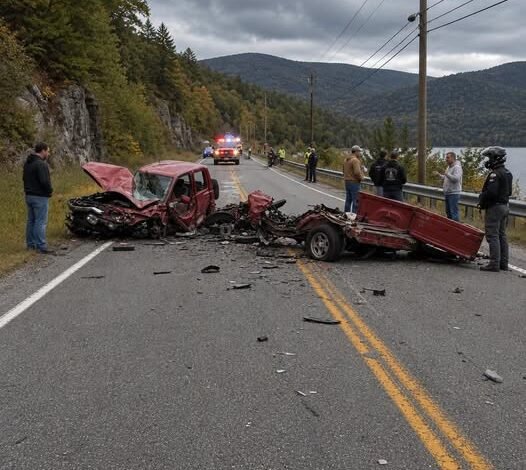
A fatal vehicle collision on Manhattan’s Upper West Side left two people dead and three others seriously injured, prompting investigators to examine what happened during a chaotic sequence of impacts on a busy city street.
The crash occurred on May 15, 2026, near Amsterdam Avenue and West 109th Street. While social-media posts circulating about the incident may use language suggesting that the event happened “just minutes ago,” the incident described in those posts corresponds to the May 2026 crash. It should not be presented as a newly confirmed accident occurring today.
The tragedy raised important questions about the circumstances leading up to the collision, the movement of the vehicle after the first impact, and the factors that may have contributed to the deadly outcome.
According to police information reported after the crash, a 61-year-old man was driving a Mercedes-Benz SUV northbound on Amsterdam Avenue when the vehicle struck a parked car. The collision then involved additional vehicles and pedestrians, creating a large emergency response in the surrounding area.
Police later identified the driver as Elvin Suarez and charged him with manslaughter, vehicular manslaughter and driving while intoxicated.
Those charges are allegations, not findings of guilt. An arrest or criminal charge does not establish that a person committed the alleged offenses, and a final court outcome is not presented in the material available for this account.
What Happened on Amsterdam Avenue?
The collision took place at approximately 6 p.m., a time when Manhattan streets can be busy with pedestrians, drivers and people traveling through the neighborhood.
The initial information indicated that the Mercedes-Benz SUV was traveling north on Amsterdam Avenue before striking a parked vehicle. The impact did not end the incident, however. Other vehicles and pedestrians became involved as the sequence continued.
For investigators, reconstructing that sequence is one of the most important parts of understanding a complicated traffic collision.
In a straightforward crash involving two vehicles, investigators can often begin with the location of the impact, vehicle damage and statements from the drivers. A multi-vehicle collision involving pedestrians can require a much more detailed reconstruction.
The location of each vehicle, the direction in which the SUV was traveling, the position of the parked car and the locations of pedestrians can all help establish the timeline.
Investigators may also examine traffic signals, roadway conditions, surveillance footage and statements from people who witnessed the collision.
These details can be particularly important when the events occur within only a few seconds.
Two People Lost Their Lives
The most serious consequence of the crash was the loss of two lives.
Early reports described two men as having died following the collision. Three additional people were reportedly taken to hospitals with serious injuries.
Those casualty figures reflect the information reported in connection with the original May incident. They should not be interpreted as a new update about the surviving victims.
The material reviewed for this article does not establish what happened to those injured individuals after their initial hospitalization. For that reason, no later recovery information is presented as fact here.
Behind every number in a crash report are individuals, families and communities affected by an unexpected event.
For relatives of those who died, the consequences extend far beyond the initial emergency response. A fatal collision can bring grief, difficult decisions and a long period of adjustment.
The same is true for people who survive serious crashes. Physical injuries may require extended treatment, while emotional effects can continue long after the vehicles and emergency crews have left the scene.
Emergency Crews Responded Quickly
Following the crash, emergency personnel arrived at the scene as police officers worked to control the area.
Medics treated injured people while officers managed crowds and began documenting what had happened.
Scenes involving multiple vehicles and pedestrians can quickly become difficult to navigate. Emergency workers must provide medical assistance while police officers preserve information that may later become important to an investigation.
The first hours after a serious crash are often focused on immediate safety and medical care. Investigators then begin working toward a more detailed reconstruction of the incident.
That process can involve photographs, measurements, vehicle inspections, witness interviews and video evidence.
What appears obvious from an early social-media post may look very different once investigators have examined the available evidence.
Why Investigators Must Reconstruct the Sequence
One of the central questions in a crash like this is not simply where the vehicles ended up, but how they got there.
The first impact may have changed the direction or speed of the SUV. A subsequent impact could have moved another vehicle. Pedestrians may have been struck at different points in the sequence.
That means investigators need to determine the order of events.
A reconstruction can help answer questions such as:
- Where did the first impact occur?
- How fast was the vehicle traveling?
- What happened immediately after the first collision?
- Which vehicles were involved in each stage?
- Where were pedestrians positioned?
- What traffic conditions existed at the time?
- Were there witnesses who saw the moments before the crash?
- Was surveillance footage available?
- Did the driver experience a medical or mechanical problem?
- Were alcohol or other factors suspected of affecting the driver?
These questions do not automatically provide answers. They illustrate why investigators may need time before reaching conclusions.
Early Questions Included Several Possible Causes
Initial reporting surrounding the crash raised questions about what might have caused the driver’s actions.
Possible explanations discussed at the time included a medical emergency, mechanical failure or driving error.
It is important to distinguish between a question raised during an early investigation and an established finding.
Investigators frequently consider multiple possibilities after a serious collision. Doing so does not mean every possibility is equally likely, nor does it mean that an early theory will ultimately become part of the official explanation.
Later reporting added an important development: police charged the driver with manslaughter, vehicular manslaughter and driving while intoxicated.
That information changes the context of the early reports, but the charges still need to be described accurately.
They are allegations made through the criminal justice process and should not be presented as proof of guilt.
Understanding the Difference Between an Arrest and a Conviction
Serious crash stories can easily become confusing when early reports use terms such as “charged,” “arrested” or “accused.”
These terms have specific meanings.
A person who is charged with a crime has been formally accused of violating the law. The charge itself is not a final determination that the person committed the offense.
A conviction, by contrast, is the result of a later legal process in which guilt is established under the applicable standard.
Because the available material does not provide a final court outcome in this case, it would be inappropriate to describe the allegations as proven facts.
This distinction is especially important in stories that receive attention on social media, where headlines and captions can sometimes compress complicated legal situations into a few words.
Responsible reporting should preserve the difference between what police allege, what witnesses report and what a court ultimately determines.
The Role of Witnesses and Video Evidence
Witnesses can play an important role in reconstructing a traffic collision.
People who were nearby may have seen the SUV before the first impact or observed what happened immediately afterward. Their accounts can help investigators establish the general sequence of events.
However, eyewitness memories can also differ.
That is why investigators may compare witness statements with physical evidence and available video footage.
Manhattan contains numerous buildings and businesses with cameras, while traffic-related incidents may also be captured by other recording systems.
When footage is available, investigators can examine the movement of vehicles and pedestrians frame by frame.
Video does not necessarily answer every question, but it can provide an objective record of portions of the event.
Physical Evidence Can Tell Part of the Story
Vehicles involved in a serious collision can contain important physical evidence.
Damage patterns may help investigators determine where an impact occurred and how forces moved between vehicles.
Marks on the roadway can also provide information about braking, vehicle movement or the position of a vehicle before and after an impact.
Investigators may document the roadway, inspect the vehicles and compare physical evidence with witness accounts.
The goal is to develop a consistent explanation of what happened.
In complicated crashes, the investigation can take time because different pieces of evidence need to be considered together.
A Busy Manhattan Neighborhood Changed in Moments
Amsterdam Avenue is part of a densely populated Manhattan neighborhood where pedestrians, parked vehicles and moving traffic share limited street space.
That environment means a collision can affect many people even when only one vehicle is initially involved.
A parked car can become part of the sequence. A pedestrian standing near the roadway can suddenly be placed in danger. Drivers approaching the scene may have only seconds to react.
This helps explain why investigators look beyond the first visible impact.
The initial collision is only one part of the overall event.
Understanding what happened afterward can be just as important when determining how people were injured and why the crash became fatal.
Why the Date Matters When Sharing the Story
The date of this crash is particularly important because the incident has appeared in social-media material that may give readers the impression that it happened recently.
The matching incident occurred on May 15, 2026.
That means a post circulating months later should not automatically be interpreted as breaking news.
Social-media users frequently encounter older news stories without the original publication date being immediately obvious. A dramatic caption can make an older event appear current, particularly when phrases such as “just happened” or “minutes ago” are included.
Readers should therefore check the date and source of an article before sharing it as a current event.
In this case, the available information connects the described incident to the May 2026 collision on Manhattan’s Upper West Side.
No New Crash Is Confirmed by This Account
It is also important not to add details that are not supported by the available information.
The material reviewed for this article does not confirm a separate new crash on an unspecified road referenced by social-media content.
It also does not provide new casualty figures or later medical updates concerning the surviving victims.
The purpose of clarifying those points is not to minimize the seriousness of the original tragedy. Instead, it helps ensure that readers understand exactly what is being reported.
Accurate dates and careful sourcing are especially important when discussing fatal accidents.
The Human Side of the Investigation
Although investigators must focus on evidence, legal questions and reconstruction, the aftermath is ultimately about people.
Two individuals lost their lives in a sudden event that began as a traffic collision.
Other people were seriously injured and required hospital care.
Families were left waiting for information, while police and emergency personnel worked through the difficult scene.
For neighbors and witnesses, seeing a serious collision outside their homes or businesses can also be deeply unsettling.
The effects of a fatal traffic crash can therefore extend beyond those physically involved.
What Remains Important for Readers
The Manhattan crash illustrates why serious incidents should be reported with both accuracy and context.
The confirmed information includes the date and location of the May collision, the involvement of a Mercedes-Benz SUV, the deaths of two people, the hospitalization of three others, and the criminal charges later reported against the driver.
Other questions require more caution.
The early possibilities of medical trouble, mechanical failure or driver error should not be presented as established explanations. Likewise, the later intoxication-related charges should be described as allegations unless and until a court establishes otherwise.
That distinction allows readers to understand the development of the story without confusing preliminary information with final conclusions.
A Reminder About Responsible Social-Media Sharing
When a serious accident appears on Facebook or another social platform, it can be tempting to share immediately.
However, readers can protect themselves from misinformation by checking several basic details first.
Look for the original date of publication. Check whether the article is describing a current event or an older incident. Determine whether the information comes from police, emergency officials, witnesses or an unnamed social-media account.
It is also useful to distinguish confirmed information from speculation.
If a story says investigators are examining several possible causes, that does not mean any one of those causes has been proven.
If a person has been charged, that does not mean a conviction has occurred.
These distinctions may seem small, but they make a significant difference when reporting on a tragedy involving fatalities.
Final Perspective
The May 15, 2026 collision on Manhattan’s Upper West Side remains a serious and tragic incident involving two deaths and several injuries.
The crash near Amsterdam Avenue and West 109th Street generated an emergency response and a subsequent investigation into how the sequence of impacts unfolded.
Police later identified the driver as Elvin Suarez and reported charges including manslaughter, vehicular manslaughter and driving while intoxicated. Those charges remain allegations unless established through the legal process.
The available information does not provide a final court outcome, nor does it establish later medical conditions for the injured victims.
For readers encountering the story through social media, perhaps the most important point is the date. This is an account of the May 2026 incident, not confirmation of a new crash happening today.
As investigators examine evidence and legal proceedings continue, separating confirmed facts from unanswered questions remains essential. A fatal crash deserves serious attention, but it also deserves careful reporting that respects the victims, avoids unnecessary speculation and gives readers enough context to understand what is actually known.