News
I Stopped a Man From Leaving With a Crying 3-Year-Old — He Sued Me for $250,000, Then a Young Woman Stood Up in Court
I Stopped a Man From Leaving With a Crying 3-Year-Old — He Sued Me for $250,000, Then a Young Woman Stood Up in Court

I Lost My Job After Listening to a Frightened Little Girl—Months Later, She Walked Into the Courtroom
This is a fictional story. All names, characters, businesses, and events are invented.
“He’s not my daddy. I want my mommy.”
Even now, I remember how she said it. There was no anger in her voice, none of the frustration I sometimes heard from children leaving the toy aisle empty-handed.
She sounded frightened.
My name is Mavis Keller. I was seventy-one that spring, and I had spent nine years greeting customers at a large store in Fort Smith, Arkansas.
I handed out shopping carts, pointed people toward the pharmacy, and kept yellow smiley-face stickers in my vest pocket for the children.
Most days, the work was ordinary. That was why I liked it.
Then a little girl in pink rain boots grabbed my vest, and an ordinary afternoon became something I would think about for the rest of my life.
The Job That Made My House Feel Less Empty
Before becoming a greeter, I delivered mail for thirty-one years.
I knew which porch steps were loose and which customers needed an extra moment to reach the door. I knew the dogs that barked for show and the ones that meant business.
When I retired at sixty, my husband, Walt, had plans for us.
There were roads he wanted to drive, relatives we had promised to visit, and a kitchen cabinet he had been meaning to fix for a decade.
He died the following spring.
For a while, I stayed home and tried to learn how to live there alone. I left the television running through dinner. Sometimes I caught myself listening for his truck.
Eventually, I applied for the greeter position.
The work gave my mornings a purpose. People began recognizing me, and children started asking for stickers before their parents had even found a cart.
One boy called me the “door grandma.”
I went home smiling that day.
A Rainy Afternoon at the Entrance
The Tuesday I met Quinn, rain had been tapping against the front windows since lunchtime.
Business was slow. I was separating two stubborn shopping carts when I heard a child crying.
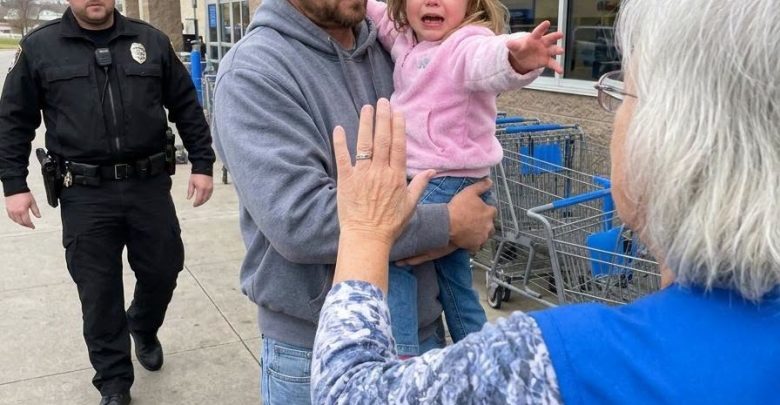
A man in a gray sweatshirt approached the exit with a little girl on his hip. She had curly hair, a damp jacket, and pink boots that knocked against his leg as she struggled.
At first, I assumed she was tired.
Then she turned toward me.
“He’s not my daddy!”
The man adjusted his grip and kept walking.
I stepped closer and reached into my pocket.
“Hello, sweetheart. Would a sticker help?”
She stretched both arms toward me. Before I could react, her fingers caught the front of my vest.
The man gave a tight smile.
“She needs a nap. We’ve had a long day.”
Perhaps they had. But the child was clinging to me hard enough to pull the fabric away from my shirt.
The Question He Did Not Want to Answer
“What’s her name?” I asked.
He looked toward the doors.
“Excuse me?”
“Her name, sir.”
“Quinn.”
I lowered myself slightly so she could see my face.
“Quinn, do you know this man?”
Her chin trembled.
“He took me from Miss Corliss.”
The man pulled her closer.
“She’s confused. Miss Corliss watches her sometimes.”
I could feel my heartbeat in my neck. I did not know their family. I did not know whether there was an explanation.
I knew only what the child had said.
“Let me get my manager,” I told him.
“We’re leaving.”
“It will take a moment.”
He leaned toward me.
“You need to move.”
Quinn tightened her hands around my vest.
I pressed the call button on my radio.
My Manager Wanted the Problem to Disappear
Mr. Darby arrived looking irritated.
The man immediately began explaining that his daughter was exhausted and that I had misunderstood her. He showed Mr. Darby a driver’s license, then opened a photograph on his phone.
It showed him holding a baby.
“There,” he said. “Now can we go?”
Mr. Darby glanced at the screen.
“Mavis, let them leave.”
“She says he took her from her caregiver.”
“And he’s explained that.”
Quinn was crying against the man’s shoulder.
“Please,” I said. “Could we have someone check?”
My manager lowered his voice.
“You’re making a scene.”
Those words embarrassed me more than I wanted to admit. Customers were watching. I was an older employee standing in front of an angry man, and suddenly everyone seemed to be waiting for me to apologize.
I stepped aside.
Quinn’s fingers slipped from my vest.
She kept looking at me as he carried her outside.
Three Pictures in the Parking Lot
For several seconds, I stood beside the carts.
Then I followed them.
I stayed near the covered entrance and watched the man cross the parking lot. He opened the rear door of a dark blue pickup and placed Quinn inside.
My hands were shaking as I took out my phone.
I photographed the truck. Then the license plate. In another picture, the man’s face was visible beside the open door.
When he drove away, I called emergency services.
I explained what I had heard, described the child, and read out the plate number.
“Did she tell you her name?” the dispatcher asked.
“Quinn. She has curly hair and pink rain boots.”
The dispatcher asked me to repeat the name of the caregiver.
“Miss Corliss.”
I waited beneath the awning until the call ended. Rain had blown onto my sleeves, and I was cold, though I had barely noticed it.
Nine Years Ended in a Small Office
The next morning, Mr. Darby called me into his office.
A complaint had been made.
According to the man, I had harassed him, frightened his daughter, and followed them outside after being told to stop.
“I reported what the child said,” I explained.
“You ignored my instruction.”
“I was worried about her.”
He pushed a document across the desk.
My employment was being terminated.
I stared at the paper. After nine years, I had expected a conversation, perhaps a warning, or at least a chance to explain myself to someone else.
Instead, I emptied my locker.
I folded the blue vest and placed it on the counter. A strip of yellow stickers remained in the pocket. I took it out, then put it beside the vest.
On the drive home, I kept reaching for the radio and turning it off again.
The Envelope That Arrived Three Weeks Later
Losing the job hurt. The papers delivered to my house frightened me.
The man was suing me for a sum far beyond anything I could afford.
I read the allegations at my kitchen table, with Walt’s old coffee mug beside my hand.
The document described me as reckless and malicious. Reading it, I barely recognized the afternoon it claimed to describe.
I found an attorney named Elaine Mercer.
She listened without interrupting while I told her everything, including the part where I had stepped aside.
Then she asked to see my photographs.
“Have you heard anything about the child?”
“No.”
That was the question I could not stop asking.
I understood that I might not receive updates. Understanding did little to quiet the worry.
Some nights, I wondered whether I had misunderstood everything.
Other nights, I remembered Quinn reaching for me and felt sick that I had let go.
Seven Months of Waiting
Elaine handled the paperwork. I tried to keep living.
I tended my small garden, helped at a church clothing drive, and visited my sister on Sundays.
People asked why I had left the store.
“I’m taking some time,” I usually said.
It was easier than explaining the lawsuit.
Elaine never promised an easy outcome. She asked precise questions and made sure my account stayed consistent because it was accurate, not rehearsed.
A few weeks before a scheduled court hearing, she called.
“We’ve located someone who may help explain what happened.”
“Someone who saw us?”
“Quinn’s mother.”
I sat down before asking my next question.
“Is the little girl safe?”
“Yes, Mavis. She is.”
I cried so hard that Elaine waited on the telephone without speaking.
The Little Girl in the Yellow Dress
On the morning of the hearing, I wore my navy Sunday dress.
The man sat across the courtroom beside his attorney. Seeing him again made my hands cold.
Elaine touched my arm.
“Look behind you.”
A young woman stood near the rear doors with a little girl beside her.
The child wore a yellow dress.
And pink rain boots.
She studied me for a moment. Then her face brightened.
“Sticker lady!”
Several people turned.
I pressed Walt’s handkerchief against my mouth.
The young woman gave me a small, trembling smile. Elaine had arranged for her to attend, but knowing she was coming had not prepared me to see Quinn standing there.
She was taller than I remembered.
She was holding her mother’s hand.
Her Mother Explained What I Had Not Known
Her name was Tessa Monroe.
During the proceedings, she explained her connection to the man, Brandon Pike.
They had dated briefly when Quinn was an infant. The relationship had ended, and he was not authorized to collect the child.
The photograph on his phone had been taken years earlier. It showed a real moment, but it did not establish the story he had told my manager.
On the day I met Quinn, Brandon had arrived at her caregiver’s home and claimed Tessa had sent him.
When the caregiver went to verify his account, he left with the child.
Tessa learned what had happened while she was at work.
She contacted police and supplied his name, but she did not know which vehicle he was using.
Then another report came in.
An older store employee had called about a crying child. She had photographs and a license plate number.
Tessa looked toward me.
“That was the information they needed to find the truck.”
What Happened After My Call
I learned that officers had stopped the pickup outside town.
Quinn had been recovered safely, and the incident had led to a criminal investigation.
There were details that I had never known and did not need to know in order to understand the most important part.
She had gone home to her mother.
Tessa had tried to find the woman who made the report. For a long time, she knew me only as a greeter who gave children stickers.
I had spent those months wondering whether anyone had listened.
She had spent them trying to learn my name.
Eventually, information about the civil lawsuit helped connect her with Elaine.
Sitting in the courtroom, I looked at the man who had insisted I was mistaken. For months, his account had occupied far too much space in my mind.
Now other people were hearing what Quinn had tried to tell us.
The Case Against Me Came to an End
The hearing did not unfold like a television drama.
There were documents to review, questions to answer, and conversations between attorneys. At times, I struggled to follow the discussion.
Elaine explained it afterward in the hallway.
The records and testimony had changed the position of the case. In the weeks that followed, the claims against me were withdrawn, and the matter was brought to an end.
When Elaine called with the final news, I asked her to repeat it.
Then I thanked her and sat quietly at my kitchen table.
For the first time in months, I opened the envelope containing the court papers without feeling my stomach tighten.
I put them away.
They no longer needed to sit beside the telephone.
The Hug Outside the Courtroom
Before we left the courthouse that first day, Quinn approached me.
“Do you still have stickers?”
I laughed through my tears.
“Not with me, sweetheart.”
Tessa knelt beside her.
“This is the lady I told you about.”
Quinn wrapped her arms around my knees.
Her mother stood and hugged me too.
“Thank you for making that call.”
I wanted to tell her that I should have done more, that I should have found a way to keep them inside.
Before I could speak, she said, “Your pictures helped bring her home.”
I held onto those words.
They did not erase the memory of Quinn leaving the store. They gave me another memory to place beside it: a little girl in a courthouse hallway, safe enough to ask for a sticker.
Returning to the Sliding Doors
With Tessa’s permission, the story eventually reached the local news.
Former customers recognized my name. Cards arrived at my house, some with smiley-face stickers tucked inside.
The company reviewed what had happened and contacted me.
A regional representative came to my home. She apologized for the way my concern had been handled and offered to discuss my return.
I asked what would happen if another child said something frightening.
She described changes to staff training, including how employees should report concerns promptly and involve the appropriate people.
I took time to consider the offer.
Then I returned for three mornings a week.
The first day, I stood beside the sliding doors in a new vest. My name tag felt unfamiliar for about ten minutes.
Then a child asked where the stickers were.
I reached into my pocket.
The First Sticker Is Hers
Tessa and Quinn began visiting on Saturday mornings.
Sometimes they needed groceries. Sometimes they stopped only long enough to say hello.
Quinn would come through the entrance searching for me.
“Sticker lady!”
I always saved one for her.
Over time, she became less interested in talking about the day we met. She wanted to show me a drawing, tell me about preschool, or explain why her stuffed rabbit needed a sticker too.
I was glad.
I remembered the frightened child because I could not help it. She deserved the freedom to become a child with ordinary things on her mind.
Now, when the house is quiet, I still think about that rainy afternoon.
But I also think about Saturday mornings, pink boots squeaking across the floor, and a small hand reaching toward mine without fear.
This story is fictional and is presented for entertainment. It does not describe a verified incident or an actual company policy.