Uncategorized
I Came Home Early From Deployment and Found My 4-Year-Old Daughter Alone—Then My Husband Begged Me Not to Open the Closet

The Return I Had Dreamed About for Six Months
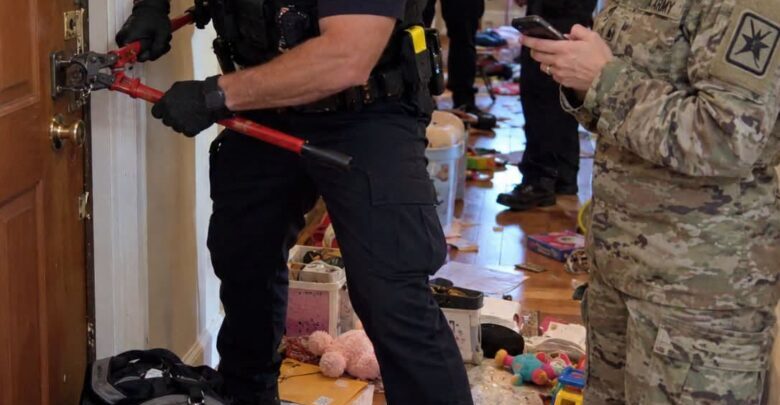
The bolt cutters snapped shut with a sharp metallic crack.
The brass shackle broke, and the heavy padlock fell to the hardwood floor with a dull thud.
From the phone in my hand, my husband made a sound I had never heard before. It wasn’t quite a scream or a word. It was the sound of someone watching a carefully constructed life collapse in a single moment.
Officer Marcus Bell placed the bolt cutters against the wall and looked at me.
I nodded.
He reached for the handle of the hallway closet and pulled.
But to understand why my husband was terrified of that little white door, you need to understand what happened during the six months I spent thousands of miles away, believing my daughter was safe at home.
My name is Hannah Nolan. I was thirty-four years old, a major in the United States Army, and a military intelligence officer with twelve years of service.
My work involved recognizing patterns, examining conflicting information, and identifying the details other people overlooked. I had spent years learning to stay calm when circumstances became dangerous and to make decisions when every second mattered.
I thought I understood deception.
I never imagined the people deceiving me would be my own family.
My husband, Derek Nolan, was thirty-seven. He sold commercial heating and air-conditioning systems for a company in Norfolk, Virginia. We met at a friend’s wedding in Virginia Beach in 2017. Derek was funny, confident, and charming. He could turn an ordinary dinner into an evening full of laughter.
We married the following year.
Our daughter, Lily, arrived in 2021.
She had my dark, curly hair, Derek’s gray eyes, and a tiny gap between her front teeth. She talked to her stuffed animals as though they were old friends, and she carried a beloved rabbit named Mr. Biscuit everywhere she went.
When I left for deployment in March, Lily stood beside the airport security entrance wearing pink rain boots. She held Mr. Biscuit against the glass and made him wave at me.
“Mama, how many sleeps until you come home?”
“A lot of sleeps, baby.”
“A hundred?”
“More than a hundred.”
She looked down at her rabbit and thought about that answer.
“Will you write to me?”
“Every single week,” I promised. “And Daddy will read every letter to you.”
She hugged my legs.
I kissed the top of her head, picked up my bags, and walked away before I could change my mind.
I had no idea how much those promises would matter.
Twenty-Six Letters That Never Reached My Daughter
During my deployment, I wrote Lily a letter every week.
Twenty-six weeks meant twenty-six letters.
Some were long. Others contained only a few paragraphs. Every one included a drawing because Lily loved pictures, even though I had never been particularly good at making them.
I drew crooked hearts, smiling suns, and animals that rarely resembled the creatures they were supposed to represent.
One letter described a camel I had seen near the base.
Dear Lily,
Today I saw a camel. It was bigger than our car and had the funniest face. I decided to name him Gerald. I think you would have laughed at him.
I miss you more than all the stars in the sky.
Love, Mama.
I sent another letter about the heat, explaining that the weather was hotter than the hottest summer day at Virginia Beach.
In June, I found a small gray stone shaped almost like a heart. I picked it up during a patrol and kept it in my pocket until I could mail it to Lily.
I wanted her to have something I had personally touched, something that had traveled across thousands of miles because I had thought of her.
I also sent four packages.
One contained coloring books and hair bows. Another included a stuffed camel I had found at the base exchange. I named it Gerald, just like the camel in my letter.
The remaining packages contained children’s books and little surprises I hoped would make her smile.
I recorded my voice reading Goodnight Moon, The Kissing Hand, and Guess How Much I Love You into recordable storybooks. My plan was simple: when Lily missed me at bedtime, she could press a button and hear her mother reading to her.
Derek assured me that everything was going well.
“She loves the letters,” he told me during one of our video calls. “She makes me read them twice.”
“Can I talk to her?”
“She just fell asleep.”
Another time, he said she was visiting his mother.
On another occasion, he claimed she was having a difficult day and didn’t feel like talking.
I tried to be understanding. Four-year-olds have unpredictable moods, and military deployments are difficult for families. I knew my absence was hard on Lily.
Still, something about our conversations began to bother me.
In six months, I spoke to my daughter on video only four times.
Each call lasted less than two minutes.
Derek always held the phone. Lily rarely looked directly at the camera. She seemed distracted, unusually quiet, and somehow distant.
“She gets shy when she sees herself on the screen,” Derek explained.
I accepted his answer because I wanted to believe him.
I was trained to recognize patterns in complicated situations.
But I kept overlooking the pattern unfolding in my own family.
The Surprise That Changed Everything
Three weeks before my scheduled return, our deployment rotation changed. A replacement unit arrived ahead of schedule, and several of us were assigned to an early flight home.
I decided not to tell Derek.
I wanted to surprise my family.
I imagined ringing the doorbell in my uniform and watching Lily race down the hallway, shouting “Mama!” before throwing her arms around my neck.
I had watched videos of military reunions throughout my career. I had cried at strangers’ reunions because I understood the longing behind every embrace.
Now I would finally experience one myself.
I landed at Norfolk International Airport on a Thursday morning in September.
A retired Navy chief named Walt drove me home. When he saw my uniform, he refused to accept payment.
“Go see your family, Major,” he said with a smile.
Our house stood on a quiet cul-de-sac in Chesapeake’s Great Bridge area. It was a modest brick ranch with three bedrooms, a fenced backyard, and a swing set I had assembled the previous summer.
As the taxi approached, I noticed that the lawn had grown wildly out of control. Weeds covered the flower beds, and newspapers had accumulated on the porch.
Derek’s truck was missing.
My Subaru sat in the driveway, coated in pollen.
I assumed Derek had taken Lily somewhere for the morning.
I collected my bags, walked to the front door, and rang the bell.
Nobody answered.
I rang it again.
Then I heard small footsteps approaching from inside.
They stopped just before reaching the door.
I used my key and stepped into the house.
The smell hit me immediately.
Rotten food. Garbage. Stale air.
And then I saw my daughter.
Lily sat cross-legged on the hardwood floor, about ten feet from the entrance. She was clutching a pink cereal bowl against her chest.
The bowl was empty except for a crust of dried food.
She wore a stained Frozen nightgown. Her dark curls were tangled into thick knots, and her bare feet were black underneath.
Mr. Biscuit rested in her lap.
Her face looked painfully small. Her cheeks were hollow, and dark circles surrounded her eyes.
I dropped my duffel bag.
“Mama?” she whispered.
I couldn’t move for a moment.
“Are you really here?”
I fell to my knees.
“It’s me, baby. I’m home. Mama’s home.”
Lily set down the bowl and reached toward my face. She touched my cheeks carefully, as though she needed to confirm that I was real.
Then she wrapped her arms around my neck.
She began to cry.
But she made no sound.
Her entire body trembled against me. Her tears soaked into my uniform, yet she barely made a noise.
I had seen people cry from grief, pain, fear, and exhaustion.
I had never seen a four-year-old try so hard to cry silently.
I held her tightly and promised I wasn’t going anywhere that day.
Then I looked around the house.
Three Days Without Anyone to Care for Her
The kitchen was in terrible condition.
Garbage overflowed from the trash can. Food containers covered the counters, and flies gathered around spoiled leftovers. A gallon of milk sat unrefrigerated beside an open pizza box.
The refrigerator door stood slightly open.
Near the pantry was a kitchen chair pushed against the counter. Cereal, crackers, and pieces of snack food littered the floor.
An empty peanut butter jar lay on its side. Finger marks scraped the inside where someone had tried to reach every last bit.
I looked at Lily’s hands.
There was dried peanut butter beneath her fingernails.
“Sweetheart, where’s Daddy?”
She looked at me.
“On the giant ship.”
My stomach tightened.
“What ship?”
“The giant boat. Grandma Patty and Aunt Jenna are there too. They’re on vacation.”
I took a slow breath.
“Who’s been staying here with you?”
Lily looked down the hallway.
“No one,” she said. “Grandma said Mrs. Price would bring crackers.”
Evelyn Price was our seventy-one-year-old neighbor. She was a retired elementary school librarian who sometimes brought Lily popsicles during the summer.
“Did Mrs. Price come over?”
Lily shook her head.
“I waited by the window. She didn’t come.”
I immediately called 911.
My hands shook so badly that I entered the wrong number the first time. When the dispatcher answered, I gave her our address and explained that I had just returned from deployment to find my four-year-old daughter alone.
I requested an ambulance and police assistance.
The dispatcher asked whether Lily was conscious, whether she was breathing normally, and whether she could speak. She instructed me to offer small sips of water while waiting for help.
I found a bottle in my field bag and carefully held it to Lily’s lips.
“Little sips, baby.”
She tried to drink too quickly, so I slowed her down.
I also had a small applesauce pouch from the airport. Lily used to love them. I offered her a little at a time while the dispatcher remained on the line.
“Lily, when did Daddy leave?”
She slowly raised three fingers.
“Three sleeps?”
She nodded.
Three days.
My four-year-old daughter had been alone in our house for approximately seventy-two hours.
I had survived dangerous deployments and situations that still appeared in my nightmares.
Nothing prepared me for those three little fingers.
The Neighbor Who Tried to Help
The paramedics arrived within minutes.
A woman named Tonya knelt beside Lily and introduced herself gently. She checked Lily’s pulse, blood pressure, and signs of dehydration.
When Tonya lifted the skin on the back of Lily’s hand, it took longer than expected to return to normal.
She exchanged a concerned look with her partner.
“We need to get her to Children’s Hospital,” she told me. “She needs medical evaluation and fluids.”
I promised Lily I would ride with her.
A Chesapeake police officer arrived moments later. His name tag read BELL. He was a tall man in his fifties, with gray hair at his temples and a serious expression.
He surveyed the kitchen, the garbage, and the scattered food.
Then he looked at me.
“I’m Officer Marcus Bell. Are you the child’s mother?”
“Yes. Major Hannah Nolan. I returned early this morning.”
“Where is the father?”
“Apparently, he’s on a cruise.”
Officer Bell paused.
“I’ll need to search the house to make sure there’s nobody else inside.”
“Search everything,” I replied.
As the paramedics prepared Lily for transport, I opened Instagram.
Derek’s latest post showed him standing on the deck of a cruise ship beneath a brilliant blue sky. He held a pink cocktail with a tiny umbrella.
His mother, Patricia, stood beside him. His sister Jenna posed on his other side, while several relatives smiled behind them.
The caption read:
Living my best life. #FamilyVacay #CruiseLife #NoKidsAllowed
I stared at those final words.
No kids allowed.
Then I checked the date of an earlier photograph. Derek and his mother had posed in front of the ship at the Port of Baltimore three days earlier.
The same day Lily had raised three fingers.
I opened our joint bank account.
Before deployment, it held a little over $19,000 in emergency savings. I had planned to add to that balance while I was away so we could eventually buy a larger home for Lily.
The available balance was $41.18.
I refreshed the page, hoping there had been a technical error.
The number remained unchanged.
I reviewed the transactions.
Thousands of dollars had gone toward cruise charges, excursions, onboard expenses, and payments to credit cards I had never opened.
Capital One. Discover. Chase Sapphire.
I knew Derek had credit cards, but I had not authorized these payments from our joint savings. I also knew nothing about the accounts connected to them.
Nearly $19,000 had disappeared.
Before I could examine the statements further, Evelyn Price rushed through the front door.
She was breathless and visibly shaken.
“Oh, Hannah,” she whispered. “I knew something was wrong.”
I asked whether Patricia had requested that she check on Lily.
Evelyn shook her head.
She explained that she had seen Lily standing at the front window the previous afternoon, wearing what appeared to be a nightgown.
Something about the sight had worried her, so she crossed the street and rang our doorbell.
Nobody answered.
Then the doorbell camera activated.
A man’s voice came through the speaker.
“Hey, Mrs. Price! Everything’s fine. The babysitter is upstairs. Lily’s just being silly at the window. Thanks for checking!”
Evelyn believed him and returned home.
Now she looked devastated.
“I went home,” she whispered. “I thought someone was there.”
Officer Bell stepped forward.
“Ma’am, there was no babysitter.”
Evelyn sat down heavily on the hallway bench.
I took her hand.
“It wasn’t your fault,” I told her, even though my own thoughts were racing.
Derek had watched our neighbor approach the house. He had seen her concern through the camera and deliberately reassured her.
He had lied from thousands of miles away while our daughter waited inside.
Then my phone rang.
Derek’s name appeared on the screen.
My Husband’s Terrified Warning
“Hannah?” he said over the sound of music and laughter. “Why are you home early? The Ring app just showed me your face on the porch!”
He laughed nervously.
“What happened? Did they send you home?”
I ignored the question.
“Where is the person who was supposed to be taking care of Lily?”
The background music continued, but Derek fell silent.
Finally, he claimed the babysitter had canceled on Monday morning, just before the family left for Baltimore.
He said his mother had promised that Evelyn would check on Lily.
Evelyn shook her head.
I looked directly at the phone.
“You left our four-year-old daughter alone for three days.”
“Keep your voice down,” Derek snapped.
The words stunned me.
He was worried about my tone while our daughter was being taken to the hospital.
“We’ll be home Sunday,” he continued. “She’s fine. She’s a smart kid. I left her plenty of food.”
I looked at the empty peanut butter jar and the cereal scattered across the pantry floor.
“The police are here,” I said.
Everything changed.
Derek’s voice dropped.
“What did you do?”
“I came home.”
A long pause followed.
Then he spoke again, urgently and quietly.
“Hannah, listen to me carefully. Don’t let them search the house.”
Officer Bell turned toward me.
“Give me one reason they shouldn’t,” I replied.
Derek said nothing for several seconds.
Then he whispered five words that changed the entire investigation.
“Stay away from the hallway linen closet.”
Everyone looked down the hallway.
The closet stood between the bathroom and Lily’s bedroom. It had once held towels, bedsheets, a vacuum cleaner, and our Christmas decorations.
Now a heavy brass padlock secured its two doors.
I had never seen that lock before.
Officer Bell approached it.
Derek heard the movement through the phone and suddenly began shouting.
“IF YOU OPEN THAT LOCK, YOU’RE GOING TO DESTROY EVERYTHING!”
The paramedics stopped what they were doing.
Evelyn covered her mouth.
Officer Bell examined the padlock before turning toward me.
“Was this closet locked when you left for deployment?”
“No.”
“Did you authorize your husband to secure anything inside it?”
“No.”
Lily was being prepared for transport when she looked toward the hallway.
“Daddy told me never to touch that door,” she whispered.
Officer Bell knelt slightly to speak with her.
“Did he tell you why, sweetheart?”
Lily shook her head.
“He said Mama would be mad if I saw his papers.”
Papers.
That was all she knew.
Officer Bell returned to his patrol car and came back with bolt cutters.
Derek began pleading.
“Hannah, please. Don’t do this.”
For the first time since I had known him, my husband sounded genuinely afraid.
I looked at the locked closet, then at the phone.
“Open it,” I told Officer Bell.
The bolt cutters snapped shut.
The padlock fell to the floor.
The Letters Behind the Locked Door
Officer Bell pulled open the closet.
At first, I didn’t understand what I was seeing.
The towels and sheets were gone. So was the vacuum cleaner.
In their place sat six cardboard banker boxes, each marked with a label written in Derek’s handwriting.
FINANCIALS.
HOUSE.
LAWYER.
POA.
MOM’S NOTES.
A clear plastic storage bin sat on the floor at the back.
I knelt and pulled it toward me.
Inside were dozens of envelopes.
I recognized the handwriting immediately.
My handwriting.
Every envelope was addressed to Lily. Each one had a little heart drawn on the back flap.
Twenty-six letters.
All unopened.
Beneath them were four shipping boxes containing every package I had sent from deployment.
I tore open the nearest box.
Inside was the coloring book, the hair bows, and a recordable storybook containing my voice.
Then I found the stuffed camel.
Gerald.
I had written his name on a small tag with a black marker.
For six months, I had imagined Lily hugging that camel while listening to my bedtime recordings.
Instead, it had sat in a locked closet, hidden from her.
Not one letter had reached my daughter.
Not one package had been opened.
I sat on the hallway floor, holding Gerald in my hands.
I couldn’t speak.
Officer Bell knelt beside me and waited until I was ready.
Then he looked at the boxes.
“Ma’am, I need to examine these documents.”
I nodded.
He opened the box marked POA.
Inside was a three-page document titled Durable General Power of Attorney. It named Derek as my attorney-in-fact and appeared to bear my signature.
The date was March 22.
I had been overseas on that date, processing through a military installation in Kuwait.
“I never signed this,” I said.
The signature looked similar to mine, but several details were wrong. The document also carried a notary stamp bearing the name of Patricia Nolan, Derek’s mother.
I had never authorized her to notarize a power of attorney on my behalf.
Officer Bell documented the document and began reviewing the remaining records.
The FINANCIALS box contained applications for credit cards opened in my name, along with approval letters, account statements, and balances totaling tens of thousands of dollars.
My personal information had been used without my permission.
The HOUSE box contained paperwork for a home equity line of credit secured against our property. The documents indicated that approximately $60,000 had been drawn from the account and transferred to a separate bank account associated with Patricia.
The full circumstances and authorization behind those transactions would need to be investigated, but the records raised serious questions about what Derek and his mother had been planning.
Then Officer Bell opened the box marked LAWYER.
Inside was a retainer agreement from a family law firm and a draft petition seeking sole legal and physical custody of Lily.
I read the document slowly.
The petition claimed that I had repeatedly abandoned my daughter through military deployments. It alleged that I had failed to maintain meaningful contact with her and had sent no letters, packages, or gifts during my latest deployment.
It also claimed that Lily had developed a stronger attachment to Derek and Patricia and no longer recognized me as her primary caregiver.
I looked down at the unopened envelopes scattered across the floor.
Twenty-six letters.
Four packages.
Three recordings of my voice.
The petition described me as a mother who had made no effort to contact her child.
The evidence of my effort had been hidden ten feet from Lily’s bedroom.
The final box contained a green spiral notebook.
Its cover was worn, and the handwriting inside was neat and precise.
It belonged to Patricia.
The Notebook That Exposed the Plan
Officer Bell opened the notebook and began reading.
The first entries described Lily crying for me after I left. Patricia recorded how she redirected Lily’s attention and told her that I was busy.
A few days later, another entry mentioned the arrival of my first letter.
Derek had placed it in the bin.
Patricia wrote that she had told Lily her mother had forgotten to write.
The next entries described video calls that never reached Lily, packages hidden in the closet, and questions my daughter had asked about me.
Then I reached an entry dated May 6.
L. asked if Mommy still loved her. Told her Mommy loves the Army more. L. asked what the Army was. Told her it’s where Mommy goes instead of being with you.
I stopped reading.
My four-year-old daughter had been asking whether her mother still loved her, and the people responsible for protecting her had used that question to make her feel abandoned.
I turned the page.
The notebook described Patricia’s satisfaction when Lily stopped asking about me as frequently.
One entry noted that the custody lawyer believed the child’s apparent distance from me could support Derek’s petition.
The final relevant entry described plans to file after I returned home.
It also mentioned the family cruise.
The babysitter had been expected to stay with Lily, but the notebook did not explain every detail of what happened after that arrangement collapsed. What was clear was that the adults had left the child without the care she needed.
And they had gone anyway.
I looked at the closet.
I thought of Lily sitting alone in the house, waiting for someone to bring crackers.
I thought of the doorbell camera and Derek’s reassuring lie to Evelyn.
Then I thought of my daughter looking at me and asking whether I was really home.
The documents suggested that hiding my letters was part of a larger effort to make me appear absent from Lily’s life. The suspected financial fraud added another disturbing dimension to the situation.
I had gone overseas believing I was protecting our family’s future.
While I was away, someone had used my name, my savings, and my absence to construct a story in which I was the person who had failed my child.
Officer Bell carefully secured the documents for the investigation.
I gathered the letters and packages that had been recovered, making sure nothing was discarded or damaged.
Then I walked to the ambulance.
The First Time Lily Cried Out Loud
Lily lay on the stretcher with an IV in her arm and Mr. Biscuit tucked beneath her chin.
I placed Gerald beside her.
She studied the stuffed camel with a puzzled expression.
“Who’s this?”
“His name is Gerald,” I told her. “I sent him to you in April.”
“You sent him?”
“Yes, baby. I sent him, and I wrote you letters. Every single week.”
She looked at the camel, then at me.
“Grandma said you didn’t write.”
My throat tightened.
“I know what she said.”
“She said you were too busy. She said you loved the Army more.”
I gently held her face between my hands.
“Lily, look at me. I wrote to you every week. I never forgot you. Not one day. I drew pictures for you, and I sent you a rock that looks like a heart.”
Her eyes filled with tears.
“I put it in an envelope because I wanted you to keep it in your pocket,” I continued. “I wanted you to have something that reminded you I was thinking about you.”
Her lower lip trembled.
Then she began to cry.
Not silently.
She cried loudly, desperately, and without trying to hide it. Her entire little body shook as the months of confusion and loneliness seemed to spill out of her.
I wrapped my arms around her.
I didn’t tell her to calm down.
I didn’t ask her to be brave.
I simply held her and let her cry.
When she finally caught her breath, she looked at me.
“Mama,” she whispered, “can I have my rock?”
I promised her we would find it.
At Children’s Hospital of The King’s Daughters in Norfolk, doctors evaluated Lily for dehydration and inadequate nutrition. She remained in the hospital for four days while the medical team monitored her condition.
Her doctors treated her dehydration and watched her laboratory results. They also addressed a severe diaper rash and other problems associated with the lack of appropriate care.
Physically, she began to improve.
Emotionally, we knew recovery would take much longer.
A pediatrician named Dr. Amara Osei spoke with me during the first night.
“She told one of our nurses something while she was getting cleaned up,” Dr. Osei explained.
“What did she say?”
“She said she stayed quiet so nobody would know she was alone. She was afraid that if she cried loudly, the neighbors would hear and Daddy would get in trouble.”
I covered my face with my hands.
“She thought it would be her fault.”
Dr. Osei sat beside me.
“She’s four years old, Hannah. She was trying to protect the adults around her. She needs to learn that she was never responsible for their choices.”
That night, I began reading Lily the letters.
All twenty-six of them.
A Mother’s Voice, One Letter at a Time
I started with the first letter, the one about Gerald the camel.
Lily held the stuffed animal while I read the words I had written months earlier.
She asked questions about the camel, the heat, the place where I had been stationed, and the drawings I had included.
When I reached the letter about the heart-shaped stone, I opened the original envelope.
The little gray rock slipped into my hand.
I placed it in Lily’s palm.
She closed her fingers around it and held it tightly.
Then I brought out the recordable storybooks.
She pressed the buttons on every page, listening to my recorded voice read the familiar words. When the recording ended, she pressed the button again.
And again.
I sat beside her until she was satisfied.
“Mama,” she said quietly, “you were thinking about me the whole time?”
“The whole time, baby.”
“Even when you were at the camel place?”
“Especially when I was at the camel place.”
She thought about that for a while.
Then she looked at Gerald.
“Grandma lied,” she said.
I didn’t correct her.
“Daddy lied too.”
I held her hand.
She was beginning to understand what had happened, but she was still very young. I knew she needed honesty delivered gently, without being asked to carry the anger or responsibility of the adults involved.
I promised her that she could ask me questions whenever she wanted.
I also promised that she would never be punished for missing me, crying, or telling someone she was afraid.
Those promises mattered more than any explanation I could give her.
The Arrests and the Investigation
The cruise ship returned to Baltimore on Sunday morning.
Authorities were waiting at the port, and Derek and Patricia were taken into custody following the investigation into the alleged child neglect, forged documents, and financial transactions.
The evidence included the recovered letters and packages, the notebook, the disputed power of attorney, credit applications, and records associated with the home equity loan.
Investigators also examined the circumstances surrounding Lily’s abandonment and the false statement made through the doorbell camera.
The case involved multiple potential offenses, and each allegation had to be supported by evidence through the legal process.
Derek’s sister, Jenna, contacted me while the family was still on the ship.
She was crying when she called.
“Hannah, is Lily okay?”
“She is in the hospital, but she’s getting better.”
Jenna said she had believed a babysitter was caring for Lily. She had spoken to the woman who was supposed to stay with her before the cruise, but she did not know the arrangement had fallen through.
She also admitted that she had seen something suspicious months earlier.
In July, she had visited the house and seen Patricia placing one of my packages inside the hallway closet. Lily had asked whether the package was for her, and Patricia had told her it was for Derek.
Jenna had questioned her mother afterward, but she had not contacted me or the authorities.
“I should have done something,” she said.
“Why didn’t you?”
She was silent for a long time.
“Because I’m afraid of my mother,” she finally admitted. “I have been afraid of her for years.”
Jenna agreed to provide investigators with a statement about what she had seen and heard. Her account helped establish a clearer timeline of the family’s actions and the concealment of the correspondence.
She also described a conversation she had overheard about selling the house while I was overseas.
Those allegations became part of the broader investigation.
The legal proceedings took months.
Derek eventually pleaded guilty to several charges, including child neglect, forgery, and identity theft. Patricia’s case proceeded separately, and the disputed documents and notebook became important pieces of evidence.
During the proceedings, Patricia argued that she had been acting in Lily’s best interests. She described me as an absent mother and claimed she had been trying to provide stability.
But the records told a different story.
The letters showed that I had maintained a regular effort to contact my daughter. The packages demonstrated that I had sent gifts and recordings intended to comfort her. The notebook documented deliberate efforts to make Lily believe I had forgotten her.
The court proceedings also addressed the financial allegations and the documents bearing my disputed signature.
The outcome brought legal consequences for the adults responsible, but it did not erase what Lily had experienced.
Justice could hold them accountable.
It could not give my daughter those six months back.
Choosing to Be Home
After the investigation began, I reconsidered my military career.
I loved serving in the Army. It had shaped my identity, given me a purpose, and allowed me to do work I believed mattered.
My commander offered support and discussed options that would let me remain in uniform while avoiding another lengthy deployment.
I took time to consider those possibilities.
Ultimately, I decided to leave active duty and join the Army Reserve. I later accepted a civilian analytical position with the Department of Defense in Norfolk.
It was not a decision I made because I believed military service had caused what happened to Lily. Derek and Patricia were responsible for their choices.
I made the decision because I wanted a different balance in my life, one that allowed me to be present for my daughter every day.
I wanted to pick her up from school, help her with dinner, read her bedtime stories, and be there when she woke from a nightmare.
I wanted to show her through ordinary routines that love could be dependable.
By the following school year, Lily was attending kindergarten at Grassfield Elementary.
She was learning to write her name and read familiar books. She talked to Mr. Biscuit and Gerald in long, elaborate conversations, inventing adventures for them that involved camels, castles, and enormous sandwiches.
Most importantly, she began to cry when she needed to cry.
When she fell down, she let herself be comforted.
When she felt sad, she told me.
When she didn’t get the purple cup she wanted, she sometimes protested loudly.
Those moments made me smile, because she was learning that she did not have to hide every feeling to keep the adults around her safe.
She also began seeing a child therapist who specialized in trauma. We attended appointments regularly and followed the guidance of her care team.
Healing wasn’t a straight line.
Some days were easy. Other days, a missed phone call or a closed door could bring back a memory she didn’t fully understand.
We learned to talk about those feelings without forcing her to discuss anything before she was ready.
Her therapist reminded me that trust is rebuilt through repeated experiences of safety, patience, and consistency.
So that was what I tried to give her.
Every day.
The People Who Helped Us Begin Again
Evelyn Price started coming to dinner every Wednesday.
She brought pies, read stories to Lily, and sat with me on the porch after bedtime.
For months, she blamed herself for believing Derek’s voice through the doorbell camera.
“He told me the babysitter was upstairs,” she said one evening. “I believed him, and I went home.”
I reached across the table and took her hand.
“Evelyn, you were the one who noticed something was wrong. You saw Lily standing at that window, and you came over. You rang the bell. You tried to help.”
Her eyes filled with tears.
“You were the first person who noticed,” I continued. “That matters.”
She never completely stopped feeling guilty, but she slowly began to understand that the person who lied to her was responsible for that lie.
Jenna also began rebuilding her relationship with Lily.
She moved out of her mother’s house and started therapy of her own. She found an apartment in Portsmouth and began working at a veterinary clinic.
On Sundays, she often visited us with small gifts for Lily.
A sticker book.
A plastic camel from a dollar store.
A gray rock from Fort Monroe that almost looked like a heart.
Lily placed that rock beside the one I had mailed from overseas.
The two stones became treasures on her bedroom windowsill.
Jenna eventually told me something about her childhood that helped explain the strange significance of the locked closet.
When she and Derek were children, Patricia sometimes took the things they loved most and locked them away.
Jenna remembered a dollhouse. Derek had once lost access to his baseball glove.
Their mother would place the objects inside a closet and tell them they would have to earn them back.
“She said it taught us a lesson,” Jenna explained. “She wanted us to understand that the things we loved could be taken away.”
I thought about the letters in the plastic bin.
I thought about Gerald sitting in the dark.
I thought about Lily being told that her mother had forgotten her.
Derek had grown up watching someone use affection and access as tools of control. That history helped me understand where some of his behavior might have come from, but it did not excuse what he had done.
He had been an adult with choices.
So had Patricia.
And they had chosen to harm a child.
Turning the Closet Into Something Good
One afternoon in February, Lily stopped in front of the hallway closet.
The doors were open, and the shelves held towels, sheets, and the Christmas decorations we had returned to their usual places.
She looked inside for a long time.
“Mama, is this where Gerald was?”
“Yes, sweetheart.”
“And my letters?”
“Yes. They were here too.”
She looked at the shelves again.
“I don’t like this closet.”
I knelt beside her.
“I understand.”
She thought for a moment, tilting her head the way she did whenever she was working through an important question.
“Can we make it a good closet instead of a bad closet?”
I smiled.
“Yes. We can.”
The project took an entire weekend.
Evelyn came over to help. Jenna brought supplies, and Officer Marcus Bell stopped by on Saturday with a drill and a toolbox.
He had remained in touch during the investigation, and he admitted that the closet had stayed in his thoughts long after the original incident.
We removed the bifold doors entirely.
The towels and sheets moved into a bathroom cabinet. The vacuum cleaner went into the laundry room, and the Christmas decorations were stored in the attic.
Then we painted the inside.
Lily chose bright yellow, the color of sunshine.
Officer Bell built three low shelves so she could reach everything herself. Jenna made soft purple and pink cushions for the floor, and Evelyn brought a little reading lamp shaped like a crescent moon.
We carefully placed the twenty-six letters in clear protective sleeves.
They stood upright on the shelves, visible and accessible, with every drawing and envelope preserved.
The recordable storybooks went on the middle shelf.
Gerald the camel sat beside the heart-shaped stone.
Jenna’s almost-heart-shaped rock rested beside it.
Above the opening, we installed a wooden sign.
Lily painted the letters herself with a little help from the rest of us.
It read:
LILY’S LETTER CLOSET
ALWAYS OPEN
The closet had once been a place where love was hidden from her.
Now it became a place where she could reach for it whenever she wanted.
Every night, Lily settled onto the cushions with Mr. Biscuit and Gerald. She chose one of my letters and read as much of it as she could.
When she encountered a word she didn’t recognize, she asked me what it meant.
Sometimes she invented her own words.
Sometimes she laughed at my drawings.
And sometimes she simply held the paper and looked at the handwriting.
The important thing was that she could choose.
Nobody decided whether she was allowed to see a letter.
Nobody told her that asking for her mother was wrong.
Nobody locked the door.
“Will I Get Your Letters?”
One evening, I passed the hallway and found Lily sitting inside her little reading nook.
She was wearing her pajamas and holding Letter Number Fourteen, the one about the heart-shaped rock.
The crescent moon lamp cast a warm glow over her curls.
She looked up.
“Mama, are you going away again? To the camel place?”
I sat down beside her.
“Sometimes I may need to travel for work,” I explained. “But I won’t be gone for a long time like before. And I’ll always make sure you know what’s happening.”
She considered that answer carefully.
“Will you write me?”
“Every day if I’m away,” I promised. “Every single day.”
She glanced at the letters on the shelves.
“And will I get them?”
The question hurt more than she could possibly understand.
I looked at my little girl, at the yellow walls, and at the sign above the opening.
“Yes, baby. You’ll get them.”
“How do you know?”
I touched the wooden sign.
“Because this closet doesn’t have a lock anymore.”
She looked up at the words.
“Always open,” she read slowly.
“Always open,” I repeated.
Then she returned to her letter.
What I Learned From the Twenty-Six Letters
People sometimes ask me what I learned from that experience.
They expect me to talk about betrayal, military deployments, marriage, or the importance of paying attention to warning signs.
Those things matter.
I learned that trust should never mean ignoring evidence. I learned that a person can be charming in public and cruel in private. I learned that children can become frightened enough to hide their own distress because they believe the adults around them might suffer consequences.
I also learned that asking for help is not the same as failing to protect your family.
But when I think about what happened, I return to the letters.
Twenty-six letters.
Four packages.
Three recordings of my voice reading bedtime stories.
Every one of them had been sent because I loved my daughter. Every one had traveled thousands of miles to reach her.
And every one had been hidden behind a locked door.
For months, Lily believed I had forgotten her. She believed I had chosen my career over her. She believed the absence she experienced meant she was not important enough to remember.
None of those things was true.
Yet the lie became real in her mind because the people she depended on repeated it, and the evidence that could have comforted her was kept out of reach.
I cannot change those six months.
I cannot give her back the evenings she spent waiting by the window or the nights she tried to cry without making a sound.
What I can do is help her understand that none of it was her fault.
I can be there when she needs reassurance.
I can listen when she has questions.
I can let her cry without telling her to be quiet.
And I can keep the letters where she can see them.
The yellow walls of her reading nook remind me that a place associated with fear can become something different when people work together to make it safe.
The shelves remind me that the truth does not become less true because someone tries to hide it.
And the little sign above the doorway reminds me that love needs more than good intentions. It needs honesty, protection, and a way to reach the person who depends on it.
Sometimes, the people who claim to protect a family are the very ones who create the danger.
Sometimes, the most important thing a parent can do is notice what has changed, ask difficult questions, and refuse to accept an explanation that doesn’t make sense.
And sometimes, the bravest thing a child can do is finally cry out loud.
I still think about the morning I came home early and found Lily sitting on the floor with an empty bowl.
I think about how carefully she touched my face, as though she was afraid I might disappear.
I think about the letters in the closet and the way my hands trembled when I found them.
But I also think about the moment she held the heart-shaped rock in her palm and realized I had been thinking about her all along.
That was the beginning of something new.
Not a perfect life. Not a life without fear or painful memories.
A life in which she would never again have to wonder whether she was loved simply because someone had hidden the proof.
The closet is still there.
The doors are gone.
The shelves are yellow, the cushions are soft, and the letters remain where Lily can reach them.
And above the opening, in purple letters painted by a five-year-old girl, are the words that matter most:
ALWAYS OPEN.