News
Brain Only, No Calculator! This Simple Math Puzzle Is Tricking People — Can You Solve It?
Brain Only, No Calculator! This Simple Math Puzzle Is Tricking People — Can You Solve It?

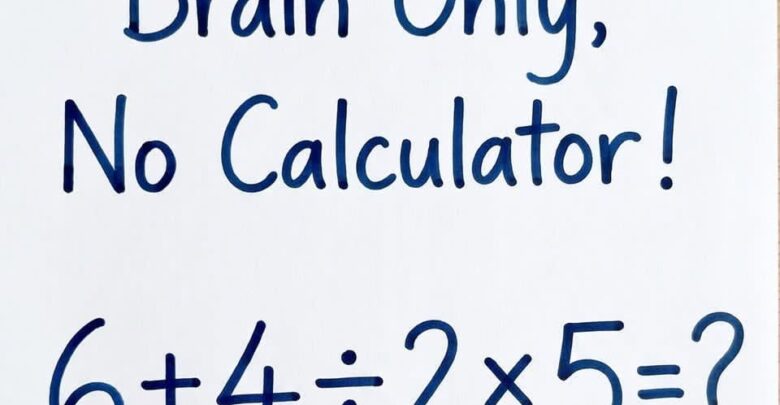
Can You Solve 6 + 4 ÷ 2 × 5? One Familiar Rule Makes the Difference
A short arithmetic puzzle can seem almost too simple to deserve a second look. The numbers are small, the symbols are familiar, and none of the individual calculations appears difficult.
Then someone shares a different answer.
Consider this expression:
6 + 4 ÷ 2 × 5 = ?
Take a moment to work through it without a calculator.
The correct answer is 16. However, understanding how to reach that result is more useful than remembering the number.
The main challenge is the relationship between multiplication and division. They share the same priority, so you cannot automatically complete every multiplication before beginning any division.
Addition comes later in this particular expression.
Once those rules are clear, the calculation becomes straightforward. Let’s examine the correct solution, the common wrong turns, and a simple way to approach similar problems.
Read the Whole Expression Before Calculating
Begin by looking at every operation:
6 + 4 ÷ 2 × 5
The expression contains addition, division, and multiplication. There are no parentheses or exponents.
That observation tells us where to begin.
Although the addition symbol appears first when reading from the left, its position does not give it priority over the division and multiplication.
This distinction is central to the puzzle.
Reading order and calculation order are related, but they are not identical in every situation. You first identify the priority of the operations. Then you apply the left-to-right rule where operations share the same level.
A brief look at the complete expression can prevent an incorrect first step.
What the Order of Operations Tells Us
The order of operations provides a shared convention for evaluating mathematical expressions.
Without that convention, people could group the same written symbols differently and obtain different results.
For this puzzle, two rules are enough:
- Complete multiplication and division before addition.
- Evaluate multiplication and division from left to right when they appear in the same sequence.
The second rule is often the one people forget.
Multiplication does not automatically outrank division. Instead, both belong to the same priority level.
Once those operations have been completed, you can evaluate the remaining addition.
The arithmetic itself is simple. Choosing the right sequence is what makes the answer reliable.
Step One: Divide 4 by 2
Return to the original expression:
6 + 4 ÷ 2 × 5
The multiplication and division must be handled before the addition.
Within that sequence, the division appears first from the left:
4 ÷ 2 = 2
Replace that completed calculation with its result:
6 + 2 × 5
Notice that the initial 6 has not disappeared. It remains in the expression while the higher-priority operations are completed.
Also, the multiplication is still waiting.
At this stage, adding 6 and 2 would be premature. The expression has become shorter, but its remaining operations still have different priorities.
Therefore, multiplication comes next.
Step Two: Multiply the Result by 5
The simplified expression is:
6 + 2 × 5
Now complete the multiplication:
2 × 5 = 10
Substitute that result:
6 + 10
The division and multiplication have both been completed in the correct sequence.
Only one operation remains, so there is no longer a question about which part should come first.
This step also shows why keeping the expression visible can help. You can see the untouched addition waiting while the multiplication is carried out.
Instead of trying to hold every number in your head, you gradually replace completed sections with their values.
That produces a simpler expression without changing its meaning.
Step Three: Complete the Addition
The final calculation is:
6 + 10 = 16
Therefore:
6 + 4 ÷ 2 × 5 = 16
The complete sequence can be written as:
6 + 4 ÷ 2 × 5
= 6 + 2 × 5
= 6 + 10
= 16
Each line has the same value as the line before it.
That is the goal of simplifying an expression: make it easier to evaluate while preserving what it represents.
If you obtained 16 on your first attempt, check that your reasoning followed this sequence. A correct result is most useful when you can explain the steps that support it.
The Solution at a Glance
Here is the same calculation in a compact table:
| Step | Calculation | Result |
|---|---|---|
| 1 | Divide 4 by 2 | 2 |
| 2 | Multiply that result by 5 | 10 |
| 3 | Add the remaining 6 | 16 |
The table highlights an important detail: the 5 multiplies the result of 4 ÷ 2.
It is not combined with the divisor before that division takes place.
Likewise, the first 6 waits until the multiplication and division have been evaluated.
Keeping those relationships clear is more important than trying to answer as quickly as possible.
Why Someone Might Answer 25
One possible wrong answer is 25.
This result comes from performing every operation strictly from left to right without considering priority:
6 + 4 = 10
Then:
10 ÷ 2 = 5
Finally:
5 × 5 = 25
Each individual calculation is correct. However, the first step does not match the standard evaluation of the original expression.
The addition must wait until after the multiplication and division.
This example explains why knowing basic arithmetic is not enough by itself. You also need to know which numbers belong to the calculation you are performing.
The sequence determines the result.
Why Someone Might Answer 6.4
Another possible result is 6.4.
That answer can appear when someone assumes that multiplication always comes before division.
They might begin with:
2 × 5 = 10
Then calculate:
4 ÷ 10 = 0.4
Finally:
6 + 0.4 = 6.4
The mistake is treating the multiplication as though it has a higher priority than the division.
In the expression as written, they share equal priority. Therefore, the division on the left must be completed first.
The calculation leading to 6.4 would be appropriate for a differently grouped expression:
6 + 4 ÷ (2 × 5)
Those parentheses are not present in the original puzzle.
PEMDAS Does Not Mean Multiplication Always Comes First
Many people remember the order of operations through PEMDAS:
- P: Parentheses.
- E: Exponents.
- M and D: Multiplication and division.
- A and S: Addition and subtraction.
The letters are useful, but they can become misleading if each is treated as a separate priority level.
The M appearing before the D does not mean that multiplication must always be completed first.
Instead, think of multiplication and division as a pair. Similarly, addition and subtraction form another pair.
Within each pair, evaluate from left to right when working through a sequence.
That understanding explains why the division comes first in this puzzle, even though multiplication appears earlier in the familiar memory aid.
BODMAS Leads to the Same Answer
Other readers may have learned BODMAS rather than PEMDAS.
The wording differs, using brackets and orders for the first stages. However, the relevant principle here remains unchanged.
Division and multiplication share a priority level. Addition and subtraction share another.
Therefore, BODMAS does not instruct you to perform all division everywhere before any multiplication, just as PEMDAS does not require the opposite.
For the original expression, the leftmost operation within the multiplication-and-division sequence is:
4 ÷ 2
That produces 2, which is then multiplied by 5.
Both memory aids lead to 16 when interpreted correctly.
Parentheses Can Change the Problem
Grouping symbols tell us which part to evaluate first.
Compare these three expressions:
| Expression | Correct answer |
|---|---|
| 6 + 4 ÷ 2 × 5 | 16 |
| (6 + 4) ÷ 2 × 5 | 25 |
| 6 + 4 ÷ (2 × 5) | 6.4 |
The numbers and basic operation symbols are the same. The grouping is different.
In the second expression, the parentheses require the addition to happen first.
In the third, they require 2 and 5 to be multiplied before the division.
This comparison helps explain the competing answers. A person may accidentally calculate a grouped version of the problem that was never actually written.
Always work with the expression in front of you.
What “Left to Right” Really Means
The phrase “work from left to right” needs context.
It does not mean carrying out every symbol in the original expression in reading order. Instead, it applies within the relevant priority level.
Consider:
24 ÷ 6 × 2
Division and multiplication share equal priority, so:
24 ÷ 6 = 4
Then:
4 × 2 = 8
The answer is 8.
The same idea applies to addition and subtraction:
18 − 6 + 3
First:
18 − 6 = 12
Then:
12 + 3 = 15
Understanding where the left-to-right rule applies makes the wider order of operations much easier to remember.
A Useful Mental-Arithmetic Approach
You can solve the original puzzle mentally by temporarily focusing on its multiplication-and-division section:
4 ÷ 2 × 5
Half of 4 is 2. Five groups of 2 make 10.
Then bring back the addition:
6 + 10 = 16
This approach keeps the untouched part of the expression available without trying to evaluate it too early.
However, there is no need to force mental calculation if it makes the sequence harder to track.
Writing down one intermediate line can be enough:
6 + 10
The objective is accuracy and understanding. Speed can come later as the process becomes familiar.
Check Your Working Without Starting Over
If you are uncertain, review the solution in stages.
First, check whether you completed the addition too early.
Next, look at the multiplication and division. Did you work through them from left to right?
Then confirm that every number from the original expression has been used in the correct place.
For this puzzle, the division gives 2, the multiplication gives 10, and the final addition gives 16.
You can also compare your working with the alternative grouped expressions above. If your steps resemble one of those, you may have introduced parentheses mentally.
That is often easier to identify than a vague feeling that the answer “looks wrong.”
Why Explaining Your Answer Helps
When discussing a puzzle with friends or family, sharing only a number leaves the reasoning hidden.
Instead, explain the sequence:
“I divided 4 by 2, multiplied the result by 5, and then added 6.”
That short explanation makes it possible to compare methods without turning the conversation into a contest over confidence.
Someone who answered 25 can immediately see that they began with addition.
Likewise, someone who answered 6.4 can identify the grouping they used.
The most useful discussion is about the written steps. Once those are visible, the disagreement becomes easier to resolve.
The Final Answer Is 16
The expression is:
6 + 4 ÷ 2 × 5
Complete division and multiplication from left to right:
4 ÷ 2 = 2
2 × 5 = 10
Then finish the addition:
6 + 10 = 16
The answer is 16.
If you initially reached another number, the mistake may have come from reading every operation from left to right or giving multiplication priority over division.
Remember the paired levels, respect any grouping symbols, and complete the calculation one stage at a time.
🧠 Did you get 16 on your first attempt? Share your answer—and the steps you used—in the comments!