News
An Army Sergeant Mocked an 81-Year-Old Woman Eating Alone in the Dining Hall, Then She Asked Him to Read the Wall Behind Him!!!
An Army Sergeant Mocked an 81-Year-Old Woman Eating Alone in the Dining Hall, Then She Asked Him to Read the Wall Behind Him!!!

The Woman in the Gray Coat
“Hey, Grandma. What was your rank back in the Stone Age?”
Instead of looking up, I kept my eyes on my bowl. After all, I had driven forty minutes for that chili.
“I’m talking to you, ma’am.”
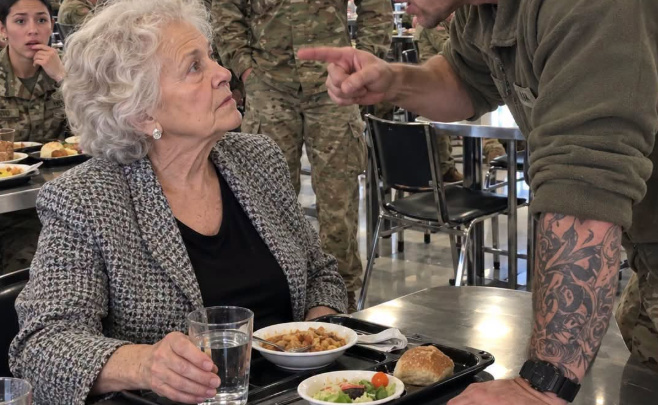
Three soldiers stood over my table. The one speaking was perhaps twenty-seven, with broad shoulders and a voice used to getting attention. His name tape read REESE, and his rank showed he was a staff sergeant.
My name is Quinn Braddock. At eighty-one, I live alone in a yellow house in Clarksville, Tennessee, with far too many stairs. For thirty-one years, I worked as a school nurse at Burt Elementary.
Before that, however, I had lived a very different life.
That Thursday in October, I was eating in the dining hall at Fort Campbell, Kentucky. While everyone around me wore camouflage, I had chosen my good gray wool coat and church shoes.
Most of those soldiers were young enough to be my grandchildren. Yet one of them had decided I didn’t belong.
A Quiet Lunch Becomes a Public Scene
“This is a military installation,” Reese said. “You need a pass. Or did you wander over from the old folks’ home for a free lunch?”
At that, his two friends laughed.
Around us, conversations began to fade. Soon, I could hear forks scraping against trays as people tried to listen without appearing to.
Calmly, I set my spoon beside the bowl.
For some reason, that seemed to anger him further. After placing his tray on the next table, he leaned over mine with both hands flat on its surface. An eagle tattoo covered his right forearm.
“Look at me when I’m talking to you. We’ve got standards here, so we don’t let just anybody stroll in. Who are you, and what are you doing on my post?”
Nearby, a young private looked up. Although she opened her mouth to speak, one glance at his stripes made her stop.
Only then did I turn toward him.
The Crest on His Uniform
Underneath that harsh expression, Reese had a good face. Perhaps he had spent his life being told he was the strongest person in the room. Until now, he might never have had reason to question it.
First, I studied his name tape. Then my eyes moved to his shoulder patch and the small crest above his right breast pocket.
A blue shield held a white heron with its wings spread wide.
Without saying anything, I reached for my water.
“What, you deaf?” one of his friends asked.
Meanwhile, Reese snapped his fingers in front of my face.
“I asked for ID. Now.”
There was a visitor’s pass in my purse, complete with my photograph and a blue lanyard. Earlier that morning, I had collected it at the Gate 4 visitor center.
Even so, I left it where it was. If there was a real concern about my visit, the military police could deal with it. Snapping fingers at an elderly woman over lunch was another matter.
The Pin on My Coat
My late husband, Walt, used to call my stubborn streak the eighth wonder of the world. Perhaps he had a point.
After another sip of water, I set the glass down. My hand remained steady, although very little else about me did these days.
By then, Reese’s face had turned red. He had begun this performance in front of two hundred soldiers, but it wasn’t going as planned.
“That’s it,” he said. “We’re walking to the gate. Get up.”
Instead, I stayed seated.
As he looked me over, his eyes stopped at the collar of my coat. There was a small pin there, its brass dark with age and its blue enamel chipped at one corner.
Like his crest, it showed a white heron on a blue shield.
The difference was that mine was fifty-six years older.
Immediately, he pointed at it, his finger an inch from my throat.
“Where did you get that?”
“Take It Off”
Before I could answer, Reese kept going.
“That’s my battalion’s crest. Men bled for that, and men died for it. You don’t buy one at a flea market in Hopkinsville to get a free lunch. Take it off.”
“No.”
Until then, I hadn’t spoken a single word to him.
“Take it off,” he repeated, “or I’ll take it off for you.”
At once, the young private stood. However, a small shake of my head stopped her.
Then I looked past Reese toward the wall above the serving line. Blue letters stretched across the cinder blocks, a foot high and impossible to miss.
For three years, he had eaten beneath those words.
“Sergeant,” I said, “before you put your hands on me, turn around and read what that wall says.”
For a moment, he didn’t move.
“I know what it says.”
“Then it won’t take long. Read it out loud.”
The Words Above the Serving Line
By now, the room was so quiet that I could hear the steam table hissing.
Something in my voice must have reached him, because Reese slowly turned toward the wall.
“We Carry Our Own.”
Those words were the battalion motto. Every soldier in the unit learned them upon arrival.
“Keep going,” I said.
Below the motto was another line in smaller blue letters. Usually, people treated it as part of the background, like the clock or the fire extinguisher.
This time, however, Reese read every word.
“This dining facility is dedicated to First Lieutenant Quinn Hollis, Army Nurse Corps, who carried forty-one of ours home. May 1969.”
After finishing, he stood with his back to me for a long time.
Finally, he turned around.
“Ma’am.” His voice had grown small. “What did you say your name was?”
“I didn’t. You never asked my name, Sergeant. You asked my rank.”
Then I folded my hands on the table.
“It was first lieutenant. And my maiden name was Hollis.”
The Men Who Had Come to Meet Me
At those words, Reese’s face went from red to white. Meanwhile, his friends stepped back, and one stared at the wall as though seeing it for the first time.
From near the double doors, a deep voice broke the silence.
“Staff Sergeant Reese.”
Everyone turned as a tall man with gray at his temples walked down the center aisle. It was Command Sergeant Major Darnell Hayes, the battalion’s senior enlisted soldier.
Beside him came Lieutenant Colonel Gerald Ortiz, the battalion commander, carrying a clipboard.
They had come to meet me for our one o’clock appointment. However, I had arrived early for the chili.
After stopping beside my table, Hayes looked from Reese to me.
Then he did something I will never forget.
With his heels together and shoulders straight, he came to attention and saluted.
“Ma’am,” he said, “welcome home to the Herons.”
Two Hundred Soldiers Stand
All at once, chairs scraped against the floor. Across the dining hall, two hundred soldiers rose to their feet.
Nearby, the young private was crying. Reese, however, stood frozen beside my chair, unsure what to do with his hands.
Slowly, I got up. My knees needed a moment because they were no longer the knees I’d had in 1969.
Then I returned the salute. Although it wasn’t as sharp as it once had been, I still remembered how.
“At ease, Sergeant Major. Please, everybody sit down. Your chili’s getting cold.”
Even so, nobody sat.
Next, Ortiz stepped forward and took my hand in both of his.
“Mrs. Braddock, I’m sorry. We were coming to meet you at the visitor center, but you beat us here.”
“It’s Chili Thursday,” I told him. “I wasn’t going to miss it.”
A Quiet Order from the Commander
After releasing my hand, Ortiz turned to Reese. There was no need to raise his voice.
“Staff Sergeant. My office at thirteen-thirty. Bring your first sergeant.”
“Roger, sir.”
Although Reese tried to keep his voice steady, it cracked. Then he looked at me with wet eyes.
“Ma’am, I’m…”
Before he could finish, I answered quietly.
“Not now, son. Go on, and we’ll talk later.”
With two hundred soldiers watching, he walked toward the exit. Only after the double doors closed did the room begin to stir again.
Meanwhile, Hayes pulled out a chair beside me.
“Ma’am, there’s someone we’d like you to meet.”
He introduced a young lieutenant named Helen Park. Her grandfather had been one of the forty-one soldiers I helped evacuate in 1969.
As she spoke, her voice trembled.
“He talked about you until the day he died. He said you refused to leave anyone behind.”
Gently, I reached for her hand.
“Your grandfather was a brave man. I was simply doing my job.”
The Apology That Needed an Answer
Later that afternoon, Reese returned. His eyes were red, and the confidence he had shown at lunch was gone.
“Lieutenant Hollis,” he said, “I owe you an apology. Before I knew who you were, I treated you with disrespect.”
For a moment, I studied him.
“Sergeant, that’s exactly the problem. You shouldn’t need to know someone’s history before treating them with dignity.”
At that, he lowered his head.
“Yes, ma’am.”
The commander had ordered formal corrective action and further leadership training. Still, I hoped Reese would learn something beyond the rules.
After all, he had made his decision about me before asking a single honest question. An old coat and white hair had been enough for him to dismiss the person sitting at that table.
Now he had a chance to remember that mistake the next time someone unfamiliar walked through the doors.
What It Means to Carry Our Own
Before leaving, I stopped beneath the words on the dining hall wall.
“We Carry Our Own.”
For fifty-six years, that motto had reminded me of the soldiers we brought home. On this visit, however, it had taken on another meaning.
Those words also meant protecting the dignity of the people who walked through the doors. Whether someone wore four stars, a sergeant’s stripes, or an old gray coat, they deserved to be treated with respect.
As I stepped into the October sunshine, I smiled.
Recognition had never been the reason for my visit. All I wanted was a bowl of chili and a little time with the people who still wore that blue shield.
Yet perhaps, somewhere between a cruel joke and a quiet apology, one young soldier had begun to understand what it meant to serve.