News
After His Funeral They Took My Room Until The Convoy Arrived
After His Funeral They Took My Room Until The Convoy Arrived

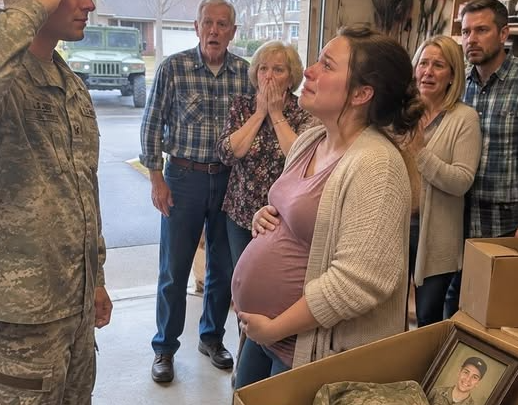
My Family Sent Me to the Garage After My Husband’s Funeral—Then a Soldier Saluted Me
The soldier held his salute while my family watched from the porch.
“Major Cole,” he said. “The convoy is ready. We can move when you are.”
Behind him, three dark vehicles waited at the curb. Frost covered the lawn, and somewhere across the street, a small dog barked.
Julian stopped turning his Audi keys around his finger.
My father stood with his newspaper pressed against his chest. Behind him, my mother clutched the edges of her pink robe, while my sister, Harper, held a coffee mug in both hands.
For once, nobody spoke.
After returning the salute, I rested a hand against my stomach. The baby had been moving since the vehicles arrived.
“There is a secured case upstairs,” I told the soldier. “First bedroom on the left. I also need the small cardboard box beside the garage door.”
A younger member of the team approached the porch. Then he stopped.
“Permission to enter, ma’am?”
That simple question nearly brought me to tears.
For months, my family had moved through my home without asking. Now a stranger was waiting for permission at my own front door.
The Life My Family Barely Understood
My name is Maya Cole. I was thirty-four, pregnant, and grieving the husband I had buried the previous afternoon.
For twelve years, I had served in the United States Army.
My family knew very little about my work. Whenever they asked, I gave the limited description I was permitted to share: Department of Defense administration.
Over time, they decided that meant an ordinary office job.
Assignments away from home became, in their minds, long stretches at another desk. Because I could not explain more, their assumptions remained.
David understood those limits.
We met during an officer training course in Virginia. On the first morning, he sat beside me and ate an apple loudly enough to make concentrating difficult.
“Are you planning to finish that before the lecture?” I asked. “Or should I take notes for both of us?”
He took another bite.
“You can take notes for both of us.”
For two weeks, I found him unbearable.
Eventually, he became the person I wanted beside me whenever life became difficult.
The House David Built Into a Home
We married at a courthouse on a Tuesday because our schedules finally placed us in the same country.
Years later, we bought a two-story house with a maple tree, a garage, and a kitchen that needed work.
David approached every repair as though it mattered personally.
Between deployments, he replaced cabinets, patched walls, and built an oak desk beneath our bedroom window.
“You need somewhere with good light,” he told me. “A place to sit and think.”
He also insisted on handling the mortgage payments.
“My job,” he would say, “is keeping this roof over your head.”
Our lives were often interrupted by work. Still, the house gave us somewhere that belonged to us through every departure and return.
Then, after two years of hoping, I discovered I was pregnant.
When I showed David the test, he sat up so quickly that he struck his head on the bedside lamp.
The next day, he bought a yellow blanket decorated with little gray elephants.
“It’s early to buy things,” I said.
He carefully folded it.
“It’s a blanket, Maya. We’re allowed to be happy.”
The Knock at the Door
A few weeks later, David left on deployment.
Then two officers came to the house.
Before they spoke, I understood that something terrible had happened.
They told me David had been killed during an overseas operation. His remains had not yet been recovered.
After they left, I sat on the hallway floor with my back against the wall.
That evening, I called my parents.
My mother, Diane, answered. Once she understood, she said they would come the next day.
They arrived with two suitcases and a casserole.
At first, their presence helped.
My mother prepared meals, while my father, Gary, handled the lawn and answered calls. Some days, having someone else manage small tasks made getting through the hours possible.
“You can stay as long as you need,” I told them.
I meant it as an invitation offered during the worst period of my life.
Over the following months, they began treating it as something much larger.
When Help Became Control
The changes happened gradually.
First, my parents moved into the larger guest bedroom. Then my mother rearranged the kitchen.
“It makes more sense this way.”
My father moved David’s recliner into the basement. Soon afterward, his friends began coming over for poker on Thursday evenings.
He never asked whether I wanted company.
“The fellows are coming tonight,” he would announce.
As time passed, their language changed too.
My mother invited relatives to visit “our house.” My father discussed improvements with neighbors as though he were the owner.
Usually, I stayed quiet.
Grief made every conversation feel heavy. I told myself they were helping and that arguing over cabinets or furniture would accomplish little.
However, each silence seemed to encourage another decision made without me.
By the time I recognized the pattern, it had become part of everyday life.
Bringing David Home
Months later, David’s remains were recovered.
I stood on the tarmac in uniform as his flag-draped casket was carried from the aircraft.
Behind me, my mother whispered, “Why are you wearing that?”
“Because I’m in the Army.”
“I know, but you work in an office.”
There was nothing I could say that would make that moment easier.
The funeral took place the day before Thanksgiving.
Officers and soldiers approached afterward, sharing brief memories of David. Some spoke about his kindness. Others described moments when his decisions had protected them.
A colonel who had commanded me shook my father’s hand.
“Your son-in-law was an exceptional soldier,” he said. “Your daughter is an outstanding officer too.”
My father looked confused.
Across the cemetery, I saw him studying me as though someone had described a person he had never met.
Guests Invited Without My Permission
Harper and her husband, Julian, attended the funeral.
They had recently sold their condo and were looking for another place to live. Julian also wanted space for his consulting business.
After the service, Harper approached me.
“Mom said we could stay with you until our new place is ready.”
I was holding the folded flag.
“Fine,” I said.
That evening, they moved into the smaller guest room.
Julian brought suitcases, a monitor, a desk chair, and a printer.
At the time, I was too exhausted to consider why a supposedly brief visit required so much equipment.
The next morning, I came downstairs wearing sweatpants and David’s old Army T-shirt.
My back hurt, and I had barely slept.
In the kitchen, my mother chopped vegetables while my father read the newspaper. Harper stood beside the counter.
Julian occupied David’s chair at the table.
Nobody said good morning.
The Bedroom They Had Already Given Away
“Maya, we need to discuss your room,” Harper said.
I turned toward her.
“What about it?”
“Julian needs an office. The guest room is too small, and your bedroom has that desk.”
“David built it for me.”
“I know. It’s perfect.”
For a moment, I waited for someone else to speak.
Then I asked, “Where am I supposed to sleep?”
My mother continued chopping.
“Your father put the camping cot in the garage. Just until Harper and Julian move.”
“The garage?”
“It has insulation,” my father said from behind his newspaper. “There’s a heater.”
Outside, frost covered the ground.
“I’m pregnant,” I said. “And it’s freezing.”
Harper sighed.
“It’s temporary. Please don’t make this difficult.”
Then I noticed the boxes stacked near the garage door.
My belongings were already inside them.
Beside Julian’s Car
“You packed my things?”
“Only the essentials,” my mother answered. “We thought we were helping.”
She pointed toward the garage.
“Put them beside Julian’s car. Just leave room for him to get out.”
Julian laughed without looking away from his phone.
“And don’t scratch the Audi.”
I looked around the kitchen David had renovated.
His work remained everywhere, yet somehow I had become the person expected to make room.
Part of me wanted to argue. Another part wanted to lie down somewhere and escape the effort of speaking.
“Okay,” I said.
Harper smiled at Julian.
“I told you she would understand.”
As I carried the first box into the garage, cold air moved through David’s thin T-shirt.
The camping cot stood between the lawnmower and his workbench. A single blanket lay across it.
The small heater was unplugged.
The Box With the Yellow Blanket
After moving the larger boxes, I collected one I had packed myself.
Inside were uniforms, medical papers, photographs of David, and the yellow blanket with gray elephants.
I placed it near the garage door and sat on the cot.
For a while, my hands rested over the baby.
Then my phone rang.
Colonel Reese was calling.
“Major Cole, are you somewhere you can speak?”
“Yes, sir.”
He explained that a security assessment connected with David’s final mission had changed. Because of the updated concern, arrangements were being made to relocate me temporarily.
A team would collect me and secure the materials at the house.
“How soon?”
“About an hour.”
I looked at the cot, the concrete floor, and the boxes beside Julian’s car.
“I’ll be ready.”
The Team in the Driveway
Upstairs, Julian’s monitor already stood on David’s desk. His printer occupied my nightstand, and the bedding had been stripped from my side.
After preparing the secured case, I sat beside it and waited.
Eventually, engines sounded outside.
My father’s voice rose from downstairs.
“What is going on?”
A few moments later, I was in the driveway, returning a salute while my family watched.
The team leader’s name was Ortiz.
His task concerned my security and relocation. The argument about bedrooms was something he had encountered on arrival.
Nevertheless, his presence forced my family to see me differently.
“You’re a major?” my father asked.
“Yes.”
“But you said you worked in an office.”
“I gave you the description I could share.”
Harper folded her arms.
“So you lied.”
“Some parts of my work were never mine to discuss.”
What Harper Had Promised Julian
Julian looked toward his wife.
“You told me she had already left the service.”
“I said she was basically finished.”
“You also told me she had agreed to give me the bedroom. Last week.”
The driveway became quiet.
Last week.
Harper had promised my room before the funeral and before anyone had spoken to me.
Then Julian added, “You said your parents owned this house.”
“They practically do,” Harper replied.
“No,” I said. “They don’t.”
He turned toward my father.
“Is your name on the deed?”
My father said nothing.
For the first time, Julian seemed to understand that the office he expected had never been offered by its owner.
That realization did not erase his laughter in the kitchen.
However, it exposed the story Harper had told him.
Taking Back My Permission
While the younger soldier carried out my case and cardboard box, Ortiz asked who would remain at the property.
“They can stay temporarily,” I answered. “I’ll communicate future arrangements in writing.”
My father stepped forward.
“You’re making your parents leave?”
“I’m ending an arrangement that no longer works.”
“On Thanksgiving?”
“You told your pregnant daughter to sleep in the garage this morning.”
“That was temporary.”
“So was my invitation.”
Then I sent a message to everyone involved.
No rooms were available for Julian’s business. Nobody had permission to move my belongings or make decisions about the house on my behalf.
I also stated that future arrangements would be handled through the appropriate written process.
The soldiers continued with their assignment.
The house matter would be addressed separately.
For once, the boundaries existed somewhere everyone could read them.
Leaving Without an Apology
Julian announced that he was leaving.
Harper followed him down the driveway, demanding that he stay. Before driving away, he told her they needed to discuss what else she had misrepresented.
My father immediately blamed me.
“You’ve damaged your sister’s marriage.”
“I corrected the information about my house.”
Harper returned, crying.
“You couldn’t let me have one thing.”
Behind her stood the home David had repaired between deployments.
“You promised someone my bedroom before I had even buried my husband.”
Then the baby shifted, and exhaustion settled heavily through my back.
Ortiz moved closer.
“Ma’am, we should go.”
Inside the vehicle, someone had placed a folded blanket on the seat.
That small consideration nearly undid me.
My mother stood beside the open door.
“Where are you going?”
“I can’t share that.”
For years, she had heard those words as rejection.
This time, I hoped she would finally hear their actual meaning.
A Refrigerator Full of Ordinary Kindness
The temporary apartment was plain.
It had a small kitchen, a couch, a bed, and a window overlooking a parking area.
After bringing in my belongings, Ortiz paused.
“I served with Captain Cole for a short time,” he said. “He talked about you constantly.”
My throat tightened.
Once the team had left, I opened the refrigerator.
There was water, fruit, and food I could manage. On the counter sat crackers and the ginger tea I had been drinking throughout my pregnancy.
Someone had asked what I needed.
David used to care for me that way.
After deployments, he stocked the refrigerator, checked the car, and made sure familiar things were ready.
Standing in that unfamiliar kitchen, I finally stopped trying to hold myself together.
I sat on the floor and cried until the exhaustion caught up with me.
Then I slept.
Their Explanations Kept Changing
When I woke, my phone was full of messages.
Harper said I had embarrassed her. My father called me ungrateful. My mother wanted to resolve everything privately.
I answered once.
I will discuss the house in writing. I need space to grieve and focus on my pregnancy.
Over the following days, their explanations shifted.
The garage was supposedly warmer than I remembered. The arrangement had supposedly been intended for only a few hours.
Everyone had been tired. Nobody had meant harm.
Yet none of those explanations addressed the boxes packed without my permission.
Eventually, Harper called from my mother’s phone.
“You could have agreed and sorted it out later.”
“That was what you expected?”
“Because you always give in eventually.”
There it was.
The room had been promised because she expected my exhaustion to finish the argument for her.
A Boundary They Could Not Debate Away
Harper also spoke about years of resentment.
David and I had missed events. We had traveled without explaining our work. She felt excluded from parts of my life.
I listened.
However, those feelings did not explain why my belongings had been placed beside a car the morning after the funeral.
“I can’t repair your marriage for you,” I told her. “And I won’t pretend this arrangement was something I offered.”
Afterward, I worked with an attorney to address the house.
Written notices established the arrangements and dates. My parents were given time to prepare their departure.
Whenever my father sent messages about gratitude, I returned to practical matters: belongings, access, and moving plans.
There were still things I appreciated about their early help.
That appreciation did not require continuing an arrangement that had become harmful.
The Key in My Mother’s Hand
Shortly before moving out, my mother asked to meet alone.
I considered the request for a day before agreeing.
When I entered the house, she stood beside taped boxes with the spare key in her hand.
“I knew the house was yours,” she said.
“I know.”
“When Harper wanted the room, I knew it was wrong.”
Then she looked toward the garage.
She explained that the funeral had made my father feel excluded. Officers had spoken about lives and responsibilities he barely understood.
“So he treated me like a guest in my own home?”
“Yes.”
For once, the answer contained no excuse.
My mother continued.
“I liked believing you needed us. It helped me avoid seeing how much we were taking.”
The truth hurt.
Still, it was the first honest explanation I had received.
Returning What Was Mine
My mother closed her hand around the key.
“Your father wants me to keep it in case you change your mind.”
“What do you want?”
After a long pause, she placed it in my palm.
“To stop treating your boundaries as something you are doing to me.”
The key felt cold.
Returning it did not restore the months that had passed. Nor did it make me ready to welcome her back into the same role.
But she had made a choice without attaching a condition.
“Thank you,” I said.
She nodded and returned to the boxes.
My father left without speaking to me.
Harper collected her belongings that week. Later, she wrote that she would wait for me to contact her.
I accepted that.
The house was mine again, although I needed more time before returning.
Avery
That winter, my daughter arrived with dark hair and a determined voice.
When the nurse placed her against me, she grew quiet and opened her eyes.
I named her Avery.
It was David’s middle name.
For a moment, the room held joy and grief together. I could see him in her face while wishing desperately that he were beside us.
Before my mother visited, we agreed on clear expectations.
There would be no surprise arrivals, no criticism of my grieving, and no messages passed through other relatives.
She accepted.
On the first visit, she knocked and waited.
After setting grocery bags on the counter, she left them there.
Then she asked, “Where would you like me to sit?”
Such a small question.
I noticed every word.
Coming Home on My Own Terms
Eventually, I returned to the house with Avery.
Before moving back, I repainted the kitchen and brought David’s recliner upstairs.
Julian’s office equipment was gone. His hooks came down from the bedroom wall, and the oak desk became mine again.
The small cardboard box moved with us.
Its bottom had softened after sitting on the garage floor, so I reinforced it with tape.
Inside were David’s photographs, his old Army T-shirt, the memorial bracelet, and the yellow blanket with gray elephants.
The objects once treated as clutter now held part of the story I would share with our daughter.
Someday, Avery would ask about her father.
When she did, I wanted to have more than dates and official words.
I wanted her to see his smile.
The Question That Changed Something
One evening in spring, my mother visited during the time we had agreed upon.
I went to warm a bottle. When I returned, she was no longer in the living room.
I found her beside Avery’s crib.
She knelt near the cardboard box, holding a package of protective photograph sleeves.
The lid remained closed.
“I saw these and thought about David’s pictures,” she said.
Then she looked up.
“May I help you protect them?”
For a moment, I remembered the boxes by the garage, her hand pointing toward Julian’s car, and the cold key returned to my palm.
Now she was waiting.
She had brought something useful without deciding that it gave her permission.
I placed the bottle on the dresser and sat beside her.
Then I opened the box myself.
The first photograph showed David and me years earlier, sunburned and laughing, his arm around my shoulders.
After looking at it for a moment, I handed it to my mother.
And together, we began.