News
Mold on Cheddar: When to Cut and When to Throw Cheese Away
Mold on Cheddar: When to Cut and When to Throw Cheese Away

Mold on Cheddar: When Can You Cut It Off, and When Should You Discard the Cheese?
You open the refrigerator, pick up some cheddar, and notice an unexpected patch of mold. Your first thought may be to throw everything away. Alternatively, you might wonder whether removing the visible spot is enough.
The answer depends on the type and form of the cheese.
A suitable whole block of hard cheddar is a different situation from shredded cheddar, sliced cheese, or a container of soft cheese. The same name on the package does not mean the same handling rule applies.
USDA guidance allows trimming certain hard cheeses, with a substantial margin around the affected area. However, moldy shredded, crumbled, and sliced cheeses should be discarded, along with soft cheeses containing unexpected mold.
Before reaching for a knife, identify what you have. Then follow the appropriate guidance rather than relying on a quick scrape or a clean-looking corner.
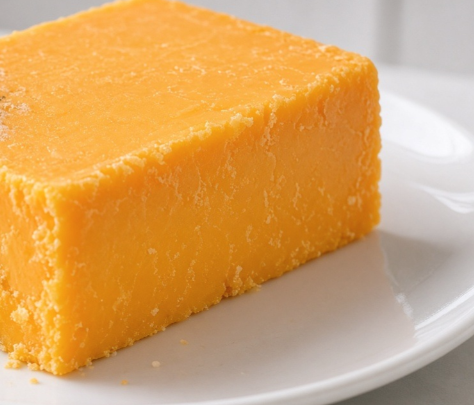
The images accompanying this article are illustrations, not assessments of whether the pictured food is safe to eat.
Start With the Cheese in Front of You
The word “cheddar” does not answer the entire question.
You might have a large natural cheese block, a small remaining piece, a bag of shreds, or a package of slices. Those forms need to be considered separately.
Look at the product itself and its label before deciding what to do.
The practical distinction is whether you have an appropriate hard block that can be trimmed according to the full instructions, or a product covered by discard guidance.
Do not move directly from “this is cheddar” to “I can save it.”
The form matters, and so does having enough unaffected cheese to allow the required cut.
When a Hard Block May Be Trimmed
A large block of hard cheese with limited mold is the situation in which trimming may be appropriate.
Clemson Cooperative Extension specifies that the block should be large and the mold should not be extensive. Its guidance does not describe rescuing a heavily moldy piece by repeatedly cutting until something remains.
That limitation is important.
A small patch on an otherwise suitable block should not become a reason to apply the same approach to every moldy cheese product.
If you cannot identify the cheese confidently or judge whether the guidance fits the situation, discarding it is a reasonable choice.
Saving food should begin with a clear rule, not with the hope that appearance alone will settle the question.
The Margin Must Be at Least One Inch
For an appropriate hard cheese, remove at least one inch around and below the moldy area.
That is approximately 2.5 centimeters.
The instruction includes both the surrounding cheese and the depth beneath the spot. It does not mean removing only the visible discoloration.
Mayo Clinic also advises keeping the knife out of the mold itself so that it does not spread contamination to other parts of the cheese.
Use a clean knife and assess the required margin before beginning.
If the remaining piece is too small to leave that full margin, do not reduce the cut simply to preserve something. The measurement is part of the guidance, not an optional finishing detail.
Why Scraping Is Not the Same Thing
Scraping away a fuzzy patch may improve the appearance, but it does not follow the hard-cheese trimming instruction.
The visible surface does not show everything happening within moldy food. USDA material explains that mold can extend below the surface and that other contamination may also be present.
That is why the decision involves more than making the cheese look clean.
Think about the affected area and the surrounding margin before cutting. A thin shaving across the top is not equivalent to removing the necessary amount underneath and beside it.
The purpose is to follow the appropriate handling guidance rather than produce a tidy edge.
Check the Block Before Making the Cut
It can help to pause and ask two separate questions:
Is this the appropriate type and form of cheese?
Can I remove the full required margin?
Both answers matter.
A yes to the first does not justify a smaller cut. Likewise, having a large quantity does not make shredded cheese suitable for the block-trimming method.
Keep the questions separate so that the amount you hope to save does not determine the rule you choose.
If the situation remains uncertain, you do not need to experiment. There is no obligation to keep a questionable piece of food simply because some of it looks unaffected.
Use Fresh Wrapping After Trimming
Once an appropriate hard block has been trimmed correctly, place the remaining cheese in fresh wrapping.
USDA guidance specifically includes re-covering the cheese after the affected portion is removed.
Do not treat the original packaging as automatically suitable simply because the visible patch has been cut away.
Prepare clean wrapping and a clean place to work before starting. That keeps the process organized and avoids searching for supplies while handling the cheese.
Afterward, return the remaining product to appropriate refrigerated storage and follow its care instructions.
Trimming is a specific response to a suitable situation. It does not make the cheese immune to later spoilage.
Moldy Shredded Cheddar Should Be Discarded
A bag of shredded cheddar is different from an intact hard block.
The USDA and Mayo Clinic advise discarding shredded cheese when mold appears. Picking out visibly affected strands is not the recommended approach.
The mistake often begins with a partly remembered rule:
“Cheddar can be trimmed.”
The missing detail is the form of the product.
A collection of small pieces cannot be handled as though it were one solid block with a generous surrounding margin.
Therefore, do not sort through the bag looking for shreds that appear normal. The absence of a visible patch on an individual strand does not establish that it is suitable to keep.
Slices and Crumbles Follow the Discard Guidance Too
The same distinction applies to sliced and crumbled cheese.
Removing one moldy slice or separating a few affected crumbles does not turn the rest into an intact block covered by trimming guidance.
This matters because these products can look easy to sort.
A stack of slices may tempt you to lift away the top layer, while a container of crumbles may appear to have one isolated spot.
However, the recommended decision is based on the product category rather than how conveniently the visible mold can be separated.
Use the package’s actual form to guide your decision, even when its cheese variety sounds familiar.
Unexpected Mold on Soft Cheese Means Discard
Soft cheeses require another clear distinction.
Mayo Clinic identifies cream cheese, cottage cheese, and ricotta as examples that should be thrown away when mold appears. Contamination may extend beyond the visible area.
Scooping a patch from the surface is therefore not the equivalent of trimming a hard block.
A clean-looking section elsewhere in the container does not establish that the remaining product is safe.
If you are unsure how a particular product is classified, consult reliable guidance or the manufacturer rather than deciding solely by how firm it feels when cold.
The hard-block exception should remain narrow enough to be useful and understandable.
What About Cheese Deliberately Made With Mold?
Some cheeses are produced using selected mold cultures. Blue cheeses and certain surface-ripened varieties belong to that broader discussion.
However, intended mold used during production is different from unexpected growth developing later.
USDA guidance distinguishes between these situations and gives different instructions depending on the cheese involved.
A new patch on ordinary cheddar should not be treated as though the product has become a deliberately mold-ripened cheese.
Likewise, a cheese made with selected cultures is not automatically exempt from concerns about additional, unintended growth.
For those products, seek guidance specific to the variety and the situation rather than extending one general rule to everything.
Do Not Sniff or Taste It to Decide
Avoid bringing moldy cheese close to your nose for a deliberate sniff test. Both USDA material and Clemson Extension warn against sniffing moldy food.
Tasting a small piece is not an appropriate way to resolve uncertainty either.
The practical decision should come from the cheese category and reliable handling guidance, not from whether a sample seems acceptable.
You also do not need to identify the mold by its color.
An ordinary kitchen inspection cannot establish exactly what organism is present simply because the patch appears green, blue, or white.
When the correct action remains unclear, discard the cheese instead of turning the decision into a personal experiment.
A Quick Comparison for the Refrigerator
| Product or situation | General action |
|---|---|
| Suitable large hard block with limited mold | Remove the required margin around and beneath the affected area |
| Hard block too small for the full margin | Discard rather than reduce the margin |
| Moldy shredded cheese | Discard |
| Moldy sliced cheese | Discard |
| Moldy crumbled cheese | Discard |
| Soft cheese with unexpected mold | Discard |
| Cheese intentionally made with mold | Follow guidance specific to that product and any unexpected growth |
This table summarizes the distinctions; it does not replace the full instructions.
In particular, the hard-block option includes avoiding contact between the knife and mold, followed by fresh wrapping.
Give Storage the Attention It Deserves
Once the immediate decision is made, consider how the cheese is stored.
Follow the product label, keep it appropriately refrigerated, and use suitable wrapping after opening.
Clemson Extension emphasizes refrigerated storage and careful wrapping as part of maintaining cheese quality. It also notes that storage conditions affect how long a product keeps.
A useful household routine is to notice which packages are already open before opening another.
That makes it easier to use food deliberately rather than discovering forgotten pieces later.
Good storage habits can support better planning, but they do not override the appropriate response when unexpected mold is found.
Deal With the Discarded Food and Storage Area
When cheese needs to be discarded, contain it rather than leaving it exposed where children or animals might reach it.
Clemson Extension recommends wrapping moldy cheese and trimmings before placing them in a covered trash container.
Also, check the place where the product was stored and clean any affected area.
The purpose is to complete the task, rather than remove the package while overlooking residue or nearby items.
Keep the process straightforward: make the appropriate cheese decision, contain what is being discarded, and leave the storage area clean.
Then review your routine if forgotten opened packages have become a repeated problem.
The Practical Answer to Mold on Cheddar
Start with the form of the cheese.
A suitable whole hard block with limited mold may be trimmed using the full one-inch margin around and below the affected area, while keeping the knife away from the mold and using fresh wrapping afterward.
Moldy shreds, slices, crumbles, and unexpectedly moldy soft cheeses belong in the discard category.
The most important lesson is that the word “cheddar” does not settle the decision on its own.
Identify the product, follow the guidance that actually applies, and do not shrink the required margin to save more food.
If you remain unsure about the cheese or the appropriate action, letting it go is the clearer choice.