News
I Covered a Stranger’s Diapers at My Register, but I Never Expected What She Would Leave Behind for Me
I Covered a Stranger’s Diapers at My Register, but I Never Expected What She Would Leave Behind for Me

I Paid $8.42 for a Stranger’s Groceries—The Next Morning, She Returned Something Missing for 22 Years
A fictional story about a small act of kindness, a missing family keepsake, and two generations whose lives crossed in an unexpected way.
The Second Time Her Card Was Declined
The young woman tried her debit card twice.
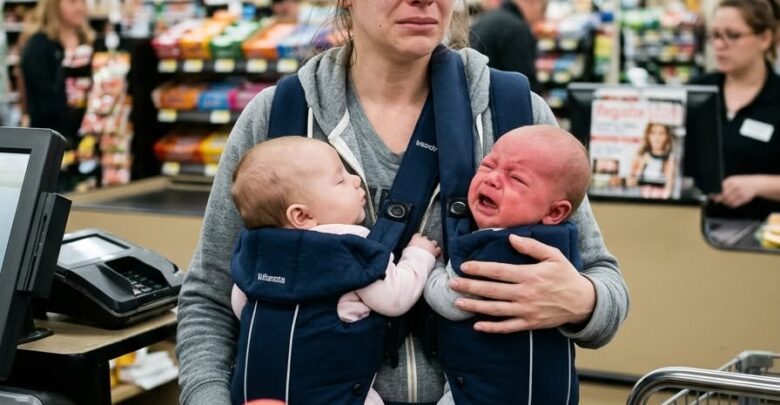
After the second rejection, she lowered her eyes and began searching through her bag. One of the babies strapped against her chest was crying. The other slept through everything.
Behind her, a man sighed loudly enough for everyone in my checkout line to hear.
“I’m sorry,” she said. “Could you take the diapers off?”
There were only three items on the counter: milk, formula, and diapers.
I looked at the money she had counted into her palm. After applying it to the purchase, she would still be short eight dollars and forty-two cents.
I knew what it felt like to calculate a shopping basket down to the last coin.
“Keep the diapers,” I told her.
Then I reached for my own card.
At that moment, I was thinking about getting a tired mother and her babies through the evening.
I had no idea she was about to recognize the photograph beside my register.
A Morning Spent Counting Bills
My name is Rachel Hale. I was thirty-four and working at Hollis Market in Millbrook when Maya came through my checkout line.
That morning had begun with an electricity bill spread across our kitchen table.
My mother, June, sat beside it with a pencil in her hand.
“How bad?” I asked.
She turned the paper toward me.
I offered to take another shift. She reminded me that I was already working six days that week.
We had shared the house since my father died. Over time, the arrangement had become something we both relied on. I helped with expenses and repairs. She made sure there was food waiting when I came home late.
We managed, but there was rarely much left over.
Before leaving for work, I checked my account.
Sixty-one dollars.
Then my old Honda refused to start until the third attempt.
By the time I reached the market, I had mentally spent most of my next paycheck.
The Photograph at Register Three
A small photograph of my father was taped beside my scanner.
In it, he stood next to his blue truck, grinning beneath a battered baseball cap. His name was Tom, and he had spent much of his working life driving long distances.
Dad died in a road accident when I was twelve.
Twenty-two years later, I still liked having his picture nearby.
He had a habit of noticing people who needed something. Sometimes it was practical help. Sometimes it was simply a few minutes of attention.
When I complained that a problem was too big to fix, he would tell me to start with the person in front of me.
“Make the next ten minutes easier,” he said. “See what you can do from there.”
As a child, I thought that sounded too simple.
After years behind a cash register, I understood it better.
A customer struggling to pay did not need me to solve every difficulty in their life.
Sometimes they needed enough time to count their coins without being rushed.
The Mother With Two Babies
Maya entered the store near the end of the evening rush.
She wore a gray sweatshirt and carried her purchases without a basket. Every few steps, she stopped to settle the crying baby against her chest.
When she reached my register, I asked the boys’ names.
“Noah and Eli,” she said.
Noah was making sure everyone knew he was present.
Eli had one tiny hand curled against her sweatshirt and appeared completely untroubled.
Maya smiled when I commented on the difference.
“They take turns,” she said. “Usually when I’m hoping to sleep.”
Then I gave her the total, and the small moment of humor disappeared.
Her first payment attempt failed.
She apologized before trying again.
By the time the terminal declined the card a second time, she could barely meet my eyes.
I kept my voice calm while she counted what she had.
There was no reason for the rest of the line to become part of her private difficulty.
Eight Dollars and Forty-Two Cents
When I offered to cover the difference, Maya immediately shook her head.
“You don’t have to do that.”
“I know.”
“I’m not sure when I could pay you back.”
“You don’t need to.”
I processed the remaining payment and placed the diapers in her bag.
For a moment, she simply stood there.
Then her eyes moved toward Dad’s photograph.
Her expression changed so suddenly that I thought she might be ill.
She leaned forward slightly.
“Is that—”
Noah began crying harder. Eli woke and joined him. Someone behind her asked whether another register could be opened.
Maya looked from the photograph to me.
“Thank you,” she said. “You really helped us tonight.”
She gathered her purchases and left.
Before the doors closed behind her, she looked back once more.
Her attention was fixed on the photograph.
The Watch We Never Found
That night, I told Mom about the woman and her babies.
She listened while I ate the soup she had left on the stove.
“Your father would have done the same,” she said.
I mentioned Maya’s reaction to his picture.
“Perhaps she knew him,” Mom suggested.
“She looked about my age.”
“He met plenty of people.”
Later, lying awake, I found myself remembering the belongings returned after Dad’s accident.
His wallet. His keys. His wedding ring.
His watch had been missing.
Mom had given it to him for their anniversary after saving for months. It had a silver case, a dark face, and a brown leather strap.
On the back, she had engraved a message asking him to come home to us.
After the accident, she contacted everyone who might have seen it.
When the snow melted, we searched beside the road.
We never found it.
Eventually, we stopped looking.
Mom never stopped wondering.
An Envelope Waiting in the Office
The next morning, my manager asked me to come into his office.
Mike was sitting behind his desk with a white envelope in front of him.
“The woman you helped came back after your shift.”
I looked at the envelope.
“She left this?”
He nodded.
“She asked about the photograph. I told her I could pass a message to you.”
My name was written across the front.
Inside were a letter, eight dollars and forty-two cents, and something wrapped in a clean cloth.
I opened the cloth first.
The watch lay across my palm.
I knew the small scratch near the edge of the face. I remembered tracing it as a child while sitting on Dad’s lap.
Slowly, I turned it over.
The engraving was there.
For several seconds, I could not speak.
Mike brought me a glass of water.
Then he stepped outside and closed the door so I could read.
A Frightened Girl in a Diner
Maya’s letter began with her age.
She was thirty-six.
Twenty-two years earlier, when she was fourteen, she had met my father at a diner in Kentucky.
She had left an unsafe living situation and reached the truck stop with a backpack, a little money, and no clear plan.
Dad noticed that she had been studying the menu without ordering food.
He bought her breakfast.
According to Maya, he did not demand her story before allowing her to eat. He talked about Mom, complained about the coffee, and showed her a picture of me.
He called me Rae-bug.
Reading that name in a stranger’s handwriting made my eyes fill.
Maya remembered that I liked animals.
She also remembered Dad describing my laugh.
It came out like a hiccup when something was especially funny.
I had not known he talked about such small things while he was away.
What My Father Gave Her
After breakfast, Dad asked whether Maya knew a safe adult he could help her contact.
She mentioned an aunt in Georgia.
With help from people at the diner, they reached her. Arrangements were made for Maya to travel to her aunt, who would meet her.
Dad helped pay for the journey.
Before they said goodbye, he worried about what would happen if she needed additional money along the way.
He had very little cash left.
So he took off his watch.
Maya tried to refuse it when she saw the engraving.
He told her it was something she could sell if she needed help reaching safety.
She remembered his confidence that Mom would understand once he explained.
Maya arrived safely and never sold the watch.
Her aunt gave her a stable home. She finished school and eventually became a nursing aide.
Through the years that followed, she kept the watch as a reminder of the morning someone had taken her seriously.
Why She Had Come to Millbrook
Maya had tried to find Dad.
But she knew only his first name, a few details about his family, and the color of his truck.
She never learned what had happened to him.
Years later, her own circumstances changed abruptly.
Her husband left while their twin sons were still very young. She found work at a nursing home near Millbrook and moved into a small rental house.
She was due to start her new job the following Monday.
Her first paycheck was still some time away.
On the morning we met, she had considered selling the watch.
The boys needed supplies, and she was running out of options.
Then she came through my checkout line.
After I paid the difference, she noticed the photograph.
The truck. The smile. The watch on his wrist.
She went home, took out the watch, and decided she had to return to the store.
At the end of her letter, she apologized for not finding us sooner.
I sat in Mike’s office holding the very thing Mom and I had imagined lying beside a road for twenty-two years.
Bringing the Watch Home
Mike covered my register.
“Go see your mother,” he said.
When I entered our kitchen, Mom turned from the sink.
One look at my face frightened her.
“Nothing bad,” I said quickly. “Please sit down.”
I placed the cloth on the table and opened it.
She stared.
Then she picked up the watch, turned it over, and pressed her fingers against the engraving.
“Where?”
I handed her the letter, but her hands were shaking too much.
So I read it aloud.
When I reached the part about Dad giving away the watch, she let out a small, disbelieving laugh.
“He told me he’d left it in the truck.”
I looked up.
“Before the accident?”
She nodded.
“Then he said it needed repairs. I suppose he was still working out how to explain.”
For years, we had believed the watch disappeared on the night we lost him.
Now we knew it had already been somewhere else, helping another person carry on.
Meeting Maya Together
We contacted Maya using the number she had included.
Mom asked whether we could visit.
That afternoon, we arrived with groceries and a meal we could share.
Maya opened the door holding one of the babies.
When she saw the watch on Mom’s wrist, her eyes filled.
“I’m sorry,” she began.
Mom stepped forward.
“You have nothing to apologize for.”
Inside, the house was simple and tidy. Bottles stood drying beside the sink. A calendar on the refrigerator marked the first day of Maya’s new job.
Mom asked permission to hold Noah.
Within minutes, she was walking slowly around the room, talking to him as though they were old acquaintances.
Maya told us more about the diner.
She remembered Dad describing the night he met Mom and admitting that he had stepped on her feet while they danced.
“Several times,” Mom confirmed.
Then Maya mentioned a story about me bringing an animal into the house.
I laughed before she finished.
She looked at me.
“That’s it,” she said softly. “That’s the laugh.”
Help That Respected Her Choices
We stayed in touch.
Mom offered a few hours with the babies when Maya needed rest. I helped with occasional errands.
We asked what would be useful instead of deciding everything for her.
Maya began working, and the first paycheck brought relief without solving every problem.
There were still bills, sleepless nights, and difficult decisions.
As people at the market got to know her, some offered practical help.
A pair of outgrown cribs found a new home. Someone brought extra meals. A coworker shared information about local services.
Maya accepted some offers and declined others.
Gradually, our visits became less about what she needed.
Mom wanted to see the boys. Maya wanted to tell her about work. I stopped by because we enjoyed one another’s company.
The Customer Who Came Back
The man who had sighed in the checkout line returned a week later.
His name was Dale.
After paying, he remained beside the counter.
“I owe that woman an apology.”
I did not argue.
He explained that his business was struggling and that he had brought a bad day into the store.
“That wasn’t her fault,” he said.
He left an envelope containing a small contribution and a note.
I asked Maya whether she wanted me to pass it along.
She did.
Later, she showed me the note on her refrigerator.
He had apologized for making a difficult evening worse.
The money helped, but she told me she appreciated that he had remembered there was a person standing in front of him.
A Jar Beneath the Register
With Mike’s permission, we started a small checkout assistance jar.
It stayed discreetly behind the counter.
Employees could contribute when they wanted. Customers sometimes added change after hearing what it was for.
We used it to cover small shortfalls without announcing anyone’s circumstances.
It did not replace the need for larger support.
It helped with the immediate moment.
One afternoon, Maya came through my line with the boys in a double stroller.
Her payment went through.
She smiled at the terminal, then reached into her bag.
She placed eight dollars and forty-two cents beside the jar.
“When I can,” she said.
I nodded.
There was no need to make her promise more than that.
The Sound in Our Kitchen
Mom had the watch checked and the strap adjusted.
She kept the marks on its case.
Sometimes I caught her looking at it while waiting for the kettle to boil.
It did not remove her grief. She still missed Dad in the middle of ordinary days.
But she no longer imagined his watch abandoned in a ditch.
She knew where it had been.
It had traveled with a young girl toward a safer life. It had stayed in drawers, suitcases, and bedside tables. It had been cared for by someone who remembered the man who gave it away.
One evening, I came home to find Mom asleep over a crossword.
Her wrist rested beside her cup.
I sat across from her and listened to the faint ticking.
The electricity bill was still on the counter. My car still needed attention. I would be back at register three in the morning.
I reached over and gently touched her hand.
She opened her eyes.
“You’re home.”
“Yes,” I said.
Then I got up to put the kettle on.