News
My Husband Brought Three Expensive Lawyers to Divorce Court …
My Husband Brought Three Expensive Lawyers to Divorce Court …

My Husband Brought Three Expensive Lawyers to Divorce Court—Then I Told the Judge I Never Signed Their Agreement
A fictional story about a disputed agreement, an overlooked professional past, and a woman determined to have her voice heard.
The Empty Chair Beside Me
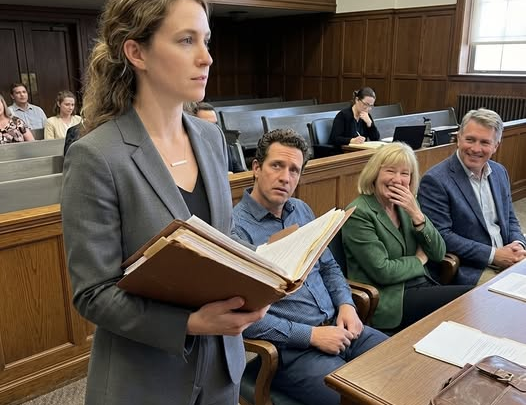
Ruth Ellison laughed when I entered the courtroom alone.
She raised one hand to her mouth, but she made no effort to lower her voice.
“No lawyer. Andrew said she would do this.”
My father-in-law, Frank, leaned toward her.
“Perhaps she finally understands there’s nothing to argue about.”
I continued down the aisle carrying the leather briefcase I had owned before I met their son.
Across the room, Andrew sat beside three attorneys.
He wore the navy suit I had collected from the tailor two months earlier. One of his lawyers was arranging papers while another spoke quietly into his ear.
Andrew looked at my empty chair and smiled.
Judge Elaine Porter entered a few minutes later.
After addressing several preliminary matters, she looked toward me.
“Mrs. Ellison, you are appearing without counsel today?”
“Yes, Your Honor.”
“You understand that you may seek independent legal representation?”
“I do.”
Andrew’s lead attorney, Stephen Calder, stood.
“Your Honor, we believe the parties have already resolved the central financial issues. We would ask the court to proceed on that basis.”
I opened my briefcase.
“Your Honor, I dispute that completely.”
The Papers Beside My Breakfast
Three weeks earlier, Andrew had placed a proposed settlement beside my breakfast plate.
“Sign it today,” he said. “There’s no reason to drag this out.”
I read the first pages while he poured coffee.
The document described our finances with a confidence that immediately troubled me.
According to its account, Andrew had carried the household financially while I had contributed little beyond personal expenses.
It treated several accounts as though I had never helped manage them. It described a property purchase without mentioning the money I had transferred toward it.
Then I reached a paragraph stating that I had received complete financial information and considered the proposed arrangement satisfactory.
I looked up.
“You haven’t given me the records.”
“You’ve seen enough.”
“No. I’ve seen a summary you prepared.”
He set his cup down.
“Mara, please don’t turn this into something bigger than it is.”
For seven years, that had been his preferred response whenever I asked an inconvenient question.
I put the papers back on the table.
“I’m not signing this.”
He stared at me as though I had spoken in a language he did not recognize.
What His Family Never Asked
Before I married Andrew Ellison, I was Mara Pierce.
I had served as a captain in the United States Army’s Judge Advocate General’s Corps.
My work had required careful preparation, attention to records, and an understanding that a confident statement could still be unsupported.
Andrew knew I had been in the Army.
He had never shown much interest in what I had actually done.
When we met, I was preparing to leave military service. I wanted a different pace and time to consider my next professional step.
Then his company expanded.
His parents needed help.
Our household became a project with no clear boundaries.
I handled schedules, reviewed paperwork, organized travel, and coordinated repairs. When an outside accountant needed missing records, I found them.
At first, Andrew called us a team.
Eventually, he began describing those same tasks as things I did because I was home.
I had allowed my professional identity to become a short answer in conversations nobody pursued.
That did not mean I had forgotten what I knew.
The Signature on the Final Page
The day before the hearing, I received a copy of the document Andrew’s side intended to rely on.
This version contained a signature.
Mine, supposedly.
I sat at my kitchen table looking at it for several minutes.
I had signed countless ordinary documents during the marriage. Delivery authorizations. Banking forms. Travel paperwork.
But I had never signed this agreement.
The realization changed the question.
Until then, I had expected to explain why I rejected Andrew’s proposal.
Now I needed to establish that someone was presenting a disputed document as an accepted arrangement.
I saved the message that delivered it.
I preserved the attachment without changing it.
Then I assembled the relevant correspondence in date order.
I also contacted a family-law attorney whose earliest full consultation was after the scheduled appearance.
She told me to make clear that consent and authenticity were disputed and to avoid treating the hearing as an opportunity to settle every issue myself.
That was advice I intended to follow.
“I Never Signed That Agreement”
Back in the courtroom, Judge Porter looked from me to Mr. Calder.
“Mrs. Ellison, explain your objection.”
“The document presented as an agreement was never signed or approved by me.”
Andrew shifted in his chair.
I continued.
“I rejected an earlier version in writing. The version I received yesterday contains what appears to be my signature, but I did not place it there.”
The room became quiet.
Mr. Calder looked down at his copy.
“Your Honor, this is the first allegation of that nature communicated directly to us.”
“I received the signed version yesterday afternoon,” I replied. “I sent notice of my objection that evening.”
I handed the court the copies I had prepared and provided the other side with the same materials.
I did not ask the judge to accept my entire account immediately.
I asked her to avoid treating the document as an undisputed settlement.
There was an important difference.
The Email Andrew Had Forgotten
The first record was simple.
Andrew had emailed me the proposed terms.
I had responded that I would not sign without complete financial information and independent advice.
The next message came from him.
It told me to stop delaying and agree before the hearing.
The dates appeared after the date printed beside the disputed signature.
Judge Porter read the exchange.
“Mr. Calder, what is your client’s explanation?”
He turned toward Andrew.
They spoke quietly.
Then Calder asked for a short opportunity to confer.
The judge granted a recess.
As we stood, Ruth leaned forward from the gallery.
“What exactly are you trying to accomplish?”
I closed my folder.
“I’m trying to make sure the court knows what I agreed to.”
“You’re embarrassing the family.”
I looked at her.
“No one required Andrew to describe an unsigned proposal as settled.”
She glanced toward him.
For the first time that morning, he would not meet her eyes.
Three Attorneys With Incomplete Information
During the recess, Andrew’s lawyers moved into a consultation room.
I remained outside with a cup of water.
For years, I had assumed expensive professionals made Andrew’s version of events stronger.
That morning reminded me of something I had known long before our marriage.
A professional can only evaluate the information available to them.
Three attorneys could organize a case, explain a position, and represent their client’s interests.
Their presence could not establish that I had signed a document.
When we returned, Mr. Calder’s tone had changed.
“Your Honor, we are not asking the court to resolve the authenticity dispute on the present record. Further investigation is necessary.”
Judge Porter nodded.
The agreement would not be treated as an uncontested resolution that day.
She addressed the need for proper records, further proceedings, and time for me to obtain counsel.
There was no dramatic announcement that everything belonged to me.
There was a process.
For the first time since Andrew put those papers beside my plate, it felt as though I had room to participate in it.
The Contribution He Had Erased
Before the appearance ended, the judge asked whether other preliminary concerns needed to be identified.
I referred briefly to the financial disclosures.
Several documents required clarification.
I had bank records showing a transfer from funds I held before the marriage toward a property purchase. I also had correspondence concerning accounts that did not appear in the summary Andrew supplied.
Those records did not automatically determine how anything would be treated.
They did establish questions that required answers.
Mr. Calder wrote something on his pad.
Andrew stared at the table.
Judge Porter made clear that the financial issues would require appropriate disclosure and consideration.
I was relieved.
I had not come to court expecting to recover seven years through a speech.
I wanted the records examined before anyone described my life in a few convenient paragraphs.
The Question in the Hallway
Afterward, Andrew caught up with me near the elevators.
“Since when do you know how to do that?”
I turned.
“Read an email?”
“You know what I mean.”
I looked at the man who had once introduced me as the person who kept his entire life organized.
“I was a military attorney, Andrew.”
He frowned.
“You never explained it like that.”
“I explained it. You moved on to another subject.”
For a moment, he seemed to search for a version of the conversation that would leave him comfortable.
Then he lowered his voice.
“We could still handle this privately.”
“We can communicate through counsel once I retain mine.”
“That will cost money.”
“Yes,” I said. “It will.”
The elevator opened.
I stepped inside before he could turn the conversation into another warning about being difficult.
Meeting My Own Attorney
I retained Rebecca Sloan after our consultation.
She listened without interrupting while I explained the marriage, the disputed signature, and the financial questions.
Then she asked for the documents.
We spent the next hour separating what I knew from what I suspected.
That exercise mattered.
I knew I had not signed the agreement.
I knew certain transfers had occurred.
I did not know who had assembled every version of the file or what explanation Andrew had given his lawyers.
Rebecca wanted evidence before conclusions.
“My background doesn’t make me the right person to handle every part of my own divorce,” I told her.
She nodded.
“It also doesn’t mean you need to ignore what you’ve noticed.”
We developed a plan around records, deadlines, and specific requests.
I left her office with work to do.
It was an enormous improvement over waiting for Andrew to decide what information I deserved.
What the Review Revealed
Over the following weeks, the document’s history became clearer.
The explanations Andrew gave did not remain consistent.
Eventually, through his counsel, he acknowledged that the signature had been taken from an earlier document and placed on the proposed agreement.
He said he had expected me to approve the terms.
I read that explanation twice.
Expecting my agreement had become, in his mind, a reason to represent it as already given.
Rebecca preserved the admission and handled the next steps.
She also reminded me that the authenticity issue and the division of finances were related parts of a larger case, not one simple question with a guaranteed result.
The financial review continued.
Some records supported concerns I had raised. Others required correction or additional context.
I was willing to make those distinctions.
I wanted an accurate outcome, even when accuracy was less dramatic than certainty.
The Cost of Quiet Work
Preparing my account of the marriage was unexpectedly difficult.
I could list transfers and produce statements.
Explaining years of unpaid work required more patience.
There were calendars showing appointments, messages arranging business dinners, and correspondence in which Andrew asked me to review documents.
There were also days with no paper trail.
The morning I stayed with his mother after a procedure.
The weekend I handled a household emergency while he traveled.
The opportunities I postponed because another family need seemed more immediate.
Rebecca helped me describe the relevant history clearly without pretending every act of care could be assigned a price.
I began to understand how much of my anger came from the effort to erase it.
The marriage could end.
That did not require me to accept a false account of having lived inside it.
Ruth’s Telephone Call
Ruth called several weeks later.
She began by saying Andrew was under considerable pressure.
“I understand this is difficult,” I replied.
“Then perhaps you could be more reasonable.”
“What would that mean?”
She paused.
“Stop bringing up the signature. He made a mistake.”
I rested my hand on the kitchen table.
“I didn’t create that issue, Ruth. I’m responding to it.”
“He thought you would agree eventually.”
“That was not his decision to make.”
For years, I would have spent the next hour trying to help her understand.
This time, I told her that further discussion about the case needed to go through the appropriate channels.
Then I ended the call.
My hands shook afterward.
Setting a boundary did not immediately make it comfortable.
I kept it anyway.
The Settlement We Actually Reached
The case took months.
There were meetings, revised proposals, financial questions, and long stretches when nothing appeared to happen.
Eventually, we reached terms I had reviewed with Rebecca and was prepared to accept.
The final arrangement accounted for the issues established through the records and gave me a workable financial foundation.
It was not an extravagant reward.
It was an agreement reached after disclosure, advice, negotiation, and my actual consent.
Before signing, I read every page.
Rebecca answered my remaining questions.
Then I picked up the pen.
The signature looked ordinary.
What mattered was that I had chosen to put it there.
Taking Back My Name
After the divorce, I returned to Mara Pierce.
I rented a smaller home with enough light for a desk beside the window.
The first weeks were full of practical tasks: changing records, arranging accounts, and deciding which belongings I wanted to keep.
I also began exploring the steps required for returning to legal work.
That meant reviewing my professional standing and finding a path suited to my experience and current circumstances.
There was no instant return to the person I had been before marriage.
I had changed.
But I recognized something familiar in the satisfaction of preparing carefully and completing a task that belonged to me.
The Briefcase on My Desk
I still have the old leather briefcase.
One corner is worn, and the clasp sometimes needs a second push.
For a while, it held copies of the divorce records.
Now it sits beside my desk, usually containing a notebook and whatever I am working on that week.
People who heard about the courtroom assumed the important moment was when Andrew learned about my military career.
It was not.
My professional past helped me understand what to question. Rebecca helped me navigate the case. The records helped establish what had happened.
But I did not need a remarkable résumé to deserve a say in my own agreement.
The most important moment came when the judge asked whether the matter was settled.
I stood up.
I said it was not.
And this time, I waited until my answer was recorded.