News
My Boss Paid My Last Paycheck in 91,500 Oily Pennies, So My Kids and I Made Him Regret It
My Boss Paid My Last Paycheck in 91,500 Oily Pennies, So My Kids and I Made Him Regret It

My Boss Dumped 91,500 Oily Pennies in My Driveway Then My Son Changed Everything
The Last Bucket Landed at Four
Mark Johnson emptied the last bucket at four o’clock on a Friday.
From my kitchen, I heard a long rattle followed by a heavy rush against the gravel. The sound kept going, far longer than it should have.
A dish towel still hung from my hand when I stepped onto the porch.
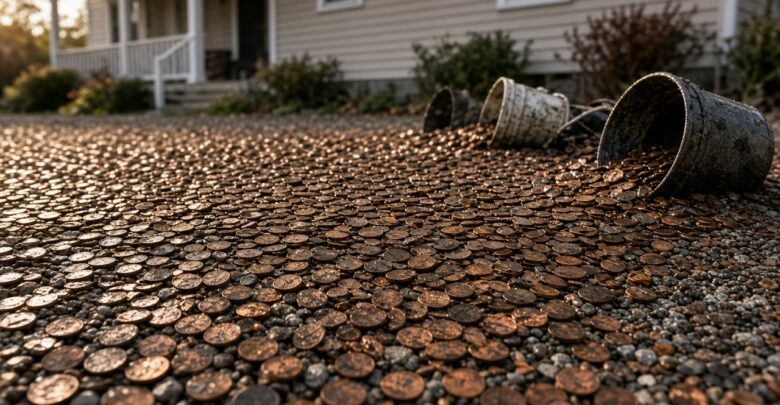
Thousands of pennies covered the driveway.
In the late September sunlight, parts of the pile shone like copper. Most of it, however, looked dark and wet. Then the smell reached me.
Motor oil.
Beside his pickup, Mark held two empty buckets. Several more lay in the truck bed.
My son, Liam, appeared behind me in his socks. His little sister, Emma, followed with her stuffed rabbit.
Neither child spoke.
Meanwhile, Mark pulled a folded pay stub from his pocket. With a strip of shop tape, he fixed it to an empty bucket and placed the bucket on the pile.
“Paid in full,” he said.
For a moment, he stared straight at me.
“Count it.”
Then he climbed into his truck and drove away, leaving my final wages spread across our driveway.
Six Years Behind the Parts Counter
My name is Jessica Miller. At thirty-four, I lived with my husband and our two children outside Merrill, Wisconsin.
Our small yellow house stood among pine trees, with a garden behind it and a swing set Chris had built over one frustrating weekend.
For six years, I had worked at Johnson Auto & Diesel.
The shop occupied a long steel building with four service bays. Farmers came for parts, coffee, and arguments about deer season. Mechanics worked beneath trucks while the phones rang at my counter.
When Mark hired me, Emma was still a baby.
“Can you read a parts catalog?” he asked.
“I can learn.”
After a long look, he nodded.
“Monday. Seven sharp.”
So I learned.
Before long, the mechanics came to me instead of searching the catalogs. Part numbers, suppliers, delivery times, and common repairs became part of my daily routine.
Mark rarely praised anyone. Still, he paid on time, and the hours worked for my family.
For years, that had seemed like enough.
A New Job Meant Health Insurance
In August, the farmers co-op advertised for a parts and inventory manager.
The pay was close to what I already earned. However, the job offered something Johnson’s did not: health insurance for me and the children.
That mattered more than a small raise.
Chris hauled logs for a trucking company. When his employer changed insurance plans, our family costs rose sharply.
Meanwhile, Liam needed daily asthma medicine and regular visits to a specialist. Emma had already broken an arm after falling from the monkey bars.
We needed coverage we could manage.
After getting the offer, I typed a notice and placed it on Mark’s desk.
He read it without speaking.
“The co-op?”
“Yes.”
“For insurance?”
“For my kids.”
Before I could explain further, he raised a hand. Then he picked up an invoice and began reading.
The conversation was over.
Unfortunately, his silence lasted through my final two weeks.
The Goodbye He Refused to Give
During those last days, Mark walked past my counter without looking at me.
If he needed something, he sent a mechanic to ask.
Robert, who had worked there for twenty years, pulled me aside.
“Don’t take it personally, Jess. He gets like this when people leave.”
“How many people have left?”
After thinking for a moment, Robert sighed.
“Everyone. Eventually.”
Despite the cold treatment, I wanted to leave the job properly.
On my final morning, I placed a binder on the counter. Inside were supplier numbers, useful part details, and the shortcuts I had learned.
A note on the cover read:
For whoever comes next.
Then I packed my mug and the photograph of my children.
Robert hugged me goodbye. Behind his closed office door, Mark stayed silent.
My final pay, including unused vacation time, should have reached my account that afternoon.
The amount was $915.
By three, nothing had arrived.
An hour later, his truck turned into our driveway.
Chris Wanted to Take the Pennies Back
That evening, after the children went to bed, I called Chris.
He was away for work, staying near Tomahawk.
At first, he said nothing. Then he offered a plan.
“I’ll borrow a trailer. We’ll load it all up and dump it outside his shop.”
“No.”
“Jess, he can’t just—”
“That’s what he wants. Another angry scene.”
Across the driveway, the pennies caught the porch light. Oil glistened between them.
At that moment, I did not know what options I had. Mostly, I wanted my wages usable and the mess out of our yard.
Chris suggested the bank.
Before taking anything there, though, I needed to ask how they would handle such a large amount of change.
A coin machine seemed no easier. The fees would take part of the money, and the oil made the idea impractical.
Eventually, Chris asked the question I had been avoiding.
“What are you going to do?”
“Clean them.”
“All of them?”
Looking at the pile, I swallowed.
“All of them.”
One Small Batch at a Time
The next morning, I set up a folding table beside the driveway.
On top sat an old blue dish tub, cleaning supplies, and towels. I wore gloves and started with a small batch.
There was no quick way through it.
First came cleaning. After that, the coins needed drying, counting, and wrapping.
Liam watched from the porch in his dinosaur pajamas.
“Can I help?”
“You can count the clean ones.”
Soon, Emma appeared in pink rain boots.
“I want a job too.”
So I spread our old plaid picnic blanket on the grass. The children stayed with the clean, dry pennies while I handled the dirty batches.
Before long, Liam had invented a counting system using small groups on strips of tape.
Meanwhile, Emma hummed a cartoon song and arranged neat rows.
Their company made the work feel less lonely.
Still, every time I looked toward the remaining pile, my chest tightened.
Fifty Pennies Filled One Wrapper
At the bank, I asked about wrappers and explained the number of coins.
The teller blinked.
“How many pennies?”
“Ninety-one thousand five hundred, if the pay stub is right.”
That meant 1,830 rolls.
Back home, I began to understand the number in a different way.
Five groups of ten filled one wrapper. Then came folded ends and another empty paper tube.
Again and again, the same steps followed.
As the finished rolls grew, I packed them into old shoeboxes.
By evening, eleven boxes sat near the table. Yet plenty of pennies remained.
My back ached, and my hands felt sore.
Liam studied the pile from the porch steps. For a while, I thought he might ask why Mark had done it.
Instead, he asked about school lunch.
“Mom, what happens when somebody’s lunch money runs out?”
That question changed what the pennies meant.
The Boy With the Different Tray
At first, I did not understand.
“What do you mean?”
Liam picked at a loose thread on his trousers.
“There’s a boy in my class. Jacob. He got a cheese sandwich three times this week.”
“A cheese sandwich?”
“That’s what they give him when his account is empty.”
According to Liam, the meal came on a different-colored tray. Everyone could see it.
Then he told me about the nickname.
“Ethan Brown calls him Cheese Boy.”
For a moment, I could not speak.
“What does Jacob do?”
“Nothing. Sometimes he doesn’t eat.”
“Did you say anything?”
His head lowered.
“I didn’t know what to say.”
Beside us, the clean rolls waited in their boxes.
After another pause, Liam looked toward them.
“Could some of the pennies pay for lunch?”
Until then, I had been thinking about what Mark had done to us.
Now my son was asking what we could do for someone else.
Money We Had Already Planned to Spend
Giving away the wages was not an easy choice.
My first co-op paycheck was still two weeks away. Meanwhile, Chris’s income had to cover the mortgage, vehicle costs, and other bills.
That $915 had a purpose.
Groceries. Fuel. Liam’s next prescription.
For a while, I sat quietly and worked through the numbers in my head.
Keeping money my family needed would have been reasonable. Still, Liam’s question would not leave me.
“How many children get that lunch?” I asked.
He named several classmates. Then he shrugged.
“There might be more.”
From the screen door, Emma had been listening.
“Could the pennies buy them pizza?”
Despite everything, I laughed.
“Let me call the school first.”
Before making any promise, Chris and I talked about our budget. It would be a tight stretch, but we agreed to find out how much help the money could provide.
On Monday morning, I made the call.
Mrs. Williams Gave Me a Number
The school secretary transferred me to the cafeteria.
“Linda speaking.”
Mrs. Williams had worked there for thirty-one years. At school events, she seemed to remember every child’s name.
After introducing myself, I explained that I wanted to help with unpaid lunch accounts.
“I can’t share children’s names,” she said.
“That’s fine. Could you tell me the total for second grade?”
Keys clicked at her end of the line.
“Twenty-three accounts have money owing.”
“Twenty-three?”
“Yes, honey.”
Then she gave me the amount.
“$908.40.”
For a moment, I stared at the kitchen wall.
Out of $915, the difference was only $6.60.
“I’d like to pay it.”
“All of it?”
“Yes. But I should explain how the money is coming.”
So I told her about the buckets, the oil, and the wrapping.
When I finished, the line stayed quiet.
Finally, she spoke softly.
“Oh, Jessica.”
Somehow, those two words made me sit down.
The Work Continued After School
During the next week, my days followed the same pattern.
At the co-op, I learned a new job. Afterward, I changed clothes and returned to the pennies.
Each batch moved slowly through the process.
Clean. Dry. Count. Wrap.
The children joined me with the counting when homework was finished. Once they went inside, I kept working under the porch light.
By midweek, kneeling hurt too much. An old cushion helped, although it soon became stained and dusty.
Chris brought cream for my cracked hands.
Then, one evening, he arrived home and found me beside the stacked shoeboxes.
Without another argument, he took off his jacket and sat down.
“Show me.”
His large hands tore several wrappers.
Nevertheless, he kept trying.
Around eleven, he glanced at the remaining coins.
“You know we could have taken them back.”
“I know.”
“Why this?”
Across the grass, the children’s counting table stood empty.
“Because I wanted them to see something besides anger.”
Emma Wrapped the Last Roll
By the following Tuesday evening, only a small batch remained.
Emma stood beside me, watching.
“Can I make one?”
After counting fifty pennies, I placed them in front of her.
Slowly, she built five little stacks. Her tongue pressed against the corner of her mouth as she worked.
The paper bent. One end folded crookedly.
Still, she finished.
“Is it good?”
Taking it gently, I smiled.
“It’s perfect.”
Liam studied the uneven roll.
“Can I give that one to the school?”
“Yes.”
For the rest of the evening, he treated it like something precious.
Meanwhile, we closed the last boxes and planned the delivery.
The final collection filled seventy-four shoeboxes, with the last one only partly full.
After so many evenings of counting, seeing everything packed brought a kind of relief I had not expected.
The pile was finally gone.
Now the pennies were ready to become something useful.
Seventy-Four Boxes Arrived at School
On Wednesday morning, Chris borrowed a pickup and brought a hand truck.
Together, we loaded the boxes.
Emma asked whether she could ride beside them.
“Absolutely not.”
At school, Mrs. Williams waited near the entrance with the principal, Mr. Garcia, and the secretary, Mrs. Martinez.
When they saw the load, Mr. Garcia let out a low whistle.
Moving the boxes took trip after trip.
Meanwhile, children arriving for breakfast paused to watch through the office window.
Liam kept checking his pocket.
Inside was Emma’s roll.
Once the final boxes were stacked, he approached Mrs. Williams and held it out with both hands.
“This is the last one. My sister made it.”
She accepted it carefully.
Then he added the reason.
“It’s for the children who get the cheese sandwiches.”
Mrs. Williams looked from him to Emma.
A moment later, she sat down.
Thirty-One Years in the Lunch Line
Holding the crooked roll, Mrs. Williams took off her glasses.
“For thirty-one years, I’ve worked in that cafeteria,” she said.
Her voice shook.
“I’ve seen children try to hide their trays. Sometimes I’ve paid accounts myself. But I could never cover all of them.”
Across the office, the shoeboxes formed a low wall.
She looked at them for a long time.
“Every second-grade account,” she said. “All twenty-three.”
Beside me, Liam stood very still.
Finally, Mrs. Williams smiled at him through her tears.
“Today, every one of those children can have the regular hot lunch.”
That was when the work felt different.
The sore hands and late evenings were still real. So was what Mark had done.
But the money had reached children who needed it.
As we left, Emma tugged my sleeve.
“Even Jacob?”
“Yes,” I told her. “Even Jacob.”
A Thank You Traveled Around Town
Later that morning, Mr. Garcia showed me a thank-you message before posting it on the school’s Facebook page.
It described a local mother and her children cleaning and wrapping 91,500 pennies.
Because of their gift, every unpaid second-grade lunch balance had been cleared.
The message ended:
Kindness counts. Every penny of it.
My name did not appear.
Neither did Mark’s.
However, people in town already knew parts of the story.
Robert had told his wife about the buckets. From there, the news had spread.
By lunchtime, comments mentioned Johnson Auto & Diesel.
Some people were angry. Others wanted to help.
As the post traveled, strangers added details they had misunderstood. One called me a single mother. Someone else corrected that.
I stayed out of the comments.
Instead, I went to work, came home, and made supper.
Outside, a dark stain remained in the gravel.
The next morning, the school called again.
Mark Was Waiting in the Office
At 7:40, Mrs. Williams spoke quietly into the phone.
“Jessica, could you come down here?”
My stomach dropped.
“Is there a problem with the coins?”
“No. Mark Johnson is here.”
“What does he want?”
“He says he needs to speak to you.”
Then her voice softened further.
“He’s crying.”
After taking the children to school, I entered the office alone.
Mark sat in a small plastic chair, holding a dented red coffee can.
His work clothes looked the same as always. The man inside them did not.
When he saw me, he stood so quickly that the chair tipped.
“Jessica.”
I stopped near the doorway.
“I’m not here to cause trouble,” he said.
Beside the counter, Mrs. Williams folded her arms.
Then Mark lifted the coffee can.
“There’s something I need to give.”
“I don’t want anything from you.”
“It’s for the lunch accounts.”
The Coffee Can Held Something Different
On the counter, Mark removed the lid.
Inside were folded banknotes held with rubber bands.
“$4,300,” he said. “That’s what the rest of the school owes.”
Looking at Mrs. Williams, I waited.
“He called yesterday,” she confirmed. “Asked for the remaining total.”
Mark stared at the can.
“Kindergarten through fifth grade. All of it.”
For a moment, nobody moved.
The gesture was generous. Even so, it did not explain the change.
“Why?” I asked.
Rather than answer immediately, he turned toward Mrs. Williams.
“Linda, tell her.”
She lowered her arms.
“My mother worked in the cafeteria before I did,” she began. “Her name was Dorothy Davis.”
Then she looked at Mark.
“He used to stand in her lunch line.”
Slowly, I began to understand that this story had started long before the pennies.
A Nickname He Had Never Escaped
Mark kept his eyes on the floor.
“My father drank,” he said. “The shop made money, but there wasn’t always enough left for food.”
As a child, he had received the same simple lunch Liam described.
White bread. Cheese. Milk.
Then came the nickname.
“They called me Cheese.”
At first, it followed him through school. Later, old classmates still used it when they met.
He had laughed along rather than admit it hurt.
“After a while, being mean seemed easier,” he said. “People leave you alone.”
Mrs. Williams explained that her mother had quietly paid his account when he was older.
Dorothy had used money from her own household budget. Afterward, hot meals appeared on Mark’s tray without any explanation.
He learned the truth years later, after she died.
“I never thanked her,” he whispered.
For a while, the office stayed silent.
Then he looked toward the boxes.
“Twenty-three children,” he said. “I kept reading that number.”
An Apology Without an Excuse
Mark finally faced me.
“I paid you that way to make you feel small.”
There was no softer version of what he meant.
“I was angry you were leaving. You were the best person I ever had behind that counter.”
His hands tightened around the edge of the can.
“Instead of saying that, I wanted to punish you.”
As he spoke, I thought about the silent two weeks. The oil. The hours spent working through the pile.
His childhood helped explain his pain. It did not make his choice fair.
“Why ask me to come?” I said.
“Because I owe you an apology before anything else.”
Then he gave one.
“For the pennies. For the oil. For the way I treated you. And for six years of never saying thank you.”
For once, he did not follow with a complaint about someone else.
No excuse. No demand that I forgive him.
Just the words he should have said.
Liam Came Back to the Office
Behind me, the door opened.
“Mr. Johnson?”
Liam stood there with his backpack hanging from one shoulder.
Later, I learned he had asked to leave class and come looking for me.
Mark recognized him.
“Your mom used to bring you to the shop.”
“You gave me a lollipop.”
“That’s right.”
After stepping closer, Liam pointed at the coffee can.
“Is that for school lunches?”
“The whole school,” Mark said.
My son considered that.
Then he asked a question that caught us all off guard.
“Did you get the cheese sandwich when you were little?”
Mark’s face changed.
“Yes.”
“Did people call you names?”
After a pause, he nodded.
Liam looked down.
“They do that to Jacob. I didn’t say anything because I didn’t know how.”
Then he looked up again.
“Did anybody tell them to stop when they did it to you?”
“No,” Mark answered.
One Clean Penny Changed the Room
From his pocket, Liam took a penny.
During the counting, he had chosen one to keep and replaced it with another from our household change.
Now he held that small souvenir toward Mark.
“We cleaned this one.”
For a moment, Mark only looked at it.
“Why are you giving it to me?”
“Because you said sorry to Mom.”
Liam paused.
“And because nobody said anything when they called you that name.”
His hand moved a little closer.
“So I’m saying something. I’m sorry they did that.”
Mark accepted the penny.
In his scarred palm, it looked very small.
Then he sat down and covered his face.
Beside the counter, Mrs. Williams reached for a tissue.
I stood close to Liam, resting a hand on his shoulder.
My son had not erased what happened to us.
Instead, he had found words for another hurt that had waited years to be heard.
The Accounts Were Finally Clear
After the coins were counted, the amount matched the pay stub.
$915.
Of that, $908.40 cleared the second-grade balances.
The remaining $6.60 went toward future meals for children who needed help.
Meanwhile, Mark’s donation covered the rest of the school’s outstanding lunch accounts.
For the first time in years, every balance was clear.
That could have been the end.
However, a week later, Mark called.
Under his shop counter sat an old container of loose change. He wanted to donate it too.
“There’s more than I thought,” he said. “Would you show me how to wrap it?”
Before answering, I let the question sit.
Then he explained his idea.
“What if people brought their own change? We could help the middle school next.”
A moment later, he added something quietly.
“I’ll clean mine first.”
Penny Saturday Drew a Crowd
Two Saturdays later, we set up tables at the fire hall.
Mark brought clean coins. I brought wrappers and the familiar blue tub.
Liam came ready to teach his counting method. Emma brought her rabbit and plenty of opinions about folding paper.
A sign near the entrance read:
Penny Saturday. Bring your change. Help with school lunches.
We expected a small group.
Instead, 240 people came.
They carried jars, bags, tins, and piggy banks.
Robert arrived with the mechanics. Several men who had known Mark since school took seats at a back table.
Meanwhile, Mrs. Williams hung her mother’s old cafeteria apron on the wall.
At the front table, Emma tried to teach Mark.
“Tuck it, then push.”
“I am pushing.”
“You’re squishing.”
Liam laughed so hard that he nearly slid off his chair.
By evening, the group had wrapped 412,000 pennies.
That was $4,120.
Together, the donations cleared the middle school’s lunch debt and left $900 for the high school.
Repairing the Damage in Our Driveway
The following Monday, I came home to find a gravel truck outside our house.
Mark stood nearby while a crew worked.
“What’s happening?”
“The stain,” he said.
The damaged surface had been removed and fresh gravel spread in its place.
Where the dark fan-shaped mark had been, the driveway looked clean again.
For a moment, I watched the work.
Then I turned toward him.
“Thank you for fixing it.”
He nodded.
“I should never have caused it.”
From his pocket, he took his keys.
A penny hung beside the truck key, threaded through a small hole.
Liam’s penny.
“Carry it every day,” he said.
Looking at it, he paused.
“Helps me remember.”
This time, his apology had been followed by something practical.
The donation helped the school.
Replacing the gravel addressed damage he had done to our home.
Both mattered.
A Year Later Some Things Had Changed
A year passed.
At the co-op, I settled into my new role. Our insurance helped us manage Liam’s care, and his asthma stayed under control.
Meanwhile, Emma continued finding new ways to frighten me at the playground.
Chris still drove for work. Occasionally, he claimed to dream about torn penny wrappers.
Mark kept running the shop.
For a while, business had slowed after the story spread. Later, some customers returned, watching to see whether his behavior would change.
One change mattered especially to me.
He began offering health coverage to his staff.
“Should have looked into it years ago,” he admitted.
As for Jacob, Liam told me the nickname had stopped.
One day, when Ethan Brown used it in the lunch line, Liam spoke up.
“Don’t call him that. It hurts.”
This time, he knew what to say.
Dorothy Davis Had Not Been Forgotten
Penny Saturday became a yearly event.
By the next September gathering, Mark had bought more tables and a coin counter.
The banner above the room read:
Every Penny Counts.
That year, donations reached almost $6,000.
After covering the district’s outstanding lunch accounts, the remaining money helped start a fund for future needs.
Mark chose the name.
The Dorothy Davis Fund.
When he told Mrs. Williams, she cried.
Later, a small plaque went up near the cafeteria.
It honored a woman who had quietly paid for a child’s meals without asking for recognition.
Her kindness had stayed hidden for years.
Yet it had not disappeared.
It had reached a boy who grew into a difficult man. Then, much later, it helped him understand what he had done to someone else.
That understanding was only a beginning.
What mattered afterward was how he acted.
The Jar Beside the Register
Last month, I stopped at Johnson’s for a filter for Chris’s truck.
The building looked familiar.
Same service bays. Same strong coffee. Same kind of calendar behind the counter.
However, a large glass jar stood beside the register.
Clean pennies filled it halfway.
Across the front, black letters read:
For the lunch kids. Every penny counts.
Underneath was a smaller note.
The writing looked careful, as though the person holding the marker had taken his time.
Thank you, Jessica.
Thank you, Liam.
Thank you, Emma.
Below those lines was a name.
Not Mark.
Not Mr. Johnson.
Just one word.
Cheese.
For a moment, I stood quietly beside the counter.
Then I reached into my purse, found some change, and added it to the jar.
Fiction notice: This story is a work of fiction for entertainment. Its characters, businesses, school, and events are fictional. Real place names are used as part of the setting.