News
The Viral 20-Year Eagle Map: What That Crazy Flight Path Really Teaches Us
The Viral 20-Year Eagle Map: What That Crazy Flight Path Really Teaches Us


There is nothing quite like sitting on the back porch with an early mug of hot ginger tea, watching the morning breeze stir through the garden. If you sit still long enough, you start noticing the neighborhood birds. They rarely fight the wind. A red-tailed hawk catches an invisible rising bubble of warm air, tilts its wing feathers just a fraction of an inch, and spirals effortlessly toward the clouds without a single flap.
A few years ago, a bizarre graphic took over the internet and stopped millions of nature lovers in their tracks. It showed a wild bird’s GPS route crisscrossing continents in a tangle of loops, sudden sharp turns, and long highway-straight lines. The viral post claimed researchers had followed this single bird for two whole decades. When people looked closer at the steppe eagle migration map, one detail stood out above everything else: the bird stubbornly refused to fly over water.
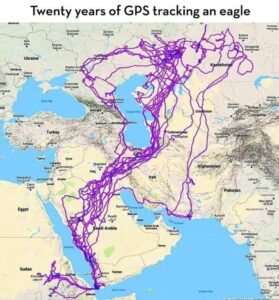
The viral tracking map that captivated millions, tracing a single year of flight across Central Asia and the Middle East instead of the rumored twenty.
The Viral Myth: Did Scientists Really Track One Bird for 20 Years?
The internet loves a good tall tale, especially when it comes wrapped in the wonder of the wild. The sensational story began early in 2019 when a man named Fahd Qash was walking through a swampy region near Jizan in southwestern Saudi Arabia. He stumbled upon a deceased eagle lying in the brush. Strapped securely to its back with lightweight Teflon ribbon was a small electronic receiver stamped with a researcher’s contact email.
Qash reached out to the scientists, who belonged to a dedicated conservation team studying Steppe Eagles across Kazakhstan and Russia. The researchers sent back the satellite history logged by the bird’s solar transmitter. Within days, someone shared a screenshot online with an embellished caption claiming the device had recorded twenty years of unbroken travel. The post spread like wildfire across social media feeds.
The real story is grounded in practical wildlife biology. Lightweight solar satellite tags small enough to sit comfortably on an eagle’s back without impeding its flight did not even exist twenty years prior. Steppe eagles rarely survive that long in the wild. The map did not show twenty years of wandering; it documented roughly twelve months of intense, breathtaking travel completed between 2018 and 2019.
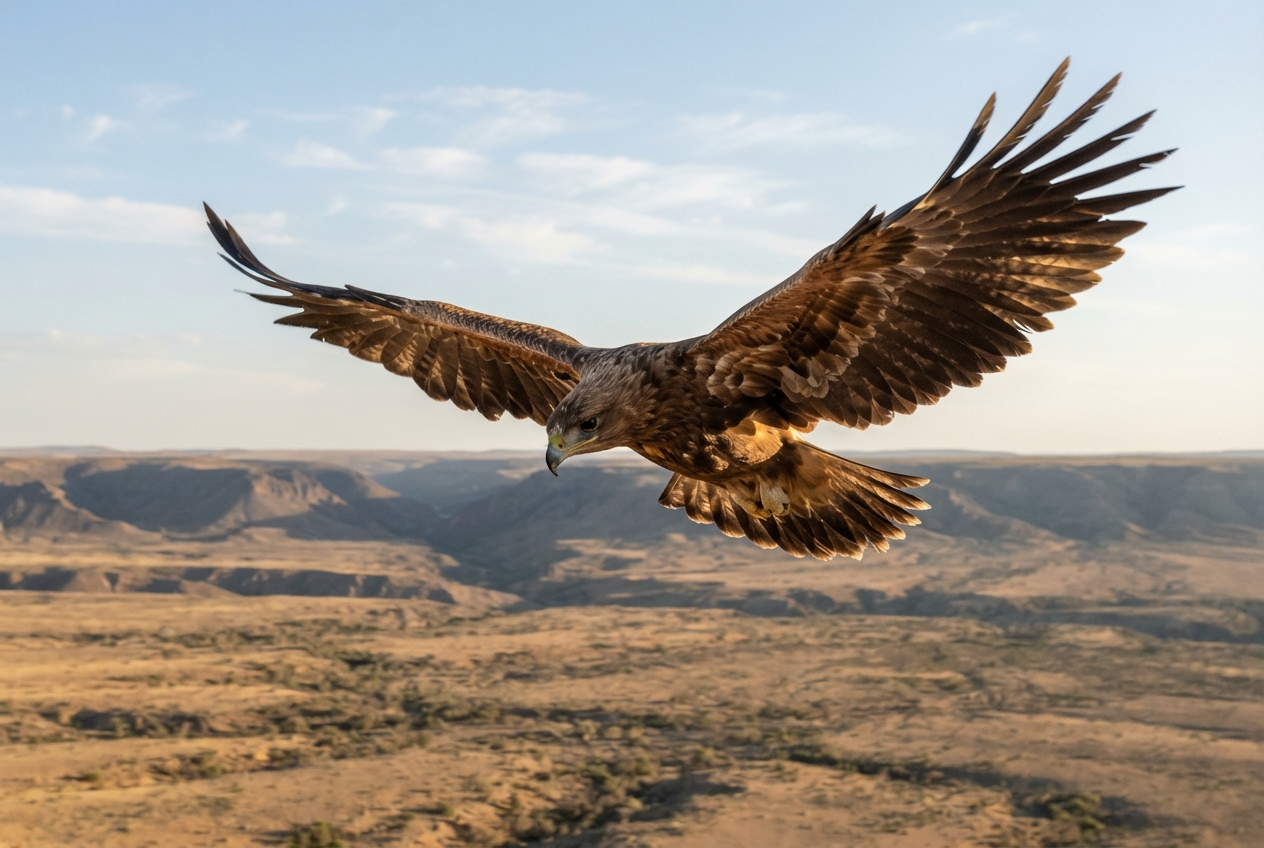
Broad wings and hollow bones: the steppe eagle is built to float on thermal air rather than flap across open waters.
Reading the Steppe Eagle Migration Map: Why It Avoided the Sea
Even though the twenty-year claim fell apart, the authentic steppe eagle migration map revealed something far more fascinating. Looking at the tracked journey, the bird flew thousands of miles across Kazakhstan, southern Russia, Iraq, Iran, Saudi Arabia, and deep into the heart of Africa. Yet, as you trace those colorful tracking lines, you notice an unmistakable boundary: the bird circled entirely around the Caspian Sea, hugged the shoreline of the Persian Gulf, and detoured hundreds of miles around the Red Sea.
Why would a creature with the power of flight take a grueling overland detour rather than cutting straight across a narrow stretch of blue water? The answer comes down to pure physics and the harsh mathematics of energy.
Large raptors do not power their long-distance journeys through sheer muscle; they survive by riding the invisible architecture of rising heat.
Steppe eagles are massive soaring predators with wingspans stretching over seven feet. Flapping those heavy wings burns through fat reserves at an alarming rate. To travel thousands of miles without starving, they rely almost entirely on thermals. These rising columns of warm air bubble upward when the sun bakes open ground, dry fields, and rocky deserts.
Deep water does not heat up quickly beneath the morning sun. Because large bodies of water stay cool, they cannot generate thermal lift. Over the sea, cool air sinks downward, creating a downdraft zone. If an eagle attempts to cross the Red Sea or the Caspian Sea, the warm lift instantly vanishes. The bird must flap continuously against heavy oceanic winds. For an animal that weighs five to seven pounds, flapping over miles of open water risks complete exhaustion and drowning.
Following the warm air: why soaring raptors stay glued to sun-warmed ground and steer clear of deep open seas.
Zig-Zags, Pauses, and Desert Buffet Lines
The other detail that confused readers in the original viral post was the messy, scribbled appearance of the routes. People expected a clean, straight arrow from northern breeding territories down to wintering grounds in Africa. Instead, the bird doubled back through valleys, lingered for weeks in remote desert patches, and took wide sweeping turns.
These detours were not mistakes or random wandering. Wild animals live on dynamic schedules dictated by food and weather fronts. In the open steppes of Central Asia, ground squirrels emerge from winter burrows in unpredictable waves. When an eagle spots an active rodent colony, it stops and stays put, stocking up on calories before continuing south.
Down in eastern Africa, summer rains trigger sudden locust outbreaks and termite swarms across the savannas. A traveling eagle senses low-pressure systems, smells incoming moisture on the wind, and alters its path to intercept these seasonal buffets. The flight plan shifts constantly in response to what the earth provides on any given afternoon.

Watching everyday backyard flyers reveals the exact same wind-riding instincts seen in wild migratory eagles.
The Real Threats Facing Soaring Raptors
Because these birds are locked into overland corridors, their travel paths are remarkably narrow. Conservation biologists track these routes because funnels like the Bab-el-Mandeb strait and the mountains of western Iran become busy aerial crossroads every spring and autumn.
Staying on dry land keeps the birds aloft, but it also forces them to pass directly through human developments. Researchers monitoring these tagged populations track several major survival hurdles:
- Uninsulated Power Lines: Electrocution on medium-voltage distribution poles across rural steppes remains the leading cause of death for young birds looking for hunting perches.
- Poisoning and Carcass Baits: Raptors feed on livestock carrion and fallen rodents, making them vulnerable to agricultural pesticides and veterinary drugs left in pastures.
- Wind Energy Installations: Windmills placed along narrow mountain passes and thermal corridors pose a direct strike hazard for soaring birds caught in heavy crosswinds.
- Habitat Loss: Conversion of native grasslands into intensive monoculture reduces the ground squirrel and reptile populations these birds need to fuel their travels.

Tracing travel corridors across open continents shows how wildlife continuously bends to wind and seasonal food supplies.
Backyard Lessons in Natural Flow
There is something grounding about stepping away from our glowing screens and looking at the world through the eyes of a traveling bird. In our modern daily routines, we often treat life like a straight line. We set strict goals, fight through fatigue, and try to force our way through obstacles by sheer willpower.
Nature operates on a completely different rhythm. The steppe eagle does not fight the storm, nor does it stubbornly insist on crossing a sea that cannot support its weight. It takes the long way around. It lets the sun warm the earth, catches the rising air, and moves forward when the lift is strong. When the wind turns cold and the air sinks, it lands, waits, and feeds.
You can see that same wisdom right outside your kitchen window. When a late spring cold snap hits your garden, the tomato seedlings stop growing and hunker down. When the midsummer sun scorches the lawn, deep-rooted native grasses wait out the drought. Everything in the natural world bends, adjusts, and responds to real-time conditions rather than clinging to a rigid blueprint.
Living in Tune With the Wind
The true story of the steppe eagle migration map is far better than the fictitious twenty-year rumor that made the rounds on the internet. It reminds us that real wildlife biology is full of wonder, rooted in the clever ways living things work with physical laws rather than fighting them.
The next time you step outside on a brisk afternoon, take a quiet second to look up. Notice which way the high clouds are drifting, feel the cooler drafts sliding down the valley, and watch the local crows coast along the tree line. When we pay attention to how nature moves, we realize that adapting to the breeze is not a sign of weakness; it is the secret to traveling extraordinary distances without losing our way.