Unique Properties
The House That Time Forgot: The Mysterious Abandoned Home Hidden Deep in the Forest
The House That Time Forgot: The Mysterious Abandoned Home Hidden Deep in the Forest

The House That Time Forgot: The Mysterious Abandoned Home Hidden Deep in the Forest
Deep inside an ancient forest, far away from busy roads, crowded cities, and the noise of modern life, stood a house unlike anything anyone had ever seen.
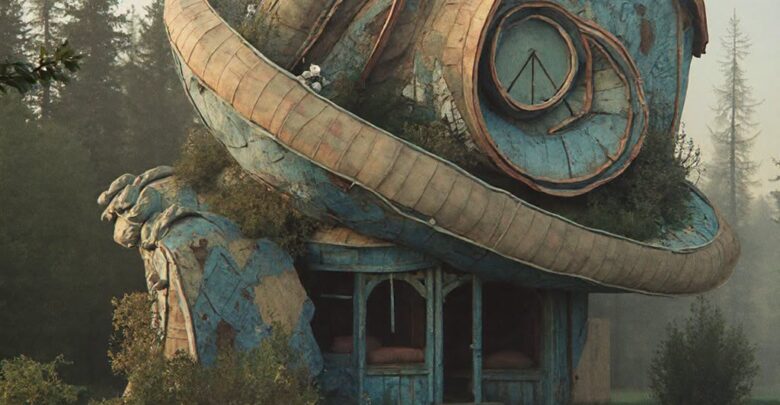
Its unusual shape looked almost like a giant seashell resting among the trees. Curved wooden walls wrapped around its structure, faded blue surfaces showed years of exposure to the weather, and a strange circular window faced the forest like a giant eye watching everything that passed.
A winding wooden structure surrounded the upper part of the building, creating the appearance of a giant spiral. Moss, wild plants, and small bushes had slowly taken over the exterior. The entrance was hidden beneath an unusual curved roof, and a few old steps led toward a dark doorway.
At first glance, the building looked like something from a forgotten fairy tale.
But there was something deeply unsettling about it.
Nobody knew who had built it. Nobody remembered seeing anyone living there. And according to the oldest residents of the nearest village, the house had been abandoned for longer than anyone could remember.
Some believed it had once belonged to an artist. Others claimed it was built by a wealthy family who wanted to escape civilization. A few villagers refused to discuss it altogether.
They all agreed on one thing.
Nobody should enter the house after sunset.
A Discovery Deep in the Woods
The story began on a quiet autumn morning when a young photographer named Daniel decided to explore a remote part of the forest.
He had spent several days traveling through the countryside, searching for forgotten places to photograph. His interest was not simply in beautiful landscapes. He loved abandoned buildings, especially those that seemed to hold pieces of history within their walls.
Old houses, forgotten factories, empty schools, and ruined structures fascinated him.
Every abandoned place had once been important to someone. Every empty room had once contained conversations, laughter, memories, and ordinary moments that eventually disappeared.
That was what Daniel wanted to capture.
On the fourth day of his journey, he noticed a narrow trail disappearing between two enormous pine trees.
The path was almost completely covered by grass and fallen branches. It did not appear on his map, and there were no signs indicating where it led.
Curiosity eventually won.
Daniel followed the trail.
After nearly twenty minutes of walking, the trees began to thin. A soft mist floated above the grass, and sunlight passed through the branches in long golden rays.
Then he saw it.
Standing alone in a small clearing was the strangest house he had ever encountered.
Its unusual spiral-shaped roof rose above the surrounding bushes. The faded turquoise walls were covered with cracks, and the wooden exterior had slowly turned gray from years of rain and cold winters.
Daniel stopped walking.
He lowered his camera and stared.
The building looked as though someone had taken a dream from a children’s storybook and abandoned it in the middle of a real forest.
He immediately began taking photographs.
But as he approached the entrance, he noticed something unusual.
The grass around the front steps was overgrown, except for a narrow strip directly in front of the door.
It almost looked as though someone had recently walked there.
The Strange History of the Spiral House
After returning to his small hotel, Daniel decided to ask the locals about the building.
At a small village café, he showed a photograph to an elderly woman who had lived in the area her entire life.
The moment she saw the image, her expression changed.
She placed her cup on the table and stared at the photograph for several seconds.
“Where did you find that?” she finally asked.
Daniel explained that he had discovered it while exploring the forest.
The woman became quiet.
She told him that the house had once been known as The Spiral House. According to an old local story, it had been built by an architect named Elias Whitmore sometime during the early twentieth century.
Elias was not an ordinary architect.
He was fascinated by unusual shapes, natural materials, and buildings that seemed to belong to the landscape rather than dominate it.
He believed houses should feel like living things. They should grow with their surroundings, welcome natural light, and create a peaceful connection between people and nature.
After years of traveling, Elias returned to the countryside and began constructing a home deep inside the forest.
He designed it himself.
Its curved roof represented the movement of water, while its circular windows were inspired by the shape of ancient tree trunks. The winding exterior structure was intended to resemble a spiral shell, protecting the rooms beneath it.
The project took several years to complete.
When it was finally finished, Elias moved into the house with his wife, Clara, and their young daughter, Evelyn.
For a while, the family lived peacefully.
Then, one winter, everything changed.
The Night the Family Disappeared
According to the elderly woman, the Whitmore family suddenly disappeared during an unusually cold winter.
Nobody in the village knew exactly what happened.
One morning, a local delivery worker arrived at the house and noticed that the front door was slightly open.
There were no footprints in the snow leading away from the building.
The family car was still parked nearby.
The kitchen appeared untouched, and several dishes were left on the dining table.
But the family was gone.
The villagers organized a search, examining the surrounding forest and nearby roads. They searched the old paths, followed the river, and questioned anyone who might have seen the family.
Nothing was discovered.
There were no signs of an accident, no evidence of a struggle, and no explanation for why an entire family would leave without taking their belongings.
Eventually, the investigation ended.
The house remained empty.
Over the years, stories began spreading through the village. Some people claimed to see a light moving behind the circular window during winter nights. Others said they heard a child laughing somewhere inside the building.
Most dismissed these stories as imagination.
But the elderly woman who spoke with Daniel did not seem convinced.
Before he left the café, she gave him one final warning.
“Whatever you find in that house, remember that some doors were closed for a reason.”
Entering the Forgotten Home
The following morning, Daniel returned to the forest.
This time, he brought a flashlight, additional camera equipment, and a small notebook.
The weather was colder than the previous day. A thin layer of mist covered the clearing, and the tall trees moved gently in the wind.
The house looked even more mysterious.
Daniel walked up the old wooden steps and pushed the front door.
It opened with a long, painful creak.
Inside, the air smelled of damp wood, dust, and something strangely sweet.
The entrance opened into a small living area. Old furniture stood beneath faded walls, and pieces of fabric hung from several windows.
A thick layer of dust covered almost everything.
Daniel slowly moved forward.
There was an old wooden table near the center of the room. Beside it stood two chairs, positioned as though someone had recently been sitting there.
On the table was a small glass bottle containing a dried flower.
Daniel photographed it.
Further inside, he discovered a narrow staircase leading toward the upper level. Its wooden steps followed the curved shape of the building, creating a spiral that seemed to continue around the central structure.
The architecture was remarkable.
Unlike ordinary houses, the rooms seemed connected through curved passages. Circular openings allowed light to travel between different areas, while small windows offered unusual views of the surrounding forest.
Daniel began to understand why the architect had designed the building this way.
It was not simply a house.
It was a personal work of art.
But the deeper he explored, the stranger things became.
The Room That Had Been Locked for Decades
At the upper level, Daniel discovered a small wooden door.
Unlike the other doors in the house, this one had a heavy metal lock.
There were scratches around the handle, suggesting that someone had once tried to open it.
Daniel examined the door carefully.
Near the bottom, he noticed a small gap.
A faint smell of old paper came from inside.
After several minutes, he managed to open the lock using a small tool from his backpack.
The door moved slowly.
Behind it was a circular room illuminated by a narrow window.
There were shelves covering almost every wall. Old notebooks, drawings, photographs, and rolled architectural plans filled the space.
In the center stood a wooden desk.
On top of it was a large leather-bound journal.
Daniel opened the first page.
The handwriting was elegant but difficult to read.
The journal belonged to Elias Whitmore.
The first entries described his ideas for the house, the construction process, and his dreams of creating a place where his family could live peacefully.
But the later pages were different.
The writing became hurried and increasingly difficult to understand.
Elias described hearing strange noises beneath the house.
At first, he believed they were caused by animals moving through the forest.
Then he began writing about sounds coming from inside the walls.
He claimed that the building sometimes made noises even when there was no wind.
One entry contained a sentence that made Daniel stop reading.
“The house is not empty when we are alone.”
The Secret Beneath the Spiral
Daniel continued reading.
According to the journal, Elias had discovered an unusual underground chamber while working on the foundations.
The chamber appeared to be much older than the house itself.
Its walls were made from large stones, and strange circular symbols had been carved into them.
Elias believed the structure might have belonged to an unknown settlement that existed long before the surrounding village.
He began investigating it.
The more he explored, the more fascinated he became.
He eventually connected the underground chamber to the central spiral design of his house.
In his journal, he described a theory that the original structure had been built around something hidden beneath the forest.
He never explained exactly what that thing was.
But his final entries suggested that he had become increasingly frightened.
Clara wanted to leave.
She believed her husband was spending too much time investigating the chamber and neglecting their daughter.
Elias refused.
He insisted that he was close to discovering something important.
Then, several pages were missing.
The final written entry was dated December 14.
It contained only a few lines:
“Tonight, I heard Evelyn speaking to someone in the lower room. When I asked her who she was talking to, she said the woman beneath the house had called her by name. Clara says we must leave tomorrow. I fear tomorrow may already be too late.”
Daniel closed the journal.
For the first time since entering the house, he felt genuinely uncomfortable.
The Voice in the Lower Room
A sudden noise came from somewhere below.
It sounded like a wooden object falling onto the floor.
Daniel froze.
He listened carefully.
Nothing.
He told himself that the sound was probably caused by an old beam shifting inside the structure.
Still, he decided to investigate.
He followed the curved staircase downward until he reached a narrow passage behind the living room.
At the end of it was another door.
Unlike the others, this one had no handle.
Instead, a small circular opening was carved into its center.
Daniel pushed gently.
The door moved.
Beyond it was a dark staircase descending beneath the house.
He turned on his flashlight.
The stone walls were covered in moisture, and the air became noticeably colder as he walked down.
At the bottom, he discovered a small underground chamber.
Its walls were covered in strange symbols.
In the center stood a circular stone structure resembling the design of the house above.
There was an old wooden chair beside it.
On the chair sat a small doll.
Daniel approached carefully.
The doll wore a faded blue dress and had one missing eye.
He recognized it immediately from one of the family photographs he had seen upstairs.
It belonged to Evelyn.
Beside the chair was a small piece of paper.
Daniel picked it up.
Written in a child’s handwriting were the words:
“Father says the house remembers everyone.”
He felt a sudden chill.
Then something moved behind him.
Daniel turned around.
At the far end of the chamber, a narrow passage appeared to lead deeper underground.
His flashlight flickered.
For a brief moment, he thought he saw a small figure standing at the entrance.
Then the light returned.
The passage was empty.
The Last Photograph
Daniel decided he had seen enough.
He climbed the stairs quickly and returned to the living room.
The forest outside had become darker. Thick clouds covered the sky, and the wind moved through the trees.
He gathered his equipment and prepared to leave.
Before stepping outside, he turned toward the unusual circular window.
Something caught his attention.
A reflection appeared in the glass.
It looked like the reflection of a woman standing behind him.
Daniel turned around.
Nobody was there.
He looked back at the window.
The reflection had disappeared.
Trying to remain calm, he raised his camera and took one final photograph of the interior.
The flash illuminated the entire room.
For a fraction of a second, the photograph captured something that Daniel did not notice at the time.
In the upper window, behind the dusty glass, stood three figures.
A man.
A woman.
And a little girl.
All three were looking directly toward the camera.
Daniel left the house without looking back.
The Photograph That Changed Everything
That evening, Daniel returned to his hotel and transferred the photographs to his laptop.
He reviewed the images one by one.
The exterior photographs were beautiful. The unusual structure, faded blue walls, and surrounding forest created an atmosphere that looked almost unreal.
Then he reached the final photograph.
He zoomed in.
His heart began beating faster.
The three figures were clearly visible in the upper window.
He enlarged the image again.
The man appeared to be wearing an old-fashioned dark coat. The woman stood beside him, holding the hand of a small child.
Daniel compared the figures with the old family photographs he had discovered in the locked room.
They looked remarkably similar.
He immediately searched for information about Elias Whitmore and his family.
The next morning, he visited the local historical archive.
After several hours, he discovered an old newspaper article dated December 1927.
The headline read:
“LOCAL FAMILY MISSING AFTER MYSTERIOUS WINTER DISAPPEARANCE.”
The article described the disappearance of Elias Whitmore, his wife Clara, and their daughter Evelyn.
But at the bottom of the page was a small detail that had never appeared in the stories told by villagers.
A neighbor had reported seeing the family entering the house on the evening of December 14.
Nobody had seen them leave.
The House Was Never Truly Empty
Daniel returned to the forest one final time.
He wanted to photograph the house in daylight and document its unusual architecture.
But when he arrived at the clearing, something had changed.
The front door was closed.
The wooden steps looked different.
And the small strip of grass that had appeared flattened during his first visit was now covered with fresh leaves.
He walked toward the entrance.
The door was slightly open.
Inside, the living room appeared exactly as he had left it.
Except for one thing.
The small glass bottle on the wooden table was gone.
In its place was a photograph.
Daniel picked it up.
It showed the Whitmore family standing outside the house.
Elias, Clara, and Evelyn were smiling.
On the back was a handwritten message:
“Thank you for remembering us.”
Daniel stared at the photograph for several minutes.
He slowly turned toward the staircase.
From somewhere above, he heard a soft sound.
A little girl laughing.
Then a woman’s voice whispered:
“Please close the door.”
Daniel dropped the photograph and ran outside.
He never returned.
Years Later: The Forgotten House Remains
Many years passed.
Daniel eventually published a collection of photographs featuring abandoned buildings and forgotten places.
The final image in the collection was the strange spiral house hidden deep in the forest.
He never explained what happened during his visit.
When asked about the building, he simply described it as a place that had once belonged to a family whose story deserved to be remembered.
Some readers believed the story was a creative interpretation of an abandoned building.
Others became fascinated by the unusual architecture and the mystery surrounding its former occupants.
But the house continued to stand in the clearing.
Seasons changed.
Snow covered its curved roof during winter. Spring flowers appeared around the entrance. Moss spread across the faded blue walls, and small plants grew between the wooden steps.
The forest slowly reclaimed the surrounding land.
Eventually, even the narrow trail leading to the clearing became difficult to find.
Yet local hikers occasionally reported seeing a warm light behind the circular window.
Some claimed to hear music drifting through the trees.
Others described the sound of a child running across the wooden floors.
Nobody could prove any of it.
And perhaps that was exactly how the house wanted things to remain.
The Final Mystery
Today, the strange abandoned house exists only in photographs, memories, and the stories passed between generations.
Its unusual spiral design remains a reminder of a forgotten architect’s imagination. Its weathered exterior tells the story of decades spent exposed to the elements. And its isolated location gives it an atmosphere that seems almost impossible to explain.
But one question continues to remain unanswered.
If the Whitmore family disappeared in 1927, who placed the photograph on the table decades later?
And why did the message appear to be written specifically for Daniel?
Perhaps the house was nothing more than an extraordinary abandoned building surrounded by local legends.
Or perhaps some places hold memories in ways that people cannot understand.
Deep inside the forest, behind faded blue walls and a strange circular window, the Spiral House continues to wait.
Waiting for someone to discover it.
Waiting for someone to remember.
And perhaps, waiting for someone to enter one more time.
Because some houses are abandoned by their owners. Others are simply waiting for their story to be told.