Uncategorized
The day I sold Mama’s house for $214,000, my husband drove home in a brand-new truck he thought I’d pay for. “Your mama would’ve wanted me to have it

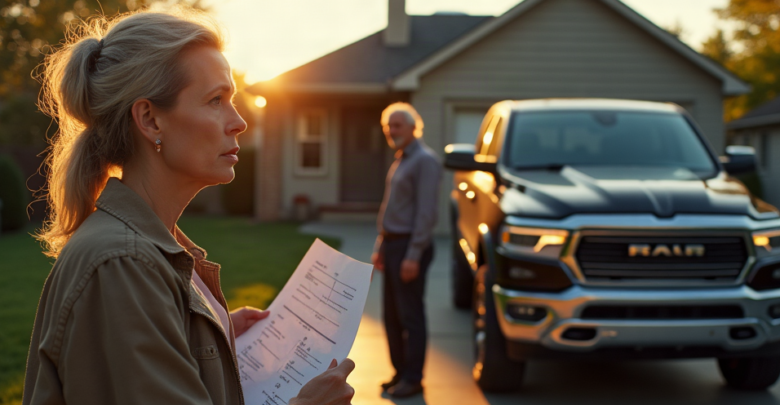
The day I sold Mama’s house for $214,000, my husband drove home in a brand-new truck he thought I’d pay for. “Your mama would’ve wanted me to have it,” he said, patting the hood. I said, “Well, it sure is red.” That weekend, at his mother’s supper table, he was still bragging about it when a tow truck pulled into her driveway. His mother put on her glasses and…
Mama’s house sold on a Monday morning, at the title company in Whitesburg. It was the little white house on the creek where I grew up, with forty acres of woods behind it. Mama passed in March, at ninety-one, in her own bed.
She left the house to me, and only me. I signed the papers, and the closing lady slid the check across the table.
“Your mama kept this place real nice,” she said.
I put every penny in my own account, with only my name on it. Then I sat in my car in the parking lot and cried a good while. Everybody in Letcher County calls me Stell.
My real name is Stella, but nobody’s used it since grade school, except the Lord and the IRS. I’m sixty-six. I sewed upholstery for forty years at a furniture shop over in Hazard.
I can tell you what’s under any couch cushion in this county, and most of it’s crackers. When I got home that afternoon, there was a truck in my driveway.
A brand-new red pickup, so shiny it hurt to look at, with a big white bow on the hood.
My husband, Delmas, was leaning on it, grinning like a possum.
“Surprise, Stell,” he said.
“Whose is that?” I asked.
“Ours,” he said. “Well, mine. I’m sixty-eight years old, and I’ve never had a new truck.”
“How much?”
“Sixty-eight thousand,” he said, like he was proud of it. “They want the cash by Friday.”
“Whose cash?” I said.
He patted the hood.
“Your mama would’ve wanted me to have it.”
Mama couldn’t stand Delmas for forty-four years. She’d have wanted him to have a flat tire. I looked at that truck a long time.
“Well,” I said, “it sure is red.”
Then I went inside and started supper, and I didn’t say another word about it. I wrapped a pan of cornbread in foil for his mother, and wrote her name on the masking tape on top, the way I always do. That night, my neighbor, Juanice, knocked on my back door.
Juanice works in the office at the dealership in Hazard. Last year, I drove her to every one of her chemo treatments at the cancer center in Corbin, two hours each way. She doesn’t forget a thing like that.
“Stell, I shouldn’t say a word,” she whispered at the door.
“But that man signed for that truck saying his wife would bring sixty-eight thousand cash on Friday. And you didn’t sign a thing.”
“I’ll be,” I said.
“If the money doesn’t come, they’ll take it back,” she said. “That’s how it works when they let you drive off first.”
I thanked her and gave her the rest of the cornbread. I lay awake most of that night, listening to Delmas snore. Forty-four years married.
If I let them haul that truck off, he might never forgive me. His mother might never forgive me. Maybe I ought to just pay it and keep the peace, like I always have.
Then I thought about Mama, sitting on her porch, watching him drive by her house without ever once stopping in. Friday came. I didn’t go to the bank.
Delmas didn’t even ask me. He was too busy driving that truck up and down Main Street with the window down. On Friday evening, the dealership called his phone.
I heard him out on the porch.
“She’ll have it Monday,” he said. “Her mama’s money’s tied up.”
Mama’s money was sitting right in my account, with my name on it and nobody else’s. Saturday morning, the dealership called the house phone, and I answered.
“Ma’am, we’re trying to locate the truck,” the man said, real polite.
“He’ll be at his mother’s for supper tonight, out on Pine Branch Road,” I said.
“You can’t miss it. It’s real red.”
His mother, Ethelene, is eighty-nine and sharp as a tack. She still makes supper for us every Saturday, in the same black skillet she’s had since 1960. Delmas parked that truck right in front of her porch, where she couldn’t miss it from the kitchen window.
All through supper, he talked about that truck.
“Heated seats, Mother,” he said. “It’s got a camera for backing up.”
“Where’d you get the money for a thing like that?” Ethelene asked.
“Stell’s mama left us some,” Delmas said, and he winked at me.
I passed the green beans. Ethelene looked at him, and then she looked at me, and she didn’t say anything. She was cutting her pie when we heard the engine.
A big flatbed tow truck backed into her driveway, beeping the whole way. A young man in a dealership shirt got out with a clipboard. Delmas jumped up so fast he knocked his chair over.
He ran out on the porch in his socks.
“Hey! That’s my truck!”
“Sir, the cash didn’t come Friday,” the young man said. “We’ve got to take it back.”
“My wife’s paying!” Delmas hollered. “Stell, tell him you’re paying!”
I came out on the porch with my coffee.
“Honey,” I said, “I never told anybody I was paying.”
The young man held out his paper. Delmas grabbed it, but before he could read a line, his mother came out the screen door behind us and took it right out of his hands. She didn’t hurry.
She never has. His mother put on her glasses, held that paper up to the porch light, and read it top to bottom while the tow truck sat there beeping.
Then she looked up at her son over her glasses and said, “Delmas, your daddy pulled this exact same stunt on me in 1971, with my mama’s burial money, and I never said a word. I’ve waited fifty-five years to see a woman in this family not let him.”
Ethelene lowered the paper. The tow truck kept beeping behind her, and Delmas stood in his socks with one hand out like he might take it back.
“Mother, that’s not the same thing,” he said.
“Isn’t it?” Ethelene asked. She held the paper close to her chest. “Your daddy said he’d pay me back by Friday, too.”
Delmas looked at me, then at the young man from the dealership. His mouth opened and closed once. I had never heard Ethelene say anything like that about her husband. She’d been married to him long before I came into the family, and she didn’t share much about those years.
“Your father was a different man,” Delmas said.
“He was your father,” she answered. “And you sound just like him when you’re trying to make somebody else pay.”
The young man shifted his clipboard from one hand to the other. He was standing in the middle of somebody else’s family business, and I could see he wanted to finish the job and get out of it.
Delmas turned on him. “I told you, my wife is paying. She has the money.”
The words stung, even though I’d heard him make that claim already. Hearing it in front of Ethelene made it worse. I felt my temper come up, and I was tired of pretending the arrangement was a misunderstanding.
“I never said I would pay,” I told him. “You know I never said it.”
He gave a short laugh and shook his head. “We talked about it.”
“We did not.”
“You said you wanted me to have something nice.”
“I said the truck was red.”
Ethelene’s eyes moved from him to me. The young man looked down at his paper. I wished I hadn’t said it so sharply, but I was done smoothing things over for Delmas while he stood there asking somebody else to carry the cost.
He pointed at me. “You can’t let me look like a fool in front of everybody.”
That got to me. I had spent a lot of years trying not to embarrass him, even when he embarrassed me. I did love him. I also knew that love wasn’t the same as agreeing to hand over Mama’s money.
“You’re doing that part yourself,” I said.
His face tightened. “Stell, this is between us.”
“No. You told the dealership I was paying. You told your mother Mama left the money to us. And now you’re standing here asking me to say something I never said.”
Ethelene handed the paper back to the young man. “Take the truck.”
Delmas turned to her. “Mother.”
“Take it,” she repeated. “Don’t make that boy stand out here all night.”
The young man nodded once and went back toward the flatbed. Delmas took two quick steps after him, then stopped when I put my hand on the porch rail between them. I wasn’t trying to block him. I just wanted him to look at me before he made the scene any bigger.
“Stell, don’t do this.”
I felt the old pull to fix it. I could picture the next few weeks of sour looks, the way he’d go quiet at supper, the way I would wonder if I’d ruined forty-four years over a truck. I was scared of that, and I was angry that he had put me in that position. Maybe he really thought I would give in because I usually had.
Maybe he was right about me. I stood there another second, then moved my hand off the rail.
“I’m not paying for it,” I said. “Take it.”
The young man climbed onto the flatbed. The truck’s bright red paint reflected the porch light while he backed it into place. Delmas watched every move, his shoulders up around his ears. Ethelene stayed by the screen door, still holding her glasses in one hand.
I thought I’d feel triumphant. I didn’t. I felt shaky and sad, and I hated that part of me was still waiting for Delmas to say he was sorry.
He didn’t. When the truck was secured, he looked at his mother.
“You could’ve talked to me in private.”
“You could’ve spoken to Stell in private before you told people she’d pay,” Ethelene said.
He looked at me as if he had another answer ready. Then he rubbed his face and turned away.
The tow truck pulled out of the driveway with the red pickup behind it. We all watched until the tail lights disappeared down Pine Branch Road. Delmas had to ride home with me in my old car. He got into the passenger seat and shut the door hard enough to rattle the window.
I started the engine. For a few minutes, neither of us spoke. My hands were tight on the steering wheel, and I could feel my pulse in my fingers.
Then he said, “You could’ve helped me out.”
I looked straight ahead. “You could’ve asked me before you signed for it.”
“I thought you would.”
“That was the problem.”
He leaned back and stared out the window. I wanted to say more. I wanted to ask how long he’d been sure I would pay, and whether he had really convinced himself that Mama would’ve wanted him to have a truck. I didn’t ask. We had both had enough to sit with on that drive home.
At our house, he got out without waiting for me to come around and open his door. I sat in the car for a moment after he went inside. Then I went in too, and I put the kettle on because that’s what my hands knew to do when the house felt unsettled.
I was hurt. I was also relieved, and I felt guilty about the relief. I don’t like saying that out loud, but I felt it. Mama’s money was still where I had put it, and nobody had taken it from me.
The next morning, Ethelene called. I was at the kitchen table sorting the mail and trying to get a coffee ring off the wood with my thumb.
“I shouldn’t have waited so long to tell you,” she said.
“Tell me what?”
“About his father. I didn’t want to put old trouble on you.”
“You didn’t make this trouble.”
She let out a breath. “No, I suppose I didn’t.”
There was a pause. I could hear the familiar clink of dishes on her end. She was probably putting breakfast away, though I didn’t ask.
“I was a fool in 1971,” she said. “I wanted peace. I told myself the money didn’t matter as much as my marriage.”
“I understand,” I said. I did understand, more than I wished I did.
“I don’t want you to make my mistake.”
“I won’t.”
She was quiet for a beat. “You sound sure.”
“I am.”
That was the first time I said it so plainly. It felt good, and it also made me feel a little sad. I wished I had been able to say it years ago. I wished she hadn’t needed to wait fifty-five years to see somebody else do it.
Over the next few days, Delmas was short with me. He didn’t bring the truck up, and I didn’t bring it up either. We still ate supper at home. I still put his coffee cup by his place in the morning. That’s how life looks when a marriage has been going on for decades. You can be angry and still know where the cups belong.
The following Saturday, I took a pan of cornbread to Ethelene’s. She had the same black skillet on the stove, and the old storm door rattled every time somebody came through it. I’d heard it rattle for years. The screen had a tear at the corner, and the latch didn’t catch unless you lifted the handle just right.
While we were clearing the table, I asked her if she’d ever thought about replacing it.
She gave the door a glance. “I keep meaning to.”
“I’ll get you a new one.”
“You don’t have to do that.”
“I know.”
She studied me for a moment, then nodded. “All right, then.”
I bought the storm door and had it put in. When I went by to see it, Ethelene pulled it shut twice, just to hear the latch catch cleanly. Her face softened.
“That sounds nice,” she said.
“It does.”
“Thank you, Stell.”
I was glad to do it. She had told the truth when it would’ve been easier to stay quiet, and she had let me choose what to do with my own money. The door was a small thing, but it made her porch feel more like hers.
A week later, Delmas came into the kitchen while I was putting away the clean dishes.
“Can you drive me to the feed store?” he asked.
I put a plate in the cupboard. “What for?”
“I need to pick up some feed.”
“Then you should go pick up some feed.”
He frowned. “I don’t have a truck now.”
“I noticed.”
He looked at me, waiting. I turned around and wiped my hands on the dish towel.
“I can take you,” I said. “But you’re telling them what happened to that red truck.”
His eyebrows went up. “Why would I do that?”
“Because everybody heard you say I was paying. Now you can tell them I didn’t.”
For a second he looked like he might argue. Then he glanced at the door, as if he could walk out and find another ride waiting. Nobody was there.
“Fine,” he said.
I picked up my keys. At the feed store, he carried his own bag while I waited by the car. Two men near the counter looked over when we came in. Delmas gave them a stiff little nod.
One of them asked, “You get that new truck home all right?”
Delmas stopped. I stood beside him with my keys in my hand.
“No,” he said. “I didn’t.”
He picked up his feed and carried it out. I unlocked the car, and he slid into the passenger seat without looking at me.
On the way back, I could see the new storm door at Ethelene’s house when we passed her road. Its clean frame caught the afternoon light, and I smiled before I could help it.
At home, I set my keys on the kitchen hook, right where they’d always been.