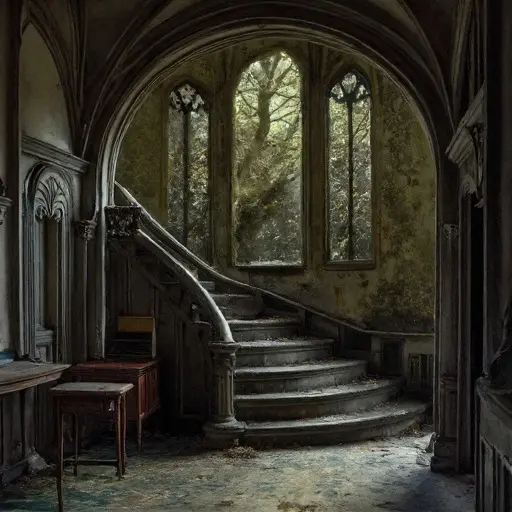
Hidden along a quiet residential street where the forest slowly overtakes forgotten gardens, an abandoned Gothic Revival Victorian house stands as a monument to fading craftsmanship. Built from dark blue-grey brick and pale limestone detailing, the three-story family residence carries an atmosphere of quiet mystery, its architectural elegance softened by decades of weather and the steady return of nature.
The exterior walls are composed of deep-toned masonry, their cool colors blending naturally with the surrounding woodland. Pale limestone tracery frames the pointed arch windows and decorative details, creating a striking contrast against the darker brick façade. Time has softened the stonework, allowing moss and climbing ivy to settle into the carved surfaces and emphasize the age of the structure.
The steep roof rises sharply above the house, covered in weathered black slate that has lost its original uniformity. Uneven sections of the roofline create a subtle rhythm of peaks and valleys, with gables reaching different heights as though the building has slowly shifted with the landscape over generations.
A narrow octagonal turret extends upward near the entrance, giving the house its distinctive Gothic character. The tower appears slightly softened by age, rising above the curved front entryway while blending into the rest of the structure rather than standing apart. Decorative stone finials crown the upper sections, adding delicate vertical accents against the heavy masonry.
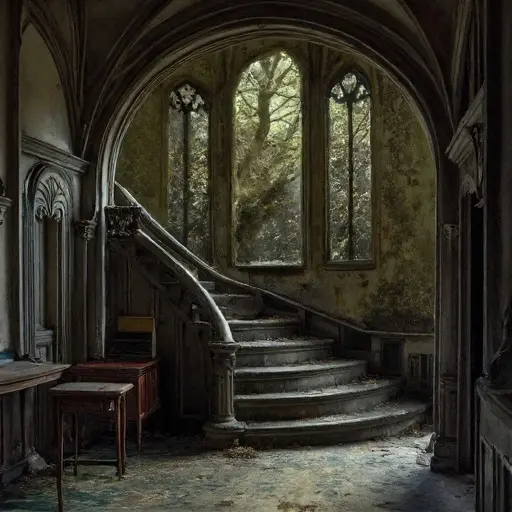
The silhouette of the house is no longer perfectly rigid. The façade bows gently outward, the gable heights vary subtly, and the porch curves around the side in a soft spiral rather than following a straight line. These irregularities give the residence a sense of having settled naturally into its surroundings.
The front entrance remains one of the most memorable elements of the home. A curved architectural approach leads toward the doorway, where carved stone details and aged brickwork frame the entrance. The surrounding vegetation has begun reclaiming the edges of the path, weaving between old garden stones and forgotten plant beds.
Inside, the abandoned rooms preserve traces of the family life that once filled the house. The interior spaces are defined by tall ceilings, heavy wooden elements, and the same Gothic influences found throughout the exterior. Shadows collect in corners where furniture remains untouched and dust covers surfaces that have not been disturbed for years.
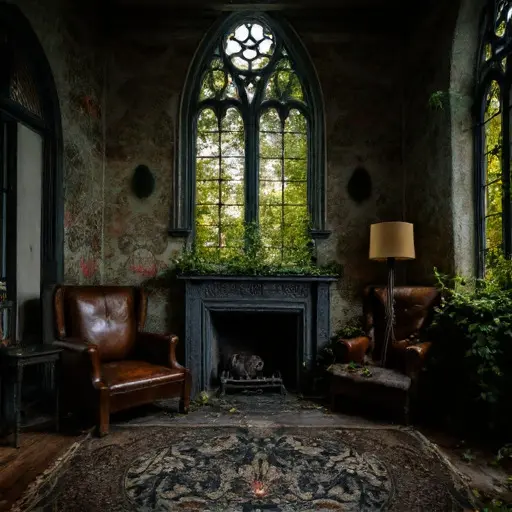
The main living areas reveal the careful craftsmanship of the Victorian period. Carved wood trim follows the walls, while aged floors display the marks of countless footsteps. The pointed window openings allow muted daylight to enter, highlighting layers of dust, peeling finishes, and weathered materials.
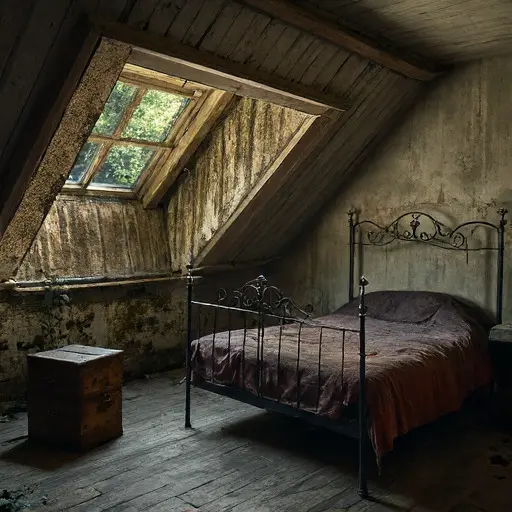
The upper floors become quieter and more secluded. Bedrooms and small private rooms sit beneath the steep roof, their proportions shaped by the dramatic Gothic architecture. Old wooden doors remain slightly uneven in their frames, and the passageways carry the feeling of a home frozen in time.
Beyond the walls, the surrounding woodland creates a peaceful setting for the abandoned residence. Tall cedar and maple trees surround the property, forming a natural canopy above the quiet street. Ferns spread across the forest floor, while moss-covered stones and neglected garden beds blend seamlessly into the landscape.
The garden still holds small reminders of the home’s former inhabitants. Near the front path sits a weathered stone statue shaped like a small animal, its surface softened by rain and moss. Nearby, a faded wooden birdhouse hangs from a crooked branch beside the old fence, quietly watching over the overgrown property.
The house exists now as a meeting point between architecture and nature. The dark brick walls, limestone carvings, and slate roof remain strong against the passing years, while ivy, moss, and forest growth slowly transform the residence into part of the woodland around it.
Although abandoned, the Gothic Revival Victorian home retains a quiet dignity. Its curved porch, pointed windows, and aged stone details tell the story of a carefully built family residence that has entered a new chapter—one where the forest continues to grow around its forgotten halls.