She Took Her Husband—Then His Ex-Wife Sent One Note That Changed Everything
There are some stories that make you pause halfway through your morning routine.
You may be drinking coffee, checking your phone, or scrolling through social media when a single sentence suddenly makes you stop.
One woman recently shared a story about a decision she once believed would lead to happiness. Instead, it eventually forced her to confront a painful truth about the man she had chosen—and about herself.
She had knowingly entered a relationship with a married man who had three young children.
At the time, she convinced herself that their marriage was already broken. She believed he was unhappy, misunderstood, and finally had a chance to live the life he truly wanted.
She believed she was different.
She believed their relationship was different.
Most importantly, she believed that the consequences would somehow be different for her.
They weren’t.
What happened afterward became an unexpected lesson about betrayal, accountability, motherhood, and the surprising ways people can choose compassion even after being deeply hurt.
When Infatuation Makes the Wrong Choice Look Right
The beginning of the relationship was easy to romanticize.
The man told her that his marriage had been unhappy for years. He said he and his wife were essentially living separate lives. He described himself as trapped by responsibility and suggested that meeting her had reminded him what happiness felt like.
She wanted to believe him.
And once she did, everything became easier to justify.
She told herself that the marriage was already finished.
She told herself that she hadn’t caused the problems.
She told herself that if he eventually left, it was because the relationship had been broken long before she entered the picture.
But there was another person who didn’t see the situation that way.
His wife.
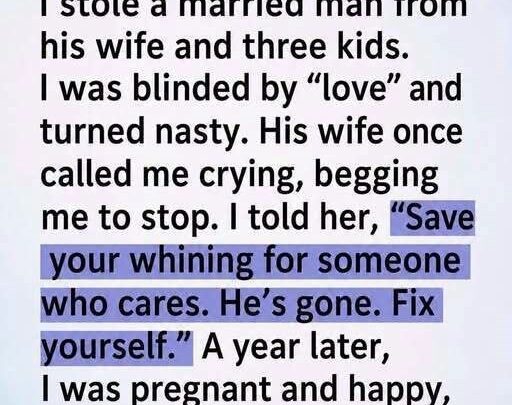
At one point, the wife called her directly.
She was emotional and desperate. She asked her to step away and give their family a chance to recover.
Instead of listening, the woman responded harshly.
She told the wife to stop complaining and accept that her husband had chosen someone else.
At the time, she believed those words demonstrated confidence.
Years later, she understood that they revealed something very different.
She had confused being chosen with being valued.
And she had mistaken another person’s pain for proof that she had won.
The Life She Thought She Had Won
Eventually, the relationship became official.
The man left his wife.
The woman who had once been the outsider became his partner.
From the outside, it appeared that she had gotten exactly what she wanted.
Then she became pregnant.
She began preparing a home for the baby and imagining a future with the man she believed had chosen her over everyone else.
There was a nursery to organize.
Appointments to attend.
Baby clothes to fold.
Plans to make.
For a while, she was convinced that the difficult part was behind them.
But life has a way of exposing the difference between promises and patterns.
One afternoon, after returning from a routine prenatal appointment, she noticed a handwritten note attached to her front door.
It contained only a few words:
“Run. Even you don’t deserve this.”
She initially assumed it was an act of revenge.
Perhaps someone was trying to frighten her.
Perhaps the former wife was finally getting even.
She threw the thought aside.
Then her phone received several photographs from an unknown account.
The photographs changed everything.
They showed her partner walking with another pregnant woman.
He wasn’t merely standing beside her.
He was holding her hand.
And he was wearing the same clothes the couple had recently chosen together.
The future she had imagined suddenly looked very different.
The Pattern She Refused to See
The shock wasn’t only that he had apparently been unfaithful again.
It was that she suddenly understood something she had refused to consider before.
Perhaps she hadn’t been the exception.
Perhaps she had simply been the next chapter.
The man had once told her that his previous relationship was uniquely unhappy.
Now she had evidence suggesting that he had repeated the same behavior with someone else.
That realization can be devastating.
When we fall in love with someone, we naturally want to believe their explanation for the past. We want to believe that their previous relationship was different, that circumstances were unusual, and that our connection is special.
Sometimes it is.
But repeated behavior deserves attention.
A person’s history does not automatically determine their future, but patterns can reveal important information about how they handle responsibility, conflict, commitment, and temptation.
The woman was about to learn that lesson in the most painful possible way.
Then Her Partner’s Ex-Wife Sent a Message
Just when she believed she had nowhere to turn, a direct message appeared on her phone.
It was from the woman whose marriage she had helped destroy.
The message was unexpected.
The ex-wife explained that she had once believed the other woman had taken her entire life away.
But with time, she had come to see things differently.
She had not lost the love of her life.
She had discovered the truth about the man she had married.
The message contained a warning.
She urged the pregnant woman to protect herself and her child, understand her financial position, and leave before the situation became even more complicated.
It would have been easy for the ex-wife to remain silent.
She had every reason to feel angry.
She could have watched the situation unfold and thought, Now you understand how I felt.
Instead, she chose to intervene.
That decision transformed the story.
Why the Ex-Wife Chose Compassion
Forgiveness and trust are not the same thing.
Neither are compassion and reconciliation.
The ex-wife did not need to become friends with the woman who had once hurt her.
She did not need to forget what happened.
She simply recognized that an innocent child was about to enter a difficult situation.
That changed the priority.
The story is particularly powerful because it demonstrates how complicated relationships can become when children are involved.
Adults make choices.
Children inherit the consequences.
A baby has no responsibility for how a relationship began.
That realization appears to have motivated the ex-wife to act.
Instead of protecting her pride, she protected someone who had not yet entered the world.
The Decision to Protect Herself
The woman now had a choice.
She could confront her partner immediately and demand explanations.
She could wait for him to promise that things would change.
Or she could quietly begin protecting herself and her unborn child.
She chose the third option.
Rather than relying solely on emotional promises, she began thinking practically.
She gathered important documents.
She learned about her financial position.
She considered housing.
She sought professional advice about matters involving custody and child support.
She began creating an independent financial foundation.
These steps weren’t about revenge.
They were about stability.
Anyone facing a major relationship breakdown should remember that legal and financial circumstances vary considerably by location. Professional legal and financial advice can be important before making major decisions involving property, custody, support, or shared accounts.
The central lesson is simple: emotional decisions become easier to manage when practical information is available.
Rebuilding a Home After Betrayal
Leaving a relationship does not instantly erase its emotional impact.
A person can change the locks, move furniture, and pack away photographs while still carrying the relationship internally.
That is why rebuilding often happens in small steps.
The woman began reclaiming her home.
She changed the bedding.
She reorganized the nursery.
She removed reminders of the relationship that no longer felt meaningful.
She opened the windows in the morning.
She spent more time creating a calm environment for herself and her child.
These actions may appear insignificant, but creating a peaceful home can provide a sense of control during an uncertain period.
After betrayal, people often feel as though their lives have been taken out of their hands.
Simple decisions can help restore that feeling of ownership.
What stays in the house?
What gets donated?
What memories deserve space?
What kind of environment should the child grow up in?
Those choices become part of rebuilding.
The Difference Between Regret and Accountability
One of the most important parts of the story is the narrator’s willingness to acknowledge her own behavior.
She had been cruel to the first wife.
She had dismissed her pain.
She had believed that another woman’s suffering was simply the price of getting the relationship she wanted.
Later, she had to confront the uncomfortable truth that she had participated in a situation she would eventually experience herself.
That does not mean betrayal is deserved.
Pain is not a mathematical equation.
One person’s mistake does not justify another person’s mistreatment.
But accountability still matters.
She could have spent the rest of her life blaming everyone else.
Instead, she began recognizing her own role in the story.
That realization did not change the past.
It did, however, give her the opportunity to make different choices in the future.
Sometimes the Person You Hurt Becomes the Person Who Warns You
Perhaps the most surprising element of this story is the ex-wife’s decision to send that message.
It challenges the idea that women must always see one another as competitors.
There was a time when these two women were connected by resentment.
One believed the other had stolen her husband.
The other believed she had found the man she wanted.
Years later, their positions had changed.
Yet instead of celebrating the other woman’s pain, the ex-wife chose to offer information that could help protect her.
That doesn’t erase what happened.
It doesn’t mean the original betrayal was acceptable.
It simply means that people can choose what they do with their pain.
They can pass it forward.
Or they can stop it.
A New Definition of Strength
Strength is often portrayed as winning.
Getting revenge.
Proving someone wrong.
Making another person regret what they did.
But sometimes strength looks much quieter.
It looks like leaving before an unhealthy situation becomes worse.
It looks like asking for professional advice instead of making decisions in anger.
It looks like protecting a child from adult conflict.
It looks like admitting that you made a terrible decision.
And sometimes it looks like helping the person who once hurt you—not because they deserve your friendship, but because you refuse to let another innocent person suffer unnecessarily.
The ex-wife had an opportunity to choose revenge.
She chose information instead.
The narrator had an opportunity to remain in denial.
She chose reality.
And those two choices changed the direction of the story.
What This Story Can Teach Us About Betrayal
Relationships rarely collapse because of one dramatic moment alone.
More often, trust disappears through repeated choices.
A secret here.
A lie there.
An unexplained absence.
A broken promise.
A pattern that gets ignored because accepting the truth feels too painful.
The warning signs may not always be obvious, but they deserve attention when behavior repeatedly contradicts promises.
And when betrayal does happen, the goal should not be to win against another person.
The goal is to protect your future.
That may involve emotional support, professional advice, financial planning, a safe living arrangement, or simply enough distance to think clearly.
Every situation is different.
There is no universal formula for leaving a relationship.
But there is one principle worth remembering:
You are allowed to choose peace even when someone else wants you to stay in chaos.
The Unexpected Gift Hidden Inside a Difficult Truth
The woman who once believed she had won another woman’s husband eventually discovered that the relationship she had fought for was built around a pattern she could not ignore.
The woman she once treated with contempt became the person who warned her.
And the warning arrived at a moment when it could still make a difference.
That is perhaps the most unexpected part of the story.
Sometimes the person we least expect to help us becomes the person who gives us the clearest warning.
Sometimes the truth arrives through someone we once refused to hear.
And sometimes losing an illusion is the beginning of building a more honest life.
The past cannot be rewritten.
The hurt cannot simply disappear.
But the future can still be different.
The narrator’s greatest transformation was not finding another relationship or proving her former partner wrong.
It was learning to stop confusing possession with love, competition with worth, and promises with proof.
She learned that dignity does not come from being chosen over another person.
It comes from choosing yourself when the situation no longer reflects the life you want to build.
And perhaps the ex-wife learned something too.
She discovered that helping someone else escape a painful cycle did not diminish her own story.
It strengthened it.
Because sometimes healing does not look like revenge.
Sometimes it looks like reaching across the wreckage, offering one honest warning, and saying:
“I know what this feels like. Don’t let it become your future.”