Uncategorized
My Father Threw Me Out on Christmas and Called My Wife “White Trash”—Two Years Later, He Demanded My Signature to Sell Grandpa’s Cabin, But One Hidden Letter Changed Everything…

## PART 3
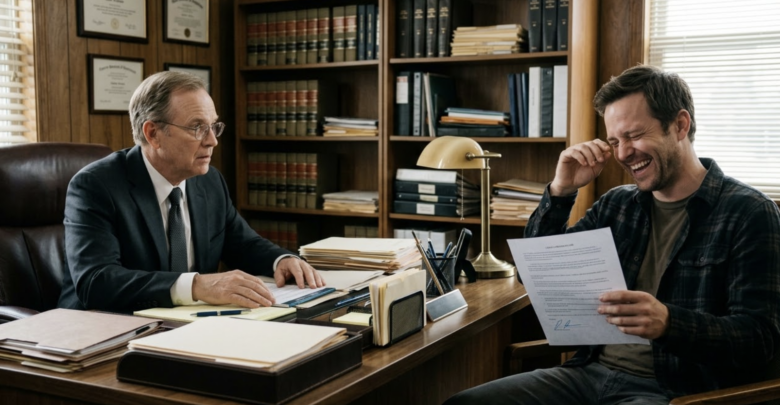
He stopped turning pages.
Then he looked at my father.
“Mr. Harlon, did you know about this?”
My father frowned.
“Know about what?”
Mr. Sterling didn’t answer him. He looked at me again.
“Where did you obtain this copy?”
“From my grandfather’s personal belongings.”
My father laughed dismissively.
“Cyrus was an old man. He had a habit of collecting paperwork. Whatever nonsense you’ve brought here doesn’t change the fact that the cabin belongs to this family.”
I leaned back in my chair.
“That’s exactly what I used to believe.”
I remembered the evening I had opened the bottom panel of the cedar tackle box.
It had taken me nearly twenty minutes to remove the tiny screws without damaging the wood. Grandpa had built the box himself, and I could still remember him telling me that a good mechanic never forced something that wasn’t ready to open.
Underneath the removable panel was a sealed envelope.
My name was written across it.
Not my father’s name.
Not Dexter’s.
Mine.
Inside was a letter, a copy of a trust agreement, and instructions to contact an attorney named Eleanor Whitmore if anything happened to the cabin.
I had spent the next three days trying to understand what I was reading.
Grandpa Cyrus had established a trust several years before his death.
The hunting cabin, along with the surrounding forty-seven acres, had been transferred into that trust.
I was the sole named beneficiary.
My father had been appointed temporary caretaker of the property, not its owner.
And there was one condition.
The property could not be sold, transferred, mortgaged, or used as collateral without my written consent.
My grandfather had anticipated that somebody might eventually try.
I had cried when I read that part.
Not because of the land.
Because Grandpa had understood something about my family that I had spent my entire childhood refusing to accept.
He knew that one day somebody might try to take away the only place where I had ever felt loved without conditions.
I looked at my father.
“Grandpa didn’t leave the cabin to you.”
Harlon stopped moving.
“What?”
“He put it in a trust. I’m the sole beneficiary.”
My father snatched the document from Sterling’s hands.
He scanned the first page, then the second.
His face changed.
“No. This is impossible.”
“It isn’t.”
“Your grandfather never told me about this!”
I almost smiled.
“Maybe he didn’t want you to know.”
“Don’t be ridiculous! I handled his affairs. I was the one who took him to appointments. I paid the bills. I maintained that property!”
“And Grandpa paid you to manage it.”
My father turned toward Sterling.
“Tell him this doesn’t mean anything. Tell him he can’t just walk in here with some old paperwork and claim ownership.”
Mr. Sterling carefully removed the document from my father’s hand.
“I need to examine the trust agreement more closely.”
“Examine it?” Harlon shouted. “You’re my attorney!”
“I’m aware of that, sir.”
“Then do your job!”
Mr. Sterling ignored him.
He examined the property description and compared it with the deed my father had prepared for me to sign.
A few seconds later, he removed his glasses.
“Mr. Harlon, there’s a serious problem here.”
My father turned toward him.
“What problem?”
“The property you’re attempting to sell appears to be held by an irrevocable trust. If these documents are authentic and the trust remains valid, you don’t have the authority to transfer ownership.”
The room went quiet.
I watched my father process those words.
For years, he had been the man who decided everything. He decided what Dexter deserved, what I owed, what my career was worth, and how much disrespect I was expected to tolerate.
Now, for the first time, he was sitting in a room where his authority meant nothing.
He pointed at me.
“He manipulated Cyrus! That’s what happened! Camille got involved, and now he’s trying to steal something that belongs to his own family!”
I shook my head.
“Camille didn’t even know about the trust until last week.”
“Liar!”
I opened the third document.
“Would you like to read what Grandpa wrote?”
My father’s jaw tightened.
I unfolded the letter and began reading.
To my grandson Warren,
If you are reading this, then something has happened that I hoped would never happen.
I have watched you grow up believing that you must earn your place in this family. You worked harder than anyone, asked for less than anyone, and apologized even when you weren’t wrong.
I watched your father praise your brother for his ambitions while treating your responsibility like an obligation.
I watched you become a good man despite being surrounded by people who constantly made you feel that you weren’t enough.
The cabin is yours, Warren. Not because you need a place to hide, but because I want you to have a place where nobody can make you feel unwanted.
Your father believes everything can be controlled with money. Your brother believes every mistake can be paid for by someone else.
But I want you to understand something.
Love is not a debt.
Family is not a business arrangement.
And being a good son does not mean allowing people to destroy your life.
I stopped reading.
My throat had tightened.
I looked down at the letter, trying to steady myself.
Then I continued.
If anyone attempts to sell the property or pressure you into surrendering it, contact Eleanor Whitmore. She has copies of the original documents and knows the instructions I left behind.
Do not sign anything without independent legal advice.
And Warren, one more thing.
If your father is sitting across from you when you read this, remember that you do not have to win an argument with him.
You only have to stop letting him decide your worth.
With love,
Grandpa Cyrus.
I folded the letter.
Nobody spoke.
For a moment, I could hear the faint ticking of the clock behind Mr. Sterling’s desk.
My father looked away.
He seemed almost offended by the letter, as if Grandpa had committed some personal betrayal by leaving me something without asking his permission.
Then he muttered, “That old fool didn’t understand what he was doing.”
I looked directly at him.
“He understood enough.”
“Enough?” Harlon leaned forward. “You think you’re going to take forty-seven acres away from your own father?”
“I’m not taking anything away. Grandpa left it to me.”
“You’re going to destroy this family over a hunting cabin?”
I almost laughed.
There it was again.
The familiar trick.
Whenever I refused to sacrifice something for Dexter, I was accused of destroying the family.
Whenever I defended Camille, I was accused of being controlled by her.
Whenever I asked for basic respect, I was told I was too sensitive.
And whenever I finally stood up for myself, suddenly I was the villain.
I placed the letter back inside the folder.
“Dad, this family was already destroyed the night you threw us out into the snow. You just didn’t expect me to stop coming back.”
His face turned red.
“You ungrateful little—”
“Mr. Harlon,” Sterling interrupted.
My father stopped.
The attorney looked uncomfortable now.
“I strongly recommend that we stop this meeting until I can verify the documents and review the trust provisions.”
“There’s nothing to review!”
“There is, sir.”
My father stood so quickly that his chair scraped against the floor.
He looked at me with an expression I recognized from childhood.
It was the expression he used when he wanted me to feel afraid.
“You think you’ve won something today?”
I didn’t answer.
He leaned closer.
“You have no idea what you’re getting yourself into. Dexter has creditors calling every day. His business is collapsing. Your mother is having panic attacks. Our estate is in danger. And you sit here acting like some kind of hero because your grandfather gave you a cabin!”
I stared at him.
For the first time, I noticed something I had never allowed myself to see.
My father wasn’t angry because I had hurt him.
He was angry because he had lost control.
And that was a very different thing.
I stood and gathered my documents.
“I’m not responsible for Dexter’s debts. I’m not responsible for your mortgage. And I’m certainly not responsible for fixing the consequences of decisions I didn’t make.”
Harlon pointed toward the door.
“Get out.”
I gave him a small smile.
“That’s the first thing you’ve said today that I agree with.”
I turned toward Mr. Sterling.
“I’ll have my attorney contact your office. Please preserve every document related to this proposed sale.”
Sterling nodded.
“Of course.”
I walked out.
My father didn’t follow me.
But before the elevator doors closed, I heard him say something that made my stomach tighten.
“Call Eleanor. Find out what that old man really left him.”
I pressed the elevator button.
I knew that name.
Eleanor Whitmore.
The attorney Grandpa had mentioned in his letter.
But I hadn’t told my father that she had already called me three days earlier.
And she had told me something else.
Something I hadn’t yet shared with anyone.
Something that made the cabin trust look like only the beginning of what Grandpa Cyrus had prepared.
When I arrived home, Camille was sitting at the kitchen island with two cups of coffee.
She looked up immediately.
“How did it go?”
I put my folder on the counter and loosened my tie.
“Dad didn’t get his signature.”
She let out a breath.
“Good.”
“But there’s something else.”
Her expression changed.
“What happened?”
I sat beside her and explained everything. The confrontation, the trust documents, my father’s reaction, and the fact that Sterling had questioned the legality of the proposed sale.
Camille listened without interrupting.
When I finished, she reached across the counter and held my hand.
“Your grandfather really knew what was going to happen, didn’t he?”
“I think he knew it was possible.”
She looked at the cedar tackle box sitting on the shelf behind me.
“I’m glad you opened it.”
“So am I.”
For a few minutes, we sat quietly.
Then my phone rang.
Unknown number.
I answered.
“Hello?”
“Mr. Warren?”
A woman’s voice.
“Yes.”
“This is Eleanor Whitmore. I believe we need to meet.”
I straightened in my chair.
“About the cabin?”
“Partly.”
There was a brief pause.
“Your grandfather left additional instructions. He asked me to contact you if your father ever attempted to sell the property without your consent.”
I glanced at Camille.
“What additional instructions?”
Eleanor lowered her voice.
“Mr. Warren, I have been holding an original document for nearly four years. Your grandfather specifically instructed me not to release it until you were ready.”
I felt a strange chill.
“Ready for what?”
“To understand the full extent of what he left you.”
I looked at the folder on the counter.
“Can you explain over the phone?”
“No. I’d rather show you in person. But before we meet, there’s something you should know.”
“What?”
“Your father already contacted my office this morning.”
My stomach tightened.
“What did he want?”
“He asked whether I would be willing to challenge your grandfather’s trust.”
“And what did you tell him?”
“I told him I would never participate in an attempt to violate Cyrus’s final wishes.”
I exhaled slowly.
Then she said something that made me grip the phone harder.
“However, Warren, your father’s request wasn’t the most concerning part of today’s calls.”
“What was?”
“Your brother Dexter contacted me yesterday. He claims your grandfather promised him the cabin years ago. He also says he has a document proving it.”
I looked at Camille.
She had heard every word.
“That’s impossible,” I said.
“I thought so too,” Eleanor replied. “But he says he intends to present it in court.”
I felt my jaw tighten.
Dexter had never cared about that cabin.
He had barely visited Grandpa during his final years. He had always considered the place too remote, too uncomfortable, and too far away from the expensive restaurants he preferred.
Why would he suddenly claim it?
Unless there was something else.
Something more valuable than the property itself.
“Ms. Whitmore,” I said, “when can we meet?”
“Tomorrow morning. Nine o’clock. Bring your wife if she wishes to come.”
I agreed and ended the call.
Camille stared at me.
“Do you think Dexter is lying?”
“I know he is.”
“Then why would he risk taking this to court?”
I looked toward Grandpa’s tackle box.
“Because he’s desperate.”
But as I sat there, another possibility entered my mind.
Maybe Dexter wasn’t simply trying to get the cabin.
Maybe he had discovered something about Grandpa’s estate that I hadn’t found yet.
And if he had, then the document he was claiming to possess might be connected to something far bigger than forty-seven acres in upstate New York.
That night, I barely slept.
Because tomorrow, I would finally meet the woman Grandpa Cyrus had trusted with his final secret.
And I had a feeling that whatever she showed me would change everything I thought I knew about my family.
## PART 4
The next morning, Camille and I arrived at Eleanor Whitmore’s office fifteen minutes early.
Her office was in an old brick building overlooking a quiet street in Albany. It wasn’t particularly impressive, but there was something comforting about the place. Wooden bookshelves covered one wall, and framed photographs of New York State court buildings hung behind her desk.
Eleanor was waiting for us.
She was in her late sixties, with silver hair, sharp eyes, and the kind of calm expression that made me think she had spent decades dealing with people who believed money could solve every problem.
She stood when we entered.
“Warren. It’s good to finally meet you.”
I shook her hand.
“Thank you for seeing us.”
She looked at Camille.
“And you must be Camille. Cyrus spoke very highly of you.”
Camille smiled politely.
“He did?”
“Oh, yes. He told me you were the first person who made Warren understand that he didn’t have to spend his entire life trying to earn somebody else’s approval.”
I felt my throat tighten.
Even after all these years, Grandpa somehow found ways to make me feel less alone.
Eleanor gestured toward the chairs.
“Please sit. We have quite a bit to discuss.”
She opened a cabinet and removed a thick brown envelope.
It had been sealed with red wax.
My grandfather’s initials were pressed into it.
C.C.
I recognized his handwriting immediately.
Eleanor placed it in front of me.
“Your grandfather delivered this to my office four years before he died. He gave me very specific instructions. I was to keep it sealed until your father or brother attempted to interfere with the hunting cabin.”
I stared at the envelope.
“What’s inside?”
“Several documents. Some relate to the cabin. Others concern your grandfather’s remaining estate.”
I looked at Camille.
She gently touched my arm.
I broke the seal.
Inside were three documents, a handwritten letter, and a small photograph.
The photograph showed Grandpa standing in front of the cabin with me when I was about twelve years old.
I was holding a fishing rod almost as tall as I was. He had one hand resting on my shoulder.
On the back, he had written:
The boy who never asked for much deserved more than he ever received.
I put the photograph down.
Eleanor waited until I had read the first document.
It was a certified statement confirming that the hunting cabin and forty-seven surrounding acres had been transferred into the trust.
The second document was a detailed inventory of the remaining property and investments Grandpa had owned.
The third was a financial statement.
I looked at the numbers.
Then I looked again.
“Is this correct?”
Eleanor nodded.
“Your grandfather had accumulated considerably more wealth than most people realized.”
The document listed investment accounts, agricultural land, several commercial properties, and shares in a private manufacturing company.
The estimated value was approximately $4.8 million.
I sat back.
“Grandpa owned all this?”
“He did. He lived modestly, but he was a careful investor. He bought properties when they were inexpensive, invested in local businesses, and held onto his assets for decades.”
I couldn’t believe it.
My grandfather had spent his life wearing old work boots, driving a pickup truck with a dented door, and repairing things instead of replacing them.
I remembered him bringing sandwiches to the cabin because he didn’t want to waste money eating at restaurants.
I had never imagined he possessed millions of dollars.
“Who inherited it?” I asked.
Eleanor folded her hands.
“That’s why we’re here.”
She slid another document toward me.
It was the final distribution schedule of Cyrus’s estate.
I read the first paragraph.
Then I stopped.
My name appeared repeatedly.
I looked up.
“What does this mean?”
Eleanor answered carefully.
“Your grandfather established a separate estate plan. You are the primary beneficiary of his remaining assets, subject to the terms of the trust and the estate administration. Your father received a limited inheritance, and Dexter received a smaller amount.”
I stared at the paper.
“How much?”
“Your father received $150,000. Dexter received $75,000, with the distribution subject to certain conditions. The remaining assets were designated for you.”
I couldn’t speak.
Camille reached for my hand.
Eleanor continued.
“Your grandfather didn’t make these decisions impulsively. He had several meetings with independent legal and financial advisers. He wanted to make sure the arrangements reflected his wishes.”
“Why didn’t he tell me?”
“Because he didn’t want money to change your relationship with him. He also didn’t want your father or brother to pressure you while he was alive.”
I looked down at the letter.
“Did he know they would do this?”
Eleanor took a breath.
“He was concerned they might.”
She pushed the handwritten letter closer.
I opened it.
Warren,
I have never been particularly good at explaining my feelings. I spent most of my life working with engines, tools, and machines. Those things were easier to understand than people.
But I understood you.
I understood how often you came to the cabin after a difficult day. I understood why you stayed outside repairing the fence long after the work was finished. Sometimes you just needed somewhere quiet.
I watched your father compare you with Dexter. I watched you try harder every year, hoping that one day your effort would be enough.
I want you to know that it always was.
I have left you these things because I trust the man you have become.
Not because I think you need money, but because I believe you will understand that wealth is a responsibility, not a weapon.
Do not use it to punish anyone.
Do not allow anyone to use it to control you.
Build something good. Protect the people who love you. And never forget the boy standing beside me in that photograph.
You were enough then.
You are enough now.
Grandpa.
I lowered the letter.
For several seconds, nobody spoke.
Then Eleanor cleared her throat.
“There’s one more matter we need to address.”
She opened another folder.
“This concerns Dexter’s claim that he possesses a document proving your grandfather promised him the cabin.”
I nodded.
“What about it?”
“Yesterday, Dexter sent me a scanned copy of what he claims is a letter from Cyrus.”
She placed a printed copy on the desk.
I read it.
The letter supposedly stated that Grandpa had promised Dexter the hunting cabin and intended to transfer it to him after his death.
But something immediately bothered me.
The handwriting looked familiar, but not quite right.
I had spent years reading Grandpa’s notes, grocery lists, fishing instructions, and repair diagrams.
I knew his handwriting.
This wasn’t it.
“That’s not his writing,” I said.
Eleanor nodded.
“I reached the same conclusion.”
She pointed to the date.
“There’s another problem. This letter is dated three months after the cabin was transferred into the trust.”
I looked at her.
“So Dexter fabricated it?”
“We cannot make that conclusion without a proper examination. But there are substantial inconsistencies. We’ve preserved the original submission and are arranging for a handwriting expert to examine it.”
Camille frowned.
“Why would he do something like this?”
Eleanor looked at me.
“That’s a question your brother may have to answer.”
I felt a heavy sadness settle over me.
Not surprise.
Not even anger.
Just sadness.
Dexter had spent his entire life believing that somebody else would eventually pay for his mistakes.
Apparently, even death hadn’t changed that belief.
Two days later, my phone rang.
It was my mother.
I stared at the screen for a long time.
Sylvia.
Two years without a single conversation.
Two years without an apology.
Two years of hearing through relatives that I was unstable, selfish, and controlled by my wife.
I answered.
“Hello?”
“Warren.”
Her voice sounded strained.
“Your father told me what happened.”
I said nothing.
“How could you do this to us?”
I closed my eyes.
“Do what?”
“Take your grandfather’s money and leave your own parents with nothing!”
I almost laughed.
“Mom, Dad received $150,000. Dexter received $75,000. Nobody left them with nothing.”
“That’s not the point!”
“Then what is the point?”
She took a breath.
“Your father says you manipulated the situation. He says you convinced Cyrus to leave everything to you.”
I looked across the room at Camille.
She was sitting on the sofa, reading a book.
“Grandpa made his decisions. I didn’t ask him to leave me anything.”
“But you’re his grandson. Dexter is his grandson too!”
“Then why are you calling me instead of asking Dexter about the letter he claims Grandpa wrote?”
Silence.
I continued.
“Did you see the letter, Mom?”
Another pause.
“I don’t know what you’re talking about.”
“Dexter says Grandpa promised him the cabin.”
“I haven’t seen it.”
“Then perhaps you should ask him.”
She became defensive.
“Your brother is under enormous pressure. His business is failing. He has creditors threatening him. Your father is trying to protect the family.”
I felt my patience slipping.
“Mom, where were you when Dad threw Camille and me out into the snow?”
She didn’t answer.
“Where were you when he called my wife white trash?”
“Warren, that was a difficult evening.”
“No. It was Christmas Eve. I remember it perfectly.”
“Your father was upset.”
“So was I. But I didn’t throw my parents out of their house.”
Her voice softened.
“We’re still your family.”
I looked down at my wedding ring.
“Family doesn’t mean you get to hurt someone forever and expect them to keep coming back.”
She began crying.
I didn’t feel happy hearing it.
I didn’t feel victorious.
I just felt tired.
“Your father wants you to come home,” she whispered.
I shook my head.
“I have a home, Mom.”
“Can’t we just talk about this?”
“We can talk when you’re ready to acknowledge what happened. Not when you need something from me.”
I ended the call.
Camille came over and sat beside me.
“Are you okay?”
I nodded slowly.
“I think I am.”
She rested her head against my shoulder.
For the first time, I understood that sometimes the hardest part of leaving a toxic family wasn’t walking away.
It was refusing to return when they finally needed something.
Three weeks later, the situation became much worse for Dexter.
Eleanor called me on a Friday afternoon.
“Warren, we have an update.”
I stepped away from my desk.
“What happened?”
“The handwriting examiner completed the preliminary review of Dexter’s document.”
“And?”
“The signature and several portions of the letter are inconsistent with authenticated samples from your grandfather.”
I felt my stomach tighten.
“Does that mean it’s fake?”
“The examiner has identified significant evidence suggesting the document was altered. The final report will be available shortly.”
I rubbed my forehead.
“What’s Dexter saying?”
“He has withdrawn his request to challenge the trust, but he hasn’t explained where the document came from.”
I looked out the office window.
“Is that the end of it?”
“Not quite. There is another issue.”
She explained that the property sale had been presented to a potential buyer as though my father had full authority to transfer the cabin.
The buyer had already paid a deposit.
When the buyer’s attorney discovered the trust, the transaction was suspended.
Now the buyer was demanding the return of the deposit and threatening legal action.
My father had created a problem that he couldn’t simply shout his way out of.
“Can he still sell it?” I asked.
“Not without complying with the trust documents and obtaining whatever approvals are legally required. Your independent attorney will need to handle any further correspondence.”
I thanked her.
When I told Camille, she shook her head.
“They really thought you would sign without reading anything.”
“They thought I was still twenty-two.”
She smiled faintly.
“Not anymore.”
But the next development came from an unexpected direction.
My father’s attorney contacted Eleanor and requested a private meeting.
He wanted to discuss a settlement.
And this time, Harlon wasn’t asking for the cabin.
He was asking me for money.
The meeting took place the following Monday.
This time, I didn’t go alone. Eleanor attended with my independent attorney, Daniel Brooks.
Harlon arrived with Sylvia and Mr. Sterling.
Dexter wasn’t there.
My father looked older than I remembered. His expensive suit was slightly wrinkled, and the confident expression he’d worn during our previous meeting had disappeared.
He sat down without greeting me.
Sterling opened his briefcase.
“Your father would like to discuss a financial arrangement,” he began.
I looked at Harlon.
“What kind of arrangement?”
My father cleared his throat.
“Your brother needs help. The brewery is finished. The creditors are coming after him, and the bank is preparing to take action.”
I waited.
Harlon continued.
“You have inherited considerably more than we expected. There’s no reason you can’t help your brother get back on his feet.”
I almost smiled.
“Are you asking me for money?”
“I’m asking you to remember where you came from.”
I looked at him for several seconds.
“Where I came from?”
“Yes.”
I leaned forward.
“I remember exactly where I came from. I remember paying for my own education while you bought Dexter a car. I remember working double shifts while you financed his brewery. I remember being told I was selfish because I wouldn’t hand over fifty thousand dollars. I remember Christmas Eve.”
My mother lowered her eyes.
I continued.
“I remember standing outside in the snow with my wife while you watched us leave.”
Harlon shifted in his chair.
“That was two years ago.”
“Yes. And apparently, you haven’t learned anything since.”
He exhaled sharply.
“People make mistakes.”
“Of course they do. But you never apologized for yours. You just waited until you needed something.”
My mother finally spoke.
“Warren, please. Your brother is in trouble.”
I turned toward her.
“Then he needs to take responsibility for his decisions.”
“He’s your brother.”
“And Camille is my wife. You called her trash. You threw us out. You told everyone I was dangerously delusional. Did you ever consider what that did to us?”
Sylvia began crying.
I didn’t interrupt her.
After a moment, Harlon pushed a sheet of paper toward me.
“There’s a proposed settlement. You could provide Dexter with $300,000. In return, we’ll agree not to pursue any further claims regarding the cabin.”
I looked at the document.
Then I looked at Sterling.
“Is this a serious legal proposal?”
Sterling looked uncomfortable.
“It is an attempt to resolve the family dispute.”
I pushed the paper back.
“No.”
My father slammed his hand against the table.
“Warren!”
I didn’t move.
“You want me to give Dexter another three hundred thousand dollars after everything that’s happened? What makes you think that would solve anything?”
“He’s your brother!”
“And I’m not his bank.”
For the first time, my mother looked directly at me.
“Your grandfather would have wanted us to stay together.”
I shook my head.
“No, Mom. Grandpa wanted us to treat each other with love. That’s not the same thing as allowing one person to take everything from another.”
Nobody spoke.
Then Eleanor opened her folder.
“There is another matter that needs to be addressed before this meeting concludes.”
She removed the preliminary handwriting examination report.
“Mr. Harlon, the document Dexter submitted as evidence of Cyrus’s promise to transfer the cabin has been found to contain significant inconsistencies.”
My father looked toward Sterling.
“What does that mean?”
“It means,” Eleanor continued, “that the document cannot be relied upon as an authentic statement from Cyrus. The estate reserves all rights concerning the matter.”
My mother looked confused.
“Are you saying Dexter made it up?”
Eleanor remained professional.
“I’m saying the examination raises serious questions about its authenticity. The final findings will be provided to the appropriate parties.”
My father turned toward the empty chair beside him.
For once, he had no immediate defense of Dexter.
I gathered my papers.
“I’m finished here.”
Harlon stared at me.
“You’re walking away from your own family?”
I stopped at the door.
“No, Dad. I’m walking away from the idea that I have to sacrifice my life to keep everyone else comfortable.”
Then Camille and I left.
The truth about Dexter came out six weeks later.
His financial situation was far worse than anyone had initially understood.
The brewery had accumulated unpaid supplier invoices, outstanding loans, and tax liabilities. Dexter had used money from several personal accounts to maintain the appearance of a successful business.
When the business finally collapsed, the creditors began investigating his financial records.
The document he had presented to Eleanor became part of a separate inquiry into the disputed estate claim.
The handwriting examiner’s final report found that the document contained substantial indications of alteration and that the signature did not match the authenticated samples.
Dexter eventually admitted that the letter had been prepared using an old sample of Grandpa’s handwriting.
He claimed he had only wanted to convince everyone that the cabin had been promised to him.
But his explanation didn’t make the situation disappear.
The estate’s attorneys referred the matter for further legal review, and Dexter faced the consequences of his actions.
My father was furious.
Not because Dexter had deceived everyone.
Because Dexter had embarrassed him.
For years, Harlon had protected my brother from the consequences of his decisions. He had explained away every mistake, blamed other people for every failure, and treated every demand from Dexter as an emergency.
Now there was no amount of money or family influence that could make the problem disappear.
A few days later, I received an email from Dexter.
The subject line read:
We Need to Talk.
I opened it.
His message was short.
Warren,
I know things have gotten out of control. I know Dad has made mistakes, and I know I haven’t always treated you fairly.
But we’re brothers. We grew up together.
I never thought things would end like this.
I need help. I’m asking you to lend me enough money to start over. I’ll pay you back.
Please don’t let Grandpa’s inheritance destroy our family.
I read it twice.
Then I forwarded it to Camille.
She came into my office a few minutes later.
“What are you going to do?”
I stared at the screen.
“I don’t know.”
She sat opposite me.
“Do you want to help him?”
I thought about it.
I remembered Dexter teaching me to ride a bicycle when we were children. I remembered the two of us fishing at Grandpa’s cabin before he became obsessed with competing against me.
There had been good moments.
That was what made everything complicated.
I didn’t hate my brother.
But I couldn’t keep confusing the memories of childhood with the reality of the adults we had become.
“I don’t want him to suffer,” I said. “But I don’t want to rescue him either.”
Camille nodded.
“Then don’t.”
I wrote a reply.
Dexter,
I don’t want anything bad to happen to you. I genuinely hope you find a way to rebuild your life.
But I won’t lend you money.
You have spent years believing that someone else will solve your problems. I hope this is the moment you finally learn to solve them yourself.
I am willing to have a conversation someday if you’re ready to take responsibility for what happened. But I won’t return to the old arrangement where you make demands and I pay the price.
I wish you well.
Warren.
I sent it.
Then I closed the laptop.
For the first time, I didn’t feel guilty about saying no.
Three months later, my father made another attempt to contact me.
This time, he came to our house.
It was a Saturday afternoon.
Camille was planting flowers near the front porch when she noticed a black SUV pulling into the driveway.
She looked toward the vehicle.
“Warren?”
I stepped outside.
Harlon got out.
He stood beside the driver’s door, holding a small cardboard box.
For several seconds, neither of us moved.
Then he walked toward me.
“Can we talk?”
I glanced at Camille.
She gave me a small nod and stepped inside.
I didn’t invite him into the house.
We stood on the porch.
“What do you want, Dad?”
He looked down at the box.
“Your grandfather left some things at my house. I thought you should have them.”
I took it.
Inside were several old photographs, a fishing reel, two pocketknives, and a collection of handwritten notes.
Grandpa’s handwriting.
I picked up one of the photographs.
It showed Grandpa standing beside his old pickup truck.
Harlon was beside him.
They looked much younger.
For a moment, I forgot why my father had come.
“Where did you find these?”
“In the garage. Your mother wanted to throw them away when we started cleaning things out.”
I looked at him.
“Why?”
He shrugged.
“We’re downsizing.”
I understood.
The financial problems had forced my parents to sell their estate.
The house where I had spent my childhood was no longer theirs.
My father looked toward the street.
“Dexter is staying with us temporarily.”
I nodded.
“He’s trying to get back on his feet,” Harlon added.
“That’s good.”
He looked surprised that I hadn’t said anything else.
Then he cleared his throat.
“I suppose things have been difficult.”
I waited.
He rubbed his hands together.
“Your mother misses you.”
I looked at him.
“Does she?”
“Yes.”
“Does she want to apologize?”
His expression tightened.
“Warren, can’t we just move forward?”
I shook my head.
“Moving forward doesn’t mean pretending nothing happened.”
He looked away.
For a moment, I thought he was going to leave.
Then he said something I had never expected to hear.
“I was hard on you.”
I stayed quiet.
He continued.
“I thought you could handle it. Dexter was always… different. He needed more help.”
I almost laughed.
There it was.
Even now, he was explaining why my brother had deserved more.
But then he lowered his voice.
“I suppose I should have treated you better.”
I looked at him.
“That’s not an apology, Dad.”
He swallowed.
“What do you want me to say?”
I took a breath.
“I wanted you to be proud of me without comparing me to Dexter. I wanted you to respect the woman I married. I wanted you to stand beside me when I was being treated unfairly. And I wanted you to understand that I was your son, too.”
His eyes became wet.
I hadn’t seen my father cry before.
“I know,” he whispered.
But those two words didn’t erase anything.
I wasn’t suddenly a child again.
I wasn’t waiting for him to pat my shoulder and tell me I had finally done something right.
I had built a life without his approval.
And I wasn’t going to abandon it just because he had finally begun to understand what he had lost.
“I appreciate you bringing Grandpa’s things,” I said. “But I need time.”
He nodded slowly.
Then he turned and walked back toward his vehicle.
Before getting inside, he looked over his shoulder.
“Your grandfather was proud of you, Warren.”
I held the cardboard box against my chest.
“I know.”
He drove away.
I watched until the SUV disappeared around the corner.
Then I went inside.
Camille was waiting in the kitchen.
“How did it go?”
I put the box on the table.
“He brought Grandpa’s things.”
She smiled.
“That’s nice.”
I nodded.
Then I told her what my father had said.
She listened quietly.
“Do you think you’ll forgive him?”
I looked at the photographs.
“Maybe someday.”
And I meant it.
But I had finally learned that forgiveness didn’t require giving someone another opportunity to hurt me.
Six months passed.
The legal matters surrounding Grandpa’s estate were resolved.
The cabin remained protected by the trust.
The disputed sale was canceled, and the deposit issue was handled through the attorneys.
Dexter eventually entered a debt restructuring process and found employment with a regional beverage distributor. It wasn’t glamorous, and it certainly wasn’t the business empire he had imagined building.
But it was honest work.
My parents sold their estate and moved into a smaller property.
Sylvia sent Camille a handwritten apology.
It wasn’t perfect.
She admitted that she had treated Camille unfairly and that she had allowed Harlon’s behavior to continue because she feared conflict.
Camille read the letter twice.
Then she put it in a drawer.
“She might be trying,” she said.
I nodded.
“Maybe.”
We didn’t rush to rebuild a relationship.
We had learned that apologies were a beginning, not a guarantee.
And for the first time, that was enough.
One October morning, Camille and I drove to the hunting cabin.
The road was covered with fallen leaves. The trees had turned gold, orange, and deep red.
When we arrived, I parked beside the old wooden fence.
The cabin looked almost exactly as I remembered it.
The roof needed a little work. Some paint had peeled from the window frames. The porch steps creaked beneath my boots.
But it was still there.
I unlocked the door.
The familiar smell of pine, old wood, and fireplace smoke greeted us.
I stood in the doorway for a long time.
Camille came up beside me.
“Welcome home.”
I smiled.
“Yeah. It feels good.”
We spent the morning cleaning the cabin.
I repaired a loose hinge, replaced a broken window latch, and checked the roof.
Camille opened the windows and let the cool air move through the rooms.
In the afternoon, we walked down to the lake.
The water was calm.
I carried Grandpa’s old fishing rod.
For a while, neither of us spoke.
Then Camille asked, “Do you ever wish things had been different?”
I thought about it.
I thought about the Christmas Eve when we had walked through the snow.
I thought about the two years of silence.
I thought about the lawyer’s office, the documents, the arguments, and the things my family had said about us.
“Yes,” I answered.
She looked at me.
“I wish they had loved us better. I wish my father had defended me. I wish my mother had treated you like a daughter instead of an outsider.”
Camille squeezed my hand.
“But?”
I looked across the water.
“But I don’t wish I had stayed.”
She rested her head against my shoulder.
And we stood there together.
That evening, I built a fire inside the cabin.
After dinner, I opened Grandpa’s cedar tackle box.
I had repaired the bottom panel and placed his letter inside a protective sleeve.
I took it out and read it again.
Love is not a debt.
Those four words stayed with me.
I had spent so much of my life believing that being a good son meant being available whenever somebody needed something.
I thought love meant giving until there was nothing left.
I thought loyalty meant accepting disrespect.
I thought keeping a family together was my responsibility, even when everyone else was busy tearing it apart.
But Grandpa had understood something I hadn’t.
A person can love their family without allowing their family to destroy them.
I looked at Camille.
She was sitting near the fireplace, holding a cup of tea.
“What?” she asked when she noticed me smiling.
“Nothing.”
She raised an eyebrow.
“That’s not a convincing answer.”
I laughed.
“I was just thinking about Grandpa.”
She put down her cup.
“What about him?”
“He knew exactly what he was doing.”
She smiled.
“Sounds like him.”
I looked around the cabin.
The old fishing photographs.
The wooden table.
The fireplace.
The little scratches on the floor where Grandpa had once dragged a toolbox.
This place had never been about money.
It had never been about forty-seven acres or a multimillion-dollar inheritance.
It was about the one person who had made me feel that I mattered without asking me to prove it.
And now I had the chance to preserve that feeling for someone else.
The following spring, I made a decision.
I established a small scholarship program in Grandpa’s name.
It would help students from working families who wanted to study engineering, construction, or skilled trades but struggled to afford their education.
I named it the Cyrus Carter Opportunity Fund.
The first scholarship went to a young man named Daniel.
He was nineteen, worked evenings at an auto repair shop, and wanted to become a civil engineer.
During our first meeting, he told me he had almost given up on college because his family couldn’t afford the tuition.
I remembered myself at that age.
I remembered the double shifts at the hardware store.
I remembered wondering whether I would ever get the chance to build something meaningful.
When I handed him the scholarship letter, his eyes filled with tears.
“Thank you, Mr. Carter. I don’t know how to repay you.”
I smiled.
“You don’t have to repay me.”
He looked confused.
“Then what do I do?”
“Work hard. Build a good life. And when you’re in a position to help someone else, remember how it felt when someone helped you.”
He nodded.
I shook his hand.
As he walked away, I thought about Grandpa.
I could almost hear him telling me that money was only useful when it made someone’s life better.
And for the first time, I felt I had done something worthy of the inheritance he had trusted me with.
A year after the first meeting at Sterling’s office, I received one final letter.
It was from my father.
The envelope contained a single handwritten page.
Warren,
I have spent a lot of time thinking about what happened between us.
I used to believe that providing for a family was the same as loving a family. I worked hard, built a business, bought a house, and made sure everyone had what they needed.
But I now understand that I confused providing with caring.
I expected you to be strong because you were responsible. I expected Dexter to need more because he always demanded more.
I didn’t realize how unfair that was.
I was wrong about Camille. I was wrong about you.
I cannot change Christmas Eve. I cannot take back the things I said. I cannot ask you to forget two years of silence.
But I am sorry.
I hope one day we can sit together without arguing about money or the cabin.
I miss my son.
Dad.
I read it slowly.
Then I placed it on the table.
Camille came over.
“From your father?”
I nodded.
“What do you think?”
I stared at the letter for a while.
“I think it’s the first time he’s actually apologized without asking me for anything.”
She smiled gently.
“That’s a start.”
I agreed.
I didn’t call him immediately.
I needed time to decide what kind of relationship, if any, I wanted with him.
But a few weeks later, I invited my parents to lunch.
Not at their old country club.
Not at the estate.
Just a small restaurant halfway between our homes.
Sylvia arrived first.
She hugged me carefully, almost as if she wasn’t sure I would allow it.
Then she turned toward Camille.
“I’m sorry,” she said. “I should have treated you better. You didn’t deserve what I said.”
Camille looked at her for a moment.
“Thank you for saying that.”
My father arrived shortly afterward.
He shook my hand.
We sat down.
The conversation was awkward at first.
We discussed the weather, work, and the changes in the neighborhood.
Nobody mentioned the inheritance.
Nobody mentioned Dexter’s debts.
And nobody demanded anything.
It wasn’t a perfect reunion.
There were still things we needed to discuss, and some wounds would take longer to heal.
But for the first time, we were speaking to one another as adults.
When lunch ended, my father walked beside me toward the parking lot.
“Warren?”
I turned.
“Yeah?”
“I’m proud of the man you’ve become.”
I looked at him.
For years, I had imagined hearing those words.
I thought they would make everything feel right.
But standing there, I realized something important.
I had already become that man.
I had built my career, married the woman I loved, created a home, and learned to stand up for myself.
His approval was no longer the thing that determined my worth.
Still, I smiled.
“Thank you, Dad.”
And this time, I meant it.
That evening, Camille and I drove back to the cabin.
The sun was setting behind the trees.
I opened the front door and placed my grandfather’s photograph on the mantelpiece.
The photograph showed him standing beside me with his hand resting on my shoulder.
I looked at it for a long time.
Then I whispered:
“I kept it, Grandpa.”
Camille wrapped her arms around me from behind.
“What did you say?”
I smiled.
“I told him I kept it.”
She kissed my cheek.
Outside, the wind moved through the pine trees.
For a moment, I could almost imagine Grandpa sitting on the porch, drinking coffee and telling me to stop worrying so much.
I thought about the day my father had slammed his hand against the mahogany table.
I remembered the demand.
Sign the damn document, or I’ll drag you through the courts until you’re bankrupt.
And I remembered how hard I had laughed when I first discovered what Grandpa had hidden inside that tackle box.
My father had believed the cabin was something he could sell.
Dexter had believed it was something he could take.
But Grandpa had left it to me for a reason neither of them understood.
It wasn’t a prize.
It was a reminder.
A reminder that I had always deserved a place where I was welcome.
A place where I didn’t have to compete with my brother.
A place where I didn’t have to pay for affection.
A place where I could simply be Warren.
I looked at Camille.
“We should come here more often.”
She smiled.
“I was hoping you’d say that.”
We sat together beside the fireplace.
And for the first time in my life, I no longer felt like the son who had been thrown out of his parents’ house on Christmas Eve.
I felt like a husband.
A successful man.
A person who had built something of his own.
And most importantly, someone who finally understood that being loved should never feel like being indebted.
My grandfather had left me a cabin, a trust, and an inheritance worth millions.
But his greatest gift had been something no document could ever measure.
He had taught me that I didn’t have to spend my entire life begging people to recognize my worth.
I already had it.
And I was finally living like I believed it.
The End.