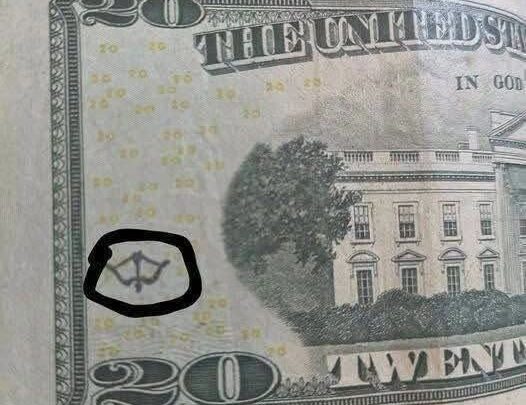
An unfamiliar stamp or tiny symbol on a U.S. dollar bill can turn an ordinary piece of currency into an intriguing mystery. You might discover one while counting cash, sorting through an old wallet, or examining money that has been tucked away for years. At first glance, the marking may seem insignificant. But it can raise several questions: Who placed it there? Does it have a historical meaning? Could it make the bill more valuable to collectors?
The answers depend on the type of mark, its origin, and the history of the banknote itself.
The term chop mark has a genuine connection to the history of money, particularly the use of silver coins in international trade. However, not every stamp found on a modern U.S. dollar bill is a traditional chop mark. Some markings may be business stamps, handwritten initials, collector notations, or other additions made after a note entered circulation.
Understanding the difference can help explain why these small details attract attention and how to investigate them without jumping to conclusions.
What Are Chop Marks?
Historically, chop marks were symbols stamped onto coins by merchants, money changers, or other participants in commercial transactions. These marks were especially associated with silver coins circulating through China and international trading networks.
Before modern financial systems became widespread, merchants frequently encountered coins from unfamiliar places. A coin might have been issued by a distant government, carried a design they did not recognize, or circulated through several different markets.
Accepting such money required confidence in its value and quality.
Merchants could examine a coin and, in some trading environments, stamp it with a distinctive symbol to indicate that it had been inspected or accepted. As coins changed hands, additional marks sometimes accumulated on their surfaces.
These impressions created a fascinating physical record of currency moving through commercial networks. Although individual marks could have different meanings, the broader practice reflected the importance of trust in trade.
Traditional chop marks are therefore most closely associated with coins, particularly silver coins used in Asian and international commerce.
When a similar-looking symbol appears on a paper dollar, its origin may be entirely different. A visual resemblance does not prove that the marking belongs to the same historical tradition.
Why Did Merchants Mark Coins?
The historical use of chop marks becomes easier to understand when considering the challenges of international trade.
Merchants often handled coins issued by different governments, and those coins did not always have identical designs, weights, or metal content. A coin familiar in one region could be unfamiliar in another.
This created a practical question: how could a merchant decide whether a particular coin was acceptable?
Physical examination was one answer. Depending on the circumstances, merchants could inspect a coin’s appearance, assess its weight, and evaluate its metal. A stamp could then serve as an indication that someone had examined or accepted it within a particular commercial setting.
The precise meaning of an individual mark depended on its historical context. Not every symbol represented the same merchant, transaction, or inspection process.
Nevertheless, chop marks reveal something important about the history of money. Currency has always depended on confidence, and communities have developed different ways to establish that confidence.
These marks also demonstrate how ordinary commercial objects can preserve traces of the economic relationships through which they passed.
Why Do Unusual Stamps Appear on U.S. Dollar Bills?
Modern U.S. banknotes sometimes acquire markings for reasons unrelated to historical coin-trading practices.
A stamp might belong to a business, an individual, a collector, or another source. It could contain initials, a logo, a number, a date, or a decorative symbol. In some cases, the original purpose may be impossible to determine from the marking alone.
A bill may have been marked for personal identification, used in a promotional activity, or altered by someone who simply wanted to leave a distinctive impression. Other explanations may be possible, but they require evidence rather than guesswork.
A stamp on a paper dollar is not automatically a traditional chop mark, an official banking notation, or proof of historical significance.
The appearance of a symbol alone cannot establish who applied it, when it was added, or what it was intended to communicate.
For this reason, it is more accurate to describe an unexplained symbol as an unusual stamp or marking until reliable information supports a more specific identification.
This distinction is particularly important when researching claims that a marked bill is rare or valuable.
Are Chop Marks Official U.S. Currency Security Features?
No. A private stamp, handwritten symbol, or added ink mark is not an official security feature of U.S. currency.
U.S. banknotes have security features designed to help people identify genuine money. Depending on the denomination and series, these may include security threads, watermarks, color-shifting ink, and other design elements.
The correct features to examine depend on the specific banknote. Older notes may have different features from more recently issued currency, so it is important not to apply the same checklist to every bill.
An added stamp cannot establish that a note is genuine. Likewise, the absence of a stamp does not prove that a bill is authentic.
If a banknote appears suspicious, consult official U.S. currency authentication guidance rather than relying on an unfamiliar symbol. The underlying note and any added marking should be considered separately.
A genuine banknote can acquire markings after entering circulation, while an unusual appearance alone cannot establish authenticity.
Can a Stamped Dollar Bill Be Worth More Than Its Face Value?
It is possible for unusual currency to attract collector interest, but there is no universal rule that makes stamped dollar bills valuable.
Collectors typically consider several factors when evaluating a banknote. These may include its rarity, condition, series, serial number characteristics, historical significance, and documented background.
The marking itself may also influence interest, depending on what it represents and whether its origin can be established.
For example, a documented historical association could make a particular note more interesting to specialists. By contrast, an unexplained stamp may have little effect on its value or could reduce collector interest by altering the original surface.
A visually striking mark is not the same as a recognized collectible feature.
It is also important to distinguish an advertised price from a confirmed sale. An online seller may ask a substantial amount for an unusual banknote, but that asking price does not establish what buyers are actually willing to pay.
Before assuming that a marked dollar is worth more than its denomination, identify the note, examine its condition, research the marking, and seek an informed opinion.
Claims that every stamped dollar could be worth hundreds or thousands of dollars should be treated cautiously unless reliable evidence supports the valuation.
What Collectors Look for When Examining Marked Currency
Collectors generally begin by identifying the banknote itself rather than concentrating exclusively on an unusual stamp.
The denomination, series year, signatures, serial number, printing characteristics, and physical condition can help establish the note’s identity.
After identifying the bill, a specialist may investigate whether the marking appears to have been added after the note was produced or whether it is associated with a documented historical context.
Ink color, placement, wear, and the relationship between the marking and the printed design may provide useful clues. However, visual inspection alone may not establish when a stamp was applied or who was responsible for it.
Collectors may also search for comparable examples.
If similar notes have been documented in credible collections or historical records, those examples may help explain the marking. Reliable provenance—the documented history of an object’s ownership or background—can also provide useful context.
However, a story passed down by a previous owner is not automatically verified history. Supporting records or independent confirmation may be needed.
The goal is to determine what can reasonably be established, rather than assigning a dramatic explanation to a mark simply because it looks unusual.
How to Examine a Dollar Bill With an Unusual Mark
If you discover a marked banknote, a few simple steps can help preserve it and make further research easier.
1. Identify the Banknote
Start with the denomination and series year, if visible. Note where the marking appears and whether it covers any part of the original design.
Photograph both sides of the bill so you have a record of its overall condition.
2. Take Clear Photographs
Use good lighting and take a close-up of the stamp alongside a photograph of the entire banknote.
Avoid filters or edits that change the apparent color, shape, or texture of the marking. Accurate photographs are more useful for research than heavily altered images.
3. Avoid Cleaning or Removing the Mark
Do not scrape, rub, bleach, or apply chemicals to the bill in an attempt to remove the marking.
Such actions can damage the paper and potentially reduce collector interest. Even if the stamp appears unattractive, removing it is not a reliable way to increase the note’s value.
Preserve the bill in its existing condition until you understand more about it.
4. Research the Symbol
Look for documented examples that resemble the marking. Compare its shape, lettering, placement, and any recognizable logo or initials.
Be cautious about websites or social media posts that promise extraordinary values without explaining how those values were established.
A photograph alone may not provide enough information to identify the stamp or authenticate the note.
5. Ask a Currency Specialist
If the marking appears unusual or potentially significant, consult a reputable currency dealer, paper-money specialist, or qualified numismatic organization.
A specialist may be able to identify the banknote, explain possible origins, and recommend further evaluation if appropriate.
Ask what evidence supports the assessment. When the origin of a mark is uncertain, a careful explanation of the possibilities is more useful than an unsupported claim of rarity.
Why the Condition of the Bill Matters
The condition of paper currency can substantially influence collector interest.
Tears, folds, stains, fading, writing, and other forms of damage may affect how a banknote is evaluated. An added stamp may also matter if it covers an important part of the design or changes the original paper surface.
However, condition is only one factor in a note’s potential value.
A historically significant banknote may remain interesting despite signs of use, while an attractive but common bill may have limited collector demand.
The significance of a marking also depends on context. A documented historical impression may be central to the interest of one particular note, while an unexplained stamp on another may simply be considered an alteration.
That is why broad claims about the value of marked currency can be misleading. Each note should be assessed according to its own characteristics and the evidence available.
Traditional Chop Marks Versus Modern Dollar Stamps
Although the terms may sometimes be confused, traditional chop marks and modern paper-currency stamps should not automatically be treated as the same thing.
Traditional chop marks are associated with the historical practice of stamping coins, particularly silver coins used in Chinese and international trading networks. The marks could indicate examination or acceptance in a commercial setting.
A stamp on a modern U.S. dollar bill may instead be a business imprint, private symbol, handwritten notation, collector addition, or an unexplained mark.
The two may look similar, but appearance alone does not establish a shared history.
The physical difference matters, too. Coins and paper banknotes have different production methods, materials, and collecting traditions. A practice associated with coins cannot automatically be applied to paper currency.
When the origin of a stamp is unknown, describing its visible characteristics is more accurate than presenting an unverified theory as fact.
That careful approach does not make the discovery less interesting. It simply separates historical evidence from speculation.
Why Small Marks Can Tell Bigger Stories
Money passes through countless hands during its lifetime. A single banknote might be used in a grocery store, a restaurant, a family business, or a private transaction before eventually reaching another owner.
An unfamiliar mark can prompt questions about one small moment in that journey.
Who applied it? Was it meant to identify the bill, record an event, promote a business, or serve a personal purpose? Did the note travel far from the place where the marking was first added?
Sometimes those questions can be answered through documentation or comparisons with other examples. In other cases, the available evidence may be too limited to reach a reliable conclusion.
Historical chop-marked coins illustrate how small impressions can reflect broader commercial practices. They remind us that money is not merely an object with a denomination. It is also part of the history of trade, trust, and human exchange.
A stamp on a modern dollar may have a much more ordinary explanation, but it can still inspire curiosity about the people who handled the note and the places it may have visited.
The key is to distinguish what is known from what is merely possible.
Should You Keep a Dollar Bill With a Strange Mark?
If a marked banknote interests you, there is nothing wrong with keeping it as a personal curiosity.
Store it in a suitable currency holder or with archival-quality materials, and protect it from excessive moisture, heat, and direct sunlight. Avoid unnecessary folding and do not attach adhesive tape to the paper.
If you suspect the note may have collectible value, document its condition before seeking an appraisal. A specialist can help determine whether the marking warrants additional investigation.
There is no need to assume that every unusual bill is a hidden treasure. At the same time, there is no reason to dismiss a potentially interesting piece of currency without first examining the available evidence.
A balanced approach allows you to explore the mystery without unrealistic expectations.
Final Thoughts: The Story Behind an Unusual Dollar Bill
Small marks on currency can open a window into the history of money, but their meaning depends on context.
Traditional chop marks have a recognized place in the history of coinage and international trade. Similar-looking stamps on U.S. dollar bills, however, may have unrelated origins and should not automatically be considered historic or valuable.
If you find one, preserve the note, document the marking, research the banknote, and seek expert advice when appropriate. Remember that a stamp neither proves authenticity nor guarantees a higher market price.
Sometimes the most interesting discovery is not a hidden fortune. It is the reminder that even a familiar object can carry unanswered questions about where it has been, how it was used, and the people whose hands it has passed through.