Uncategorized
My Daughter’s Wedding Cake Was Withheld in My Name—Then I Discovered the Secret My Husband Had Kept

A Family Drama About Trust, Boundaries, and the Truth Behind a Wedding-Day Mystery
The day before my daughter’s wedding, I went to pick up her wedding cake expecting a simple errand. Instead, the baker looked at her computer, hesitated, and told me something I never expected to hear.
“I’m sorry, ma’am. I was specifically instructed not to release the cake to Laura.”
I stared at her, certain I had misunderstood.
The cake had already been paid for. My daughter, Emma, had given me the order number and told me that everything was arranged. There was no reason for the bakery to refuse me.
Yet someone had apparently called the day before, claimed to be Emma, and instructed the bakery not to release the cake to me.
At first, I thought it was a mistake. Within hours, however, I would discover that the mysterious call was connected to a family secret involving my husband, David, my daughter’s fiancé, Ryan, and a woman whose presence threatened to turn a wedding celebration into an emotional confrontation.
What began as a confusing bakery visit became a lesson about trust, family history, and the difference between protecting someone’s privacy and leaving the people closest to you in the dark.
Chapter 1: The Bakery That Refused to Release the Cake
I had barely slept four hours the night before.
Emma’s wedding was less than twenty-four hours away, and my mind was filled with the dozens of small tasks that still needed attention. Decorations had to be delivered, relatives needed directions, and the final arrangements had to be checked.
Picking up the wedding cake was supposed to be one of the easiest jobs on my list.
Emma had called me the previous evening.
“Mom, could you pick up the cake tomorrow? Just give them your name. Everything’s paid for.”
I had promised I would.
Now, standing at the bakery counter, I gave the employee the order number and smiled.
“Laura.”
She typed something into her computer.
Then her expression changed.
“I’m sorry,” she said. “I can’t give you the cake.”
I laughed because I assumed there had been some small misunderstanding.
“I’m Emma’s mother. I’m here to collect it.”
“I understand, but there’s a note on the order.”
“What kind of note?”
She turned slightly toward the screen.
“It says the bride requested that the cake not be released to Laura.”
For a moment, I could only stare at her.
“Emma requested that?”
“That’s what the note says.”
I immediately called my daughter.
“Mom? What’s wrong?” Emma answered.
“Did you tell the bakery not to give me your wedding cake?”
“What? Of course not!”
I put the baker on the phone so they could speak directly. After verifying Emma’s identity and confirming the order details, the employee apologized and released the cake.
The practical problem was solved.
But something about the incident continued to trouble me.
“Can you tell me who called yesterday?” I asked.
The baker checked the information.
“There was a number attached to the note.”
She read it aloud.
I wrote it down. It was not my number, and I had never seen it before.
Then the baker paused.
“Actually, I think I recognize the woman who came in a few weeks ago.”
My stomach tightened.
“She came here with a man?”
“Yes.”
“What did he look like?”
The baker described a tall man with gray at his temples, a navy jacket, a wedding ring, and a small scar near his left eyebrow.
My husband, David.
I felt as though the floor had shifted beneath my feet.
Why had David visited Emma’s bakery with an unfamiliar woman? Why had someone used a false identity to interfere with the wedding cake? And why had my husband never mentioned any of it?
I secured the cake in my SUV and drove home, trying to convince myself that there had to be a reasonable explanation.
But the questions followed me all the way there.
Chapter 2: My Husband’s Uncomfortable Silence
That evening, after we had loaded the wedding decorations into our cars, I confronted David in the kitchen.
I placed the unfamiliar phone number on the counter.
“Do you recognize this?”
He glanced at it.
“No.”
“Someone used it when she called Emma’s bakery pretending to be her. And apparently, you were there with that woman a few weeks ago.”
David froze.
For a moment, neither of us spoke.
Then he looked toward the hallway.
“Laura, tomorrow is our daughter’s wedding. Please don’t do this tonight.”
His response frightened me more than an outright denial would have.
“So you know who she is.”
“It’s not what you think.”
“Then tell me what it is.”
He rubbed his forehead.
“I can’t.”
I stared at him, waiting for an explanation that never came.
“You can’t, or you won’t?”
“Please trust me.”
I wanted to trust him. We had built a life together, raised a daughter, and shared years of ordinary moments that mattered more than either of us could count.
But trust cannot survive indefinitely on requests for silence.
He had given me no reason to believe that the woman was harmless. He had offered no explanation for the bakery visit and no answer about the mysterious phone call.
Instead, he asked me to stop asking questions.
That night, I barely slept.
My imagination filled the gaps his silence had left behind. I wondered whether David was having an affair, whether the woman had been involved in our daughter’s wedding preparations, and whether everyone except me understood what was happening.
By morning, my anxiety had become difficult to contain.
I knew I needed to speak with Emma before the ceremony.
I just didn’t know how much more I was about to discover.
Chapter 3: The Conversation Before the Wedding
The next morning, I found Emma in a dressing room at the wedding venue.
She wore a robe, and her hair was only half finished. Several people moved quietly in and out of the room, preparing for the ceremony.
I waited until we had a moment alone.
“We need to talk.”
She turned toward me.
“Mom, what’s happened?”
“Your father knows the woman who called the bakery. The baker says she saw him with her.”
Emma’s expression changed.
“Mom—”
“I think your father is having an affair.”
She answered immediately.
“Dad isn’t having an affair.”
Her certainty surprised me.
“How can you possibly know that?”
She looked away.
“Because I know Dad.”
“That isn’t an explanation.”
Before she could answer, David entered the room.
I turned toward him.
“I’m telling Emma about the woman.”
“Laura, please.”
Emma faced her father.
“Dad, you need to tell her.”
That was the moment I realized the situation was more complicated than I had imagined.
Emma knew something. David knew something. And whatever the truth was, they had apparently agreed that I should not know it.
Before either of them could explain, a venue employee appeared at the door.
“I’m sorry to interrupt, but there’s a woman downstairs asking about the wedding cake.”
I felt a sudden chill.
“Who is she?”
“She says her name is Laura.”
David went pale.
“She’s here?”
He hurried downstairs, and I followed him.
Near the entrance stood a woman around our age. She wore dark pants and a cream blouse, and she clutched her purse tightly.
David stopped several feet away from her.
“You need to leave.”
The woman laughed bitterly.
“Still protecting her, David?”
I stepped forward.
“Is this her? Is this the woman you’ve been seeing?”
She looked at me in disbelief.
“Oh my God. You think I’m his mistress?”
“Then why was he at the bakery with you?”
She shook her head.
“This isn’t the time.”
“No,” I replied. “You’ve all had enough time to tell me the truth.”
She looked toward Emma, who had followed us downstairs.
Then she said something that changed the entire conversation.
“Your husband and I are not having an affair.”
I folded my arms.
“Then why does he know you?”
She glanced toward the staircase.
“That isn’t the question you should be asking.”
A voice came from behind me.
“Don’t.”
I turned.
Ryan, Emma’s fiancé, stood near the staircase.
The woman’s expression softened.
“Ryan.”
He stiffened.
“You know her?” I asked.
Ryan looked at David, then at Emma.
“My dad knows her too.”
The woman shook her head.
“Your father made sure I disappeared.”
Ryan closed his eyes.
“Stop.”
At that moment, I understood that the mystery surrounding the cake was connected to a family history I knew nothing about.
Chapter 4: The Truth About the Woman at the Bakery
I looked from Ryan to the woman.
“What is going on?”
David reached for my arm.
“Laura, we should go somewhere private.”
I pulled away.
“No. Last night, you let me believe you were having an affair. Emma knows something. Ryan knows her. Nobody is taking me into another room and asking me to be patient.”
The woman turned toward me.
“You want to know why David knows me?”
“Yes.”
“Because your daughter is marrying my son.”
For several seconds, I could not process the words.
I looked at Ryan.
“No.”
He closed his eyes briefly before answering.
“She’s my biological mother.”
Emma moved closer to him, while I tried to understand what I had just heard.
“You knew about this?”
Emma nodded.
“How long?”
“A couple of months.”
I looked at David.
“And you knew too?”
He nodded.
The truth began emerging in pieces.
Ryan’s mother had left during his childhood. His father had raised him, and for years Ryan believed that his biological mother had simply abandoned him.
As his wedding approached, questions that he had buried for years began returning.
Did she know he was getting married? Did she care? Would he regret never learning why she had left?
Ryan wanted answers, but discussing his mother with his father was difficult. Eventually, Emma encouraged him to explore his family history.
Because Ryan trusted David, he agreed to let my husband help locate his biological mother.
David found her and arranged a meeting.
That was why he had visited the bakery with her.
“That’s what this was?” I asked.
“Yes,” David replied.
“Then why didn’t you tell me last night?”
“Ryan asked me not to tell anyone.”
I struggled to understand.
“You watched me think you were having an affair.”
“I know.”
“You could have told me something.”
“I didn’t know what I could say without betraying his trust.”
I looked at my husband, feeling both relieved and deeply hurt.
The fear that he had been unfaithful began to fade, but it was replaced by another realization.
He had chosen to protect someone else’s secret at the expense of his relationship with me.
“I understand wanting to protect Ryan,” I said. “But you left me to imagine the worst.”
David had no immediate answer.
I turned toward the woman.
“Why were you at the bakery?”
She hesitated.
“I knew I wasn’t invited to the wedding.”
“Then why come?”
She looked toward Ryan.
“I wanted to see something connected to his wedding.”
David explained that he had taken her to the bakery weeks earlier. She had wanted to see the cake designs and learn more about the celebration.
But the visit had created another problem.
The woman had seen the order information and discovered where the cake was being made.
Then she made a decision that would bring all of us together in the worst possible way.
Chapter 5: The Call That Was Never Supposed to Happen
I turned back toward her.
“What exactly did you do?”
She looked down at her purse.
“I called the bakery.”
“And pretended to be Emma?”
She did not deny it.
“I told them not to release the cake to Laura.”
I stared at her.
“That was me.”
“It was also me,” she replied quietly.
For a moment, her words made no sense.
Then the implication became clear. She shared my first name, and she had deliberately used that coincidence to create confusion.
“You knew I would arrive and they would refuse to give me the cake?”
She nodded.
“You knew I would call Emma?”
Another nod.
“Why?”
She swallowed.
“I was trying to get someone to listen.”
Ryan stepped forward, visibly horrified.
“Did you really do that?”
“I knew the bakery would call once there was a problem,” she explained. “I thought the confusion would force everyone to talk.”
“You impersonated my fiancée,” Ryan replied.
“I didn’t damage the cake.”
“That isn’t the point!”
Her plan had depended on creating a problem at the worst possible time, hoping the disruption would force a conversation she could not otherwise obtain.
She claimed that Ryan’s father had obstructed visitation after their divorce. She described a difficult period when she was young, financially insecure, and overwhelmed. According to her account, unanswered calls and canceled meetings gradually became a painful pattern until she stopped trying.
“I made mistakes,” she said, her eyes filling with tears. “But I didn’t wake up one morning and decide I didn’t want my son.”
Ryan’s expression softened briefly.
Then he spoke.
“You always do this.”
She looked at him.
“What?”
“You tell the part where somebody else made you leave.”
“Ryan, please.”
“You’re leaving out what happened after I found you.”
The room fell quiet.
Ryan explained that their first meetings had gone well. He had been curious about his biological mother and had even considered inviting her to the wedding.
But as their conversations continued, she began asking for more than he was ready to give.
She wanted public recognition as his mother, a place with the immediate family, professional photographs, and an invitation to the rehearsal dinner.
Ryan told her he needed time.
He had spent most of his life without her. Finding her was emotionally significant, but it did not erase the years of absence or automatically establish the relationship she wanted.
Instead of respecting his decision, she contacted Emma, David, and one of Ryan’s cousins.
Eventually, Ryan asked her not to attend the wedding.
“I was trying to be part of your life,” she insisted.
“You were trying to skip twenty years and act like none of it happened,” Ryan replied.
“I’m your mother.”
“You’re my biological mother.”
The distinction hurt her, but it reflected the reality of their relationship.
Biology explained their connection. It did not determine how quickly trust could be built or what place she would have in his life.
She turned toward me.
“You’re a mother. Tell him people make mistakes. Tell him you don’t throw away your mother because she got things wrong.”
I considered her request carefully.
I understood that losing contact with a child could be painful. I understood that regret could remain with someone for years.
But I also understood something else.
Love did not give a person permission to ignore another person’s boundaries.
Chapter 6: A Mother’s Love Cannot Demand Instant Forgiveness
The woman looked at me as if she expected me to take her side.
I could see the pain in her face. She had missed years of her son’s life, and the wedding represented an opportunity she desperately wanted to reclaim.
But I had also watched her use deception to interfere with Emma’s wedding.
“I understand why missing this hurts,” I told her.
Hope appeared in her expression.
“But being his mother doesn’t give you the right to force your way into his life.”
She looked wounded.
“You have no idea what it’s like to lose a child.”
“No,” I answered. “But I know what it’s like to love one enough to listen when they say no.”
Ryan lowered his eyes.
His mother wiped away her tears.
For a moment, I thought she might argue again. Instead, Ryan spoke quietly.
“I wanted to know you. I still might someday. But not like this.”
She looked at him.
“Not when every boundary I give you becomes something you try to get around,” he continued. “I need you to understand that I can’t build a relationship with you if I feel pressured every time I ask for space.”
The woman stood still, absorbing his words.
She had wanted a place at the wedding, a public acknowledgment, and a chance to reclaim the role she had lost. But she had tried to achieve those things by creating a crisis rather than allowing Ryan to decide what he was ready for.
She picked up her purse.
Without another argument, she walked toward the exit.
David did not stop her.
Neither did I.
Ryan watched her leave, his expression difficult to read.
There was no triumphant feeling in the room. No one had won. A painful family history had surfaced, and the truth had exposed wounds that could not be repaired in a single conversation.
But at least the confusion had ended.
The woman was no longer a mysterious stranger, and David’s visit to the bakery was no longer evidence of an affair.
What remained was a different problem: the damage caused by secrecy, the boundaries that needed to be respected, and the trust that would have to be rebuilt.
Chapter 7: The Secret That Hurt My Marriage
After the woman left, the lobby became quiet.
Emma approached me cautiously.
“Mom?”
“Not yet,” I replied.
I turned toward my daughter and husband.
“I understand why you wanted to protect Ryan. I really do.”
Emma nodded.
“But you let me stand in my kitchen last night and accuse your father of having an affair when both of you knew who that woman was.”
“Ryan asked me not to tell anyone,” Emma explained.
“I know.”
“I didn’t want to break his trust.”
I took a breath.
“I’m not asking why you kept his secret. I’m asking why nobody found a way to tell me enough that I didn’t spend half the night thinking my marriage was falling apart.”
Emma’s eyes filled with tears.
“I thought I was protecting Ryan’s trust,” she whispered. “I didn’t realize I was breaking yours.”
Her words hurt because I knew she had not intended to cause me pain.
She had been trying to support her fiancé during an emotionally difficult time. David had been trying to help Ryan reconnect with his biological mother without exposing his private history.
Their intentions had not been cruel.
But good intentions did not make every decision harmless.
David stepped closer.
“I handled this badly,” he admitted.
“Very badly,” I answered.
“I should have told Ryan that once you suspected an affair, keeping everything secret wasn’t possible anymore.”
“Yes.”
“I’m sorry.”
He did not defend himself or tell me I was overreacting. He did not insist that I should have trusted him without an explanation.
For the first time since the bakery incident, he acknowledged the effect his silence had on me.
That mattered.
I was relieved that he had not been unfaithful, but relief was not the same as forgiveness. The experience had shown me how quickly uncertainty could grow when the people closest to us withheld important information.
I needed time to process what had happened.
Emma took my hand.
“Can we still do this?” she asked.
I looked at her wedding robe, then at Ryan and David.
“Yes,” I told her. “We can.”
Her face softened with relief.
The wedding would continue. The cake had been collected, the guests were arriving, and Emma deserved a day centered on her commitment to Ryan rather than the conflict surrounding his family.
But I knew that after the celebration, our family would need an honest conversation about privacy, trust, and how to handle difficult secrets without creating unnecessary hurt.
Chapter 8: A Wedding That Almost Became a Family Crisis
A few hours later, Emma married Ryan.
The ceremony was beautiful, and the couple exchanged their vows surrounded by family and friends.
Watching my daughter begin a new chapter in her life brought a mixture of pride and emotion. The morning had been difficult, but the woman who had tried to disrupt the wedding was gone, and the ceremony proceeded without further interruption.
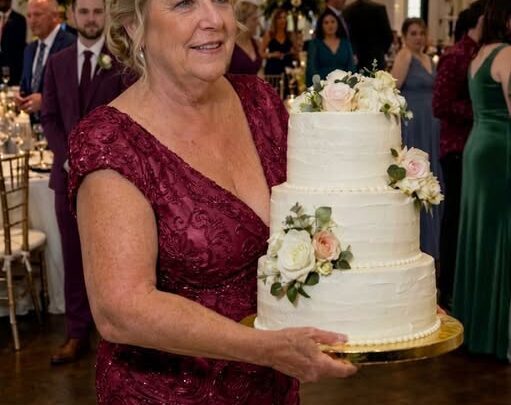
At the reception, the wedding cake stood in the center of the room.
Its three white tiers were decorated with delicate flowers, exactly as Emma had wanted.
When the time came to cut it, Ryan approached me.
“Laura?”
I turned toward him.
“Thank you.”
“For what?”
“For what you said to her.”
I understood what he meant.
I had not dismissed his biological mother’s pain, but I had also refused to tell him that he owed her immediate forgiveness. He needed the freedom to decide what kind of relationship, if any, he wanted to build with her.
“You were allowed to keep your story private,” I told him. “But secrets have consequences, even when the reasons for keeping them are good.”
He glanced toward Emma.
“I know.”
I hoped he understood that the lesson applied to all of us.
A family could protect someone’s privacy without allowing a misunderstanding to grow unchecked. It could respect a person’s need for time without using deception to force a decision.
And it could acknowledge painful history without pretending that one emotional reunion would automatically repair years of separation.
Later, the photographer called out.
“Who is helping with the cake?”
Emma pointed across the room.
“My mom.”
I looked at her, unexpectedly moved by those two simple words.
That morning, my name had nearly prevented me from collecting her wedding cake. By evening, hearing Emma call me “Mom” was enough to remind me why I had wanted everything to go well in the first place.
I was there to support my daughter, celebrate her marriage, and help her begin the life she had chosen.
The wedding was not perfect. It had brought difficult truths to the surface, and those truths would require attention long after the guests went home.
But it was still a day of love, commitment, and possibility.
And sometimes, that is what families need most: not the absence of problems, but the willingness to face them honestly.
Chapter 9: What the Wedding Taught Me About Trust
In the days after the wedding, I thought often about the events that had unfolded.
The bakery incident had seemed like evidence of an affair. The mysterious woman had appeared to be a threat to my marriage. David’s silence had made my fears feel reasonable, and Emma’s reluctance to explain herself had left me feeling excluded from my own family.
The truth was different from what I had imagined.
David had been helping Ryan reconnect with his biological mother. Emma had been trying to protect her fiancé’s confidence. Ryan had been navigating the painful discovery of a parent he had barely known.
None of those circumstances automatically made their decisions right.
David should have considered how his silence would affect his marriage. Emma could have found a way to support Ryan while recognizing that the unexplained secrecy was causing me distress. Ryan’s mother needed to understand that her regret did not give her permission to interfere with his wedding.
And I had to accept that not every family secret was mine to know immediately.
The difficult part was determining where privacy ended and harmful secrecy began.
People deserve the opportunity to process painful experiences before sharing them. They deserve to decide when and how to discuss personal history, especially when that history involves abandonment, loss, or complicated family relationships.
But protecting privacy should not require creating unnecessary confusion or allowing another person to believe something devastating without any explanation.
Trust is not simply a promise that nobody will ever make a mistake. It is the willingness to communicate honestly, take responsibility when our choices hurt someone, and make an effort to repair the damage.
David and I eventually had that conversation.
He admitted that he had been so focused on protecting Ryan’s confidence that he had stopped considering how his behavior appeared to me.
I explained that I did not expect him to reveal every detail of someone else’s private history. I did expect him to recognize when silence was creating a serious misunderstanding in our own relationship.
We did not resolve everything in one evening, but we began speaking more openly.
That was a start.
Chapter 10: The Difference Between Compassion and Permission
I also thought about Ryan’s biological mother.
Her story was painful, and I could not know every detail of what had happened during Ryan’s childhood. I had heard her explanation, and I had heard Ryan’s account of their recent meetings.
There were parts of their history that neither of them had fully explained, and I had no reason to pretend I knew everything.
What I did understand was that regret could be genuine without making every attempt at reconciliation appropriate.
A parent who has been absent may desperately want to reconnect with an adult child. The child may also want answers, yet remain uncertain about how much contact feels comfortable.
Those feelings can coexist.
A person can acknowledge the pain of an absent parent while still needing distance. They can listen to an explanation without agreeing to a relationship. They can offer a future opportunity without promising immediate forgiveness.
Compassion does not mean abandoning boundaries.
Likewise, setting boundaries does not necessarily mean a person has no compassion.
Ryan had not said that he would never speak to his biological mother again. He had said that he was not ready for the relationship she wanted and that her attempts to bypass his decisions made it harder for him to trust her.
That was a distinction worth respecting.
If she hoped to rebuild a connection, she would need to demonstrate patience and consistency. She would need to accept that Ryan’s wedding was not an opportunity to reclaim years of family life in a single day.
Most importantly, she would need to recognize that reconciliation could not be forced.
I hoped she would eventually find a way to make peace with her past. I also hoped Ryan would be able to find whatever answers and closure he needed.
But those decisions belonged to them.
My role was not to decide what their relationship should become. It was to respect their humanity while refusing to excuse behavior that crossed important boundaries.
Epilogue: The Cake Was Never the Real Problem
When I think back to that morning at the bakery, I still remember the baker’s expression as she read the note on her computer.
“I was specifically told not to release it to Laura.”
At the time, those words felt like the beginning of a disaster.
I imagined an affair, a betrayal, and the possibility that my marriage had been built on a lie. I feared that my daughter’s wedding would become the setting for a family crisis no one could undo.
Instead, the truth revealed a different kind of pain.
A son was trying to understand the absence of his biological mother. A woman was struggling with the consequences of decisions made years earlier. A fiancé was trying to protect someone he loved. A father was attempting to help without exposing a private family history.
And a wife had been left to draw the worst possible conclusions because the people she trusted had not communicated with her.
The cake was eventually delivered. Emma married Ryan, and the wedding became a celebration rather than the confrontation it might have been.
But the experience left us with lessons that mattered beyond that single day.
Privacy is important, but so is communication. Family history can explain someone’s behavior, but it does not automatically excuse every decision. Regret may open the door to reconciliation, but trust takes time and cannot be demanded.
Most of all, love does not mean that people are entitled to every answer immediately. It means trying to handle difficult truths with honesty, patience, and respect.
I learned that I could support my daughter without needing to know every detail of Ryan’s private history. I could respect David’s intention to help while still telling him that his silence had hurt me. And I could feel compassion for Ryan’s biological mother without agreeing that she had the right to disrupt his wedding.
Families are complicated. Sometimes people hide information because they are afraid of causing pain. Sometimes they keep secrets because they believe they are protecting someone. And sometimes, in trying to prevent one kind of hurt, they create another.
The solution is rarely as simple as telling everyone everything.
It begins with asking what needs to remain private, who is being affected by the silence, and whether there is a more honest way to protect the people involved.
On the evening of Emma’s wedding, when she called me her mom and asked me to help cut the cake, I realized that the day had not taken away my place in her life.
It had reminded me how much that place mattered.
And it had taught me that trust is not preserved by avoiding every difficult conversation. It is preserved when people are willing to face those conversations, acknowledge the consequences of their choices, and make room for one another’s feelings.
The cake was never the real problem.
The real problem was what happened when fear, privacy, and silence collided.
And the way forward began when we finally stopped guessing and started telling the truth.
What would you do in my position? If your spouse kept a major family secret to protect someone else’s privacy, would you understand the reason, or would the secrecy itself damage your trust?