Uncategorized
My Son Abandoned Me on Christmas—Then I Discovered My Late Husband’s Secret Cabin and a Forged Check

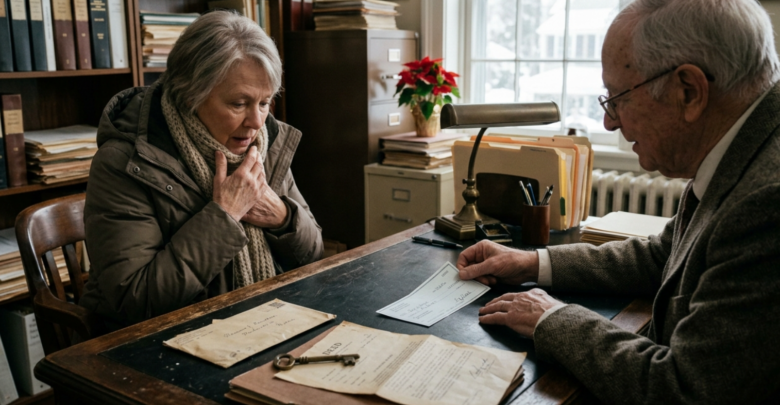
A Christmas Betrayal That Changed Everything
I used to believe that family was the one place where a person should never have to question their worth. After forty-six years of marriage, I also believed I understood the man I had shared my life with. Daniel and I had built our world slowly, through ordinary sacrifices, difficult decisions, and countless small acts of love.
We had never been extraordinarily wealthy, but we had always been careful. We paid our bills, saved for retirement, and tried to give our son, Ryan, the best opportunities we could. When Daniel became seriously ill, I devoted myself to caring for him. I never imagined that while I was worrying about his treatment and hoping for more time together, he was quietly making arrangements to protect my future.
Then came the Christmas when our son left me feeling forgotten.
I had expected a family gathering, familiar conversations, and perhaps a few moments of comfort after losing my husband. Instead, I was left confronting the painful possibility that the people I loved most did not see my needs as important.
What I did not know was that Daniel had anticipated some of what would happen. He had made arrangements I had never understood, secured a small cabin in the mountains, and documented financial concerns that he had been unable to resolve before his death.
The discoveries that followed would challenge everything I thought I knew about my son, my marriage, and the meaning of family loyalty.
The Documents My Husband Left Behind
When I entered Allison’s office, I expected a difficult conversation about estate paperwork. I had brought the brass key Daniel had left among his belongings, along with questions I had been carrying since his funeral.
Instead, Allison placed a photocopy of a check in front of me.
The amount was $18,500.
I stared at the document, trying to understand why it had been included among my husband’s financial records. Allison explained that the check had been processed approximately eleven months earlier, while Daniel was still alive and undergoing chemotherapy.
At that time, he had been weak but mentally alert. He continued making coffee in the mornings, insisted on handling small household tasks, and disliked being told to rest. Although his illness had changed our daily routine, I had never believed he was incapable of understanding his finances.
When I asked whether Daniel knew about the check, Allison told me that he had discovered the transaction three weeks after it was processed.
He had contacted her immediately.
The revelation hurt in a way I had not anticipated. Daniel and I had shared forty-six years of marriage. We had raised Ryan together, managed our household, faced financial uncertainty, and supported each other through the hardest periods of our lives.
Why would he discover something this serious and not tell me?
Allison explained that Daniel had been afraid I would confront Ryan before the evidence was properly reviewed. He believed our son would deny responsibility, offer an explanation, and persuade me that the incident was merely a misunderstanding.
My first instinct was to defend Ryan. He was my child, and I had spent his entire life believing that love meant giving him the benefit of the doubt.
But memories began returning.
There had been the loan he needed help with when his first business struggled. There had been a missing credit card payment he blamed on a banking error. More recently, he had told me that his father did not need to know every financial detail because he already had enough to worry about.
At the time, I had interpreted those comments as concern for Daniel.
Now I wondered whether I had mistaken secrecy for kindness.
The Check That Raised Serious Questions
Allison showed me additional records connected to the $18,500 transaction.
According to the documents she had reviewed, the check had been accompanied by a withdrawal authorization bearing my name, address, and what appeared to be my signature. The money had then been transferred to an account controlled by a financial consulting company.
I had never authorized the transaction.
I had never heard of the company.
When I asked who had signed the document, Allison explained that determining responsibility would require a careful review of the available evidence.
Daniel had wanted the facts established before anyone made an accusation.
That distinction mattered to me. I was hurt, frightened, and increasingly suspicious, but I did not want to make claims I could not prove. If someone had used my signature without permission, I wanted the matter investigated properly.
Allison then showed me another bank statement.
The account was unfamiliar, although my name appeared at the top.
Daniel had established it three years earlier. He had gradually funded it through personal investments and proceeds from selling a small parcel of land he inherited from his uncle.
The money had been intended to support my retirement and help maintain the mountain cabin.
I was stunned.
I had understood that Daniel had purchased the cabin in the Laurel Highlands, but I had not understood the full extent of the arrangements he had made. Allison explained that the property had been legally transferred into my name.
Daniel wanted me to have a place that belonged to me, independent of anyone else’s decisions.
The cabin was more than a building. It was a quiet refuge with a reading chair, a handmade quilt from my mother, and photographs that reminded me of the life Daniel and I had built together.
He had not simply bought me a second home.
He had created a place where I could feel secure.
Why Daniel Kept His Concerns Secret
I struggled to understand why my husband had not explained everything while he was still alive.
Why had he carried these worries alone?
Allison told me that Daniel had become increasingly concerned about Ryan’s behavior whenever money was discussed. He believed I loved our son so deeply that I might overlook conduct I would never accept from someone else.
I wanted to argue with her.
Instead, I thought about the last months of Daniel’s life. While I was preparing meals he could barely eat, helping him manage appointments, and trying to make his difficult days more comfortable, he had been reviewing financial records and attempting to protect me.
The realization filled me with sadness.
Allison explained that the consulting company had received the money and that Daniel had discovered communications between Ryan and the company’s owner. Daniel had eventually recovered $7,000 through a separate settlement.
The remaining $11,500 had not been returned to the account.
It was not an amount that could be dismissed simply because it was smaller than some people’s savings. Daniel had accumulated that money through years of careful planning. It represented security, retirement, and the practical needs of a life we had expected to share.
It could have paid property taxes, repaired the heating system, or covered unexpected expenses.
When I asked whether Ryan knew his father had discovered the transaction, Allison confirmed that he did.
According to her records, Ryan had claimed that I verbally approved it.
I had not.
Daniel had documented a conversation in which he asked me about the company. I told him I had never heard of it.
Even during his illness, my husband had been keeping records.
He had not been trying to punish our son. He had been trying to establish the truth before it was too late.
Daniel’s Notebook Revealed His Fears
Allison opened a drawer and took out a small black notebook.
I recognized it immediately. Daniel had kept it near his bed during the final months of his life. After his funeral, I searched for it because I wanted to locate a list of his medications, but I never found it.
Now I understood why it mattered.
Daniel had instructed Allison to give me the notebook if I arrived at her office with the brass key.
Its first pages contained practical notes about the cabin’s heating system, insurance payments, and things he hoped I would bring there someday.
Then I reached an entry dated eleven months earlier.
Daniel had written that Ryan had visited and asked about the separate account again. When Daniel explained that the money was intended for my future, Ryan reportedly argued that I would not need as much as his father believed.
The words were painful to read.
Forty-six years of marriage had taught Daniel that I did not need to be treated as someone incapable of understanding her own life. Yet our son appeared to have questioned whether I deserved the financial protection his father wanted to provide.
Daniel’s next entry described a conversation about a business opportunity. He offered to review the documents Ryan presented, but the discussion became tense.
His final words on the page were especially difficult to absorb. He acknowledged that Ryan was under pressure and had made mistakes, and that he remained willing to help if his son asked honestly.
But he would not allow Ryan to take what belonged to me.
I closed the notebook and sat quietly.
I could not change what Daniel had experienced. I could not ask him why he had made certain decisions or hear his explanation in his own voice.
All I could do was try to understand the information he had left behind.
The Email About the Mountain Cabin
Allison then showed me an email Ryan had sent Daniel two months before my husband’s death.
Ryan suggested that the cabin should be placed under his management. He argued that Daniel and I would not use it frequently and that renting it out could generate income.
He offered to manage bookings and expenses.
On the surface, the proposal could have sounded practical. Maintaining a property requires time, attention, and money. But Daniel’s handwritten response was brief.
One word.
“No.”
Allison explained that Ryan subsequently contacted a real estate agent to inquire about transferring the property. The agent declined to proceed because Ryan was not the owner.
Daniel learned about the inquiry and ensured that the deed was properly recorded in my name.
I remembered Ryan visiting during that period. He brought chocolates for his father and spoke about the difficulties of maintaining property during retirement. He offered to take paperwork off our hands and asked whether the cabin might be a good investment.
I had thought he was being helpful.
Now, in light of the documents, I could no longer interpret those conversations so easily.
I asked Allison what I should do.
She did not tell me to forgive Ryan, and she did not insist that I take immediate legal action against him. Instead, she encouraged me to understand what Daniel had left me and make decisions after reviewing the evidence.
That was sensible advice.
I had spent years reacting to family situations with my heart before considering what the facts required. This time, I wanted to move carefully.
The Financial Security Daniel Had Quietly Built
Allison placed a summary of Daniel’s assets in front of me.
I expected to see the cabin’s estimated value and perhaps the balance of the investment account.
Instead, one figure caught my attention.
$487,600.
I read it twice.
The total represented assets Daniel had placed in my name or designated for my benefit, including the cabin, a retirement investment account, and a separate trust intended to support my living expenses.
I could hardly believe it.
Daniel and I had never considered ourselves wealthy. I understood our household finances, knew what our home had cost, and helped manage everyday expenses. Daniel had handled many of the long-term investments, however, and I had trusted him to plan carefully.
He had invested over decades, received an inheritance, and chosen to preserve much of that money rather than spend it.
He had wanted to explain everything to me in person.
According to Allison, he planned to take me to the cabin in the spring after completing treatment. He wanted to sit with me in the quiet surroundings and explain what he had arranged for our future.
But that spring never came.
Illness had interrupted the plans we made together. The garden Daniel hoped to plant, the mornings he wanted to spend reading by the fireplace, and the trips we imagined taking remained unfinished dreams.
I had thought the cabin was simply a gift he left behind.
Now I understood that he had intended it to be part of a future we would share.
The Letter That Changed How I Saw Myself
Allison handed me a sealed envelope bearing my name in Daniel’s handwriting.
Inside was a letter he had instructed her to give me after we reviewed the financial records.
He apologized for not being able to explain everything himself. He acknowledged that I might discover things about Ryan that I had never wanted to believe.
But the most important part of the letter was not about money.
Daniel reminded me that I did not have to accept disrespect simply because it came from someone I loved. I was not a burden, an obligation, or someone who had to earn a place in the lives of the people I had raised.
He also wrote that forgiveness should not be confused with proof that someone had changed.
If Ryan came to me with an apology, I could listen when I was ready. I could give him an opportunity to tell the truth. But I did not have to ignore the evidence or rush into forgiving him simply because he was my son.
I read those words through tears.
Daniel had known how difficult it was for me to set boundaries with Ryan. I had spent years worrying that a disagreement would damage our relationship. I had sometimes accepted explanations because challenging them felt too painful.
My husband was reminding me that love did not require me to abandon my judgment.
I folded the letter carefully and placed it in my handbag.
For the first time since Daniel’s death, I felt that I had received something more valuable than an inheritance. I had received permission to protect my own peace.
A Question About the Forged Signature
I still needed answers about the check.
I asked Allison whether there was evidence connecting Ryan to the transaction. She explained that the available records included emails, account information, company correspondence, and a document Ryan had submitted to the bank claiming that he had my permission to act on my behalf.
I had given no such permission.
Allison could not promise that the money would be recovered. The outcome would depend on the investigation and any legal remedies available.
I appreciated her honesty.
I wanted the records preserved, including every document and email connected to the check. I also asked for a review of the relevant accounts to determine whether other transactions had occurred without my authorization.
It was no longer enough to hope that the problem had been isolated.
I needed to know the facts.
After Allison arranged the next steps, I left her office and sat in my car. My phone showed three missed calls from Ryan and two text messages.
The messages were not about Christmas.
They were about his father’s paperwork.
I stared at the screen, remembering the empty dining table and the holiday I had expected to spend with my son. I had waited for a call asking how I was doing, or perhaps an apology for the way things had unfolded.
Instead, Ryan wanted to know what Daniel had left behind.
I put my phone away and drove home.
The Phone Call That Exposed Our Distance
Ryan called again that evening.
When I answered, he sounded relieved that I had finally picked up. He said he had been trying to reach me all day and wanted to know where I had been.
I told him I had been out.
Then he asked whether Daniel had left me any financial documents or paperwork from the lawyer.
I asked why he wanted to know.
He said there were things we needed to sort out as a family.
The word family sounded different to me now. I wondered whether he meant the people who loved each other or simply the people whose financial interests overlapped.
I told him that Daniel had left me a great deal of paperwork.
Ryan wanted to know whether I had found anything about a separate investment account.
I had.
When I told him that, there was a pause.
He began suggesting that his father might not have understood everything near the end of his life. Daniel had been taking medication and dealing with exhaustion, Ryan said. Perhaps he had misunderstood some of the arrangements.
I reminded my son that his father had understood more than he realized.
Ryan insisted that he wanted to ensure everything had been handled properly. He raised the possibility of legal and tax complications and urged me not to let lawyers turn a family disagreement into something ugly.
I listened carefully.
Then I asked him a direct question.
Why had someone written my signature on an $18,500 check?
The silence that followed was immediate.
Ryan asked what check I meant. He claimed he knew nothing about it and suggested that Allison might be presenting information out of context.
When I explained that the lawyer had records connecting him to the company that received the money, he became defensive.
He said he had been trying to help his father manage investments while Daniel was sick.
But I had one question he could not avoid.
Had he signed my name?
He denied it.
I told him that if he had done nothing wrong, he should have nothing to fear from an investigation.
Ryan warned me that I was making a serious mistake. He reminded me that he was my son and asked how I could believe he would steal from me.
I did not have a simple answer.
I still loved him. That love had not disappeared because I had discovered troubling documents. But love could not erase questions that needed honest answers.
For years, I had feared that questioning Ryan would make him stop visiting. I worried that refusing to lend him money would make him think I did not care. I sometimes believed that asking for an apology would make me a difficult mother.
That night, I finally understood that a relationship maintained only through silence was not truly peaceful.
It was simply a relationship in which one person was expected not to ask questions.
I told Ryan I would not ask him for money, demand that he take care of me, or insist that he attend future holiday dinners.
But I would ask him to tell the truth.
Then I ended the call.
My hands trembled, and I sat alone at the kitchen table for a long time. I did not know what would happen next. I only knew that I could no longer pretend nothing had happened.
A Second Document and Another Unexpected Name
The following morning, Allison called to tell me that the first stage of the account review had been completed.
There was another document she wanted me to see.
When I arrived at her office, she handed me a new folder. Inside was a copy of an authorization form bearing my name, address, and signature.
The document purported to give Ryan limited authority to communicate with the bank about my accounts.
It was dated fourteen months earlier.
I had never signed it.
Allison explained that Daniel had discovered the document while reviewing the account records and had contacted the bank to revoke the authorization. According to Daniel’s notes, Ryan had claimed that I signed the form because I wanted to simplify my finances.
That explanation did not match my memory.
I told Allison that I had never signed anything like it.
She said the facts needed to be established formally. The original document, the bank’s records, and potentially a handwriting examination could help determine what had happened.
Then I noticed the witness line.
A name appeared beneath it.
Megan Bennett.
My daughter-in-law.
For a moment, the room seemed to tilt.
Megan had sat at my dining table, shared meals with us, and called me Mom during the years when Ryan and I were close. At Daniel’s funeral, she had held my hand and promised that I would never have to face everything alone.
Now her name appeared on a document I said I had never signed.
I asked Allison whether Megan had actually been present when the form was supposedly signed.
She did not know.
Someone could have copied my signature from another document, she explained, but that possibility would need to be investigated. The presence of Megan’s name on the form did not, by itself, establish what she knew or whether she had participated in anything improper.
I understood that distinction, even as the discovery hurt.
The question was no longer simply whether Ryan had made a mistake. I needed to know whether anyone else had been involved and whether the documents accurately represented what had occurred.
The Company That Connected the Records
Allison turned to another page.
The authorization form had been submitted through the same financial consulting company that received the $18,500 check.
The connection was difficult to ignore.
The same company appeared in both sets of records, linking the disputed transaction with the questionable authorization.
I asked who owned it.
Allison showed me the registration information. The company was registered to a man named Patrick Lawson, someone I had never heard of.
Beneath his name was a business address in downtown Pittsburgh.
Next to the address was a telephone number written in blue ink.
I recognized the handwriting immediately.
It belonged to Ryan.
I stared at the number until the figures blurred.
I did not yet know what the connection meant. I did not know whether Ryan had an innocent explanation, whether other people had been misled, or whether the investigation would establish wrongdoing.
But the pattern was becoming harder to dismiss.
There was the check I had never authorized. There was the account authorization I said I had never signed. There was the consulting company connected to both documents. And there was my son’s handwriting beside the company’s contact information.
I looked at Allison.
“I want to know everything,” I told her.
She nodded and assured me that we would proceed carefully.
I gathered the documents and placed them in my handbag. Before I left, Allison handed me one final envelope.
It had been found among Daniel’s personal papers, separate from the financial records.
He had specifically asked her to keep it apart from everything else.
I looked at the envelope and recognized my husband’s handwriting once more.
Whatever it contained, I knew that Daniel had wanted me to receive it for a reason.
I had entered Allison’s office believing I was simply trying to understand the financial arrangements my husband had left behind. I was leaving with questions about my son, my daughter-in-law, a consulting company, and documents bearing a signature I did not recognize as my own.
I was still grieving Daniel. I still wished he were beside me, explaining everything in his calm voice and reminding me not to rush into conclusions.
But I was beginning to understand the future he had tried to protect.
The cabin was mine. The financial arrangements were intended to support me. And I had every right to ask questions about documents and transactions that affected my security.
I did not yet know what the next envelope would reveal.
For the first time, however, I was prepared to face the truth, whatever it turned out to be.
Because Daniel had left me more than a cabin, an account, or a collection of papers.
He had left me a reminder that protecting myself was not an act of betrayal.
It was an act of self-respect.
Editorial Note Before Publishing
This article is based on the supplied fictional-style narrative and preserves its unresolved ending. The financial allegations, forged-signature claims, and characters’ actions should not be presented as verified real-world events without reliable supporting evidence. If this is intended as fiction, consider labeling it clearly as a fictional story. This helps readers distinguish dramatic storytelling from verified news or real allegations.