Uncategorized
My Daughter-in-Law Tried to Take Over My Retirement Cabin—One Folder Changed Everything

PART 1: THE MIDNIGHT BETRAYAL OF MY PEACE
I had been retired for barely two days when my daughter-in-law decided my new cabin by the lake would make the perfect summer vacation home for her parents.
She didn’t ask whether they could visit.
She didn’t ask whether I had plans.
She simply instructed me to prepare the bedrooms, clear the closets, and make sure everything was ready before Friday.
Then she added something that made me realize just how little she respected me.
“If you don’t like the arrangement, you can always sell the property and move somewhere else.”
I didn’t argue.
I didn’t remind her that I had spent forty-one years working to afford that cabin. I didn’t point out that my name was the only one on the deed. And I certainly didn’t raise my voice.
Instead, I made a discreet phone call, assembled a slim blue folder, and waited.
At sixty-four, I had finally retired from the steel mill and purchased the one thing I had wanted for most of my adult life: a quiet place where nobody could tell me what to do.
I wasn’t looking for luxury.
I didn’t want a sprawling mansion, an expensive vacation home, or a property designed to impress people who drove past it.
I wanted wood beneath my boots, a cool breeze coming through the screen door, and mornings quiet enough to hear the water moving against the shore.
After forty-one years surrounded by industrial noise, that seemed like more than enough.
Most of my working life had been spent around roaring furnaces, forklifts, heavy machinery, and steel scraping against steel. Men shouted because ordinary conversation was impossible. Equipment beeped constantly. Every shift seemed to involve another problem that needed fixing before something went wrong.
Even after my final day, my body hadn’t quite accepted that the noise was over.
Twice during my first week of retirement, I woke in the middle of the night convinced I had heard the factory whistle.
Instead, there was only the refrigerator humming in the kitchen and my upstairs neighbor dragging something across the floor at 12:38 in the morning.
That was when I knew I had made the right decision.
The cabin was exactly what I wanted.
It had three bedrooms, a green metal roof, a stone chimney, and a weathered wooden dock extending into the lake. The siding needed fresh stain, the boathouse door occasionally stuck, and several porch steps complained whenever I walked across them.
I loved every imperfection.
There was something comforting about a house that didn’t pretend to be perfect. If a board needed replacing, I could see it. If a door needed adjusting, I could fix it.
After decades of listening to people make promises over the sound of industrial machinery, I appreciated that kind of honesty.
I had bought the property with forty-one years of savings, careful planning, and more overtime shifts than I cared to remember.
Every dollar had a history.
Some came from weekends I spent working when other men were fishing. Others came from holidays when I volunteered for extra shifts because my son needed new shoes, school supplies, or something important for his future.
My son, Elliot, knew what the cabin meant to me.
His mother had left when he was thirteen, and I had raised him alone.
I never asked him to choose sides. I never made him responsible for the decisions adults had made. I simply did what needed to be done.
I packed lunches before sunrise, attended school events wearing work boots, taught him how to change the oil in an old pickup truck, and sat through parent-teacher conferences while still smelling faintly of the steel mill.
There were years when I barely had time to think about myself.
But I never regretted raising him.
When Elliot married Sienna seven years earlier, I genuinely tried to welcome her into the family.
I overlooked the little comments.
She once described my city apartment as “industrial vintage without the deliberate styling.”
Another time, she said my restored maple dining table looked rustic in a way that might be charming for someone who hadn’t updated their furniture in decades.
She also liked to refer to my career as my “rather unusual factory job.”
She always delivered these remarks with a smile, which somehow made them worse.
I usually said nothing.
I believed that maintaining a peaceful family relationship was worth overlooking a few unpleasant comments.
Unfortunately, people who never have to pay a price for taking advantage of someone can eventually mistake silence for permission.
That lesson became painfully clear thirty-six hours after I moved into the cabin.
It was Thursday evening, 6:17 p.m.
I was sitting on the dock with a cup of coffee when my phone rang.
Sienna’s name appeared on the screen.
“Hello,” I answered.
“Your son and I have decided my parents will stay at your cabin for the summer,” she announced.
I looked out across the water.
A loon called somewhere beyond the reeds.
“I’m sorry,” I said. “What did you just say?”
“Mom and Dad are going to spend the summer at your place. It makes the most sense.”
I waited for her to explain that she was asking for permission.
She didn’t.
“Beverly has back problems,” she continued. “So she’ll need the main bedroom. Gordon needs somewhere to keep his paperwork, and they’ll need enough closet space for their things.”
I took another sip of coffee.
“And when are they arriving?”
“Friday afternoon.”
Tomorrow.
I looked at the quiet water again.
“Sienna, have you spoken to Elliot about this?”
She gave a short laugh.
“My husband understands that family sometimes requires sacrifices. Unlike certain people.”
I didn’t respond.
She continued giving instructions.
I was apparently expected to clear the closets, prepare the guest bedrooms, make room for her parents’ belongings, and avoid creating an uncomfortable situation.
Then came the sentence that finally revealed what she thought of me.
“If this arrangement bothers you, you can sell the place and move back somewhere you can actually be useful.”
I stared at my phone.
For a moment, I couldn’t believe what I had heard.
I had worked forty-one years to purchase a small piece of peace, and now someone who hadn’t contributed a dollar toward it was telling me to leave because her parents wanted a summer vacation.
I could have shouted.
I could have reminded her that the property belonged to me.
Instead, I asked one final question.
“Did Elliot personally agree to this?”
“My husband understands,” she replied.
Then she ended the call.
I sat on the dock for several minutes, listening to the water.
I wasn’t furious in the way I had expected to be.
I was disappointed.
There was a difference.
I had spent much of my life trying to avoid unnecessary conflict. But avoiding conflict didn’t mean I had to surrender everything I had worked for.
At 7:04 p.m., I contacted the county clerk’s office and confirmed the recorded deed.
At 7:41, I printed the closing documents, property-tax receipt, insurance papers, and ownership records.
Every document identified exactly one owner.
Me.
I also printed Sienna’s message, which arrived at 8:12 p.m.
Don’t embarrass everybody over a few empty bedrooms.
I placed it beside the other papers.
Across the top of a legal pad, I wrote in black ink:
MY HOME IS NOT AVAILABLE FOR REASSIGNMENT.
By Friday afternoon, I hadn’t prepared a single guest bedroom.
The closets remained untouched.
The primary-bedroom door was closed.
On the kitchen table sat a thin blue folder containing the deed, tax records, insurance documents, copies of Sienna’s messages, and an unsigned rental agreement outlining reasonable market-rate conditions.
I wasn’t actually interested in renting the cabin to them.
I simply wanted to make it clear that owning a family relationship did not mean owning somebody else’s property.
My hands were surprisingly steady.
For a moment, I thought about all the years I had spent beside the furnaces.
The missed weekends.
The exhausting shifts.
The meals eaten standing over the kitchen sink.
The overtime hours I accepted because I wanted Elliot to have opportunities I never had.
I wanted Sienna to understand that those years hadn’t been spent so she could claim my retirement as an extension of her family’s vacation plans.
But anger is an expensive way to spend the peace you worked so hard to earn.
I didn’t need to shout.
I needed to be clear.
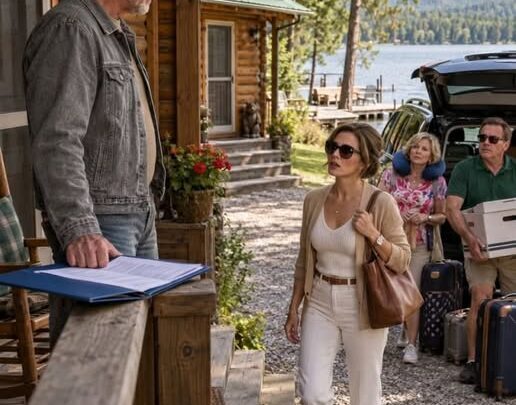
I put on my old denim jacket, picked up the blue folder, and stepped onto the porch.
The afternoon sun warmed the driveway.
A small American flag beside the mailbox moved gently in the breeze, and the screen door squeaked behind me.
At precisely 4:26 p.m., an SUV turned off the road and entered my driveway.
Sienna sat in the passenger seat wearing sunglasses.
Beverly, her mother, was in the back with a travel pillow around her neck.
Gordon, her father, held a banker’s box against his chest.
The rear hatch opened, revealing two large suitcases.
Sienna stepped out, looked toward the cabin, and smiled.
“Good,” she said. “You’re ready.”
I opened the blue folder against the porch railing.
For the first time in seven years, her confident smile began to disappear.
PART 2: THE FOLDER THAT CHANGED EVERYTHING
I opened the folder and turned the first document toward Sienna.
It was the recorded property deed.
My name appeared clearly as the sole owner.
Below it were the property’s legal description, the recording information, and the county seal.
Sienna stared at the page.
Then she looked at me.
“What is this supposed to be?”
“Proof of ownership.”
She laughed nervously.
“Dad, this is ridiculous. We’re family. We shouldn’t need documents for something like this.”
I turned to the next page.
It was the property-tax receipt.
Then came the insurance paperwork.
Finally, I placed a printed copy of her message on top.
Don’t embarrass everybody over a few empty bedrooms.
Beverly leaned forward from the SUV.
Her expression changed as she read it.
She had arrived expecting a comfortable summer retreat. Instead, she was discovering that the arrangement she had been promised might never have existed.
Gordon placed his banker’s box on the gravel.
He looked toward Sienna.
“Is there something we should know?”
Sienna ignored him.
She pointed toward the folder.
“You’re making this into something much bigger than it needs to be.”
“No,” I replied. “I’m making it clear.”
I removed the final document.
It was an unsigned rental agreement.
The terms were straightforward: market-rate rent, a security deposit, specific dates, responsibility for any damage, and no automatic right to use bedrooms or storage spaces.
I had included it because I wanted everyone to understand that even a temporary stay would require my agreement.
Sienna stared at the paper as though I had insulted her.
“You expect my parents to pay rent?”
“I expect anyone staying in my home to have my permission.”
She shook her head.
“This is unbelievable.”
I remained calm.
“Then perhaps you should have asked before making plans.”
Beverly stepped out of the SUV.
“Sienna, what exactly did you tell us?”
Sienna turned toward her.
“Mom, please don’t start.”
“No,” Beverly replied. “I want to understand. You told us everything was arranged.”
Gordon looked at me.
“We were told you wanted company and that the cabin would be available.”
I studied his expression.
He seemed genuinely uncomfortable.
That told me something important.
Sienna had apparently described the situation differently during the drive.
Perhaps she had said I offered the cabin.
Perhaps she had told them Elliot had arranged everything.
Or perhaps she had simply said I was being difficult but would eventually accept the decision.
Whatever version she had given them, it certainly hadn’t included a conversation about ownership.
I looked at Beverly.
“I understand that you and Gordon were expecting to spend the summer here. But I never agreed to that arrangement.”
She nodded slowly.
“I see.”
Sienna’s voice became sharper.
“You’re embarrassing everyone.”
I looked at her.
“I didn’t invite your parents into a situation they didn’t understand. You did.”
For several seconds, nobody spoke.
Then Sienna’s phone vibrated.
She looked down.
Elliot’s name appeared on the screen.
I recognized the opportunity immediately.
“Put him on speakerphone,” I said.
She hesitated.
“Why?”
“Because this concerns him, too.”
She looked at her parents, then back at me.
I extended my hand.
After a moment, she gave me the phone.
I answered.
“Hello, son.”
“Dad?” Elliot sounded confused. “Why is Sienna calling me repeatedly?”
“Because your wife’s parents are currently sitting in my driveway with their luggage.”
There was a pause.
“What?”
I repeated the question I had asked Sienna the previous evening.
“Did you agree to let Beverly and Gordon stay in my cabin for the summer?”
Silence.
I could hear traffic in the background.
Then Elliot answered.
“No.”
One word.
That was all it took.
Sienna went pale.
Beverly closed her eyes.
Gordon lifted his banker’s box from the gravel and held it against his chest.
Elliot continued.
“What is happening, Dad?”
I didn’t dramatize anything.
I read Sienna’s message aloud and explained that she had told me to prepare the bedrooms, clear the closets, and make room for her parents.
I also told him that the SUV was already in my driveway.
Another silence followed.
Then he said, “Let me speak to Sienna.”
I handed the phone back.
She stepped away from the porch.
We didn’t need to hear every word of their conversation.
Her posture told enough of the story.
At first, she stood rigidly with one hand on her hip, speaking in the same confident tone she had used with me.
Then her arm dropped.
She turned away from her parents.
Her voice became quieter.
Beverly sat on the edge of the SUV’s seat and rubbed the bridge of her nose.
Gordon looked toward the cabin.
I could see the disappointment on his face.
When Sienna returned, she handed me the phone.
Elliot was still on the line.
“Dad, I’m sorry,” he said.
I looked at the lake.
“I know you didn’t agree to this.”
“I didn’t know she was telling you that.”
“I believe you.”
He exhaled.
“I’ll come over tomorrow. We need to talk.”
“That would be fine.”
Before ending the call, I added something I had wanted him to understand for a long time.
“Elliot, I’m not asking you to punish your wife on my behalf. I don’t want you choosing sides just because we’re related. But I do expect you to recognize that I’m a person with my own life, not a resource everyone can claim whenever it’s convenient.”
He was quiet.
Then he said, “I understand.”
I returned the phone to Sienna.
She didn’t apologize.
Instead, she turned toward her parents.
“We should go.”
Beverly slowly stood.
“Are you sure?”
“Yes.”
Gordon returned the banker’s box to the SUV.
The suitcases followed.
The rear hatch closed with a quiet thump.
Before getting into the passenger seat, Sienna glanced toward the blue folder.
I kept one hand resting on it.
The documents were not a threat.
They were simply the truth.
Their SUV reversed out of the driveway at 4:58 p.m.
Thirty-two minutes.
That was how long it took for an arrangement built entirely on entitlement to collapse.
When the dust settled, I was still standing on my porch.
Elliot remained on the phone for another minute.
“Dad?”
“Yes?”
“I should have asked more questions.”
I nodded, even though he couldn’t see me.
“You should have.”
“I’ll come by tomorrow.”
“Bring a toolbox. The dock needs attention.”
He laughed softly.
“Okay.”
That evening, I returned to the kitchen.
The blue folder sat on the table.
I placed the deed back inside, tucked the papers into the drawer beside the stove, and made another cup of coffee.
It was late, but I didn’t mind.
For the first time since Sienna’s phone call, I felt completely comfortable in my own home.
I had expected the confrontation to leave a bitter feeling behind.
Instead, the cabin seemed more secure.
Perhaps defending a place without behaving cruelly makes it feel more truly yours.
The next morning, Elliot arrived alone.
He brought sandwiches from a roadside diner and a toolbox filled with the tools he had used when he was younger.
We spent most of the morning repairing loose boards along the dock.
For a while, neither of us mentioned what had happened.
That was how men in our family often handled difficult conversations.
We worked with our hands until the words became easier.
Eventually, Elliot explained that Sienna had told him her parents needed a place to stay temporarily.
She had described the cabin as somewhere I might enjoy sharing with family.
He hadn’t understood that she intended to make the decision without asking me.
“She said you were lonely,” he admitted. “She thought having people around would be good for you.”
I stopped tightening a screw.
“Did you tell her I wanted that?”
“No.”
“Then she shouldn’t have decided it for me.”
He nodded.
I continued working.
“Being retired doesn’t mean I’m waiting for somebody to assign me a purpose. I bought this place because I finally have the freedom to decide how I spend my days.”
Elliot looked down at the dock.
“I know.”
I believed he was beginning to understand.
But rebuilding trust takes time.
It is like replacing damaged boards on a dock. One small repair doesn’t make the entire structure new.
You work carefully, one piece at a time.
PART 3: THE PEACE I WORKED FORTY-ONE YEARS TO EARN
Over the next two weeks, the cabin slowly returned to its ordinary rhythm.
Elliot visited once more to help me stain the dock.
We replaced two loose boards, tightened the porch railing, and repaired the screen door.
Beverly sent a short letter apologizing for arriving without speaking to me directly.
She explained that she had believed the arrangement was already settled and hadn’t realized I had never agreed.
I appreciated the apology.
Gordon sent the unsigned rental agreement back with a handwritten note.
“After seeing the market rate, I have developed an even greater respect for your property.”
I laughed when I read it.
It was the first genuinely amusing moment since the entire situation began.
Sienna remained away for a while.
I wasn’t particularly surprised.
Some people find it difficult to apologize when they are still dealing with the consequences of their own decisions.
Eventually, she appeared one afternoon without her sunglasses.
She stood outside the porch instead of walking straight toward the door.
“Can we talk?” she asked.
I opened the screen door.
“Of course.”
She looked different.
Not necessarily kinder, but less confident than usual.
“I owe you an apology,” she began.
I waited.
She explained that her parents had been dealing with several personal difficulties and that she had been trying to find a solution.
She admitted she had assumed I would be willing to let them stay.
Then she acknowledged that she should never have spoken to me the way she had.
“I shouldn’t have told you to sell your cabin,” she said.
“No,” I replied. “You shouldn’t have.”
She looked down.
For a moment, I considered telling her everything I had wanted to say over the years.
I could have mentioned the comments about my apartment, my furniture, my career, and the way she sometimes treated my time as though it had no value.
But I decided against turning the conversation into a list of old grievances.
The most important issue was simple.
My home was mine.
My retirement was mine.
And my decisions deserved respect.
I told her that she and Elliot were welcome to visit when invited.
Her parents could join us for dinner sometime, too.
But nobody would be moving into my cabin for the summer.
She nodded.
“That’s fair.”
I wasn’t sure whether she meant it.
But I appreciated that she didn’t argue.
An apology doesn’t erase what happened, and forgiveness doesn’t mean pretending nothing happened.
It means deciding whether a relationship can move forward under better conditions.
For now, I was willing to leave that possibility open.
By the end of my first month of retirement, the dock was smooth, the siding had fresh stain, and the porch steps had been repaired.
The cabin looked better than it had when I purchased it.
More importantly, it finally felt like home.
I had spent forty-one years working around people who believed everything could be solved by shouting louder or pushing harder.
Retirement taught me something different.
Sometimes the strongest response is simply refusing to surrender what belongs to you.
I hadn’t needed to threaten anyone.
I hadn’t needed to humiliate Sienna in front of her parents.
I hadn’t even needed to raise my voice.
I had shown them the deed, the records, and the message she had sent.
The facts had been enough.
One morning, I sat on the dock with my coffee and watched the sunlight move across the water.
The lake was almost perfectly still.
A bird landed on one of the wooden posts.
The screen door squeaked behind me as the breeze moved through the cabin.
I thought about the years at the steel mill.
The early mornings.
The long shifts.
The weekends I missed.
The times I came home exhausted but still stayed awake to help Elliot with homework.
I thought about the money I had saved, the opportunities I had passed up, and the sacrifices that had finally made this little cabin possible.
For a moment, I wondered whether I had been too harsh.
Then I remembered Sienna standing in my driveway, telling me to prepare the bedrooms in a house she didn’t own.
I remembered her telling me to sell the property if I didn’t like her decision.
And I understood something.
I hadn’t been harsh.
I had simply stopped allowing other people to make decisions about my life without my permission.
Elliot still visits occasionally.
Sometimes he brings lunch.
Sometimes we work on something around the property.
Other times, we sit together without saying much.
I like those visits best.
We don’t need to fill every silence with conversation.
The lake does enough talking for both of us.
Beverly and Gordon have not asked to stay at the cabin again.
Sienna has been more careful about assuming what other people will agree to.
Whether our relationship becomes closer remains to be seen.
But one thing has changed permanently.
Nobody in the family treats my retirement as though it belongs to them.
I kept the blue folder.
Not because I expect another confrontation, but because it reminds me of a lesson I learned later in life than I should have.
A peaceful person still needs boundaries.
A quiet home still needs a locked door.
And a lifetime of hard work does not become communal property simply because someone uses the word family.
I didn’t spend forty-one years beside roaring furnaces so I could retire and spend my remaining years winning arguments.
I retired for something much simpler.
I wanted to hear myself breathe.
And now, every morning, when I sit beside the water with my coffee, I know exactly why I bought this cabin.
The wood beneath my boots is mine.
The dock I repaired is mine.
The quiet mornings are mine.
And after that Friday afternoon, nobody in my family ever called my home a collection of empty bedrooms again.