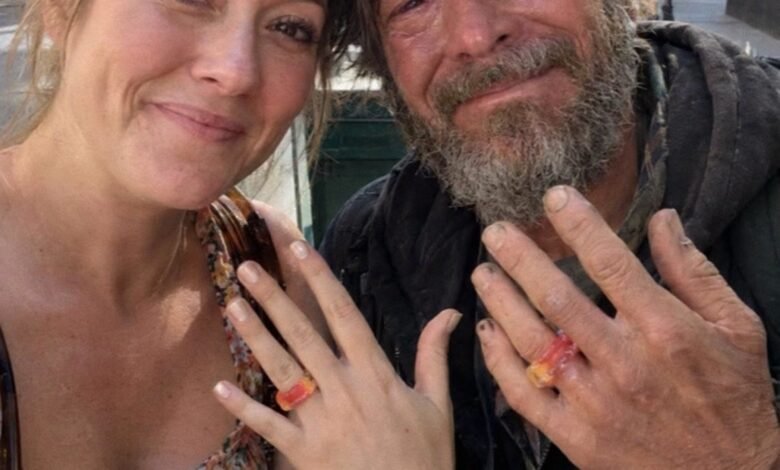
A Simple Coffee Routine That Became an Unexpected Marriage
For two years, Sarah had seen Larry almost every weekday morning outside her subway station.
He was usually sitting near the entrance with a piece of cardboard across his knees, drinking black coffee from the nearby kiosk. Sarah always ordered two coffees: one for herself with cream and one for Larry, who preferred his black.
Their relationship had never been complicated.
They talked about the weather. Larry made jokes about pigeons. Sometimes he commented on Sarah’s office shoes, teasing that they looked as though they had been designed by someone who disliked feet.
Their conversations were short because Sarah was usually on her way to work. Five minutes was often all she could spare.
But those five minutes mattered.
Larry never demanded anything from her. He didn’t constantly ask for money or make her feel obligated to stop. Instead, their connection developed through small conversations and familiar routines.
Then, one freezing Tuesday morning, everything changed.
Larry looked noticeably worse than usual. His hands were trembling when Sarah handed him his coffee, and his appearance immediately concerned her.
Then she noticed the cardboard sign resting across his knees.
It contained a message that Sarah never expected to see:
“MARRY ME. I HAVE ONE MONTH LEFT TO LIVE.”
At first, she thought it had to be some kind of strange joke.
It wasn’t.
Larry Had Received Devastating News
When Sarah asked what the sign meant, Larry explained that a clinic had told him he had approximately one month left to live.
He had liver failure.
The news left Sarah stunned.
She sat beside him on the cold concrete, trying to understand what he was saying.
Larry, however, still managed to make a joke. When Sarah looked at him with sadness, he told her not to make the face people make when they are already attending someone’s funeral.
Even in a frightening moment, Larry was still Larry.
But his request was serious.
He explained that he did not want to die without anyone who could formally claim responsibility for his remains.
For Larry, the issue was not simply about companionship. It was about what would happen after his death.
He did not want to become another unidentified person whose final arrangements were handled entirely by strangers.
“I just want somebody who can say, ‘He’s mine. I’ll take him,’” he told Sarah.
It was an extraordinary request.
Sarah was single.
Larry was dying.
And somehow, she found herself considering it.
Why Sarah Said Yes
Sarah later reflected that she had always been better at solving problems than walking away from them.
That characteristic had shaped her relationship with Larry for years.
She had brought him coffee and food. She had given him socks. She had provided phone numbers for shelters. Once, when temperatures fell dangerously low, she spent part of her lunch break calling around to find an available shelter bed.
Helping Larry had become part of her routine.
So when he presented her with what appeared to be an urgent final problem, Sarah responded in the way she knew best.
She tried to solve it.
Two days later, they went to the courthouse.
Larry wore a clean blue shirt that someone at the shelter had given him. Sarah wore her navy work dress.
The ceremony was simple.
When the clerk asked about rings, Larry checked his pockets and joked that he had forgotten something.
Sarah laughed.
Eleven minutes later, they were legally married.
It was not a traditional love story.
There was no elaborate proposal, no large wedding, and no long engagement.
There were simply two people standing in a courthouse, making a decision neither of them could have expected when they first met outside a subway station.
Three weeks later, Sarah was sitting beside Larry at a state hospice facility as his breathing slowly stopped.
Their marriage had lasted only three weeks.
But the story was not finished.
Six Days After the Funeral, a Letter Arrived
Larry’s letter arrived six days after his funeral.
It was inside a thick white envelope, and Sarah immediately recognized the shaky handwriting from his hospice paperwork.
At first, she smiled.
She assumed it was a goodbye letter.
Larry had always thanked her repeatedly for even the smallest acts of kindness. Sarah imagined that the letter would be his final expression of gratitude.
Instead, the first sentence unsettled her.
“Sarah, I need to apologize before I thank you.”
She read it twice.
Then came another sentence:
“Nobody was going to bury me as a John Doe.”
Sarah’s blood ran cold.
She sat down.
Something about the letter told her that the story Larry had given her before their marriage was incomplete.
The Truth Behind His Request
Sarah continued reading.
Larry admitted that his liver failure was real.
The diagnosis was real.
The limited time was real.
But the reason he had asked her to marry him was not entirely true.
His arrangements had already been handled.
He knew that hospice personnel or county officials would deal with the paperwork after his death.
He was not actually going to disappear without a name.
The revelation left Sarah angry.
Larry was dead.
There was no opportunity to confront him.
No phone call.
No argument.
No chance to ask why he had manipulated the situation.
Then she reached the sentence that hurt her most.
Larry explained that he had given Sarah a problem because he knew she would solve it.
And he was right.
For two years, Sarah had been helping him.
She had brought coffee.
She had brought food.
She had found socks.
She had searched for shelter information.
She had always tried to fix whatever problem she could see.
Now she wondered whether Larry had quietly learned exactly how to ask her for something.
One Final Instruction
At the bottom of the letter, Larry gave Sarah an instruction.
He told her to return to the courthouse where they had married.
He told her to ask for a woman named Margaret.
And he told her to explain that she was his wife.
Sarah almost threw the letter away.
Instead, she went to the courthouse.
The familiar building suddenly looked different.
Couples sat in plastic chairs waiting for their own ceremonies. A woman in a white jumpsuit adjusted her lipstick while her fiancé held a bouquet. A small child crawled beneath chairs as his father tried to catch him.
Sarah remembered sitting in that same courthouse with Larry only three weeks earlier.
She remembered his nervous hands.
At the time, she had assumed his shaking was caused by his illness.
Now she wondered what else she had misunderstood.
Margaret Knew Larry
At the records counter, Sarah asked for Margaret.
An older woman wearing red glasses looked up.
When Sarah introduced herself as Larry’s wife, Margaret immediately recognized the name.
Her hands stopped over the keyboard.
Then she stood and hugged Sarah.
Margaret knew Larry was sick, but she had not realized how close to the end he was.
Then Sarah asked the question that had been bothering her.
“How did you know Larry?”
Margaret gave an answer Sarah never expected.
Larry had worked at the courthouse.
Not for a few months.
Not for a few years.
For 28 years.
Sarah struggled to understand.
How could a man who had worked in the courthouse for nearly three decades end up sitting outside a subway station?
Margaret explained that Larry’s health had failed after he retired. Medical bills had consumed his savings, and eventually he lost his apartment.
But there was another important detail.
Larry had worked primarily with marriage licenses.
Larry Had Witnessed Hundreds of Weddings
Margaret led Sarah into a small civil ceremony room.
Sarah immediately recognized the wooden arch where she and Larry had been married.
But Margaret had another story to tell.
The afternoon before Sarah’s wedding, Larry had returned to that room.
He had sat there alone for nearly an hour.
He told Margaret that he was nervous.
That surprised her.
After all, Larry had spent 28 years around weddings.
He had seen countless couples stand before the same desk.
He had watched strangers arrive as two separate people and leave as legally connected spouses.
Margaret had joked about his nerves.
But Larry had simply looked at the wedding arch and said that the next day he would be standing on the other side of the desk.
Sarah suddenly remembered his trembling hands.
Maybe it had not been entirely about his illness.
Maybe the ceremony had meant more to him than she realized.
Then Margaret opened a binder.
His Name Was Everywhere
Inside were old marriage records.
Sarah saw a couple’s names at the top of a document.
Near the bottom was a signature she recognized immediately.
Larry.
Beside the signature was one word:
Witness.
Margaret turned another page.
Another couple.
Another date.
Another signature.
Larry.
Witness.
Then another.
And another.
Different couples.
Different years.
The same handwriting.
Sarah asked what she was looking at.
Margaret explained that many people came to the courthouse without anyone else present. When they needed a witness, Larry would sometimes step out from behind the counter and sign for them.
He had apparently hated the idea of someone getting married without anybody standing beside them.
He had been a witness for countless strangers.
His name appeared again and again.
But never as someone’s husband.
Until Sarah.
For the First Time, Larry Was the Spouse
Margaret eventually closed the binder.
Sarah asked whether Larry had ever been married.
Margaret answered:
“Once.”
Sarah waited for the name.
Margaret looked directly at her.
“You.”
Sarah sat down.
For decades, Larry’s name had appeared beside the word witness.
He had spent years helping strangers make their marriages official.
But when his own name appeared on a marriage certificate, the word next to it was different.
Spouse.
Margaret then showed Sarah another document Larry had asked her to keep.
It was a copy of Sarah and Larry’s marriage certificate.
Their names were printed clearly.
Sarah remembered Larry carefully folding his own copy after the ceremony.
She remembered teasing him because he was acting as though their courthouse marriage were a real wedding.
Larry had smiled and told her it was his first marriage and that she should let him be nervous.
At the time, she had laughed.
Now the memory carried an entirely different meaning.
Margaret Could Not Give Sarah Every Answer
Sarah explained Larry’s letter to Margaret.
She told her about the claim that his final arrangements were already handled.
She told her that Larry had admitted making the situation sound more urgent because he knew Sarah would help.
Margaret did not try to excuse him.
She told Sarah that what Larry had done was not fair.
But she also offered another perspective.
Larry, she explained, had always been better at asking for practical help than asking someone to choose him.
That sentence stayed with Sarah.
Maybe Larry had not simply wanted someone to handle his funeral arrangements.
Maybe he had wanted to experience something he had spent decades watching other people experience.
He wanted to know what it felt like to be chosen.
The Letter Explained What the Courthouse Could Not
Sarah left the courthouse carrying Larry’s letter and a copy of their marriage certificate.
But she still had more pages to read.
Instead of immediately going home, she got off the subway at Larry’s old stop.
She returned to the coffee kiosk.
The woman working there recognized her.
“Two?” she asked.
Sarah almost said yes automatically.
She looked toward the empty place where Larry used to sit.
Then she nodded.
The woman handed her a coffee with cream and another black coffee.
Sarah carried both outside.
For the first time in two years, she sat in Larry’s usual place.
She put his coffee beside her and opened the next page of the letter.
Larry’s Final Explanation
Larry wrote that he did not need a wife to make his life matter.
But he wanted to know what it felt like to have somebody choose the word “wife” with him.
Sarah stopped reading.
She had expected another explanation.
Instead, she found something much more personal.
Larry admitted that he had made the situation easier for Sarah by turning loneliness into paperwork.
He acknowledged that she had a right to know the truth.
And he apologized.
Sarah whispered that he should have told her.
The letter continued.
Larry explained that Sarah had always wanted to fix things for him.
He joked that she had driven him crazy with her constant efforts to solve every problem.
Sarah smiled through her tears.
During their three weeks of marriage, she had brought him socks, a phone charger, a blanket, and enough toiletries to last for months.
Every hospice visit began with Sarah arriving with something in her hands.
And every time, Larry told her to sit down.
She always answered that she would sit down in a minute.
There was always another form.
Another nurse.
Another problem.
Something else to fix.
Then Larry wrote the sentence that finally made Sarah laugh.
He told her he had not needed better socks nearly as much as she thought he did.
What Larry Really Needed
The next line was simpler.
He needed Sarah to sit down.
That was all.
Not another purchase.
Not another phone call.
Not another problem solved.
Just her presence.
Sarah remembered their final Tuesday together.
She had brought his coffee.
Larry had asked whether she was staying.
She told him she had five minutes.
He joked about her generosity.
She stayed for twelve.
Twelve minutes.
It suddenly felt like one of the most meaningful gifts she had ever given him.
“You Were Not My Failed Rescue”
Larry’s final words changed how Sarah understood their relationship.
He asked her not to turn him into another person she had failed to save.
Sarah realized that was exactly what she had been doing since his death.
She had been replaying every decision.
Wondering whether she should have found better doctors.
Wondering whether she should have found better housing.
Wondering whether she could have done more.
But Larry rejected that idea in his letter.
He told her she was not his failed rescue.
She had been his wife for three weeks.
And he had liked it.
Sarah laughed through her tears.
She called him an idiot.
It was perhaps the most honest goodbye she could have given him.
A Different Kind of Goodbye
When Sarah finished the letter, she folded it around the copy of their marriage certificate.
For most of Larry’s adult life, his name had appeared beside one word:
Witness.
For three weeks, it had appeared beside another:
Spouse.
Those three weeks did not erase the complicated circumstances surrounding their marriage.
Larry had not been completely honest with her.
Sarah had every reason to feel hurt.
But the letter gave her another way to understand the man she had known for two years.
Larry had spent decades standing beside strangers while they promised to share their lives.
He had signed their documents.
He had watched them leave the courthouse together.
And after losing his home, his savings, and much of the stability he once had, perhaps what he wanted most was not someone to manage his final paperwork.
Perhaps he wanted to experience, even briefly, what it felt like to belong to someone.
A Stranger Sat Beside Sarah
As Sarah sat outside the station, a man with a worn backpack approached.
He asked whether the empty seat beside her was taken.
Her first instinct was caution.
Then she remembered Larry.
She told him no.
The man sat down.
Sarah almost asked whether he needed coffee.
Instead, she remembered something Larry had written near the end of his letter.
Before trying to fix someone’s life, ask what they actually want.
So Sarah simply introduced herself.
The man’s name was Jeremy.
For a few moments, they watched people hurry toward the subway station.
Sarah held Larry’s black coffee.
She eventually realized something.
She did not have to become Larry’s replacement.
She did not have to solve every stranger’s problems.
She could simply begin by listening.
One Last Coffee
Sarah returned to the kiosk.
The woman behind the counter asked whether she wanted another black coffee.
Sarah shook her head.
This time, she asked for cream.
She returned to the bench with Larry’s letter and their marriage certificate beside her.
For once, she was not rushing anywhere.
The black coffee had belonged to Larry.
The memories belonged to both of them.
But the coffee in Sarah’s hands finally tasted like hers.
And perhaps that was the quiet lesson Larry had left behind.
Sometimes helping someone does not mean solving their entire life.
Sometimes it means sitting beside them.
Sometimes it means listening.
And sometimes, even a relationship that lasts only three weeks can leave behind a memory that remains for years.