Part 1: The Morning Everything Fell Apart
“What the hell do you mean you were helping somebody?”
Gavin Mercer’s furious voice echoed through the advertising agency, silencing conversations and drawing the attention of nearly everyone in the office.
I stood outside the conference room with my laptop bag hanging from one shoulder. My tie was crooked, my breathing was uneven, and my hands still trembled from the frantic drive to work.
Inside the conference room, the presentation I had spent most of the previous night preparing remained frozen on the large monitor.
The clients were gone.
Our biggest potential account of the year had walked out before I arrived.
“I had an emergency,” I explained. “A woman collapsed beside Route 18. She was struggling to breathe, and I stayed with her until the ambulance arrived.”
Gavin stared at me as though I had just confessed to something unforgivable.
“Was it your wife?”
“No.”
“Your mother?”
“No.”
He gave a short, bitter laugh.
“So you missed an eight-thirty presentation because a complete stranger needed help?”
“She collapsed in front of me. I couldn’t just leave her there.”
“Yes, you could have.”
The words struck harder than I expected.
For nearly four years, I had given Mercer & Field everything I had. I had worked weekends, rescued failing campaigns, soothed angry clients, and answered late-night calls whenever a project threatened to fall apart.
I had stayed after closing so often that the cleaning staff knew my daughters’ names.
Yet Gavin seemed to believe that none of it mattered.
“We lost the account,” he continued. “Do you understand what that means for this company?”
“I understand. I’m sorry about the presentation, but what was I supposed to do? Drive past someone who might have been dying?”
“Yes,” he answered coldly. “You were supposed to remember that you had a responsibility here.”
For a moment, I couldn’t speak.
Then he pointed toward the hallway.
“Pack your things, Christopher. You’re done.”
I waited for him to reconsider. I expected him to acknowledge the years I had devoted to his company or at least allow us to discuss what had happened.
Instead, he turned away.
I returned to my desk, gathered the photographs of my daughters, my notebook, a painted coffee mug, and the headphones Sophie had given me for Father’s Day.
Nobody stopped Gavin.
A few coworkers looked uncomfortable, but most remained silent.
Outside, the morning sunlight seemed painfully bright. I climbed into my car, locked the doors, and gripped the steering wheel.
Then I screamed.
I was thirty-eight years old, divorced, responsible for two daughters, and suddenly unemployed.
I had no new job waiting for me. No guarantee of severance. No immediate solution for the mortgage, school tuition, insurance, or the ordinary bills that would arrive regardless of what had happened.
I had simply done what I believed was right.
And it had cost me the life I thought I had built.
What I didn’t know was that the woman I had helped that morning was about to walk into the same office and change everything.
Part 2: The Stranger on Route 18
The incident had happened less than two hours earlier.
I was driving toward the agency when I noticed a dark sedan stopped on the shoulder of Route 18.
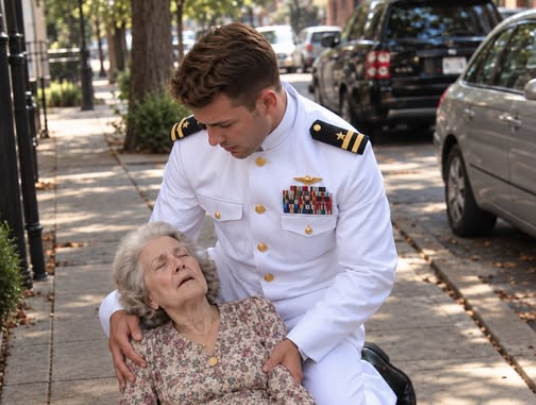
An elderly woman stood beside the driver’s door, one hand gripping the frame and the other pressed against her chest.
At first, I assumed she was searching for something inside the car.
Then her knees buckled.
The SUV ahead of me slowed but continued moving. A van passed her without stopping.
For one uncomfortable second, I considered the presentation.
Gavin had warned us repeatedly that this account could determine the agency’s financial future. He expected everyone to be punctual, prepared, and available.
I glanced at the clock.
Then I looked in the rearview mirror.
The woman had fallen out of sight.
I pulled over.
I called emergency services, followed the dispatcher’s instructions, and stayed beside her until help arrived. She was frightened and struggled to remain focused, so I kept talking.
I told her about my daughters, Sophie and Lucy. I complained about the traffic. I mentioned a disastrous school science project involving glitter and a kitchen table.
Anything that encouraged her to keep responding.
When the paramedics arrived, I answered their questions and watched as they took her to the hospital.
Only after the ambulance departed did I realize how late I was.
I drove to work knowing Gavin would be furious.
I simply hadn’t imagined that he would fire me.
After leaving the agency, I sat in my car for nearly twenty minutes before driving to a small diner I used to visit with my former wife, Sarah.
The restaurant hadn’t changed much. The red booths were worn, the coffee was terrible, and Marlene, the longtime waitress, still remembered nearly every regular customer.
She approached my table carrying a coffee pot.
“You look like somebody stole your dog.”
“Worse.”
“Job?”
I nodded.
“Today?”
“About an hour ago.”
I explained what had happened.
Marlene stopped pouring coffee and stared at me.
“He fired you because you helped someone?”
“Apparently, business obligations are more important than human beings.”
She shook her head.
“Sometimes people do you a favor by showing you exactly who they are.”
I wanted to believe her.
Unfortunately, wisdom doesn’t pay a mortgage.
I opened my laptop and started searching for positions in marketing, advertising, and account management. Every job listing looked possible until I remembered how competitive the market had become.
My phone rang.
Sarah was calling about the girls.
“Hey,” I answered.
“Chris, what’s wrong?”
“Nothing.”
“You sound terrible.”
I looked out the diner window.
“I lost my job.”
Silence followed.
“What happened?”
I told her.
She listened without interrupting, then asked the question I had been dreading.
“What about the mortgage?”
“I’ll figure it out.”
“And tuition?”
“I know.”
“I’m not asking to make you feel worse.”
“I know, Sarah. I’m sorry.”
Her voice softened.
“You always figure things out, Chris.”
After we ended the call, I stared at the blank document on my screen.
I wanted to believe her.
Then my phone rang again.
This time, it was Nina, the agency’s receptionist.
“Chris, where are you?”
“Why?”
“You need to come back.”
“No, I don’t.”
“Please listen. The woman you helped this morning is here.”
I sat upright.
“She’s okay?”
“She says she’s feeling better. But she keeps asking for you.”
“Tell her I’m glad she’s all right.”
“Chris, there are three other people with her.”
“Family?”
“I don’t think so. One is an attorney. And I heard someone mention Halston Capital.”
The name immediately caught my attention.
Halston Capital was a major investment organization involved in acquisitions, commercial property, and industrial businesses. Its founder, Eleanor Halston, was frequently featured in business publications.
“What does Halston Capital have to do with her?”
“I don’t know. But Gavin is in Conference One with them.”
“And?”
Nina lowered her voice.
“I’ve never seen him this frightened.”
Twenty-five minutes later, I returned to the agency.
I told myself I was there only to collect the rest of my belongings.
But when I entered reception, conversations stopped. Employees who had avoided looking at me earlier now watched with undisguised curiosity.
Nina pointed toward the conference room.
“She wants to see you.”
Through the glass, I recognized the woman from Route 18. Her silver hair had been brushed, and she stood beside the table looking composed and alert.
When she saw me, she immediately walked over.
“Christopher?”
“Yes.”
She took both my hands.
“You came back.”
“I heard you were asking for me. How are you feeling?”
“Better, thanks to you.”
“You don’t owe me anything. I’m just glad the ambulance got there in time.”
She looked toward the office.
“Did something happen after you left me?”
I hesitated.
“Nothing important.”
“Christopher.”
I looked down.
“I was late for a meeting. My boss wasn’t happy.”
“Was that why you were fired?”
I didn’t answer.
Her expression hardened.
“What is your boss’s name?”
“Gavin Mercer.”
She turned toward him.
“Mr. Mercer, would you care to explain?”
Gavin approached with an uncomfortable smile.
“Mrs. Halston, I believe this is a misunderstanding.”
Eleanor Halston.
The recognition hit me.
The woman I had helped on the roadside was one of the most influential business leaders in the region.
“I didn’t recognize you,” I admitted.
“Good,” she replied. “That means you helped me because I needed help, not because of my name.”
Then she turned back to Gavin.
“Tell me why Christopher was carrying a box when I arrived.”
Gavin swallowed.
“He missed a critical client presentation.”
“Because he stopped to help me.”
“He neglected his professional responsibilities.”
Eleanor looked at him for several seconds.
“Let me make sure I understand. You dismissed an employee because he stopped when another human being was in medical distress?”
“It was a business decision.”
“Then let’s discuss business.”
One of her attorneys opened a folder.
“Halston Capital has been conducting due diligence on Mercer & Field for a potential acquisition,” Eleanor explained. “The preliminary valuation was approximately eighteen million dollars.”
A murmur spread through the office.
Gavin straightened.
“Mrs. Halston, that process is confidential.”
“It was.”
She turned toward her attorney.
He closed the folder.
“Halston Capital is terminating the acquisition negotiations effective immediately.”
Gavin’s face went blank.
“You can’t be serious.”
“I am.”
“Because of one employee?”
“No,” Eleanor replied. “Because of the leadership decisions that revealed themselves today.”
She looked around the office.
“An organization is more than its financial statements. It is the people who build it, the people who serve its clients, and the decisions its leaders make when circumstances become inconvenient.”
Gavin attempted to defend himself, but every explanation sounded weaker than the one before.
Finally, Eleanor looked at me.
“Christopher, I’d like you to visit my office on Monday.”
“Why?”
“To discuss an opportunity.”
“I’m an advertising professional, not an investor.”
She smiled.
“Then we have something to talk about.”
I accepted her business card, still uncertain what any of it meant.
Then one of her attorneys hurried back into the room.
“Mrs. Halston, we have another problem.”
“What is it?”
“Confidential acquisition documents were accessed from this office last night.”
He glanced at a report on his tablet.
“The transfer was recorded under Christopher Bennett’s user profile.”
My stomach tightened.
“That is impossible.”
Gavin looked at me, then at Eleanor.
And for the first time, I realized that losing my job might be the least of my problems.
Part 3: The Files on My Computer
My laptop was still sitting on my desk.
Daniel, one of Eleanor’s senior associates, instructed me not to touch it until their cybersecurity specialist could examine the activity logs.
Gavin immediately tried to distance himself from the situation.
“Christopher has nothing to do with confidential documents,” he said.
Daniel looked at him.
“Then the investigation should establish that.”
The specialist connected remotely and reviewed the machine’s recent activity.
Several minutes later, he identified an unfamiliar folder named HALSTON_DUE_DILIGENCE_FINAL.
I had never seen it before.
The folder contained confidential documents connected to the proposed acquisition.
The transfer had occurred at 11:42 p.m. the previous night, using my employee profile.
Gavin crossed his arms.
“Well, there you go.”
I turned toward him.
“You were in the office last night.”
He frowned.
“What?”
“You came into my office after eleven-thirty. You asked whether I was almost finished with the Whitcombe presentation.”
“I don’t remember that.”
“You were wearing your gray coat. You said your wife was angry because you’d missed dinner again.”
His expression tightened.
Daniel asked the specialist to determine whether an external storage device had been used.
The answer came quickly.
“Yes. The files were transferred using a removable drive.”
“Can you identify it?” Daniel asked.
“We have its serial number.”
Gavin suddenly became restless.
When Daniel requested that the agency’s IT manager check his office computer, Gavin protested that nobody had permission to search his desk.
Eleanor remained calm.
“Then you should have no reason to fear what they find.”
A short time later, the IT manager returned carrying a small black flash drive.
It had been connected to Gavin’s desktop computer.
Gavin claimed he had never seen it before.
However, its serial number matched the device used to transfer the confidential files onto my laptop.
The room fell silent.
Eleanor instructed her attorneys to preserve the evidence and contact the appropriate authorities.
Under questioning, Gavin eventually admitted that someone had approached him about obtaining information concerning the acquisition.
He claimed he had believed the documents would be used as leverage in negotiations, not to frame another employee.
He identified the intermediary as Richard Field, Mercer & Field’s former managing partner.
But Richard arrived later that afternoon and denied authorizing the disclosure.
He still owned a substantial minority stake in the agency and had withdrawn from daily operations years earlier because of disagreements with Gavin over the company’s management.
Richard reviewed the evidence, then addressed Gavin directly.
“You weren’t protecting this company. You were protecting yourself.”
Gavin’s face reddened.
“You have no idea what I’ve been dealing with.”
Richard remained composed.
“I know you dismissed a talented employee for helping someone in danger. And now we’re discussing confidential files placed on his computer.”
He produced a copy of the company’s shareholder agreement.
Its misconduct provisions allowed executive authority to be suspended when a leader’s actions threatened the business or exposed it to serious legal risk.
Richard announced that Gavin would be suspended pending a formal investigation.
For the first time that day, Gavin had nothing to say.
I expected the situation to settle.
Instead, Daniel received another call.
He listened carefully, then turned toward Eleanor.
“The emergency call reporting your location was placed before Christopher arrived.”
Eleanor frowned.
“I thought Christopher called the ambulance.”
“He did. But another caller contacted dispatch approximately ninety seconds earlier.”
“Who?”
“The caller hasn’t been identified.”
“Why is that significant?”
Daniel hesitated.
“Because the report gave your exact location before you collapsed.”
The room became very quiet.
Until then, we had assumed Eleanor’s medical emergency was unrelated to the confidential documents.
Now the possibility emerged that somebody had been watching her movements.
And the investigation was beginning to suggest that the roadside incident might not have been as random as we had believed.
Part 4: The Photographs in the Safe
Eleanor’s security team reconstructed her movements that morning.
She had visited a bakery she regularly frequented before driving toward her office. She began feeling unwell on Route 18 and stopped near mile marker twenty-two.
The medical team found evidence consistent with an underlying cardiac condition. Nothing established that her episode had been deliberately caused.
That distinction mattered.
An unexplained emergency was not proof of a crime.
However, the anonymous caller’s knowledge of her location deserved investigation.
Eleanor eventually remembered telling her granddaughter, Claire, about her plans the previous evening.
Claire was married to Marcus Vale, a property developer whose businesses had received substantial financing from funds connected to Halston Capital.
Daniel had been reviewing several of Marcus’s projects during the acquisition process.
Some appeared overvalued, and investigators were examining transactions that might have diverted money away from their intended purposes.
The figures were serious, but the evidence still needed to be verified.
Then Claire arrived at the agency.
“Grandma!”
She hurried toward Eleanor and embraced her.
After confirming that her grandmother was safe, Claire explained that Marcus had told her Eleanor was at the office.
Daniel asked how he had learned about the incident.
Claire hesitated.
“He left the house before sunrise,” she said. “When he came back, his shoes were covered in mud.”
“Did he explain where he’d been?” Daniel asked.
“He said he’d visited a construction site.”
She looked down.
“Then he burned his coat.”
Eleanor’s expression changed.
“Claire, why didn’t you tell me this earlier?”
“Because I didn’t know what it meant.”
Claire reached into her handbag and removed a small envelope.
“I found this in Marcus’s safe last week.”
She spread several photographs across the conference table.
They showed Eleanor leaving restaurants, entering buildings, and driving along familiar routes.
The collection looked like a record of her movements.
Then I noticed one photograph that made my stomach tighten.
It appeared to show me kneeling beside Eleanor on Route 18.
But I had never seen the picture before.
Daniel enlarged it on his computer.
The man in the photograph wore a charcoal coat similar to mine, and his hair and build looked remarkably familiar.
Then I noticed the difference.
My coat had a small tear near the right cuff.
The man in the picture had no tear.
“That isn’t me,” I said.
Claire looked shocked.
“Marcus told me the photograph was proof that you had met Eleanor before the emergency.”
“But I hadn’t.”
Daniel examined the image’s metadata and requested that investigators preserve the original files. We could not yet determine who had created the photograph or when it had been taken.
Still, the possibility was disturbing.
Someone had apparently been collecting images of Eleanor’s movements and preparing a misleading account of what happened on Route 18.
Then Claire asked me a question.
“Christopher, were you adopted?”
“Yes.”
“What was your surname before the adoption?”
“Vale.”
Her face drained of color.
“My husband has a relative named Thomas Vale,” she whispered. “His father once told him that Thomas had a son with a woman named Laura.”
I felt as though the floor had shifted beneath me.
“My mother’s name was Laura.”
Claire sat down.
The connection was too specific to dismiss, but it was not enough to establish our family relationship.
Investigators began checking historical records.
Several hours later, documents confirmed that my biological father had been Thomas Vale, Marcus’s older half-brother.
Thomas had died in a car accident when I was eight.
I had been raised believing that my biological father had simply disappeared from my life.
I had never known that he belonged to the Vale family.
Nor had I known that his estate included an interest in an early family real-estate partnership.
The legal documents suggested that some of those interests might have passed to his descendants. Whether I owned any current assets, and their value, would require a separate legal review.
But the discovery offered a possible explanation for Marcus’s interest in me.
If I was a legal heir to assets he had been attempting to consolidate, I could represent an obstacle to his plans.
The suspicious photographs, the confidential documents, and the anonymous emergency call were no longer isolated concerns.
Investigators began examining whether they were connected.
Part 5: The Message That Changed Everything
That evening, my phone vibrated.
The message came from an unknown number.
YOU SHOULD HAVE KEPT DRIVING.
Beneath the words was a photograph of my house.
It had been taken from across the street. Through the front window, I could see Sophie and Lucy inside.
My daughters.
My hands went cold.
I called Sophie.
No answer.
I called again.
Still nothing.
Then Lucy picked up.
“Dad?”
“Lucy, listen carefully. Go upstairs and find Sophie. Lock yourselves in my bedroom, and don’t open the door for anyone except the police.”
“Dad, what’s wrong?”
“I need you to do exactly what I say.”
I hated how frightened she sounded, but I could not afford to waste time.
Daniel contacted the authorities while Eleanor’s security team arranged transportation.
By the time we reached my neighborhood, police officers were already outside the house.
Nobody had broken in.
The girls were unharmed.
The photograph appeared to have been taken from the sidewalk shortly before the message arrived, but investigators could not immediately identify the sender.
When I finally held my daughters, the entire week seemed to collapse into that one moment.
Sophie tried to be brave.
Lucy clung to me and cried.
I held them both until my breathing steadied.
Sarah arrived soon afterward and took the girls to her home while police arranged additional precautions.
Before leaving, Sophie stopped beside the door.
“Dad, was the woman you helped worth all this?”
Her question hurt.
Not because she was wrong to ask, but because she was frightened and trying to understand why one decision had brought so much trouble into our lives.
I crouched beside her.
“Yes.”
“Even now?”
“Especially now.”
“Why?”
“Because if you ever needed help, I would want somebody to stop for you.”
She looked down.
I gently touched her shoulder.
“We can’t control what other people do. But we can decide what kind of people we want to be.”
Later that night, investigators traced the disposable phone used to send the threatening message to an abandoned construction property connected to Marcus’s business network.
Police found Marcus at the site.
He was taken into custody, and investigators recovered documents and electronic devices that they believed could be relevant to the suspected scheme.
Among the records were communications with Gavin, payment records, copies of confidential acquisition materials, and photographs relating to Eleanor’s movements.
The evidence provided investigators with a much clearer picture of what might have happened.
Gavin admitted receiving $300,000 through a consulting company connected to Vale Development. He said the money had been offered in exchange for obtaining confidential documents.
He continued to deny knowing about the roadside incident or the threatening message.
Those claims would have to be evaluated by investigators.
Marcus’s devices, meanwhile, contained material suggesting that he had attempted to build a narrative linking me to Eleanor and the confidential files.
The apparent goal was to make my actions look suspicious and create uncertainty around the acquisition process.
The plan had depended on assumptions about how people would behave.
But I had stopped my car.
I had called for medical assistance.
And I had remained with Eleanor long enough for the paramedics to arrive.
That decision had created a clear record of what I had actually done.
It had also brought me into contact with people who could help uncover the truth.
I had lost my job that morning.
But I had not lost my integrity.
And I had not lost my daughters.
Part 6: The Letter From Thomas Vale
After the immediate threat passed, I faced a different kind of uncertainty.
I still needed a job.
I still had a mortgage, school tuition, and ordinary bills.
Richard Field offered me the opportunity to return to Mercer & Field under new management. I appreciated the gesture, but I was no longer certain that I wanted to rebuild my career in the same place.
Eleanor’s invitation remained.
On Monday, I visited Halston Tower.
I expected a conventional interview.
Instead, I spent hours discussing employee retention, small-business investment, leadership, and the long-term consequences of decisions made in conference rooms.
The questions were challenging.
“What would you do if investors demanded immediate staff reductions?” one board member asked.
“I would examine the actual costs before making the decision,” I replied. “Experienced employees carry knowledge that doesn’t always appear on a balance sheet.”
“And if the numbers still demanded cuts?”
“Then I would be honest about the consequences and look for alternatives. But I wouldn’t pretend that people are interchangeable.”
Later that afternoon, Eleanor joined me in a private office.
“The position you interviewed for isn’t available,” she said.
I stared at her.
“Excuse me?”
“There was never an opening for that specific position.”
I was not amused.
“Then why did I spend six hours interviewing?”
“Because I wanted the board to meet you.”
She placed a folder on the desk.
Its cover read Halston Community Ventures — Formation Plan.
The proposal outlined a new investment platform designed to support smaller businesses that struggled to obtain traditional financing.
Family-owned manufacturers.
Independent restaurants.
Rural service providers.
Local companies with promising operations but limited access to capital.
“I want you to lead it,” Eleanor said.
I shook my head.
“I have no private-equity experience.”
“You can hire an experienced investment team.”
“I don’t know how to manage a portfolio worth millions.”
“You will learn. And you will have people who understand the financial side.”
“Why me?”
Eleanor leaned forward.
“Because I have spent decades hiring people who can read financial statements. I want someone at the table who remembers that those statements represent human beings.”
Her proposal included a salary, an equity arrangement, decision-making responsibilities, and a recruitment budget.
It was an opportunity far beyond anything I had imagined that morning when Gavin fired me.
I was still considering the offer when Eleanor reached into her handbag and removed an old envelope.
My name was written across the front.
Not Christopher Bennett.
Christopher Vale.
My heart began racing.
“Where did you get that?”
“Your father gave it to me twenty-six years ago.”
I sat down.
Eleanor explained that Thomas had worked with her and her husband during the early years of their business. He had been talented, impulsive, and deeply committed to helping people.
She remembered one occasion when he arrived late to a financing meeting because he had stopped to help a stranded motorist.
“He believed that a person’s inconvenience was never a good enough reason to ignore somebody else’s emergency,” she said.
I looked at the envelope.
“Why didn’t I receive this?”
“Your mother asked me not to deliver it when Thomas died. She was afraid that reopening the past would disrupt the life you had built.”
“My mother knew?”
“Yes.”
The revelation hurt.
I had spent years wondering why my biological father had disappeared. Now I was learning that he had known about me and had left a letter explaining his decision.
Eleanor apologized for keeping it.
She had promised Thomas to deliver the letter when I turned eighteen, but after my mother’s request, she had delayed.
I was thirty-eight.
Twenty years late.
I opened the envelope.
Inside was a handwritten letter.
Christopher,
If you are reading this, then you are old enough to understand something I wasn’t brave enough to explain when you were small.
I did not leave because you were unwanted.
Your mother found a man willing to become the father I had already failed to be. I believed that interfering in your life might bring you more pain than happiness.
I hope you grow into a man kinder than the men in my family.
I hope money never teaches you that another person matters less.
And when life gives you the choice between being important and being decent, I hope you choose decent.
If you ever see someone stranded on the side of the road, stop.
Your father always did.
Love,
Dad.
I read the letter twice.
Then I folded it carefully.
For years, I had interpreted my father’s absence as rejection. The letter did not erase that pain, nor did it answer every question about the choices he had made.
But it offered something I had never possessed before: his own explanation.
I finally understood that a complicated past did not have to dictate the person I became.
I signed the agreement to lead Halston Community Ventures.
Not because I suddenly believed I was an expert in finance, but because the opportunity allowed me to build something meaningful with the help of people who understood the parts I still needed to learn.
For the first time in years, I was no longer trying to prove my worth to someone who measured it only by my usefulness.
I was building a future around values I wanted my daughters to inherit.
Part 7: The Inheritance That Wasn’t Money
The following eighteen months were demanding.
We recruited an experienced investment team, established careful review procedures, and began evaluating businesses across several states.
Our first investment supported a family-owned manufacturer facing closure.
The second helped a rural medical transportation company expand its service area.
The third went to a bakery operated by two sisters who had remained profitable for fifteen years but had struggled to secure financing from traditional lenders.
Eleanor insisted that every investment committee meet at least one ordinary employee before making a decision.
That meant spending time with machine operators, receptionists, drivers, cooks, and warehouse workers.
We asked questions about equipment, staffing, customers, and the practical problems that affected daily operations.
Not every investment succeeded.
Some businesses could not recover from years of financial difficulties. Others grew, hired additional employees, and became stable parts of their communities.
We learned to be honest about both outcomes.
Meanwhile, Mercer & Field began rebuilding under Richard’s leadership. Nina became chief operating officer, and several former interns advanced into management roles.
Gavin did not return to the agency.
Claire eventually separated from Marcus and began working with a nonprofit organization that taught financial literacy to young adults.
Our relationship developed slowly.
Neither of us expected an extraordinary family connection to create instant trust. We learned about one another through conversations, shared holidays, and the ordinary moments that gradually turn strangers into relatives.
One Thanksgiving, Claire helped Sophie with her college applications while Lucy accidentally burned a tray of dinner rolls.
Eleanor watched the scene from the other side of the table.
“Your father would have loved this,” she told me.
“I hope so.”
“He would have.”
I smiled.
“You can’t know that.”
Eleanor looked at me warmly.
“I knew him.”
Years later, when Eleanor finally retired, hundreds of employees gathered for a farewell dinner.
There were speeches, photographs, and stories about the businesses she had helped build.
But when she reached the stage, she set aside her prepared remarks.
Instead, she told everyone about Route 18.
She spoke about the vehicles that had passed while she was struggling beside her car. She described the fear of being alone in a moment of medical distress.
Then she spoke about the driver who had stopped.
She did not describe me as a hero.
She simply explained that someone had seen a person in trouble and decided not to drive away.
My daughters sat beside me, listening to a story they already knew.
When the audience stood to applaud, Sophie squeezed my arm.
“Dad?”
“Yeah?”
“You’re doing the emotional dad thing again.”
“I’m allowed.”
Lucy shook her head.
“Apparently, this is going to happen forever.”
We laughed.
After the dinner, we walked toward the parking garage. Cold autumn rain began falling, and people hurried toward their cars.
Near an intersection, we noticed an elderly man standing beside a sedan with its hood raised.
He looked frustrated and thoroughly soaked.
Drivers continued past him.
Sophie stopped.
I looked at her.
She smiled and crossed the street.
Lucy sighed dramatically.
“Oh, come on. We’re going to be here forever.”
But she followed.
So did I.
The elderly man looked up as we approached.
“You folks know anything about engines?”
Sophie laughed.
“Not really.”
“Then why did you stop?”
She glanced at me before answering.
“Because you looked like you needed someone to.”
I stood beside my daughters as rain fell around us.
I thought about Eleanor on Route 18, my father’s letter, and the morning Gavin had told me to keep driving.
I had once believed that losing my job was the worst thing that had ever happened to me.
Instead, that painful morning forced me to reconsider what success meant.
It introduced me to Eleanor, uncovered secrets about my family, and led me toward work that reflected the values I wanted to live by.
But the greatest change was not a new job, a larger salary, or a possible inheritance.
It was the lesson my daughters had witnessed.
We cannot control every consequence of doing the right thing.
We cannot guarantee that kindness will be rewarded or that other people will respond with gratitude.
Sometimes, helping someone will cost us time, comfort, money, or an opportunity we desperately wanted.
But our choices still matter.
Not because they guarantee a happy ending, but because they reveal the people we are becoming.
As we helped the elderly man inspect his car, Sophie held the flashlight while Lucy called roadside assistance.
I watched them work together and thought about the words in my father’s letter.
Choose decent.
For years, I had believed that inheritance meant money, property, or a family name.
Now I understood that some of the most important things people leave behind cannot be placed in a bank account.
They are passed through examples.
A parent stops for a stranger.
A daughter sees it.
Years later, she stops for someone else.
And without a speech, a lecture, or a promise of reward, a value passes from one generation to another.
My life did not truly change when Gavin fired me.
It changed several minutes earlier, on the shoulder of Route 18.
It changed when I saw a woman in distress, pulled over, and decided that reaching the office on time was not the most important thing I could do that morning.
I had stopped because someone needed help.
And in doing so, I discovered an inheritance far more valuable than money: the chance to live by the kind of decency I hoped my daughters would carry into their own lives.
Sometimes, the most important road in your life is the one that asks you to stop moving forward long enough to help someone else.