Dolly Parton Chose a Private Burial Beside Carl Dean, Her Cousin Reveals
Dolly Parton spent much of her life in the public eye, but when it came to her final goodbye, she wanted something very different.
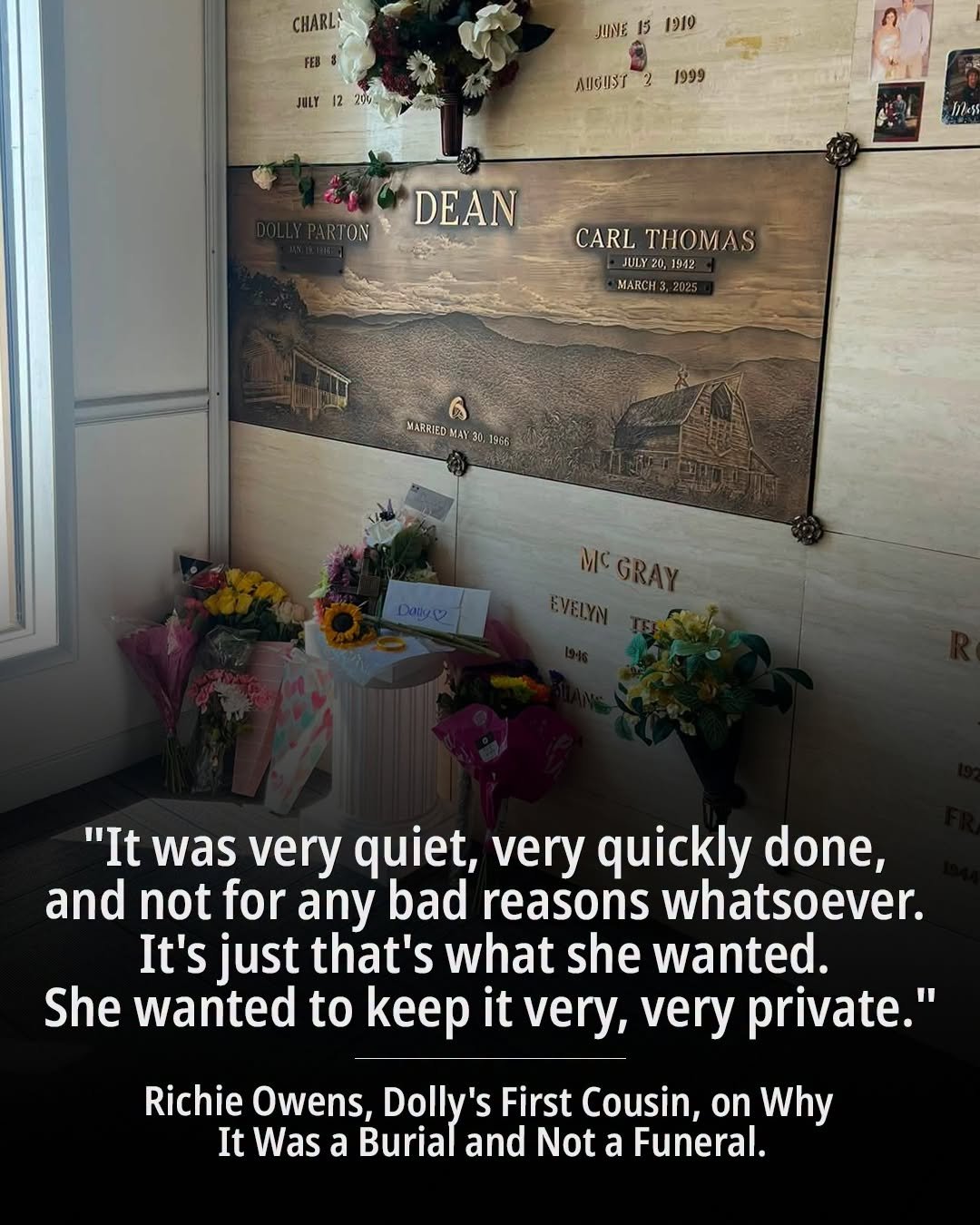
Rather than a large, star-filled funeral or a public memorial service, Parton was given a small and private burial beside her husband, Carl Dean, at Woodlawn Memorial Park and Mausoleum in Nashville. Her cousin Richie Owens recently explained that even the word “funeral” does not accurately describe what took place.
Speaking on NBC’s TODAY on September 3, Owens said Parton had made her wishes clear long before her death. She wanted the moment to be quiet, simple and limited to a small number of family members.
Parton died on August 25, 2026, at the age of 80, following a brief battle with cancer. Three days later, on August 28, family members gathered at Woodlawn for her burial beside Dean, who died in March 2025.
The decision reflects another side of a woman whose professional life was almost impossibly public. While millions of fans knew her through music, movies, television appearances and philanthropy, Parton apparently wanted her final moments to remain personal and family-centered.
Richie Owens Says It Was a Burial, Not a Traditional Funeral
Owens, Parton’s cousin and longtime musical collaborator, explained the distinction during his TODAY appearance.
He said that people continued referring to the event as a funeral, but he did not believe that was really what happened. In his description, it was primarily a burial intended to place Parton beside her husband.
Only a few family members attended.
Owens emphasized that the small gathering was not the result of conflict, disagreement or a lack of people who cared about Parton. Instead, it was simply what she had wanted.
The burial was described as quiet and very quickly completed, with the family respecting Parton’s preference for privacy.
That detail is significant because Parton’s death generated an enormous public reaction. Fans around the world mourned the singer, while fellow entertainers and public figures shared memories of her career and influence.
Yet behind all of that public attention, Parton’s family followed a much simpler plan.
Parton Was Buried Beside Carl Dean
Parton’s final resting place is beside her late husband, Carl Dean.
The couple had been married for nearly 60 years before Dean died in March 2025. Their relationship was notably private compared with the enormous amount of attention surrounding Parton’s professional career.
Dean rarely appeared publicly and generally stayed away from the entertainment industry. Parton frequently spoke warmly about their marriage while maintaining clear boundaries around their personal life.
Their final resting place now reflects that long relationship.
Parton was buried beside Dean at Woodlawn Memorial Park and Mausoleum in Nashville on August 28, just three days after her death.
For a performer who spent decades entertaining stadiums, television audiences and millions of listeners, the simplicity of the burial is particularly striking.
There was no need for a massive production.
There was no requirement for a public spectacle.
Her family simply carried out the wishes she had expressed.
Why Dolly Wanted Everything Kept Private
According to Owens, Parton had spoken about her preferences many times.
She apparently did not want an elaborate goodbye centered around flowers, large gatherings or expensive arrangements.
Instead, she wanted people to direct that money toward something she considered more meaningful: helping children through her Imagination Library.
Owens recalled that Parton had repeatedly said she would rather someone take the money they might spend on flowers and donate it to the organization.
That request is consistent with one of the most important themes of Parton’s life: using her success to create opportunities for others.
The Dollywood Foundation’s Imagination Library provides free books to young children, and the program has distributed hundreds of millions of books since its creation.
Her preference for charitable donations instead of funeral flowers therefore fits closely with the values she had promoted throughout her career.
The Imagination Library Was More Than a Celebrity Charity
The Imagination Library was established by Parton in 1995 and grew from a local initiative into an international literacy program.
The idea was straightforward: put books directly into children’s hands from an early age.
Over time, the program expanded through partnerships with local organizations and supporters. It became one of the most recognizable parts of Parton’s philanthropic work.
That makes Owens’ comments about flowers especially meaningful.
Parton was not simply asking people to avoid spending money.
She was directing attention toward a cause that had personal importance to her.
Her father, Robert Lee Parton, had limited formal education and could not read or write. Parton frequently connected her commitment to literacy with his experience.
The Imagination Library eventually became a lasting part of her legacy, reaching families far beyond Tennessee.
A Private Goodbye for a Very Public Life
There is an interesting contrast between Parton’s professional career and the way her family handled her burial.
Her career was built on visibility.
She became famous through country music, crossed into mainstream pop culture, starred in movies, appeared on television and developed major business ventures.
Her name became recognized around the world.
Yet she consistently protected certain parts of her personal life.
Her marriage was one example.
Her health was another.
And her final wishes appear to have followed the same philosophy.
Owens said Parton wanted the burial to remain very private, even though many people would understandably have wanted to attend.
That does not diminish the public’s connection to her.
Instead, it shows that Parton’s relationship with her fans and her relationship with her family were two different things.
Millions could celebrate her music.
Only a small group needed to be present when she was laid to rest.
Richie Owens Had a Long Personal Connection With Dolly
Owens was not simply a distant relative.
He was also a musician and longtime collaborator who had worked with Parton professionally.
Reports following his TODAY appearance have described him as someone who worked closely with Parton over the years, including involvement with her music and recording projects.
That personal connection gave his comments about her final wishes particular weight.
He also shared one of his final memories with Parton, involving an old guitar connected to her childhood.
His father had given Parton a small Martin guitar in 1958. The original instrument was eventually lost in a house fire, but Owens later helped locate the same model.
He worked with Martin Guitar to obtain a similar instrument for Parton.
The story became one of their final personal connections.
She Was Still Creating Music Near the End
Perhaps the most remarkable detail Owens shared was that Parton’s creative energy had not disappeared.
According to Owens, after receiving the guitar, Parton continued writing songs.
He recalled her contacting him with excitement about the music she was creating and telling him about new songs she had written.
Owens described Parton as a workaholic who remained relentless about her creativity.
That image is consistent with the working habits that defined much of her career.
Parton was not someone who treated songwriting as merely a job.
For her, writing appeared to be part of everyday life.
Even after decades of success, awards and international recognition, she continued to create.
Dolly Parton’s Songwriting Legacy
Parton’s songwriting catalog remains one of the most important parts of her career.
She wrote thousands of songs throughout her life, including some of country music’s most recognizable compositions.
“Jolene” became an enduring country standard.
“I Will Always Love You” became a worldwide hit through multiple recordings, most famously Whitney Houston’s version.
“9 to 5” connected Parton’s songwriting to her breakthrough film career and became one of her signature songs.
Her ability to write across different subjects and musical styles helped make her career unusually durable.
But her songwriting also had another important consequence: it allowed her to build long-term value from the work she created.
Parton’s understanding of music publishing became an important part of her business success.
The Business Lessons Behind Her Career
Parton’s public image was often associated with humor, warmth and entertainment.
But she also possessed a strong understanding of business.
One of the most frequently discussed examples involves Elvis Presley and “I Will Always Love You.”
When Presley considered recording the song, Parton has said that the deal would have required her to give up a significant portion of the publishing rights. She ultimately chose to keep control of her composition.
At the time, turning down an opportunity involving Elvis was an extremely difficult decision.
But decades later, the importance of that choice became clear.
Whitney Houston’s recording of “I Will Always Love You” became one of the biggest pop singles in music history, bringing enormous attention and commercial value to Parton’s composition.
The episode demonstrated why ownership matters to songwriters.
Parton’s career was therefore not only about performing.
It was also about understanding the long-term value of intellectual property.
Her Success Eventually Became a Tool for Giving
Parton’s professional achievements created financial success, but her philanthropic work demonstrated how she chose to use part of that success.
The Imagination Library is perhaps the clearest example.
Rather than creating a temporary charitable campaign, Parton helped establish a program designed to continue operating year after year.
The result was a literacy initiative that reached millions of children.
That legacy makes Owens’ comments about funeral flowers especially appropriate.
Instead of encouraging people to spend money on a traditional symbol of mourning, Parton wanted those resources directed toward children.
It is a simple request, but it says a great deal about her priorities.
The Meaning Behind a Quiet Burial
A large public funeral might have been understandable for someone of Parton’s stature.
She had millions of fans.
She had worked with some of the biggest names in entertainment.
She had received major awards and created music that crossed generations.
A major memorial could easily have attracted celebrities, musicians, political figures and thousands of members of the public.
But Parton apparently did not want that.
She wanted something smaller.
She wanted to be buried beside her husband.
And she wanted the family to keep the moment private.
Owens’ explanation suggests that the decision was not intended to make a statement or create controversy.
It was simply a personal preference that the family respected.
Fans Can Still Remember Her in Their Own Way
A private burial does not prevent fans from remembering Parton.
In many ways, her music provides a much larger public memorial than any single ceremony could have created.
Listeners can return to her recordings.
Families can continue reading books distributed through the Imagination Library.
Visitors can experience Dollywood.
Actors and musicians can continue performing her songs.
And future generations can discover the songwriting that made her famous.
That may ultimately be more fitting for Parton’s legacy than one large event.
Her work was always designed to continue.
A Final Chapter That Reflected Her Personality
The details shared by Richie Owens offer a glimpse into the woman behind the celebrity.
Dolly Parton spent her professional life in front of cameras, on stages and in recording studios.
She became one of the most recognizable entertainers in the world.
But when it came to the end of her life, she chose privacy.
Her burial was small.
Her family followed her wishes.
She was placed beside Carl Dean.
And rather than flowers, she had repeatedly encouraged people to support children through the Imagination Library.
Perhaps most remarkably, according to Owens, she was still thinking about music shortly before her death.
That detail brings her story back to where so much of it began: songwriting.
The public may remember Dolly Parton for the rhinestones, the voice, the movies, the businesses and the unforgettable songs. But the memories shared by her family reveal another side of her — someone who valued privacy, family, creativity and helping others.
Her final goodbye was not a massive production.
It was exactly what she wanted: quiet, private and centered on family.
And in a life filled with extraordinary achievements, that simple final choice may be one of the clearest reflections of the person Dolly Parton wanted the world to remember.