News
Can You Solve This Math Puzzle? One Multiplication Changes the Result
Can You Solve This Math Puzzle? One Multiplication Changes the Result

Can You Solve This Math Puzzle? Why the Answer Is 106
Some math puzzles look so simple that you want to answer right away. The numbers seem familiar, and none of the steps looks difficult.
However, a quick answer can miss one important rule.
Take a look at this challenge:
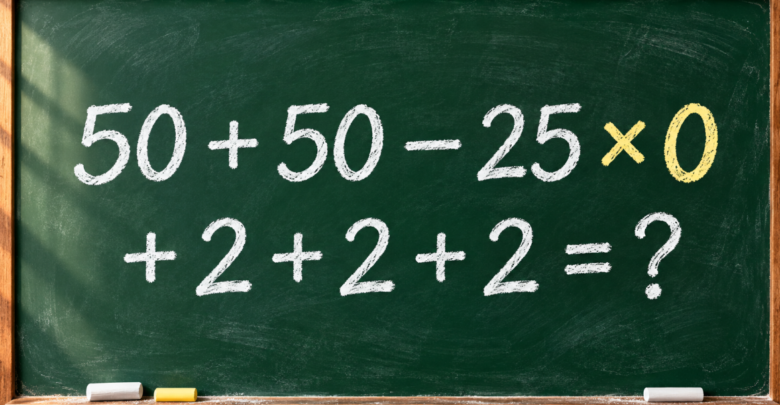
50 + 50 − 25 × 0 + 2 + 2 + 2 = ?
Can you solve it without a calculator?
Before you begin, check which operation comes first. Should you add the two fifties immediately? Does the zero cancel the whole line? Or should you focus on the multiplication?
The correct answer is 106.
If you found a different result, take a moment to review your steps. You may know how to do every calculation but still reach the wrong answer because you chose the wrong order.
Fortunately, the solution becomes clear when you work through one step at a time.
Read the Whole Problem First
Start by looking at every number and sign:
50 + 50 − 25 × 0 + 2 + 2 + 2
You can see addition, subtraction, and multiplication. However, you will not find parentheses, division, or powers in this problem.
That makes the task easier to organize.
First, locate the multiplication:
25 × 0
Next, notice the numbers outside that part. The two fifties come before it, while three twos follow it.
Keep those other numbers in place for now.
Although the line begins with addition, the order of operations tells us to complete the multiplication first.
Use the Order of Operations
The order of operations gives us a clear way to calculate the same expression consistently.
For this puzzle, remember one main rule:
Complete multiplication before addition and subtraction.
Therefore, begin with 25 × 0, even though it appears near the middle of the line.
After that, finish the additions and subtraction.
This rule prevents us from choosing a different grouping just because it feels natural to read from the left.
Reading and calculating serve different purposes here. You read the whole problem to understand it. Then you choose the first calculation according to the rule.
Once you make that distinction, the rest becomes straightforward.
Step One: Calculate 25 × 0
Any number multiplied by zero gives zero.
Therefore:
25 × 0 = 0
Put that result into the original expression:
50 + 50 − 0 + 2 + 2 + 2
Notice what changed: the multiplication became zero.
Meanwhile, every other number stayed in place.
The two fifties did not disappear. Likewise, the three twos still need to join the total.
This is the main point behind the puzzle. Zero affects the product 25 × 0. It does not erase the other terms across the addition and subtraction signs.
Now you can continue with a much simpler line.
Step Two: Add 50 and 50
After completing the multiplication, you have:
50 + 50 − 0 + 2 + 2 + 2
Only addition and subtraction remain. Since they share equal priority, work through them from left to right.
First:
50 + 50 = 100
That leaves:
100 − 0 + 2 + 2 + 2
You have reached an important point, but you have not finished yet.
The final three twos still matter.
Before moving on, compare this shorter line with the previous one. Both fifties have become 100, while the remaining signs and numbers have stayed the same.
Step Three: Subtract Zero
Next, calculate:
100 − 0 = 100
Subtracting zero leaves the amount unchanged.
Therefore, the expression becomes:
100 + 2 + 2 + 2
This small step explains why the subtraction does not reduce the final total.
You are subtracting the result of 25 × 0, which is zero. You are not subtracting 25 before multiplying.
That difference matters.
If you subtract 25 too early, you change which quantity the zero affects. As a result, you end up solving a different version of the problem.
Keep following the original signs and their correct order.
Step Four: Add the Three Twos
Finally, include the remaining numbers.
Start with:
100 + 2 = 102
Then continue:
102 + 2 = 104
One more addition gives:
104 + 2 = 106
Therefore:
50 + 50 − 25 × 0 + 2 + 2 + 2 = 106
Alternatively, combine the three twos first at this stage:
2 + 2 + 2 = 6
Then add that total to 100:
100 + 6 = 106
Both methods work because you have already completed the multiplication. Choose whichever makes the remaining addition easiest to follow.
Check the Complete Solution
Here is the full calculation in one table:
| Step | Calculation | Result |
|---|---|---|
| First | 25 × 0 | 0 |
| Next | 50 + 50 | 100 |
| Then | 100 − 0 | 100 |
| Continue | 100 + 2 | 102 |
| Add again | 102 + 2 | 104 |
| Finish | 104 + 2 | 106 |
The table shows that the answer does not require advanced math.
Instead, it requires the right order and a complete calculation.
Each number has a role. Once you account for all of them, the final result follows naturally.
Why the Whole Expression Does Not Become Zero
Seeing × 0 can tempt someone to answer zero immediately.
However, multiplication by zero only affects the quantity within that product.
Compare these examples:
8 + 3 × 0 = 8 + 0 = 8
But with parentheses:
(8 + 3) × 0 = 11 × 0 = 0
In the first example, only 3 joins the multiplication.
In the second, the parentheses group 8 and 3 together before multiplication.
Therefore, the results differ.
The original puzzle has no parentheses around the two fifties or the other additions. Consequently, those numbers do not all become part of 25 × 0.
Why Some People Answer 6
The answer 6 often comes from calculating everything from left to right.
That approach begins:
50 + 50 = 100
Then it continues:
100 − 25 = 75
Next:
75 × 0 = 0
Finally:
0 + 2 + 2 + 2 = 6
Every small calculation works on its own. However, the first two steps happen too early for the original expression.
Multiplication must come before addition and subtraction.
Therefore, the correct first step is 25 × 0, not 50 + 50.
This example shows why knowing the basic facts is only part of the task. You also need to connect the right numbers at the right stage.
Parentheses Can Make 6 Correct
A slightly different expression would give 6:
(50 + 50 − 25) × 0 + 2 + 2 + 2
Here, the parentheses tell you to calculate the enclosed part first.
That gives:
75 × 0 + 2 + 2 + 2
Then multiplication produces zero, leaving the three twos:
0 + 2 + 2 + 2 = 6
Therefore, 6 is correct for this changed problem.
However, it does not answer the original puzzle.
This comparison helps explain the mistake without making the arithmetic feel mysterious. The numbers stay familiar, but the grouping changes their relationship.
Always follow the expression that actually appears in front of you.
Remember PEMDAS as Groups
Many people learned the rules through the word PEMDAS.
It stands for:
- Parentheses
- Exponents
- Multiplication and division
- Addition and subtraction
The last two lines contain pairs.
Multiplication and division share a priority level. Likewise, addition and subtraction share another level.
Within each level, work from left to right.
If you learned BODMAS, the relevant rule here remains the same.
Since this puzzle contains no grouping symbols, powers, or division, you only need two stages: multiplication first, followed by addition and subtraction.
Understanding those stages is more useful than repeating the letters without applying them.
Use a Second Method to Confirm 106
After completing 25 × 0, you can check the remaining terms another way.
The positive amounts are:
50 + 50 + 2 + 2 + 2
Together, they make:
100 + 6 = 106
Meanwhile, the amount you subtract is zero.
Therefore:
106 − 0 = 106
This check reaches the same result without repeating every individual addition.
However, use it after dealing with the multiplication. Otherwise, you risk mixing parts of the original expression too early.
A good checking method should preserve the meaning of the problem while making the result easier to confirm.
Write Short Lines When You Feel Unsure
You do not need to solve everything in your head.
Instead, write a few clear lines:
50 + 50 − 25 × 0 + 2 + 2 + 2
= 50 + 50 − 0 + 2 + 2 + 2
= 100 + 2 + 2 + 2
= 106
Each line keeps the same value as the one above it.
As a result, you can check your work in small sections.
Look for missing numbers, changed signs, or an operation that happened too soon.
This method also helps when explaining the answer to someone else. They can follow your reasoning rather than accept a result without seeing why it works.
Discuss the Steps Instead of Comparing Confidence
If a friend reaches a different answer, ask which calculation they completed first.
That question often explains the disagreement quickly.
Someone who starts with 50 + 50 may be following reading order. Another person may believe that zero cancels every number in the line.
Rather than arguing, compare the original expression with the examples containing parentheses.
Then explain why those versions differ.
A clear discussion focuses on the written signs and the order of the steps.
You do not need to judge how quickly anyone answered. The useful outcome is understanding why one method matches the problem and another changes it.
A Simple Routine for Future Puzzles
You can use the same approach next time:
- Read the full expression. Notice every number and sign.
- Check for grouping symbols. Parentheses can change the starting point.
- Complete higher-priority operations. Handle multiplication before addition here.
- Keep untouched terms in place. Avoid dropping a number during simplification.
- Finish the remaining steps. Continue until no operation remains.
- Review the result. Check that your working still matches the original.
This routine gives you something dependable to follow.
Instead of guessing from the overall appearance, you make a sequence of small decisions that you can explain and verify.
The Final Answer Is 106
Return to the challenge:
50 + 50 − 25 × 0 + 2 + 2 + 2
First, calculate 25 × 0 = 0.
Then add the two fifties, subtract zero, and include all three twos.
That gives:
100 − 0 + 6 = 106
The zero changes one product. Meanwhile, the other terms remain part of the calculation.
If you answered correctly at once, you can now explain the reason. If you needed another attempt, you have a clear method for checking similar puzzles.
🧠 Did you get 106 on your first try? Share your answer and the first step you took in the comments!