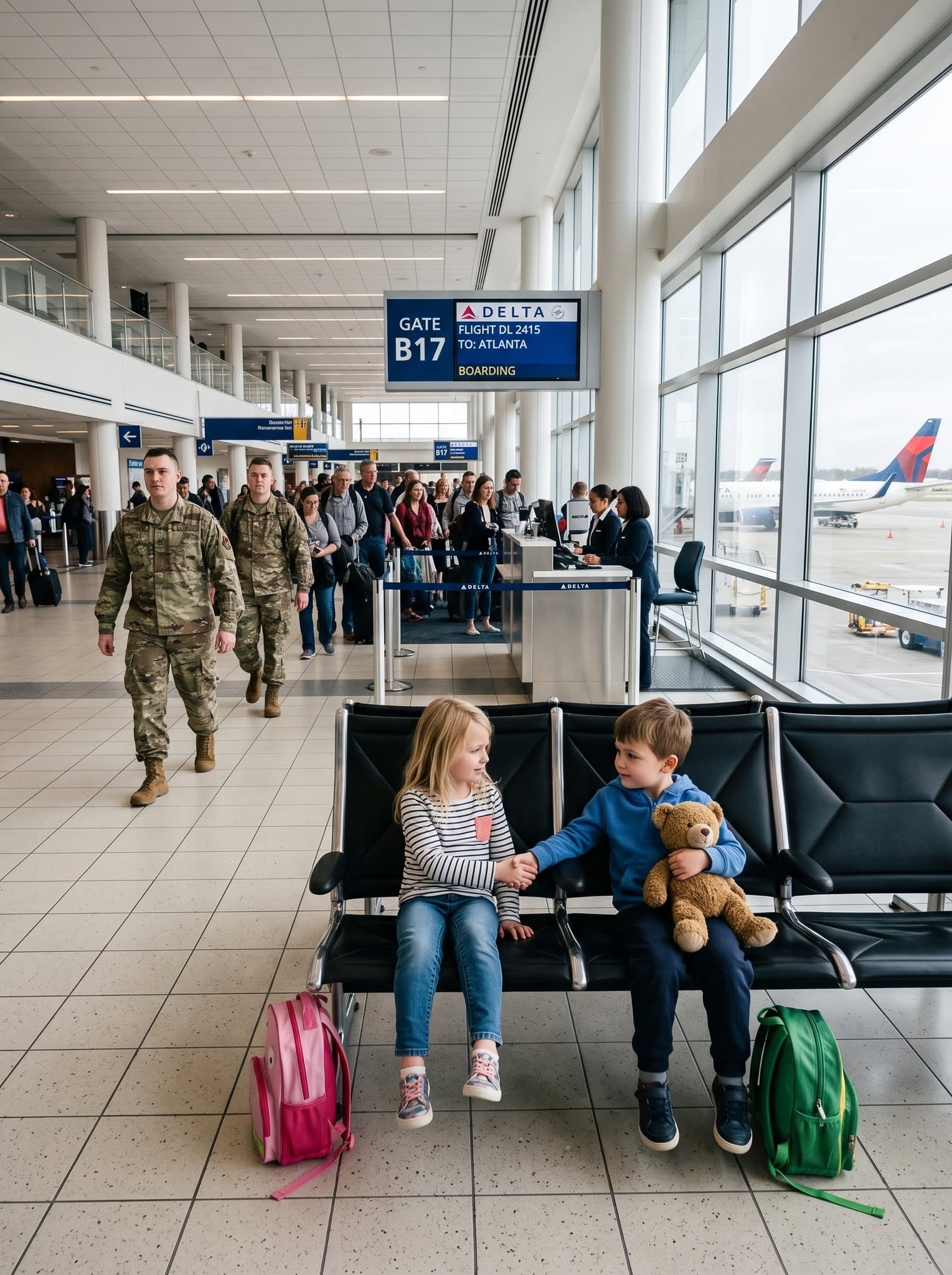
An Army Colonel at O’Hare Airport Made One Unexpected Decision — And It Changed Two Children’s Lives
A Fictional Human-Interest Story About Compassion, Responsibility, and Second Chances
The following is a fictionalized story created for entertainment and inspirational purposes. Names, events, dialogue, and circumstances are fictional.
There are moments in life when an ordinary day suddenly becomes something completely different.
For most travelers, an airport is simply a place between destinations. People arrive with suitcases, check their phones, search for departure gates, buy coffee, and hurry toward their flights. The noise is constant, the crowds are unpredictable, and everyone seems to have somewhere else to be.
But sometimes, in the middle of all that movement, someone notices something that everyone else has missed.
That is what happened in this fictional story involving an Army colonel, two young twins, and one decision that changed the direction of an otherwise ordinary evening at O’Hare Airport.
An Ordinary Afternoon at the Airport
Colonel Daniel Hayes had already spent a long day traveling.
After completing an official assignment, he was making his way through the terminal with Major Marco Ellis when something caught his attention.
Near one of the departure gates sat two young children.
They appeared to be around five years old.
The boy was holding a worn teddy bear tightly against his chest. His sister sat beside him, watching the people around them with an unusual seriousness for someone so young.
At first, Colonel Hayes assumed an adult was nearby.
Airports are full of families, and children often wait while parents handle tickets, luggage, or boarding arrangements.
But after a few seconds, something didn’t seem right.
The children were alone.
The colonel looked around the gate area.
No parent was sitting beside them.
No relative appeared to be waiting nearby.
No adult seemed to be watching them.
The children simply remained in their seats.
The Moment He Decided to Stop
Major Ellis reminded the colonel that their transportation was waiting.
They had a schedule to follow.
But Colonel Hayes stopped walking.
He had spent decades in the military learning that responsibility sometimes means recognizing when something matters more than the original plan.
He walked toward the children.
Rather than approaching them suddenly, he lowered himself to their level and introduced himself.
The little girl looked at him cautiously.
The boy kept holding the teddy bear.
“Are you waiting for someone?” the colonel asked.
The girl nodded.
But when he asked who they were waiting for, she did not immediately answer.
Finally, she quietly explained that the woman who had brought them to the airport had left.
The colonel looked toward the boarding area.
The situation immediately became more serious.
Two Children Who Didn’t Know What Would Happen Next
The children explained that the woman was not their biological mother.
Their father had died, and they had been living with their stepmother.
According to the fictional account, the children had been told to remain seated while the adult continued toward the aircraft.
They did not know where she was going.
They did not know who was coming for them.
Most importantly, they did not know whether anyone was coming at all.
Colonel Hayes contacted airport personnel.
Rather than attempting to handle the situation himself, he asked trained airport security staff and appropriate authorities to respond.
That distinction is important.
When children may be at risk, the safest response is to involve professionals who can verify identities, contact relatives, and arrange appropriate care.
Airport Personnel Respond
Within minutes, airport staff began coordinating the situation.
Security officers arrived.
A supervisor spoke with the children.
The gate staff reviewed what had happened.
The woman who had accompanied the twins was located and questioned.
Her explanation was unclear and changed several times.
The children, meanwhile, were moved to a quieter area where they could wait away from the busy terminal.
A child welfare professional was contacted.
For the twins, the most important thing was no longer the flight schedule.
It was knowing that an adult was taking responsibility for their immediate safety.
A Small Teddy Bear Becomes an Important Clue
The boy continued holding his teddy bear.
It was old and visibly worn.
The bear had clearly become a source of comfort for him.
During a conversation with the child welfare worker, the boy revealed that something was hidden inside the bear.
A small fabric flap contained an emergency contact.
It was a phone number that had apparently been placed there by the children’s father.
The contact belonged to a relative named Grace.
The discovery offered authorities a possible family connection.
However, a phone number alone was not enough.
The adults involved still needed to verify the identity of the relative and determine whether she could safely care for the children.
This is an important part of any real child-welfare situation: emotional reunions may be powerful, but proper verification and safeguarding procedures still matter.
A Relative Receives an Unexpected Phone Call
Grace answered the call.
When she learned that the twins were safe, she was overwhelmed.
She explained that she had been trying to maintain contact with the children but had lost communication with the family.
She had not forgotten them.
She had not abandoned them.
She had simply been unable to reach them.
The child welfare worker continued asking questions and verifying information.
Grace immediately began making arrangements to travel to Chicago.
She wanted to see the children as soon as possible.
But she understood that the authorities needed to complete their procedures first.
Why Patience Mattered
For the twins, everything had changed in a single day.
They had traveled to an airport expecting one thing and suddenly found themselves surrounded by unfamiliar adults asking questions.
Even people trying to help them could feel frightening.
The professionals therefore kept their conversations simple.
They offered food and water.
They provided a quiet room.
They allowed the children to stay together.
And they avoided making promises they could not guarantee.
That last point was especially important.
When children have experienced instability, adults need to be careful about making statements such as “Everything will be perfect now.”
Instead, the adults explained what was known.
Someone was coming.
The children were safe.
Professionals were working on the next steps.
One decision would be made at a time.
Grace Finally Arrives
Later that evening, Grace arrived at the airport.
She did not enter the room dramatically.
She did not demand that the children immediately run into her arms.
Instead, she sat several feet away and waited.
The twins watched her carefully.
They were unsure.
They had experienced too much uncertainty in too short a period.
Grace understood that trust could not be demanded.
It had to be rebuilt.
She talked about their father.
She remembered small details about the children.
She recognized the teddy bear.
Slowly, the children began to relax.
The Importance of Familiar Memories
One of the most touching moments in the fictional story involved the teddy bear.
Grace remembered that the children’s father had once repaired it.
The stitching was imperfect.
The thread was uneven.
But the repair had been made with care.
For the twins, that small detail was meaningful.
It connected the present moment to memories of their father.
Sometimes, emotional security does not come from expensive gifts or dramatic gestures.
It comes from familiar objects.
A photograph.
A favorite blanket.
A handwritten note.
A stuffed animal.
A familiar voice.
These seemingly ordinary things can become powerful reminders of stability during difficult transitions.
A Safe Plan for the Children
Grace’s arrival did not immediately end the situation.
The necessary checks and legal procedures still had to take place.
The children needed a safe and stable placement.
Professionals needed to confirm family relationships and evaluate the circumstances.
That process may seem slow from the outside, but when children are involved, careful decisions are essential.
Eventually, in the fictional story, Grace was approved as a temporary family placement while the broader legal process continued.
For the twins, this meant they had somewhere safe to go.
They had an adult they knew.
They had each other.
And they had a chance to begin rebuilding a sense of normality.
The Colonel’s Role Was Smaller Than It First Appeared
Colonel Hayes did not rescue the children by himself.
He did not solve every problem.
He did not become their legal guardian.
Instead, he did something much simpler.
He noticed.
He stopped.
He contacted people who could help.
And he stayed long enough to make sure the situation was being handled properly.
That is often what real compassion looks like.
It does not always require a dramatic gesture.
Sometimes it means refusing to walk past something simply because someone else might deal with it.
A Lesson About Paying Attention
Airports are designed for movement.
People are constantly going somewhere.
That makes it easy to assume that someone else is responsible for a problem.
A child sitting alone may have a parent nearby.
A person who appears distressed may simply be tired.
A confused traveler may already have someone helping them.
Most of the time, there may be an innocent explanation.
But paying attention does not mean making assumptions.
It means noticing something unusual and contacting the appropriate people when necessary.
In this fictional story, that small act of attention changed everything.
Why Responsible Intervention Matters
The story also highlights an important principle: helping someone does not mean taking control of a situation beyond your expertise.
Colonel Hayes did not attempt to investigate the family himself.
He did not confront the woman aggressively.
He did not attempt to remove the children from the airport without authorization.
Instead, he contacted airport security and child welfare professionals.
That approach allowed trained authorities to handle the case.
For readers, the lesson is straightforward: if a child appears abandoned or unsafe in a public place, contact security, law enforcement, airport personnel, or the relevant emergency services rather than trying to manage the situation alone.
A New Beginning
The twins’ story did not end at the airport.
The following weeks were filled with adjustments.
New routines had to be established.
School arrangements had to be made.
Legal matters had to be addressed.
And the children needed time to understand that their circumstances had changed.
Grace learned that rebuilding trust would happen through small, consistent actions.
If she said she would return at five, she returned at five.
If she said they were going somewhere, she explained where.
If plans changed, she told them.
Predictability became part of their recovery.
The Teddy Bear Stayed Close
The boy continued carrying the teddy bear for some time.
At first, it rarely left his hands.
Later, he began leaving it at home.
That seemingly insignificant change represented something much bigger.
He no longer needed the bear constantly beside him to feel secure.
The object remained important, but it no longer carried the entire burden of his anxiety.
The children were slowly learning that adults could leave and return.
They were learning that a goodbye did not necessarily mean abandonment.
They were learning that promises could be kept.
One Year Later
In the fictional story, nearly a year after the airport incident, Colonel Hayes visited the twins.
Their lives looked different.
There were school books on the table.
Backpacks near the door.
Shoes in the hallway.
Drawings attached to the refrigerator.
The house looked ordinary.
And that was exactly what made the moment meaningful.
The children were no longer living inside an emergency.
They were simply living.
Lily had become confident and outspoken.
Owen still loved his teddy bear, although he no longer carried it everywhere.
Grace had become a steady presence in their lives.
The family was still dealing with the past, but they were also building a future.
The Most Powerful Part of the Story
The most powerful part of this fictional story is not the airport.
It is not the military uniform.
It is not the dramatic confrontation.
It is the idea that a single moment of attention can create a chain of positive decisions.
One person notices.
Another person calls for help.
Professionals respond.
A relative is located.
A safe plan is created.
And two children receive an opportunity to begin again.
No individual solves everything.
But several people doing the right thing at the right time can make an enormous difference.
A Reminder That Small Actions Matter
Modern life can make people feel disconnected.
We rush through airports, shopping centers, highways, offices, and neighborhoods while focusing on our own schedules.
Yet every community depends on people being willing to notice one another.
That does not mean interfering unnecessarily.
It means caring enough to respond appropriately when something genuinely appears wrong.
Sometimes the most important decision of the day is simply deciding not to keep walking.
Final Thoughts
This fictional story of an Army colonel, two abandoned twins, and a teddy bear is ultimately a story about compassion and responsibility.
The colonel could have continued toward his flight.
He could have assumed another traveler would notice the children.
He could have believed that airport employees would eventually handle the situation.
Instead, he stopped.
That decision brought the children into contact with the people who could actually help them.
The story also reminds us that difficult circumstances rarely have instant solutions. Safety, trust, family reunification, and stability can require time and professional support.
Most importantly, the twins eventually discovered something that every child deserves to know:
They matter.
Their questions matter.
Their fears matter.
And when they need help, there should be adults willing to listen.
The teddy bear that once represented uncertainty eventually became something different—a reminder of their father, their childhood, and the difficult night that ultimately led them toward a safer future.
And perhaps that is the central message of the story.
You never know how much difference one compassionate decision can make.
Disclaimer: This article is a fictionalized inspirational narrative. It should not be presented as a verified news report or as documentation of an actual incident. Any resemblance to real people, places, or events is coincidental.