News
My Family Mocked Me for Being Poor at the Auction—Then I Bought the $12.5 Million Estate They Thought Was Theirs
My Family Mocked Me for Being Poor at the Auction—Then I Bought the $12.5 Million Estate They Thought Was Theirs

My Relatives Laughed When I Entered the Auction—Then I Bought the Estate They Thought I Could Never Afford
This is a fictional story. All names, characters, businesses, and events are invented.
My cousin Vanessa noticed my dress before she noticed the bidding paddle in my hand.
“Stella,” she said, glancing at the registration desk. “Are you working here?”
Her husband smiled into his coffee.
I looked down at my navy dress. I had chosen it because it was comfortable and appropriate for a long afternoon in an auction room.
“No,” I said. “I’m registered to bid.”
Vanessa laughed.
Across the room, her father, my uncle Gerald, turned toward us.
“On what?”
“Whitmore Estate.”
For a moment, nobody spoke.
Then Gerald shook his head with the patient expression he used whenever he thought someone needed correcting.
“Please don’t make a scene.”
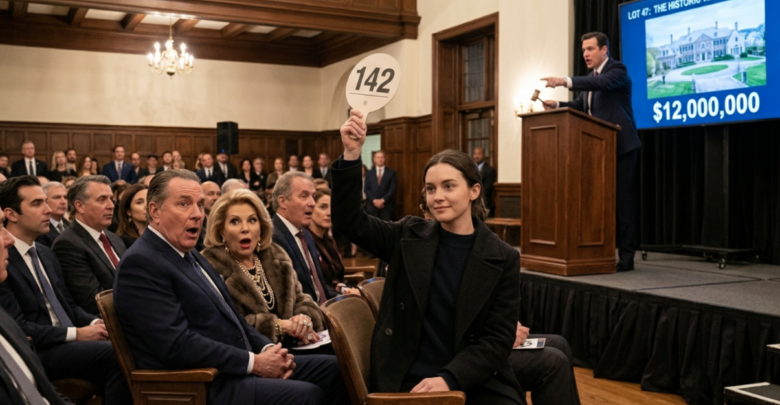
I checked the number on my paddle.
Forty-seven.
Then I took my seat.
The Family Story They Preferred
My name is Stella Whitmore.
Seven years earlier, when I was twenty-two, my parents died in an accident. In the months that followed, I worked, studied, and tried to manage a grief that made ordinary decisions feel exhausting.
My relatives remembered that period clearly.
They remembered my small apartment, my secondhand furniture, and the occasions when I declined expensive family outings.
They seemed less interested in anything that happened afterward.
Vanessa continued making remarks about my clothes. Gerald offered advice I had not requested. At gatherings, someone usually asked whether I was “still struggling.”
Eventually, I stopped giving detailed answers.
They took my silence as confirmation.
The version of me they understood had become convenient: the cousin who had very little and should be grateful to be included.
What I Had Been Building Quietly
My life had changed, although not through one extraordinary investment or a sudden inheritance.
I worked in financial analysis, then helped establish a company that provided reporting tools to businesses. The early years involved long hours, mistakes, and more uncertainty than I enjoyed remembering.
We grew because clients found the work useful.
When a larger company acquired a controlling interest, my share gave me financial freedom I had once struggled to imagine.
I continued working and maintained a diversified investment portfolio with professional support.
My apartment remained modest.
I did not buy a new wardrobe to announce that my circumstances had improved.
There were people who knew about the company and the sale. My relatives could have known too.
They rarely asked what I was doing long enough to hear the answer.
Why I Wanted Whitmore Estate
The estate had interested me long before the auction announcement.
It was a large old property with a main house, gardens, a lake, a guesthouse, and former stables. It also carried my family’s name.
I remembered visiting as a child.
My mother walked with me beneath an enormous oak near the entrance. My father took photographs beside the stone bridge.
Those memories had stayed with me, but sentiment alone was not a reason to spend millions.
For nearly two years, I studied the property.
I reviewed maintenance information, sought professional assessments, and developed a restoration budget. My attorney, Lawrence Brennan, coordinated the transaction preparations.
We established a maximum bid and reserved funds for expenses beyond the purchase.
I had come prepared to walk away.
What I had not prepared for was seeing Vanessa arrive with her parents, determined to buy the same place.
Paddle Number Forty-Seven
The early bids moved quickly.
Vanessa raised her paddle with a confidence that drew attention. Gerald leaned close to her between increments, speaking behind his hand.
When I entered the bidding, she turned around.
For several rounds, we answered one another.
The room became quieter as the figures rose.
At eleven million eight hundred thousand dollars, Vanessa looked toward her husband.
He nodded.
She bid again.
I checked my notes rather than their faces.
The property was still within the limit Lawrence and I had agreed upon.
Finally, I raised my paddle.
“Twelve million five hundred thousand.”
Vanessa’s hand moved, then stopped.
Gerald spoke urgently beside her.
The auctioneer waited.
Nobody offered another bid.
The hammer fell.
The Question They Finally Asked
I lowered my paddle.
For a few seconds, I felt only the weight of what I had agreed to buy.
There would be contracts, inspections already arranged, closing requirements, and years of work.
Then Vanessa reached my chair.
“Where did you get that kind of money?”
I put my notes into my bag.
“From my work.”
“What work?”
It was the first time she had asked without smiling.
I gave her the name of my company.
Gerald approached before she could respond.
“We need to talk about this.”
“My attorney is handling the purchase.”
“You brought a lawyer?”
“Yes.”
He looked toward the registration desk, where the auction manager was waiting.
I had expected the afternoon to be demanding.
I had not expected my relatives to find my preparation more surprising than the price.
A Message After the Auction
Lawrence called while I was outside.
We discussed the next steps and confirmed that the purchase remained subject to the transaction’s formal closing process.
Then his tone changed.
“There is something from the historical records review we need to examine.”
“What is it?”
“A reference to your mother’s branch of the family. It concerns an old financial obligation associated with the estate.”
I looked back toward the building.
Vanessa was still inside with her parents.
“Does it affect the purchase?”
“We don’t know yet. It needs careful review.”
That evening, a message from Vanessa arrived.
Dad says there are things about the property you don’t understand.
I forwarded it to Lawrence.
Then I opened the box containing my parents’ papers.
The Letter in My Mother’s File
Most of the box held ordinary things.
Insurance correspondence. Receipts. My father’s notes about a car repair. Recipes my mother had copied from friends.
Inside a folder, I found a letter addressed to Eleanor Whitmore.
My mother.
The writer referred to an unresolved family agreement and asked whether she had received the documents she requested.
One paragraph mentioned payments owed to descendants of Rose Whitmore, my great-grandmother.
I photographed the letter and sent it to Lawrence.
He called the following morning.
“This is relevant,” he said. “But we need the complete agreement and its amendments.”
I wanted an immediate explanation.
Instead, he gave me an appointment with a specialist and asked me to preserve everything in the order I found it.
For once, waiting felt harder than making a decision.
Following the Family Records
Margaret Ellis joined us at Lawrence’s office.
She specialized in property and trust matters and had begun tracing the estate’s earlier ownership arrangements.
The records described a family settlement that included financial rights for Rose’s descendants.
My mother had been named in later correspondence.
Several changes had occurred over the decades, including a transfer into a holding company. Some obligations had been documented clearly; others had been left unresolved.
“Did my mother own part of the house?” I asked.
“That is not established,” Margaret said. “A right to a payment and ownership of the property are different questions.”
She explained that the records needed to be considered together.
There would be no reliable answer from one letter, however moving it might be.
Returning to the House
With permission and the property manager present, I visited again before closing.
The entrance hall felt larger than I remembered.
In the library, boxes of historical material had been set aside during the inventory. Lawrence had arranged for relevant documents to be reviewed and preserved.
Among them were copies of agreements, correspondence, and family photographs.
I recognized my mother beside an older woman near the lake.
On the back was her name and Rose’s.
I sat at a table while the manager opened the next box.
For years, my relatives had spoken about the estate as though my mother’s connection to it were unimportant.
Here she was in photograph after photograph.
She had not imagined her place in the family.
I had simply heard other people diminish it for so long that I had stopped asking questions.
The Meeting Gerald Insisted Upon
Gerald requested a family meeting after the records review began.
I agreed to attend with Lawrence.
My uncle objected to his presence.
“This is family business.”
“It also concerns a purchase and financial claims,” I answered.
Gerald began by suggesting that my parents had misunderstood old arrangements.
Lawrence asked which documents supported that position.
My uncle spoke about maintenance costs, sacrifices, and the burden his branch had carried.
Those might all have been relevant subjects.
They did not answer the question.
Eventually, references emerged to an earlier payment and an account controlled by Gerald’s father.
The figures required investigation.
I listened while relatives who had spent years questioning my judgment struggled to explain decisions they had never expected anyone to examine closely.
Letting the Review Do Its Work
The process took months.
There were incomplete records, conflicting explanations, and amendments requiring examination.
An independent accounting reviewed earlier transactions, including a substantial transfer associated with Gerald’s family.
Not every irregularity meant the same thing, and I learned to stop treating each new document as the final answer.
The purchase and the historical financial claims were handled through separate agreements and proceedings.
After the relevant issues were addressed, the auction transaction closed.
I became the owner.
The review of my mother’s rights continued.
It was not the dramatic conclusion I had imagined while standing outside the auction house.
It was slower, more tiring, and far more dependent on patient professional work.
But it produced answers that could stand without anyone having to believe me simply because I was hurt.
What My Mother Wanted Me to Understand
During that period, I returned to my mother’s papers.
In an envelope marked with my name, I found a personal letter she had written while organizing family documents.
She described the estate as a place she had once loved and later found difficult to visit.
There were references to arguments she did not want shaping my childhood.
Then she wrote about my future.
She hoped I would have opportunities, but she did not want me measuring my life by what our relatives owned.
I read one passage several times.
She wanted me to remember that I deserved kindness before I achieved anything.
I put the letter beside my parents’ photograph.
The house had become a project involving contracts and records.
Her words reminded me that it was also connected to a life we had shared before I knew what any of those papers meant.
The Outcome Was More Than a Number
The review eventually confirmed that my mother’s financial interest had not been properly resolved.
A settlement followed the accounting and legal process.
It was substantial, but it did not erase the years during which my parents’ concerns had been dismissed.
It also did not mean the estate had been free. I had purchased it through a separate transaction and remained responsible for its future.
When Lawrence called with the final update, I thanked him.
Then I went outside.
A contractor was examining a damaged section of roof. The grounds needed work, and the guesthouse required a careful plan.
There was enough to do that afternoon without turning the settlement into a celebration.
I stood beneath the oak for a few minutes before going back to the meeting.
Apologies Without Immediate Reconciliation
Gerald visited alone later that year.
He apologized for the way he had treated my mother and for the remarks he made after my parents died.
“You joined in,” I told him.
He nodded.
I appreciated that he did not argue.
Vanessa came separately.
She spoke about her jealousy, the pressure she felt to impress people, and the way she had treated my difficulties as evidence that she was doing better.
I listened.
Then I asked whether she would have apologized if I had remained in the apartment she liked to mock.
She could not answer.
We did not reconcile in an afternoon.
I agreed to occasional contact and watched what happened afterward.
Their disappointment, embarrassment, and regret belonged to them. I no longer felt responsible for making those feelings easier.
Giving the Estate a Different Future
Restoration began with the necessary work.
The roof came first. Then damaged areas, essential systems, and the careful preservation of features worth keeping.
I hired people with relevant experience and learned to make decisions without pretending I knew their trades.
Later, I established a foundation in my mother’s name.
With its own advisers, budget, and approval process, it began offering scholarships and practical support to young adults who had lost parents or faced financial hardship.
We explored appropriate ways to use parts of the property for workshops and gatherings.
The project grew gradually.
I wanted it to remain useful, not become another ambitious promise that consumed resources without helping the people it was meant to serve.
The First Gathering in the Garden
At the foundation’s first small event, students and volunteers gathered near the old oak.
Someone needed extra chairs. A speaker arrived late. The refreshments table ran out of cups.
I spent much of the afternoon carrying things.
It was wonderful.
At one point, I saw a young woman studying the house.
She told me she was working while finishing an accounting qualification.
“I feel behind,” she admitted.
I remembered saying the same thing years earlier.
I introduced her to the program coordinator and asked about her classes.
For the rest of our conversation, she spoke about the work she wanted to do.
Nobody asked what her clothes cost.
Nobody made her explain why she deserved to be there.
A Home I Could Finally Understand
Two years after the auction, I sat in the restored library with my mother’s letter beside me.
Outside, a groundskeeper was speaking with one of the volunteers. A workshop was due to begin later that morning.
The estate still required money, attention, and difficult decisions.
Owning it had not removed grief from my life.
But the rooms no longer felt like the center of an argument I had inherited.
They held conversations, work, and people with reasons to return.
I thought about paddle number forty-seven, tucked away in a drawer.
My relatives remembered the moment the hammer fell.
I remembered coming back afterward and discovering how much responsibility followed.
A knock interrupted my thoughts.
The coordinator needed a decision about the next workshop.
I put the letter away and went to help.
This story is fictional and is presented for entertainment.