My son sold my car for $3,200 while I was lying in a hospital bed with a broken hip. He kept every dime. Two days later, a stranger knocked on my front door holding my car keys and a plastic grocery bag. “Ma’am, I bought your car. I found this hidden in the spare tire well. I don’t think your son knew it was there.”
I was seventy-nine. The car was an old, reliable sedan, and I had no plan to sell it.
I had taken a bad fall in my kitchen that spring and broken my hip. I spent eleven days in the hospital, then three painful weeks in rehab. Kevin, my son, had a spare key to my house. I had given it to him for emergencies.
He came to see me twice while I was in the hospital. Both times, the conversation got around to the car.
“Mom, you’re not going to be driving for a long time,” he said on one visit. “Maybe never. That car is just sitting there.”
“It’s fine right where it is.”
“I’m just saying.”
He didn’t argue after that. I understood he was worried about me driving. I also understood that selling my car was not his decision. I didn’t make a speech about it. I was recovering, and I wanted to believe the subject would stay where I had left it.
On the other visit, he brought it up again. He talked about the car sitting unused and how long it might be before I could drive.
I told him I had heard him the first time. He let the subject drop, but the fact that he kept returning to it stayed with me.
I came home on a quiet Tuesday, driven by a nurse. My driveway was empty.
For a moment, I thought the car might have been moved for some ordinary reason. Then I remembered no one had asked me to move it, and I hadn’t given permission for anyone else to take it. I called Kevin.
“Oh, yeah. I sold it,” he said. “Met a guy online. $3,200. You weren’t using it anyway.”
“You sold my car?”
“You’re not driving right now, Mom.”
“Where is the money?”
“I had some bad bills. I’ll pay you back.”
I knew what that promise meant. Kevin had borrowed money from me before and never paid it back. I didn’t shout. I was tired from the hospital and rehab, and there was no point pretending this was a misunderstanding.
He had sold my car, taken the money, and told me after the fact.
I hung up and sat alone in my kitchen for a very long time.
There was something else in the car that Kevin didn’t know about. My husband, Walt, had died a decade earlier. Before he died, he told me more than once, “Don’t keep everything in the bank, Peg. Keep some hidden where only you know.”
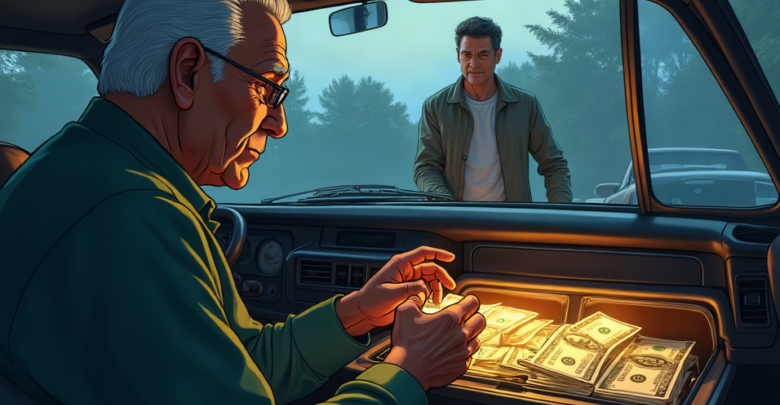
So I had. In the trunk, under the spare tire, I kept a plastic grocery bag wrapped tightly in a towel. Inside was our funeral money, along with the extra dollars I had saved from my pension over ten years.
Forty-one thousand dollars.
I hadn’t told Kevin. I hadn’t told anyone. When I understood that the car was gone, I understood the money was gone with it.
I couldn’t call Kevin and explain what he had sold. If he learned there was cash under the spare tire, I feared he would contact the buyer and try to get it back for himself.
I had no way to know what he would do. So I kept quiet.
For two days, I stayed in the house and waited. I could not drive, and I wasn’t ready to ask anyone for help finding the buyer. Kevin had arranged the sale. I knew he had taken the money from it. That was enough to make me cautious about telling him there was more to lose.
On Thursday morning, someone knocked at my front door. I pushed my walker over and opened it. A man stood on the porch, a workman in paint-splashed jeans and heavy boots. He held my car keys in one hand and a plastic grocery bag in the other.
“Ma’am, are you Peggy Larson?”
“Yes.”
“I bought your car on Sunday. From a guy named Kevin.”
“My son.”
He nodded. “The registration was still in the glove box. It had your name and this address.”
He held up the bag. The towel was wrapped around it the way I had left it.
“I got a flat tire yesterday,” he said. “Went to get the spare and found this. I counted it, just to make sure it was real. It’s all there. Forty-one thousand.”
He set the bag on the little table by the door. I looked at it, then at him. I couldn’t speak at first.
“I don’t think your son knew it was hidden there,” he said. “If he had, I don’t think he would’ve sold me the car for just $3,200.”
I started crying. He took off his hat and waited while I tried to get myself together. There was no good way to thank a stranger who had just handed back all the money I had saved.
Then he said, “I’ve got to tell you one more thing. Your son called me early this morning.”
My stomach dropped.
“He said he forgot something important in the trunk. Said he’d come by and get it. Called it ‘personal papers.’”
The buyer looked straight at me. “I told him I’d already cleaned out the car and thrown everything away.”
He paused, then told me what he had actually said: “I told him I found your mother’s money and brought it back to her. I told him it wasn’t his, and he shouldn’t come here expecting to take it.”
“He’s coming here?” I asked.
“He said he’d be here in about an hour.”
I looked down at the bag. The money was back in my house, but Kevin had heard enough to know it existed. I asked the buyer to stay until Kevin arrived. He agreed. I didn’t want to meet my son alone while I was still getting around with a walker, and I didn’t want the conversation to become one more thing Kevin could later describe differently.
We waited in the front room. I didn’t ask the buyer for more details about the sale. I knew the car had been sold for $3,200, and I knew Kevin had kept that money. What mattered now was what Kevin would say when he walked in and saw the cash.
When he came to the door, he glanced at the buyer first, then at me. His expression changed when he saw the grocery bag on the table.
“What’s that?” he asked.
“The money from the car,” I said.
He looked at the buyer. “You said you threw everything out.”
“I told you I’d thrown out the papers,” the man replied. “I didn’t tell you I’d throw away money that belonged to her.”
Kevin’s eyes went back to the bag. “Mom, I was going to explain.”
“Explain what?”
He rubbed his forehead. “I didn’t know that was in there.”
The buyer spoke before I could. “You called it personal papers.”
“I remembered I had things in the trunk,” Kevin said. “I didn’t know what was still in there.”
I watched him choose his words. He had called the buyer to retrieve something he said was his, but now he was saying he hadn’t known what it was. The bag sat between us, with the towel still around it.
“You sold my car while I was in the hospital,” I said. “You kept the money. You didn’t ask me.”
“You weren’t using it.”
“That wasn’t your decision.”
“I had bills, Mom. I told you I’d pay you back.”
“You always say that.”
He shifted his attention to the buyer. “You don’t know what’s going on between us.”
“No,” the man said. “I know I bought her car from you, and I found her money in it.”
Kevin turned back to me. “I was trying to help. You couldn’t drive. It was sitting there.”
“Then you could have asked me.”
He started to answer, stopped, and looked down at the bag again. “I didn’t know there was forty-one thousand in the trunk.”
“I believe you didn’t know what was under the spare,” I said. “But you knew the car was mine.”
He drew a breath, as if he was about to explain the bills again. “I needed the money.”
“You needed to ask.”
“I’m your son.”
The words landed as if that settled it. For years, being his mother had made it easier to give him another chance. It was harder to say no to him than it was to see the pattern. But I had heard this promise before: he would pay me back. And I had heard this reason before: he needed the money.
“I know you’re my son,” I said. “That is why this hurts.”
He looked at the buyer, then at me. “So you’re taking his side?”
The buyer didn’t answer. He didn’t need to. He had brought my money back and stood there while Kevin tried to make the sale sound like a favor.
“I’m asking you to leave,” I said.
“Mom, come on.”
“No. You sold my car without permission. You took the money. You called him to come back for something you said was yours. I’m not handing you anything.”
“I said I didn’t know about the cash.”
“And I said I believe you. That doesn’t make the rest all right.”
He looked at the bag once more. Then he left without it.
The buyer stayed until I was sure Kevin wasn’t coming back inside. I thanked him, though the words felt too small. He returned the keys, and I put the money somewhere safe in the house. The car was gone. The $3,200 was still with Kevin, and I had no reason to believe he would repay it. I did not call the buyer to ask for the car back. I had the money Walt and I had saved, and I had to decide what I could manage without driving.
The next thing I did was tell Kevin he no longer had permission to use the spare key to my house. I asked him to return it. He did. I didn’t make a threat or bargain with him. I told him that if he needed to see me, he had to ask first and come when I agreed. He said I was making this into more than it was.
I didn’t argue. The bag was in my house. My key was back in my hand. The decision was mine.