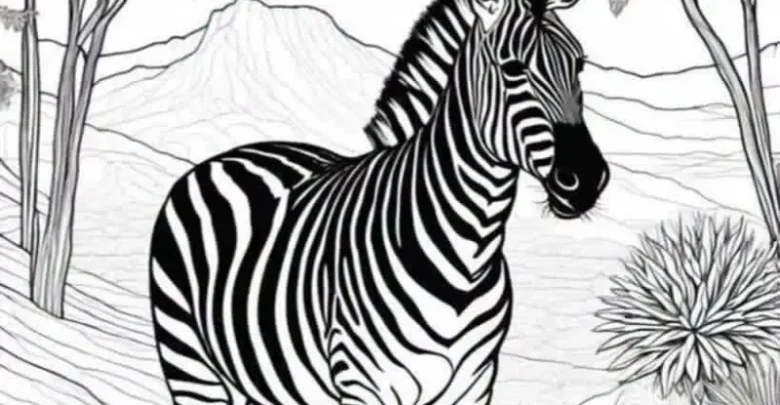
Some puzzles shout at you. This one whispers. At first look, it’s a calm black-and-white drawing of a zebra standing in a quiet valley, with palm trees on both sides, spiky plants at its feet, and a soft mountain rolling along in the back. Lovely. Peaceful. Totally innocent.
Except the caption on top makes a bold promise: “Your brain is still young if you can find the man.” Somewhere in this scene, a man is supposedly tucked away, hiding in plain sight. Ready to test those eyes? Grab a cup of tea, get comfortable, and let’s play.
Here’s the Hidden Man Zebra Illustration
Take a good long look at the picture below before you scroll any further. Don’t rush. The fun of a hidden-figure puzzle is in the hunt, not the answer.

Did you find him in the first ten seconds? If so, take a bow. If not, you’re in very good company. Most people spend their first look staring right at the zebra, and that’s exactly what the artist wants you to do.
Why the Zebra Is the Perfect Distraction
Zebras are basically walking optical illusions. Those bold black-and-white stripes grab the eye instantly, and once your brain locks on, it doesn’t want to let go. Everything else in the drawing turns into “background noise.”

That’s the clever trick behind puzzles like this one. The zebra is the star of the show, so your eyes keep circling back to it. Meanwhile, the hidden man could be lounging quietly in the trees, the grass, the plants, or the hills, and you’d walk right past him.
Fun fact: scientists have spent years arguing about why zebras have stripes in the first place. Popular ideas include keeping biting flies away and helping with heat.
Whatever the reason, the stripes sure do a great job of stealing the spotlight in a drawing.

Tips to Help You Spot the Hidden Man
If he’s still playing hide-and-seek with you, try these simple tricks. They work on almost every “find the hidden figure” puzzle you’ll come across online.
1. Ignore the zebra for a minute
This is harder than it sounds. Cover the zebra with your thumb if you need to. Once the big striped animal is out of the way, your eyes are free to wander around everything else.
2. Go section by section
Imagine the picture split into a grid, like a tic-tac-toe board. Look at the top left square, then the top middle, then the top right, and so on.
Slow and steady wins this race.
3. Look at shapes, not objects
Stop thinking “tree,” “leaf,” or “mountain.” Instead, ask yourself: does this curve look like a nose? Could these two dots be eyes? Is that line a shoulder, an ear, or a chin? Hidden figures are usually built out of ordinary lines that do double duty.
4. Check the spaces in between
Artists love hiding faces in the gaps: between tree trunks, between leaves, or even between an animal’s legs. The empty space can be just as sneaky as the drawing itself.
5. Zoom, squint, or step back
Zoom in on your phone to see the small details. Then do the opposite: hold the screen at arm’s length and squint a little. Some hidden faces only pop out when you see the big picture all at once.
6. Try turning it around
Many vintage puzzles hide their secret upside down or sideways. Rotate your phone and look again. You may be surprised what appears.

So, Where Is He? Here’s the Honest Answer
We dug around for an official solution before writing this, and here’s the truth: we couldn’t find a confirmed answer from the original creator.
The puzzle has been shared again and again across social media and puzzle pages, but none of the versions we checked show a verified reveal of where the man is hiding.
Rather than make something up and send you on a wild goose chase, we’d rather be straight with you. Some readers say they see a face formed by the outlines in the background, others point to the plants and grass near the zebra’s legs, and some swear the trick only works when you turn the picture upside down. Without an official reveal, we can’t tell you which one is right.
And honestly? That makes it even more fun. It turns the puzzle into a friendly debate. Show it to your family, your friends, or your coworkers, and see what each person finds. You might be surprised how many different “men” people spot!

Why Hidden-Picture Puzzles Are So Much Fun
Hidden-figure drawings have been around for well over a hundred years. Old newspapers, magazines, and children’s books loved printing scenes with secret faces tucked into trees and clouds.
Readers would spend whole afternoons turning the page around, trying to find the “missing” person.

Today, these puzzles are back in a big way, mostly because they’re perfect for sharing. They’re quick, they’re free, and they spark friendly competition. Who doesn’t love being the first one in the group chat to say, “Found him!”?
Does finding him really mean your brain is “young”?
Let’s be real: the caption is just for fun. There’s no scientific test hiding in a zebra drawing, and not spotting the man doesn’t say anything about your age or your brain. Some people are simply better at this kind of puzzle, and some days our eyes are just more tired than others.
That said, puzzles like this are a nice little workout for your attention.
You practice slowing down, looking carefully, and seeing the same thing in a new way. That’s a great habit, whatever your age.
A Few More Fun Ways to Play
- Set a timer. Give everyone in the house 60 seconds and see who comes closest.
- Explain your answer. Have each person point to the spot they think is the man and explain why. The explanations are often funnier than the puzzle!
- Make your own. Draw a simple scene and try hiding a face in it. You’ll quickly see how tricky (and clever) these artists are.
- Take breaks. If you’re stuck, walk away for five minutes and come back fresh. Many people spot hidden figures right away on their second try.
Why Our Brains Love to See Faces Everywhere
Ever noticed a smiley face in an electrical outlet, or a grumpy face on the front of a car? That’s called pareidolia, and it’s completely normal.
Our brains are wired to spot faces quickly, because recognizing people has always been important for us.
Hidden-man puzzles play with that instinct. The artist hides a face in shapes that aren’t really faces, and your brain has to switch between “that’s a tree” and “wait, that’s a nose.” It’s also why two people can stare at the same drawing and swear they see completely different things. Neither of them is wrong; their brains just connected the lines in different ways.
Your Turn: Did You Find the Hidden Man?
Take one more slow look at the zebra puzzle. Check the trees on both sides. Scan the mountain line. Peek between the leaves and around the zebra’s hooves. Then flip your phone upside down and try again.
Think you’ve found him?
Tell us exactly where you spotted him, and share the puzzle with a friend to see if they find the same thing. If an official answer ever turns up, we’ll be just as excited as you are to finally settle the debate.
Thanks so much for playing along with us today! This puzzle is shared purely for fun and entertainment, so enjoy the hunt and don’t take the “young brain” claim too seriously.