News
The teller had been a little girl on my route. She leaned toward me and lowered her voice.
The teller had been a little girl on my route. She leaned toward me and lowered her voice

My Husband Said His Paycheck Made Him the Boss—Then I Checked Our Accounts
A fictional story about a marriage, a missing pension deposit, and a woman learning to make her own decisions.
The Deposit That Did Not Arrive
My pension usually arrived on the third of the month.
I checked before the coffee finished brewing.
Nothing.
At first, I assumed there was a delay. Then I looked again at the account information and found that I could no longer access the joint checking account.
My name is Joanne Kittle. I carried mail on a rural route out of Yellville, Arkansas, for thirty-one years.
I learned to read addresses carefully, check dates twice, and notice when something familiar had changed.
That morning, I put on my coat and drove to the bank.
The employee who helped me had once been a little girl waiting beside her family’s mailbox.
She examined the records, then looked up.
“Miss Joanne, this checking account was closed on Tuesday.”
“By whom?”
“Alden.”
I held my checkbook against the counter.
“What about my pension?”
“We’ll need to trace what happened to the deposit.”
A Number I Did Not Recognize
In the parking lot, I signed into the pension website.
Alden had helped set up the login years earlier. Since then, I had rarely looked beyond the deposit confirmation.
Now I checked the payment instructions.
The account number was unfamiliar.
I read it twice, then compared it with my old records.
Someone had changed where my pension was supposed to go.
For a moment, I sat with both hands on the steering wheel.
I felt embarrassed that I had not noticed sooner. Then I reminded myself that sharing access with my husband had not been permission for him to make changes without telling me.
I took screenshots.
After thirty-one years of handling other people’s mail, I was finally giving my own paperwork the attention it deserved.
The Photograph He Wanted
Alden was home between trucking runs.
He had spent years traveling for work, often leaving for two weeks before returning for a few days.
I placed the bank information beside his plate.
“Why was our account closed?”
He glanced at it.
“I arranged something different.”
“Where is my pension going?”
“It’s still family money.”
“That isn’t what I asked.”
He reached into his shirt pocket and pulled out his paycheck.
Then he held it up.
“Whoever brings this home calls the shots, Joanne.”
He laughed.
I stared at him.
“Take my picture,” he said. “My sisters will enjoy this.”
So I did.
He smiled at my phone, pleased with himself.
I looked at the image afterward: my husband holding his wages as though they gave him authority over mine.
“Okay, honey,” I said. “I’ll have something waiting when you get back.”
The Farm My Father Left Me
My father died in the spring before our wedding, in 1981.
He left me the farmhouse and forty acres around it.
I was twenty-three, grieving, and grateful when Alden offered to help organize everything.
For a long time, I thought that was what we were doing together.
Gradually, his offers changed.
“I’ll take care of it” became “You should have asked.”
Then it became “We can’t afford that.”
When the water heater failed, he told me to wait.
I heated water on the stove while he discussed whether replacing it was necessary.
During that same period, he bought a zero-turn mower for $12,800.
I watched him drive it around the pasture.
I told myself there must be a financial explanation I did not understand.
That had become a habit too.
Miriam’s Unanswered Question
Across the road lived Miriam Yoder and her husband.
They kept goats and had asked several times about renting my front pasture.
Miriam wanted grazing space. Her family could maintain the fencing and the water troughs.
Every time she raised the subject, Alden answered before I could.
“Not that pasture.”
Eventually, she stopped asking.
I had never given her an answer of my own.
After the morning at the bank, I kept thinking about that.
There were two matters I needed to understand: what had happened to my pension and what choices were available concerning the property.
For once, I decided to ask people who could give me answers without raising their voices.
The Courthouse Folder
Alden left before sunrise for another run.
I went to the courthouse when it opened.
Vonda, the clerk, helped me obtain a certified copy of the deed.
My name appeared in the ownership record.
She passed it across the counter.
“Here you are, Joanne.”
I stood looking at the date.
Then I asked where I could find further help reviewing the property documents and a proposed lease.
The deed was important, but I wanted to understand what it meant for the decision I was considering.
By the time I returned to my truck, I had a folder and several practical next steps.
I cried in the parking lot anyway.
Knowing where to begin did not make beginning easy.
Taking Back Access
I contacted the pension office and explained that I had not authorized the change.
They began reviewing the payment information and told me what they needed to investigate the missing deposit.
I changed my password and updated the contact details.
At the bank, I arranged an account I could access independently.
Correcting everything required more than one conversation. Some questions remained open while records were checked.
Still, by the end of the day, I knew more than I had that morning.
I also had reference numbers, names, and notes.
For years, Alden had told me that finances were too complicated for me to worry about.
They were complicated.
That did not mean I could not learn.
Tea at Miriam’s Table
That afternoon, I knocked on Miriam’s door.
“About the pasture,” I said.
She pulled out a chair.
We talked about the area she wanted to use, access, maintenance, and payment. I wrote down questions rather than agreeing to everything immediately.
Over the following days, we clarified the proposal and had the agreement reviewed.
The arrangement would cover the front grazing area, not the entire forty acres.
It would provide regular rent, while the Yoders took responsibility for the work specified in the agreement.
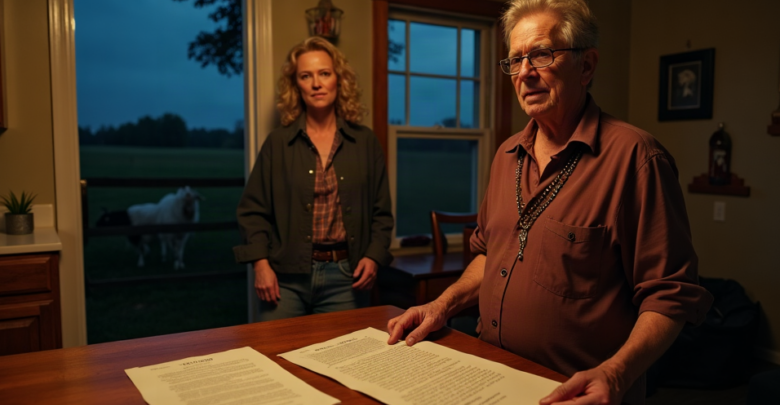
When the papers were ready, Miriam set them on her kitchen table.
“Are you sure?” she asked.
I read them again.
“Yes.”
Then I signed my name.
Calls From the Road
Alden called during his trip.
“Wash my good jeans. I’ve got a meeting when I’m home.”
Another evening, he reminded me about his blue shirt.
Then he mentioned chicken and dumplings.
“And tell the Yoders to stop looking at that pasture.”
I held the phone away from my ear for a moment.
“Joanne?”
“I heard you.”
He began explaining his schedule.
I listened, asked a question about his return, and ended the call.
Afterward, I wrote another note in my folder.
I was learning that I did not need to argue during every conversation to continue with a decision.
His Return
Two weeks after he left, his truck came up the gravel road.
Miriam sat on her porch across the way. The pasture was ready for the fencing work we had arranged.
Alden entered carrying a bag of laundry.
“What’s for supper?”
“There’s food on the stove.”
Then I handed him the lease.
He read the first lines.
His eyes moved toward the window.
“You rented the pasture?”
“Yes.”
“I told you not to.”
“You answered when Miriam asked me. I’ve given her my answer now.”
He put the paper on the table.
“Who told you to do this?”
“I asked questions. I reviewed the arrangement. Then I decided.”
He seemed to find that answer harder to accept than an accusation would have been.
What He Called Family Money
I placed the pension correspondence beside the lease.
“We also need to discuss this.”
“I already told you. I was handling it.”
“Without telling me where my money was going.”
“It wasn’t leaving the family.”
“It was leaving an account I could see.”
He folded his arms.
“I keep track of the bills.”
“That doesn’t explain why I wasn’t told.”
He looked toward the paperwork.
I waited.
Finally, he said, “I didn’t want you spending it.”
“On what?”
“Things we didn’t need.”
“The water heater?”
He sighed.
“That again?”
“Yes. That.”
I thought of the trips between the stove and the bathroom.
I had spent so much effort making the inconvenience manageable that I had nearly stopped questioning why it continued.
The Mower
“You said we couldn’t afford the repair,” I continued.
“Money was tight.”
“But there was money for the mower.”
“That was something I wanted.”
We both became quiet.
He had answered more plainly than he intended.
I sat down.
“I wanted hot water.”
He looked away.
“And I want to know where my pension goes. I want us to discuss household expenses with the same information.”
“You’re making me sound unreasonable.”
“I’m telling you what I need.”
For years, I had tried to phrase requests so carefully that he could not object.
He had objected anyway.
That evening, I stopped trying to find the perfect sentence.
A Knock at the Door
Miriam came over to confirm something about the fence work.
She stopped when she saw our faces.
“I can come back.”
“No,” I said. “It’s all right.”
Alden looked at her.
“This is between my wife and me.”
“I’m here about our agreement,” she replied.
He picked up the lease.
“I can tell you not to use the pasture.”
Miriam stayed beside the door.
“We’ve agreed on the arrangements with Joanne. If there’s a question about the documents, we can address it properly.”
She did not shout.
Neither did I.
Having another person in the room changed something for me. I no longer felt responsible for making the conversation appear pleasant.
His Sisters Heard His Version
Alden called his sisters from the hallway.
He told them about the pasture.
He told them I had contacted the pension office.
Then I heard him say, “She’s making trouble over an account.”
When he returned, his expression had hardened.
“They don’t need to be involved.”
“You called them.”
“I wanted them to know what happened.”
“Did you explain that I hadn’t agreed to the pension change?”
He put his phone away.
“They don’t need every detail.”
I looked at the folder on the table.
I had spent years staying quiet while he summarized our disagreements for other people.
I did not need to call everyone immediately and defend myself.
But I did need to stop accepting his summary as the only one that mattered.
What I Asked For
“Do you want me to leave?” he asked.
I took a moment before answering.
“I want you to stop making financial decisions for me without discussing them.”
He waited.
“I want access to my information. I want my work treated as work. And I want to speak without being reminded that you earn more.”
“So I’m supposed to take orders now?”
“I’m asking for a conversation.”
He looked at Miriam, then back at me.
“If you go ahead with this lease, I won’t speak to you.”
The threat frightened me.
I did not want an empty house. I did not want to discover what his silence might mean for our marriage.
But I was already lonely during many of our conversations.
“The agreement is going ahead,” I said.
The Truck Leaving
Alden picked up his bag.
“I’m staying somewhere else tonight.”
“All right.”
He paused by the door.
I could see him waiting for me to offer a different answer.
I stayed beside the table.
After he left, Miriam sat with me until the truck lights disappeared down the road.
Neither of us celebrated.
She asked whether I wanted company for a while.
“Yes,” I said.
It was a simple answer.
I was getting better at those.
The First Goats Through the Gate
The next morning, I organized the deed, pension correspondence, and notes into a folder.
There were still questions to resolve.
The pension review was continuing. Alden and I had not decided what would happen next. One difficult evening had not repaired years of avoiding difficult subjects.
But some things were clear.
I knew where my records were.
I knew whom to call.
And I knew what I had agreed to with Miriam.
When her family finished the fencing, I went outside to watch the first goats enter.
They hesitated at the gate, then spread into the grass.
Miriam checked the latch.
“Looks good,” she said.
I nodded.
Then I went back inside, put on my reading glasses, and sat at the kitchen table to review the next piece of mail.