News
My Brother Left Our 81-Year-Old Dad With a $340 Bill at His Own Birthday Dinner — Then the Restaurant Owner Walked Out Holding an Old Framed Receipt
My Brother Left Our 81-Year-Old Dad With a $340 Bill at His Own Birthday Dinner — Then the Restaurant Owner Walked Out Holding an Old Framed Receipt

My Brother Left Dad With His Birthday Dinner Bill—Then the Restaurant Owner Recognized Him
A fictional story about an abandoned birthday dinner and a kindness remembered decades later.
The Man Who Always Showed Up
My father, Ray, drove a city bus for thirty-four years.
He raised my brother Brent and me after our mother left. He packed lunches before his early shifts, attended school meetings, and found ways to make a modest paycheck cover more than it should have.
For nineteen winters, he wore the same brown coat.
Whenever we suggested replacing it, he inspected the sleeves and announced that it had another year left.
Meanwhile, we had shoes that fit.
Dad rarely spoke about those choices. He simply made them.
So when Brent called about Dad’s eighty-first birthday, I was pleased.
“I’m taking him to Callahan’s,” he said. “Somewhere nice.”
Callahan’s was the kind of restaurant we usually passed on our way somewhere less expensive.
“That sounds wonderful.”
“I’ve booked a table.”
I could not leave work until eight, but I promised to join them for dessert.
A Table Covered in Plates
I arrived at eight-fifteen.
Dad sat alone.
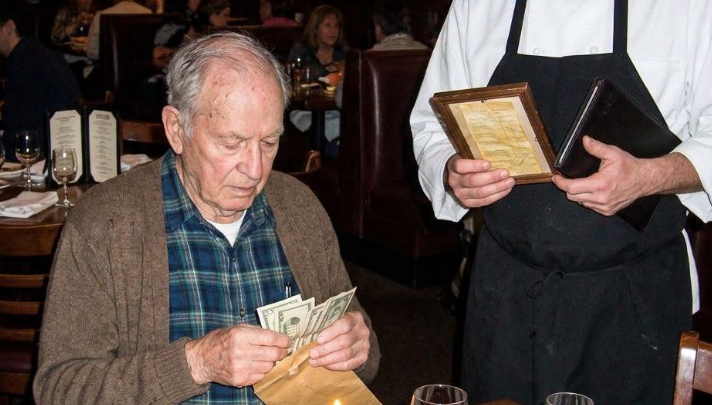
Around him were the remains of an expensive dinner: lobster shells, steak bones, a seafood platter, and an empty wine bottle.
In front of him stood a slice of cake with an extinguished candle.
He was counting cash from a worn white envelope.
I recognized it immediately.
Dad withdrew money for groceries at the beginning of each month and kept it in that envelope. He could usually tell you how much remained without opening it.
That evening, he had spread the bills beside his plate.
“Dad?”
He looked up and tried to smile.
“Hello, sweetheart.”
“Where’s Brent?”
“Kayla wasn’t feeling well. He went to get the car.”
I pulled out the chair beside him.
“How long ago?”
Dad looked toward the entrance.
“About forty minutes.”
The Grocery Money
The bill was $341.
Dad’s meal appeared near the bottom: a chicken sandwich and water.
Everything else belonged to the dinner Brent and his wife had enjoyed.
“He said he’d come back,” Dad told me.
“Have you called?”
“He isn’t answering.”
I looked at the cash.
A hundred and twelve dollars.
Dad began gathering the smaller bills into a pile.
“I’ll work something out.”
He sounded embarrassed, as though this were a failure in his planning rather than something done to him.
I opened my bag and reached for my credit card.
“You don’t have to do that.”
“I was invited,” he said quietly.
“I know.”
My hands were shaking.
I wanted to settle the bill, take Dad somewhere comfortable, and call my brother from a place where Dad could not hear what I intended to say.
Before I could catch the waiter’s attention, a man in a white chef’s coat approached our table.
The Frame in His Hand
He carried an old wooden picture frame.
For a moment, he stood beside Dad without speaking.
Then he asked, “Sir, did you drive a city bus?”
Dad looked up.
“Yes.”
“Route Nine?”
“For quite a while.”
The man’s expression changed.
He placed the frame on a clear space between the plates.
Inside was a faded green guest check from a diner.
The date read November 14, 1987.
The order listed coffee, cheeseburgers, fries, and a piece of pie.
Across the bottom, someone had written:
Go home, kid. Your mom’s worried sick.
— Ray, Route 9
I knew that handwriting.
It had appeared on permission slips, birthday cards, and notes left beside my breakfast.
Dad picked up the frame.
“Oh,” he said.
Then, more softly, “Oh, son.”
The Boy at the End of the Route
“My name is Michael Callahan,” the man said.
He pulled out the chair across from us.
“I was sixteen.”
Dad stared at him, searching the older face for the boy he remembered.
Michael explained that he had left home during a difficult period in his family. His father’s drinking had made the house frightening, and he had been sleeping around the bus station.
He boarded Dad’s bus because it was warm.
“I didn’t have the fare,” he said. “You let me sit down anyway.”
When the route ended, Dad noticed that the boy had nowhere to go.
Instead of sending him back outside, he took him across the street to the Starlite Diner.
“You ordered food,” Michael continued. “Then you sat there and let me talk.”
Dad lowered his eyes to the receipt.
“I remember you.”
Michael nodded.
“I’ve hoped you would.”
A Safe Place to Go
Dad had listened while Michael described what was happening at home.
They discussed his mother, who did not know where he was, and an aunt in Toledo who might be able to help.
Dad helped him make contact so the people worried about him knew he was alive. Once they had arranged for his aunt to receive him, Dad helped him get there.
Michael remembered the bus ticket.
He remembered the forty dollars Dad pressed into his hand.
And he remembered the note on the diner check.
“I kept it in my wallet until it nearly fell apart,” he said. “Then I put it in the frame.”
Dad studied the paper.
“I wondered what happened to you.”
“I finished school. Started working in kitchens.”
Michael glanced around the restaurant.
“Eventually, this.”
I looked from the frame to the name printed on the menu.
Callahan’s.
Why He Had Come to Our Table
“I never knew your last name,” Michael said. “I asked about you, but I couldn’t find the right person.”
“How did you recognize him tonight?” I asked.
“The reservation mentioned a birthday. Ray, eighty-one.”
He had heard the details from the hostess and come out to see whether it might be the man he remembered.
At first, he had not been certain.
Then he had watched Dad smile at the waiter.
“I was going to introduce myself after dessert,” he said.
His eyes moved toward the envelope.
“Then the staff explained that your party had left and you were waiting.”
Dad began putting the cash away, then stopped.
“I don’t want to cause trouble.”
Michael leaned forward.
“You haven’t.”
“You Paid for This Dinner Years Ago”
The waiter came closer with a fresh glass of water.
Michael rested his hand beside Dad’s envelope.
“Put that away, Ray. Your dinner is my gift.”
Dad shook his head.
“There’s no need.”
“I know there’s no need. I want to.”
He looked at the framed receipt.
“You paid for this dinner years ago.”
Dad’s face crumpled.
He removed his glasses and pressed his fingers against his eyes.
I put an arm around him.
For forty minutes, he had sat at that table trying to solve a problem with money meant to feed him.
Now someone was asking him to accept something without apologizing for it.
Michael waited.
Eventually, Dad nodded.
“Thank you.”
Brent’s Part of the Evening
“What about the rest?” I asked, glancing at the plates.
“We’ll speak to the person who arranged the dinner,” Michael replied. “You don’t need to handle it here.”
He did not turn our table into a public argument.
He asked a staff member to contact Brent and resolve payment for the food and wine he and Kayla had ordered.
Then he had the plates cleared.
Dad watched the envelope disappear into his jacket pocket.
I could see him trying to recover his composure.
Michael noticed too.
“Would you like a proper birthday dessert?”
Dad looked at the slice already in front of him.
“I thought I’d had one.”
“That one looks as though it’s had a difficult evening.”
For the first time since I arrived, Dad laughed.
A Different Birthday
The kitchen brought out a fresh cake.
There were candles, although Michael sensibly stopped short of putting eighty-one flames on the table.
The staff sang.
A few nearby diners joined in.
Dad looked embarrassed at first. Then he began laughing so hard that he had to remove his glasses again.
Someone offered to take a photograph.
It captured him leaning slightly forward, one hand resting beside the cake, with Michael standing behind his chair.
His eyes were still wet.
But he no longer looked abandoned.
We stayed after the dessert plates were empty.
Michael told us about his aunt, his first kitchen job, and the years before opening the restaurant.
Dad asked practical questions.
Had he liked the work?
Was his aunt still living?
Did he get any time off?
Soon they were talking as comfortably as though the decades between their meetings had been a long interruption.
My Brother’s Call
Brent called me the following morning.
“What happened at the restaurant?”
I asked whether he had spoken to Dad.
“Not yet.”
“Then listen first.”
I told him about the forty minutes.
The white envelope.
The hundred and twelve dollars.
I explained that Dad had believed he was coming back.
Brent started talking about Kayla’s headache.
“You could have settled the bill before leaving,” I said. “You could have answered your phone.”
He fell silent.
Then I told him about Michael.
The bus.
The diner.
The green receipt.
For a long time, I heard nothing but my brother breathing.
“Is Dad okay?”
“He had a good end to the evening.”
“That’s not what I meant.”
“I know.”
I waited.
Finally, Brent said, “I should call him.”
“Yes. You should.”
What Dad Chose to Keep Private
Brent visited Dad that afternoon.
I do not know everything they said.
Dad did not offer a transcript, and I did not ask for one.
Some conversations belonged to the two of them.
Afterward, Brent began calling more regularly.
I remained angry longer than Dad seemed to.
That did not mean the evening had not hurt him. It meant he was entitled to decide what he wanted from his relationship with his son.
I watched what Brent did next rather than treating one visit as the end of the matter.
He had years of ordinary opportunities ahead of him.
Birthdays were only one of them.
Coffee at the Starlite
Michael and Dad arranged to meet again at the diner.
The Starlite was still open.
They chose November 14, the date written on the receipt.
Coffee and cheeseburgers.
I joined them for the first visit.
Michael paid, but Dad insisted on leaving the tip.
They negotiated that with the seriousness of two men discussing a major contract.
Eventually, Michael agreed.
On the way home, Dad looked out of the window.
“I didn’t know he kept that paper.”
“You gave him a reason to.”
“I just wanted him somewhere safe.”
I glanced at him.
“I think he understood.”
Two Things on the Office Wall
The green receipt still hangs in Michael’s office.
Beside it is the birthday photograph.
In one frame is a meal that a bus driver bought for a frightened teenager.
In the other is that bus driver, many years older, laughing beside a birthday cake.
Dad does not tell the story as though he performed a grand act.
He remembers a boy who needed food, someone to listen, and help reaching a safe place.
Michael remembers what that felt like.
I remember arriving at a table and seeing my father count grocery money beside someone else’s empty wine bottle.
I also remember leaving with him later that night.
His envelope was back in his pocket.
A piece of cake was boxed for the next day.
And he had a new friend asking when they could have coffee again.