The Night Everything Changed
My daughter was born at 4:52 on a Tuesday morning.
Her name was Wren Celeste.
She weighed just over seven pounds, had a tiny red face, and screamed the moment she entered the world as though she had already decided she had opinions about everything.
I remember laughing through my tears.
I remember the nurse placing her against my chest.
And I remember thinking that nothing in my life would ever be the same again.
I was right.
I just didn’t understand how quickly everything would change.
The first person to hold Wren after me wasn’t her father.
It wasn’t my mother.
My mother had been gone for sixteen years.
It wasn’t even the nurse.
It was my mother-in-law.
Beverly.
She had apparently been waiting in the hospital since three that morning because my husband, Roland, had texted her that we were close.
I didn’t know that.
I barely knew what time it was.
I was exhausted, emotional, and completely overwhelmed.
When the hospital room door opened, Beverly walked in wearing perfectly arranged clothes, pearls around her neck, and not a strand of her silver hair out of place.
She smiled.
“Oh, let Grandma see her.”
The nurse looked at me.
I hadn’t said yes.
I hadn’t said no.
I was still trying to understand that this tiny person lying on my chest was actually my daughter.
Then Beverly reached down and lifted Wren from my arms.
Just like that.
The warmth disappeared from my chest.
Beverly carried my newborn toward the window.
“Oh, she’s definitely a Tran,” she announced.
Roland smiled.
Beverly looked back at me.
“She hardly looks like you at all.”
Then she laughed.
I didn’t.
I simply stared at my daughter.
“Roland,” I whispered. “Can I have her back?”
He glanced at his mother.
“In a minute, Simone. Mom waited all night.”
That sentence stayed with me.
Not because Beverly waited.
But because, somehow, everyone else’s feelings suddenly seemed more important than mine.
I was the mother.
I had just given birth.
Yet I was the person who had to wait.
I Had Spent My Whole Life Waiting for Someone to Show Up
My name is Simone Caldwell.
I was born into a family where money was never the problem.
Time was.
My father, Malcolm Caldwell, built a massive logistics company from almost nothing.
In 1981, he started with one truck.
Over the years, that one truck became hundreds.
Then thousands.
Warehouses appeared across the Southeast.
The company became known throughout Atlanta.
My father’s name eventually appeared on buildings, charitable donations, and hospital wings.
But when I was growing up, I didn’t understand any of that.
I only understood that my father was usually somewhere else.
My mother, Celeste, was different.
She had been an English teacher before marrying my father, and she never stopped being a teacher.
She read to me every night.
She helped with homework.
She attended school plays.
She remembered my friends’ names.
She planted roses in the garden herself.
My mother believed showing up mattered.
My father believed providing mattered.
I loved them both.
But when I was fourteen, my mother became sick.
Two years later, she died.
I was sixteen.
My father was in Chicago negotiating a business deal.
He believed there would be more time.
There wasn’t.
I remember sitting beside my mother’s hospital bed.
I remember holding her hand.
I remember hearing the quiet change in the room after she was gone.
And I remember walking into the hallway and seeing Raymond.
Raymond had been my father’s driver for years.
He didn’t ask questions.
He simply opened his arms.
I walked into them.
He held me while I cried.
My father eventually arrived.
He apologized.
But something between us had already changed.
After that, he worked even more.
He sent Raymond to my graduations.
Raymond drove me to college.
Raymond helped carry my boxes.
Raymond attended my graduation.
My father sent flowers.
I convinced myself that I didn’t need him.
When I was twenty-two, my father offered me a position at his company.
A career.
A future.
A place on the board.
I turned him down.
“I want to teach,” I told him.
He couldn’t understand it.
“You’ll make forty thousand dollars a year.”
“I know.”
“You’re a Caldwell.”
“I know.”
Then I told him the truth.
“I don’t want to be someone who only provides. I want to be someone who shows up.”
He didn’t answer.
I moved out shortly afterward.
For years, we barely spoke.
Then I Met Roland
I met Roland Tran when I was twenty-seven.
He was charming, funny, and easy to talk to.
He came to my school for a career event and immediately connected with my students.
Afterward, he asked me out.
I liked that he didn’t seem impressed by money.
So I never told him about mine.
I told him my father worked in logistics.
That was technically true.
I simply didn’t mention that his company carried his name.
We married two years later.
It was a small wedding.
My father didn’t attend.
He sent an antique silver tea service and a short note explaining that he was overseas.
Raymond attended instead.
At the reception, I overheard Beverly talking about me.
“Her own father didn’t even come.”
Then she looked toward Raymond.
“Poor girl. She practically has no family.”
I heard it.
I said nothing.
That was my mistake.
Because Beverly spent the next six years treating me like an outsider.
She called me “the teacher.”
She criticized our furniture.
She corrected my cooking.
She gave me household books.
She reminded me how fortunate I was to be part of the Tran family.
And whenever I objected, Roland said the same thing.
“That’s just Mom.”
Eventually, I realized that “that’s just Mom” had become an excuse for everything.
When Wren Was Born, It Got Worse
Beverly was thrilled when she learned I was pregnant.
Not simply because I was becoming a mother.
Because her son was becoming a father.
There would be another Tran.
She bought furniture for the nursery.
She chose blankets.
She bought clothes.
She even had an opinion about my daughter’s name.
Roland wanted to name her Beverly.
I refused.
I named her Wren Celeste after my mother.
The first week after Wren was born was exhausting.
I barely slept.
My body hurt.
I cried for reasons I couldn’t explain.
Roland went back to work after only three days.
Beverly told him I would manage.
She had managed.
Apparently, that was supposed to be enough.
One afternoon she even told me I should wear makeup before Roland came home.
Then she reminded me that men noticed when women stopped taking care of themselves.
I didn’t respond.
I was too tired.
A neighbor named Mrs. Adeyemi left chicken soup on our porch the next day.
There was a simple note attached.
“For the new mama. Eat something.”
I cried over that soup.
Because a woman who barely knew me had noticed that I needed help.
The people closest to me hadn’t.
The Dinner That Wasn’t for Us
Six days after Wren’s birth, Roland came downstairs wearing a nice jacket.
“Faye is hosting dinner,” he said.
I looked down at Wren.
“What time are we leaving?”
He hesitated.
“It might be easier if you stayed home.”
I stared at him.
His SUV was being repaired.
For days, he had been using my car.
The infant seat was installed.
The diaper bag was inside.
Wren’s car seat was in the back.
“You are taking my car?”
“Just for a few hours.”
“And leaving us here?”
He sighed.
“It’s just a family dinner, Simone. Please don’t make this difficult.”
Then he walked out.
Through the window, I watched my car disappear.
A moment later, my phone buzzed.
Beverly had sent me a message.
“He deserves one peaceful night away from you.”
Then another notification appeared.
A photograph.
Roland was sitting at the dinner table beside his mother.
Everyone was smiling.
Seven places had been set.
Beverly.
Roland.
Faye.
Derek.
Aunt Glenda.
Uncle Paul.
Mariah.
The caption said:
Family’s all here!
I stared at it.
There was no place for me.
No place for Wren.
I looked down at my sleeping daughter.
And suddenly, I understood something.
I had spent my entire life waiting for people to show up.
I wasn’t going to teach my daughter to do the same.
I Packed One Bag
I carried Wren upstairs.
I packed diapers.
Clothes.
Formula.
The breast pump.
A toothbrush.
And a small yellow blanket covered with white ducks.
It was the first blanket I had wrapped around her.
I sat on the edge of the bed.
Then I opened my phone.
There was one contact I hadn’t called in almost two years.
Dad.
My finger hovered over his name.
I remembered my mother’s funeral.
His briefcase.
His apology.
The years of silence.
Then I remembered the message he had sent after Wren was born.
Is she healthy?
Are you?
Not just the baby.
Me.
I pressed call.
He answered almost immediately.
“Simone?”
“Dad.”
My voice shook.
“Come get me.”
He didn’t ask why.
He didn’t ask what Roland had done.
He didn’t ask whether I was exaggerating.
He simply said:
“Is the baby safe?”
“Yes.”
“Are you safe?”
“Yes.”
“I’m sending Raymond. Thirty minutes. Don’t lift anything heavy.”
Then, after a pause:
“Thank you for calling me.”
My Father Had Been Waiting
Thirty minutes later, Raymond arrived.
His hair was completely gray now.
But he still had the same calm expression.
He looked at me.
Then at Wren.
Then at the bags.
“Hello, Simone.”
I nearly cried.
He handed me an envelope.
My father’s handwriting was on the front.
Simone Celeste Caldwell.
Not Tran.
Caldwell.
I put the envelope in my bag.
Raymond installed a new infant seat.
My father had apparently instructed him to purchase one.
Before we left, I wrote Roland a note.
Wren and I are safe.
We’re staying with my family.
When you’re ready to explain why your mother counts as family and we don’t, you can call me.
I left my house key beside the note.
Then I walked away.
The Secret My Father Had Been Keeping
We drove to my childhood home.
The house was exactly as I remembered it.
Large.
Quiet.
Surrounded by old oak trees.
My mother’s roses were still growing.
But upstairs, something had changed.
One of the rooms had become a nursery.
A white crib.
Cream-colored walls.
Books.
A changing table.
A rocking chair.
And above the crib was a mobile made of paper birds.
Wrens.
I stared at Raymond.
“When did this happen?”
“Your father started in May.”
Six months earlier.
My father had known I was pregnant.
He had prepared a room.
But he hadn’t called.
“Why?”
Raymond looked at me.
“Because he was waiting for you.”
My father had apparently told him:
“If she calls, I’ll be there in thirty minutes. If she never calls, at least the room will be ready.”
I finally opened the envelope.
Inside was an old brass key.
The tag attached to it was written in my mother’s handwriting.
Simone’s room.
There was also a small card.
Your room is ready. Everything else can wait until you are.
I sat in my mother’s rocking chair and cried.
At Three in the Morning, My Father Met His Granddaughter
That night, Wren woke hungry.
I was feeding her when I heard footsteps.
My father stood in the doorway.
He looked older than I remembered.
More fragile.
Uncertain.
“Is everything okay?”
“She’s hungry.”
He nodded.
“Do you need anything?”
Then he hesitated.
“I practiced warming bottles.”
I laughed.
“You practiced?”
“Six times.”
He had built an empire.
He had negotiated major deals.
But he was nervous about holding his granddaughter.
I invited him inside.
He sat beside me.
Then he told me everything he had never said.
He had regretted missing my mother’s final hours every day.
He had known he failed me.
He had stayed away because he believed he had no right to return.
He had stepped away from his company.
He had gone to therapy.
He had finally realized something simple.
Providing wasn’t the same as showing up.
Then he looked at Wren.
“I can’t fix what happened in Chicago,” he said.
“But if you ever need somewhere to go, I can at least be here when you arrive.”
I looked at him.
“Dad, come get me.”
His eyes filled.
“You have no idea what those words meant.”
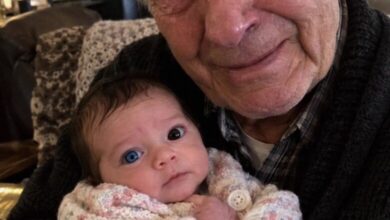
A few minutes later, I handed him Wren.
He was terrified.
“I don’t know how.”
“Support her head.”
He did.
Wren settled against his chest.
My father started crying.
Quietly.
He whispered:
“Hello, Wren. I’m your grandfather.”
Then:
“I’m sorry I’m late.”
He looked down at her.
“I’m going to try very hard not to be late anymore.”
Roland Finally Saw What He Had Done
Roland called repeatedly.
I didn’t answer.
When he eventually came to my father’s house, he looked completely different.
He saw the house.
The nursery.
The photographs.
The life I had never told him about.
“You grew up here?”
“Yes.”
“Why didn’t you tell me?”
“Because I wanted to know who you would be if you thought I had nothing.”
He had no answer.
I told him the truth.
I didn’t need Beverly to love me.
I needed my husband to stand beside me when she didn’t.
That was the difference.
My father eventually entered the library.
Roland stood immediately.
“Mr. Caldwell—”
“Sit down.”
My father told him about losing my mother.
About believing there would always be more time.
Then he looked at Roland.
“You took your wife’s car six days after she gave birth because disappointing your mother seemed harder than disappointing your wife.”
Roland lowered his eyes.
My father continued.
“Families usually aren’t destroyed by one enormous decision.”
He paused.
“They disappear one easy choice at a time.”
Then he said something Roland would remember.
“Don’t become me, son.”
Rebuilding Took Time
I didn’t immediately forgive Roland.
I didn’t think forgiveness should be automatic.
He needed to understand what had happened.
He began therapy.
Eventually, he asked his therapist to help him understand why he always placed his mother’s approval above everything else.
One exercise changed something.
She asked him to draw his family.
He drew Beverly in the center.
Faye beside her.
Then me and Wren in a corner.
Small.
Separated.
He stared at the picture.
“That’s the dinner,” he said.
Seven plates.
His mother at the center.
His wife and daughter somewhere outside the circle.
He cried.
Then he started over.
Slowly.
Sometimes Families Are Rebuilt
Beverly eventually apologized.
Not just for that dinner.
For years of criticism.
For calling me “the teacher.”
For making me feel like an outsider.
She admitted that her own mother-in-law had treated her the same way.
She said she had promised herself she would never repeat the pattern.
Then she realized she had.
I didn’t forget what happened.
But I accepted her apology.
Eventually, she asked to see Wren.
I agreed.
But I made one condition.
“You’ll hold her when I hand her to you.”
She understood.
“That’s fair.”
Roland and I also began rebuilding our marriage.
We moved to a smaller home.
We started counseling together.
We created boundaries.
We learned to make decisions without asking Beverly for permission.
Most importantly, Roland finally understood that being a husband meant protecting the family he had created, not simply maintaining peace with the family he came from.
My Father Finally Learned to Show Up
Today, my father visits every Sunday.
He drives himself.
He no longer sends Raymond in his place.
He pushes Wren around the neighborhood.
He reads her books.
His character voices are terrible.
She loves them anyway.
He even tried making Mrs. Adeyemi’s chicken soup.
It was awful.
We ate it anyway.
One Sunday, while Wren held his finger, he asked me:
“Why did you call me that night?”
I thought about it.
Then I remembered his first message.
Is she healthy?
Are you?
“You were the only person who asked if I was okay too.”
He became quiet.
“It took me sixteen years to learn how to ask.”
He looked at Wren.
“I’m glad I finally got it right once.”
I smiled.
“You got it right more than once.”
He looked at me.
“Thank you for calling me.”
“You already said that.”
“I want to keep saying it.”
The Empty Chair
There is now a picture in our house that Roland drew during therapy.
It shows a long dining table.
Everyone is there.
Me.
Roland.
Wren.
My father.
Raymond.
Gregory.
Faye.
Derek.
Paula.
Even Beverly.
And at the head of the table is one empty chair.
A white rose rests on it.
I asked who it was for.
“Your mom,” Roland said.
“Celeste.”
He looked at the drawing.
“Wren is named after her. I figured she deserved a place.”
I couldn’t speak.
I counted the plates.
Twelve.
Every person accounted for.
No one was standing outside.
No one was waiting in the hallway.
No one was being told they weren’t family.
The Lesson I Finally Understood
My hospital bracelet now sits in a drawer beside Wren’s yellow blanket.
The old brass key is there too.
The tag still reads:
Simone’s room.
My father gave it back to me.
“It’s always your room,” he said.
“Use it whenever you want. Or don’t. Your choice.”
Wren and I visit every Tuesday.
We sit in the window seat.
We look over my mother’s rose garden.
My father takes care of it now.
Sometimes he kneels in the soil with an old straw hat on his head.
He looks ridiculous.
He looks happy.
Last Tuesday, he cut a white rose and placed it in Wren’s nursery.
“Your mother would have loved her,” he said.
“I know.”
“She would have been at the hospital at three in the morning.”
He smiled.
“Probably wearing pearls.”
Then he looked at me.
“But she would have handed the baby back to you.”
I laughed.
Then cried.
Then laughed again.
My father rested his hand on my shoulder.
“Thank you for calling me that night.”
Down in the garden, a small brown bird landed beside the birdbath.
It hopped once.
Its tail lifted.
My father looked at it.
“Is that actually one?”
I smiled.
“That’s a real wren, Dad.”
His face softened.
“Good.”
He looked at his granddaughter.
“I’d hate to get that wrong too.”
And for the first time in my life, I understood that sometimes family isn’t defined by who sits at the table.
It is defined by who notices you’re missing.
Who asks if you’re safe.
Who comes when you call.
And who, when you finally reach for them, doesn’t ask you to explain why you needed them.
They simply come.